Within Delaware Cryptids
Does Bigfoot Have a Delaware Footprint?
Sparse Bigfoot reports in Sussex County reveal how pine woods, farm roads and fleeting night views localise a national legend.
On this page
- Where reports cluster
- Redden Forest and farm country
- Misread animals, shadows and roads
Page outline Jump by section
Introduction
Sussex County is the only part of Delaware with a noticeable run of Bigfoot-style reports, but even here the “footprint” is small. The clearest public pattern comes from a handful of Bigfoot Field Researchers Organization entries between the late 1990s and 2012, clustered around Georgetown, Redden State Forest, Route 404, Route 24 near Angola, and farm country north of Bethany Beach. Those reports do not prove a hidden ape in Delaware. They do show how a national legend becomes local when it is filtered through pine woods, cornfields, wetland edges, dark rural roads and the split-second uncertainty of driving at night.[BFRO]bfro.netSussex County, Delaware – Reports & ArticlesBigfoot Field Researchers. Couple hear possible screams and knocks. Traveler observes a…
That is why Sussex County’s Bigfoot material is best read as a case family rather than a single famous monster. It sits between folklore and field report: a few sincere witnesses, little physical evidence, several recognisable misidentification risks, and a landscape that can make ordinary animals briefly look too large, too upright or too strange. Delaware is not a major Sasquatch state; its Bigfoot story is quieter, flatter and more rural than the mountain-and-wilderness version familiar from the Pacific Northwest.
Where reports cluster
The public Delaware Bigfoot record is sparse and geographically lopsided. The BFRO’s Delaware state listing points to Sussex County rather than New Castle or Kent, and its Sussex County page lists five reports: a possible night-time road crossing near Angola in 1998 or 1999, a 2003 Route 404 road-crossing account between Coolspring and Gravel Hill, a 2004 late-night sighting near Georgetown, a 2010 cornfield observation north of Bethany Beach, and 2012 screams and knocks near Redden State Park.[BFRO]bfro.netSussex County, Delaware – Reports & ArticlesBigfoot Field Researchers. Couple hear possible screams and knocks. Traveler observes a…
That matters because Sussex County is not one continuous wilderness. It is a patchwork of farms, pine woods, state forest tracts, wetlands, small communities, beach traffic routes and back roads. Bigfoot reports here tend to appear at the seams: where a road cuts through woods, where a field meets cover, or where a house backs onto pines and wet ground. The geography is local rather than epic. The creature is not imagined striding across remote mountains; it is glimpsed at the edge of a Delaware road, a cornfield, a utility pole or a wooded back garden.
The pattern also helps explain why the reports feel plausible to some readers even while remaining weak as biological evidence. Sussex County has enough cover to make a strange encounter feel possible, but not enough remoteness to make a breeding population of giant primates easy to imagine. Redden State Forest is Delaware’s largest state forest, at more than 14,000 acres in central Sussex County north of Georgetown, with loblolly pine as its primary tree species and mixed hardwood stands including oak, maple and gum.[agriculture.delaware.gov]agriculture.delaware.govState ForestsState Forests That is a meaningful wooded setting for a night hike, a deer hunt or an eerie sound. It is not the same thing as evidence for an undiscovered large animal.

Redden Forest and farm country
Redden State Forest is the most important landscape in the Sussex County Bigfoot cluster because it gives Delaware’s reports a recognisable centre of gravity. The forest is not a single dark block on a map; public tourism and trail sources describe 18 tracts and about 44 miles of trails, while Delaware’s own forest service places it in central Sussex County just north of Georgetown.[visitsoutherndelaware.com]visitsoutherndelaware.comOpen source on visitsoutherndelaware.com. That broken-up layout is important. It creates many edges: road edges, field edges, trail edges, wetland edges and residential edges.
The 2012 Redden-area BFRO report is a sound case rather than a clear sighting. The witnesses described a loud scream, followed by repeated knocks, at about 6.47 pm after sunset near Milton, in an area described in the report as pine forest, wetland and flat land connected to state forest areas. The BFRO investigator visited, recorded no remarkable audio in later monitoring, and wrote that he found “no solid evidence” to back the claims, while also saying he had no reason to doubt the witnesses’ experience.[BFRO]bfro.netshow report.aspshow report.asp
That combination is typical of the better Sussex County material: the witness experience is vivid, but the evidence evaporates when tested. A scream in pine woods may be frightening. A series of knocks may sound deliberate. A dog marking an area the next morning may feel meaningful. Yet none of these details identifies a source. In Delaware woods, sound carries oddly across wet ground, roads and tree lines; human activity, wildlife, branches, farm equipment, hunters and nearby households can all complicate a night-time interpretation.
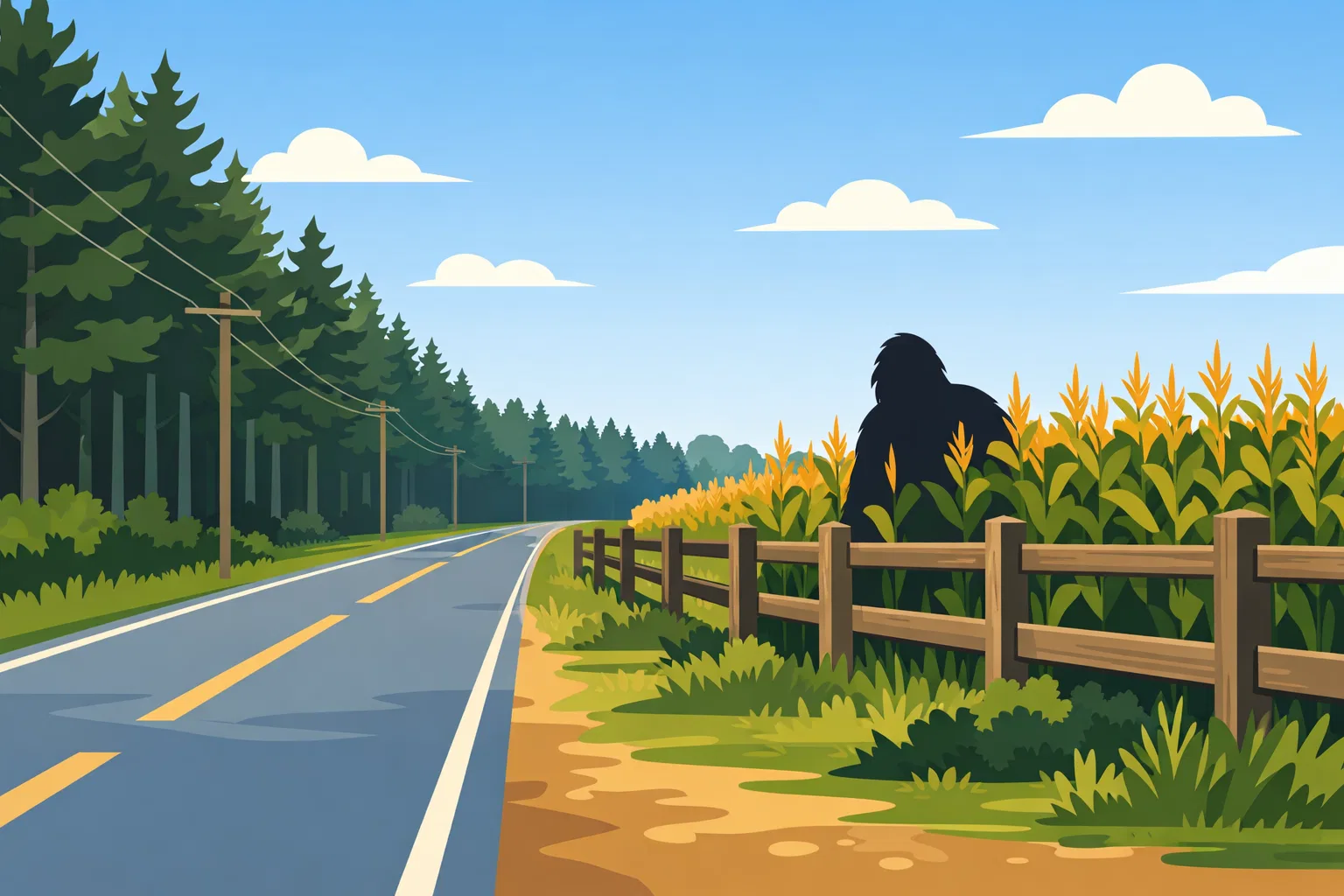
The farm-country reports work in a similar way. In 2010, a traveller north of Bethany Beach described seeing a dark brown, upright-looking form in a cornfield while riding in the rear of a minivan on Route 1. The witness had only about five to ten seconds to observe it, estimated that it was roughly 300 feet from the road, and was the only person in the vehicle to notice it. The BFRO follow-up presented the witness as sincere and noted nearby forest corridors, creeks, agricultural land, food and water sources.[BFRO]bfro.netOpen source on bfro.net.
As a story, it is memorable: a family returning from the beach, yellow corn stalks, a dark shape higher than the field, and one passenger suddenly wondering whether Delaware has a Sasquatch problem. As evidence, it is fragile. Distance, motion, a moving vehicle, brief viewing time, an unfamiliar road and an object partly hidden in a cornfield are almost a checklist of misidentification risks.
The road-crossing problem
Several Sussex County Bigfoot reports are road-crossing accounts, and that is not a coincidence. Roads create some of the most dramatic monster stories because they combine speed, surprise, headlights, fatigue and the immediate fear of hitting something. They also produce some of the worst observation conditions.
The 2003 Route 404 report is the strongest Sussex County Bigfoot account in the sense that it involved two witnesses and a close driving scenario. A father and son travelling from Cape Henlopen towards Maryland at about 1.30 am described seeing one or two upright “things” cross the road between Coolspring and Gravel Hill. The father saw a large silhouette; the son said there were two, with a smaller one following. Both descriptions emphasised darkness, headlight effects, a gentle road curve, a wooded rural road, and the difficulty of making out colour or body detail.[BFRO]bfro.netshow report.aspFather and son witness early morning road crossing of two…9 Jun 2003 — My 18-year old son and I departed Cape Henlopen State Park…
Those details cut both ways. Supporters of the report can point to two alert witnesses watching for deer, their shared surprise, and the son’s claim that the figures were not quadrupeds. Sceptical readers can point to the very same scene: 1.30 am, moving vehicle, changing headlights, backlighting from an oncoming car, low beams, silhouettes, haze and an expectation of deer on the road. It is exactly the kind of setting in which a real animal can look briefly unlike itself.
The older Angola-area account is even more tangled. It was submitted years after the alleged event and is partly second-hand in origin, though the BFRO investigator later spoke with an original witness. The described animal first moved on all fours across Route 24 near Angola, showed red eyeshine, then appeared as a tall silhouette standing on the other side of the road. The account also contains uncertainty over the time of occurrence and the loss of contact with other witnesses after more than a decade.[BFRO]bfro.netshow report.aspshow report.asp
That makes the Angola story useful less as proof than as a lesson in how rural sightings mutate. A four-legged animal with eyeshine becomes alarming; the mind follows it into a field; a tall dark form appears where the animal went; years later the memory is re-examined through the language of Bigfoot television. The interesting question is not simply “Was it Bigfoot?” but “How did a frightening animal encounter become a Bigfoot-shaped memory?”
Why ordinary animals can look extraordinary
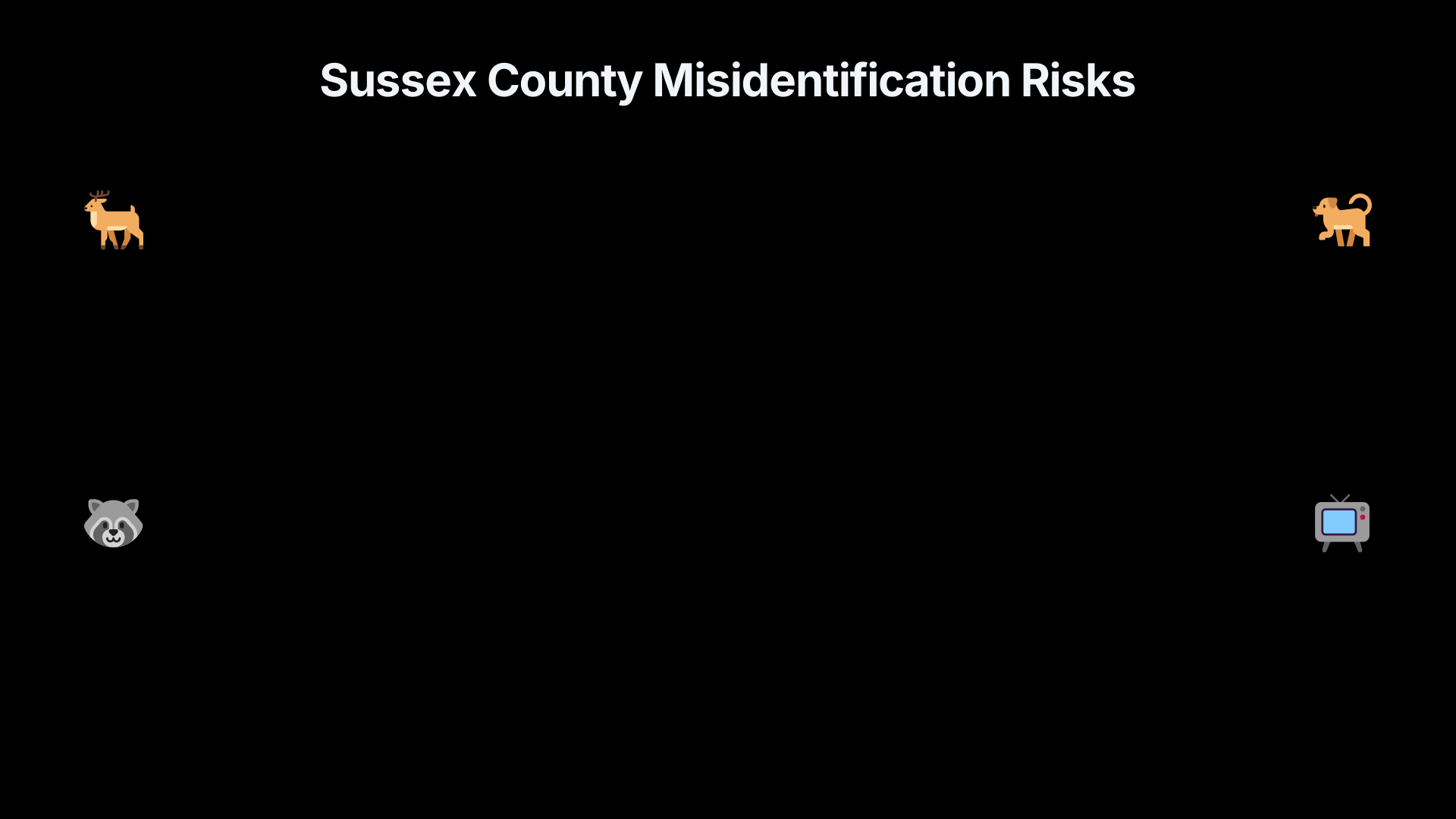
Sussex County’s misidentification problem begins with deer. Delaware officials repeatedly warn drivers about deer on roads at exactly the times that generate many eerie wildlife encounters: dawn, dusk and night. A 2024 state warning reported 1,616 deer-related roadway crashes in Delaware in 2023, with most deer-vehicle collisions occurring between 5 am and 7 am and again between 5 pm and midnight; it also noted that October, November and December accounted for 47% of all Delaware vehicle-deer collisions from 2019 to 2023.[State of Delaware News]news.delaware.govState of Delaware News Look Out for Deer Crossing Roads During Mating SeasonState of Delaware News Look Out for Deer Crossing Roads During Mating Season
Older Delaware State Police figures make the Sussex County relevance even clearer: in 2015, police investigated 876 deer crashes in Sussex County, compared with 391 in Kent County and 524 in New Castle County, with many crashes linked to dusk and dawn activity.[dsp.delaware.gov]dsp.delaware.govCaution! Deer Crashes in DelawareCaution! Deer Crashes in Delaware This does not mean every Bigfoot report is a deer. It does mean Sussex County roads are full of large, fast, poorly lit animals at the same times people are most likely to report something startling.
A deer can mislead a driver in several ways. A bounding deer seen through trees may seem taller than it is. A deer rising from a ditch, turning on a bank, or crossing in broken headlight beams can create a fleeting upright impression. Eyeshine can look red, orange or white depending on angle and light. A second deer following the first can make a crossing feel coordinated or uncanny. In the 2003 Route 404 account, the witnesses had just seen a doe cross the road and were actively watching for more deer before the stranger silhouette appeared.[BFRO]bfro.netshow report.aspFather and son witness early morning road crossing of two…9 Jun 2003 — My 18-year old son and I departed Cape Henlopen State Park…
Coyotes add another complication. DNREC says coyotes have been documented in all three Delaware counties, although the state’s population remains relatively low compared with common species such as red fox and raccoon. Confirmation has come from trail cameras, road-killed animals, public sightings and hunter or trapper reports.[DNREC]dnrec.delaware.govDNRECCoyotes in DelawareDNRECCoyotes in Delaware A coyote is not Bigfoot-sized, but in poor light a canid moving low, pausing, turning its head and producing eyeshine can become part of a bigger, stranger composite impression.
Foxes, raccoons and other common mammals are also part of the night landscape. DNREC describes red and grey foxes as native to Delaware and visible year-round across the state, with red foxes especially adaptable around urban and suburban environments.[DNREC]dnrec.delaware.govDNRECWhen Wildlife Cause ProblemsDNRECWhen Wildlife Cause Problems Raccoons and opossums are common nocturnal animals in Delaware hunting regulations and wildlife guidance, and their climbing, scrambling and reflective eyes can make them seem oddly human for a second when seen near sheds, bales, trees or road verges.[eRegulations]eregulations.come Regulations Furbearer Trapping & Huntinge Regulations Furbearer Trapping & Hunting
Black bears are the tempting comparison, but they should be used carefully. DNREC has discussed Delaware’s preparation for occasional returning black bears and notes confirmed bear sightings in 2019 and 2020, but those were short-lived visitors rather than evidence of a settled Sussex County bear population.[DNREC]dnrec.delaware.govhow delaware is preparing for the return of black bearshow delaware is preparing for the return of black bears A bear can stand upright and look startlingly human, but for the Sussex County Bigfoot reports discussed here, deer, dogs, coyotes, foxes, raccoons, shadows, people and road conditions are more routine explanations than an unreported bear.
What the BFRO labels do and do not prove
The BFRO classification system can be confusing for casual readers. In its own explanation, Class A refers to relatively clear sightings where misidentification can be ruled out with greater confidence, while Class B covers possible observations at a distance, in poor lighting, sound-only incidents, or other circumstances that did not allow a clear view. The organisation also says the classification reflects the potential for misinterpretation, not simply whether a witness is considered credible.[BFRO]bfro.netDatabase History and Report Classification SystemDatabase History and Report Classification System
That distinction is useful for Sussex County. The 2004 Georgetown sighting is listed as Class A. The witness described coming home from a night class near Delaware Technical Community College, taking back roads around Georgetown, and seeing a large black-haired figure near a utility pole at about 8.55 pm. He estimated it at about 7 to 8 feet tall and described broad shoulders, hair and a pointed top to the head.[BFRO]bfro.netshow report.aspshow report.asp
Even so, “Class A” is not a scientific confirmation. It is a database category assigned by a Bigfoot research organisation. The Georgetown report remains a single-witness night sighting on a back road with no body, no clear photograph, no recoverable physical trace and no independent confirmation. Its value is as a detailed claim with a definite place and time, not as proof that Delaware has an undiscovered primate.
The Class B reports are more openly uncertain. The 2012 Redden-area case was sound-based, and the investigator’s later audio recorder did not capture anything remarkable.[BFRO]bfro.netshow report.aspshow report.asp The 2010 cornfield case involved one observer in a moving vehicle, looking at a distant figure for seconds.[BFRO]bfro.netOpen source on bfro.net. The Angola case involved a delayed recollection, conflicting time details and a creature first seen on all fours.[BFRO]bfro.netshow report.aspshow report.asp The labels are therefore best treated as a map of reported experiences, not as a ladder of proof.
How Sussex County localises a national legend
Bigfoot is a national American figure, but Sussex County changes the costume. In Delaware, the creature is not usually framed through deep wilderness, snow tracks or remote logging camps. It appears beside utility poles, in cornfields, near beach-return routes, around state forest tracts and on roads leading away from Cape Henlopen, Lewes, Georgetown, Milton and Angola. That local texture is the real subject.
The reports also show how media expectation feeds perception. The 2012 Redden-area witness explicitly linked the experience to watching Bigfoot television and joking about calls in the back of the wooded lot.[BFRO]bfro.netshow report.aspshow report.asp The Angola recollection was revived after the submitter began watching a Bigfoot programme and called his brother to revisit the details.[BFRO]bfro.netshow report.aspshow report.asp This does not mean the witnesses lied. It means that once Bigfoot is already in the mental frame, an ambiguous sound or animal encounter has a ready-made shape to fall into.
Sussex County’s older monster tradition also matters in the background, especially the Selbyville Swamp Monster elsewhere in southern Delaware. That story is distinct from the Bigfoot reports and should not be merged with them, but it shows how Sussex landscapes have long supported hairy-creature tales around swamps, roads and night-time unease. The Bigfoot cluster is a newer, nationally recognisable version of a familiar local process: strange noises and glimpses become more memorable when they are attached to a named creature.
The result is a modest but revealing Delaware case family. It is not strong enough to carry the claim that Bigfoot inhabits Sussex County. It is strong enough to show why Bigfoot stories appear even in small, flat, heavily travelled states. A pine tract does not have to be endless to feel deep at night. A cornfield does not have to hide a monster to produce a monster-shaped moment. A deer or coyote does not have to look exactly like a person for a startled driver to remember, years later, that something on the road was wrong.
A fair reading of the Sussex County evidence
The most balanced conclusion is that Sussex County has a small cluster of Bigfoot reports, but not a strong Bigfoot case. The reports are geographically coherent, mostly rural, and often tied to places where fields, forest and roads meet. They include some sincere and specific testimony. They also depend heavily on fleeting observation, darkness, vehicle movement, delayed memory, sound interpretation and a lack of physical evidence.
The strongest points for believers are the repeated Sussex County locations, the apparent concentration around Redden and Georgetown, and the way several witnesses describe large upright forms rather than merely “an animal”. The strongest points for sceptics are the small number of reports, the ordinary wildlife context, the frequency of deer on Sussex roads, the lack of confirmatory evidence, and the fact that some accounts are explicitly shaped by Bigfoot media after the fact.
That makes Sussex County Bigfoot a good Delaware story precisely because it stays unresolved at the human level while looking weak at the zoological level. It belongs on the state’s cryptid map not as a confirmed creature, but as a study in rural misidentification, landscape atmosphere and folklore migration. National Bigfoot lore arrived in Delaware and found the places it needed: pine woods, farm roads, wetland margins, dark fields and witnesses who saw just enough to wonder.
Amazon book picks
Further Reading
Books and field guides related to Does Bigfoot Have a Delaware Footprint?. Use these as the next step if you want deeper reading beyond the article.
Field Guide To Bigfoot, Yeti, & Other Mystery Primates Worldwide
Compares Bigfoot-style reports from many regions.
eBay marketplace picks
Marketplace Samples
Live-tested eBay searches with available results related to this page.


Endnotes
1.
Source: bfro.net
Link:https://www.bfro.net/GDB/show_county_reports.asp?county=Sussex&state=de
Source snippet
Sussex County, Delaware -- Reports & ArticlesBigfoot Field Researchers. Couple hear possible screams and knocks. Traveler observes a...
2.
Source: bfro.net
Title: show report.asp
Link:https://www.bfro.net/GDB/show_report.asp?id=6470
Source snippet
Father and son witness early morning road crossing of two...9 Jun 2003 — My 18-year old son and I departed Cape Henlopen State Park...
3.
Source: bfro.net
Title: show report.asp
Link:https://www.bfro.net/gdb/show_report.asp?id=39121
4.
Source: bfro.net
Title: state listing.asp
Link:https://www.bfro.net/GDB/state_listing.asp?state=de
5.
Source: agriculture.delaware.gov
Title: State Forests
Link:https://agriculture.delaware.gov/forest-service/state-forests/
6.
Source: visitsoutherndelaware.com
Link:https://visitsoutherndelaware.com/listing/redden-state-forest
7.
Source: bfro.net
Title: show report.asp
Link:https://www.bfro.net/GDB/show_report.asp?id=37386
8.
Source: bfro.net
Link:https://www.bfro.net/gdb/show_report.asp?id=28720
9.
Source: news.delaware.gov
Title: State of Delaware News Look Out for Deer Crossing Roads During Mating Season
Link:https://news.delaware.gov/2024/10/09/look-out-for-deer-crossing-roads-during-mating-season-delaware-authorities-caution-drivers/
10.
Source: dsp.delaware.gov
Title: Caution! Deer Crashes in Delaware
Link:https://dsp.delaware.gov/2016/09/28/deer-crashes-in-delaware/
11.
Source: dnrec.delaware.gov
Title: DNRECCoyotes in Delaware
Link:https://dnrec.delaware.gov/fish-wildlife/hunting/coyotes/
12.
Source: dnrec.delaware.gov
Title: DNRECWhen Wildlife Cause Problems
Link:https://dnrec.delaware.gov/fish-wildlife/conservation/wildlife-problems/
13.
Source: eregulations.com
Title: e Regulations Furbearer Trapping & Hunting
Link:https://www.eregulations.com/delaware/hunting/furbearer-trapping-hunting
14.
Source: dnrec.delaware.gov
Title: how delaware is preparing for the return of black bears
Link:https://dnrec.delaware.gov/outdoor-delaware/how-delaware-is-preparing-for-the-return-of-black-bears/
15.
Source: bfro.net
Title: Database History and Report Classification System
Link:https://www.bfro.net/GDB/classify.asp
16.
Source: bfro.net
Title: show report.asp
Link:https://www.bfro.net/GDB/show_report.asp?id=7771
17.
Source: agriculture.delaware.gov
Title: contact delaware forest service
Link:https://agriculture.delaware.gov/forest-service/contact-delaware-forest-service/
18.
Source: agriculture.delaware.gov
Title: contact us
Link:https://agriculture.delaware.gov/office-of-the-secretary/contact-us/
19.
Source: dnrec.delaware.gov
Link:https://dnrec.delaware.gov/dewap/sgcn/mammals/
20.
Source: agriculture.delaware.gov
Link:https://agriculture.delaware.gov/wp-content/uploads/sites/108/2018/05/Jester.pdf
21.
Source: archive.regulations.delaware.gov
Title: 17 DE Reg 746 01 01 14
Link:https://archive.regulations.delaware.gov/register/january2014/final/17%20DE%20Reg%20746%2001-01-14.htm
22.
Source: news.delaware.gov
Link:https://news.delaware.gov/2019/12/04/black-bear-sighted-in-northern-delaware-public-asked-to-contact-dnrec-fish-wildlife-natural-resources-police-if-seen/
23.
Source: news.delaware.gov
Title: drivers urged to take extra caution now to avoid deer collisions
Link:https://news.delaware.gov/2025/10/06/delaware-drivers-urged-to-take-extra-caution-now-to-avoid-deer-collisions/
24.
Source: youtube.com
Link:https://www.youtube.com/watch?v=0YVCH4TL4Eo
Source snippet
The Selbyville Swamp Monster - Bigfoot in Delaware and Maryland...
25.
Source: youtube.com
Title: The Selbyville Swamp Monster
Link:https://www.youtube.com/watch?v=oIvjquc-6jg
Source snippet
Exploring Delaware's Weird Folklore: Myths and Legends of the United States...
26.
Source: firststateupdate.com
Title: dnrec closes alapocas run state park wooded areas due to black bear
Link:https://firststateupdate.com/2019/12/dnrec-closes-alapocas-run-state-park-wooded-areas-due-to-black-bear/
27.
Source: nps.gov
Link:https://www.nps.gov/upde/learn/nature/mammals.htm
Additional References
28.
Source: youtube.com
Title: Exploring Delaware’s Weird Folklore: Myths and Legends of the United States
Link:https://www.youtube.com/watch?v=HMypcEnoZVw
Source snippet
EXPLORING HAUNTED FOREST AT NIGHT WITH A BIGFOOT SIGHTING...
29.
Source: nj.gov
Link:https://www.nj.gov/dep/fgw/pdf/2005/dighnt55-69.pdf
30.
Source: nj.gov
Link:https://www.nj.gov/dep/fgw/pdf/2003/dighnt49-61.pdf
31.
Source: sussexcountyde.gov
Link:https://sussexcountyde.gov/state-parks
32.
Source: youtube.com
Title: EXPLORING HAUNTED FOREST AT NIGHT WITH A BIGFOOT SIGHTING
Link:https://www.youtube.com/watch?v=MFt9qEitQG8
Source snippet
Delaware Unsolved Ancient Mysteries Science Can't Explain...
33.
Source: facebook.com
Link:https://www.facebook.com/FoxWilmington/posts/a-black-bear-was-seen-running-through-some-yards-and-streets-in-wilmington-read-/1801306484250375/
34.
Source: facebook.com
Link:https://www.facebook.com/DelawareDNREC/posts/as-daylight-hours-grow-shorter-delaware-drivers-are-already-seeing-more-deer-on-/1227733019380376/
35.
Source: delaware-surf-fishing.com
Link:https://www.delaware-surf-fishing.com/black-bear-spotted-in-new-castle-county-contact-dnrec-if-spotted/
36.
Source: facebook.com
Link:https://www.facebook.com/cbsphiladelphia/posts/the-north-coventry-police-department-is-on-the-lookout-for-a-black-bear-that-was/1324625386480633/
37.
Source: facebook.com
Link:https://www.facebook.com/Delawareonline/posts/coyotes-are-in-all-three-delaware-counties-though-its-unlikely-youll-see-one-exc/1387400706758956/
Topic Tree