Within Alaska Cryptids
Is Alaska's Hairy Man Just Bigfoot?
Hairy Man and Urayuli stories show how Alaska's Bigfoot lore is shaped by village memory, subsistence travel and modern media.
On this page
- Yukon Kuskokwim sighting clusters
- Urayuli names and local versions
- Bears, memory and media retellings
Page outline Jump by section
Introduction
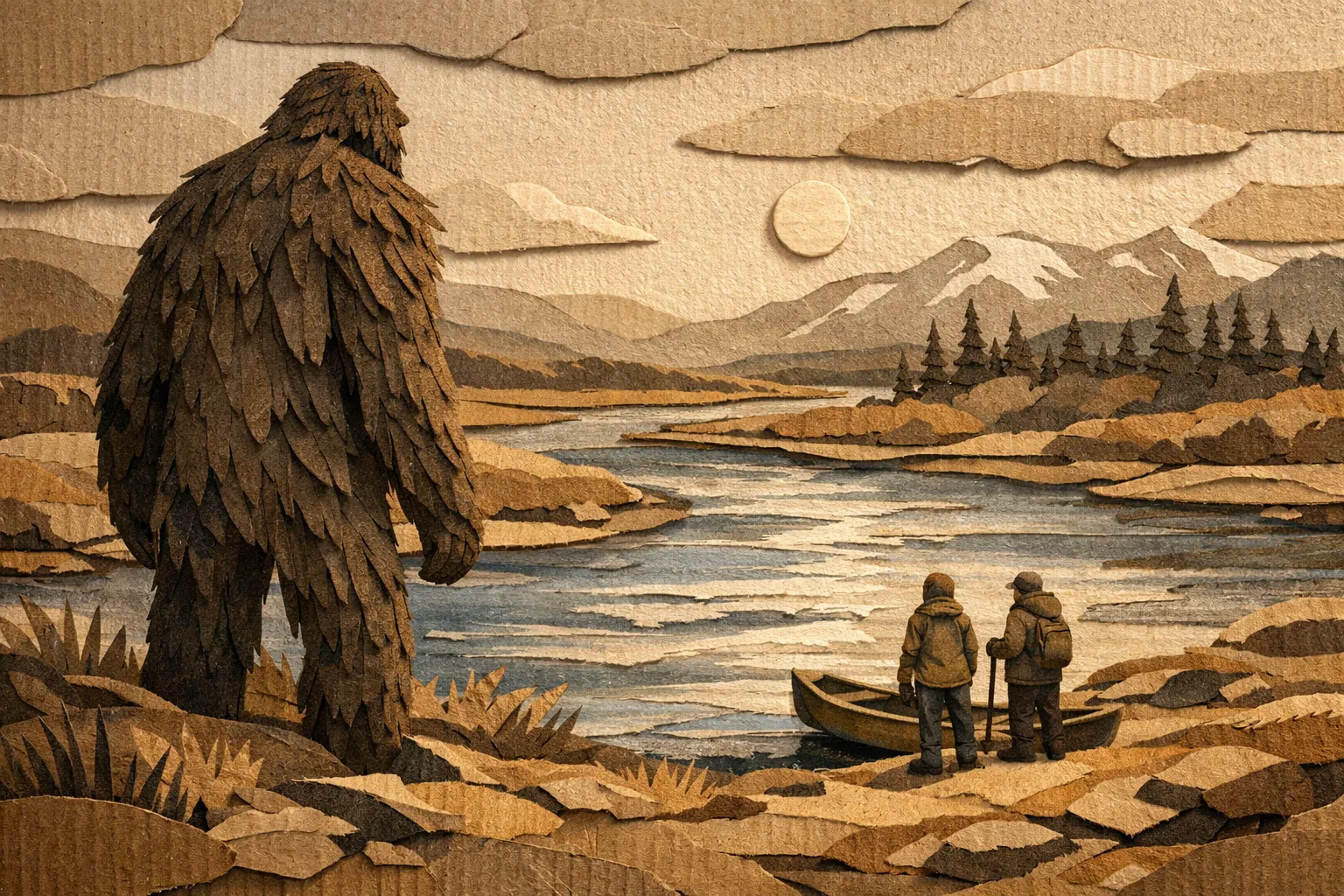
Alaska’s Hairy Man is often described as “Bigfoot in the Bush”, but that shortcut misses what makes the tradition distinctive. In the Yukon-Kuskokwim Delta, stories cluster around rivers, villages, fish camps, egg-gathering trips and older community memories, not around the road lay-bys and forest trails familiar from many Lower 48 Sasquatch tales. The creature is usually remembered as a large, hairy, human-shaped figure: sometimes seen at the tree line, sometimes heard, sometimes blamed for thrown rocks or objects, and sometimes folded into older warnings about wandering too far from home. Local reporting and public-radio coverage place the strongest modern cluster around Bethel, Kwethluk, Kasigluk and nearby river travel routes.[ktoo.org]ktoo.orgFinding Bigfoot' in the Y-K Delta in search of MiluquyuliqFinding Bigfoot' in the Y-K Delta in search of Miluquyuliq
The name “Urayuli” complicates the picture. Popular cryptid pages often present Urayuli as a southwestern Alaska hairy wild-man tradition near Lake Iliamna, but the best available open evidence is uneven: some online summaries repeat each other, while Yup’ik dictionary material more clearly supports related terms such as “miluquyuli”, a legendary thrower of heavy things, than a simple one-to-one “Urayuli means Bigfoot” translation.[beringstraits.com]beringstraits.comOpen source on beringstraits.com.
Is Alaska’s Hairy Man just Bigfoot?
The honest answer is: sometimes it is told that way now, but it did not become interesting simply because outsiders recognised it as Bigfoot. The Hairy Man tradition sits where local story, witness claim, language, landscape and television-era Sasquatch culture overlap.
In the Bethel area, “Hairy Man” is used for the creature outsiders would often call Bigfoot or Sasquatch. A 2014 KYUK/KTOO report on the Animal Planet programme Finding Bigfoot said the show came to Bethel to collect accounts of a creature known locally in the Yukon-Kuskokwim area as Hairy Man, or “Miluquyuliq” in Yup’ik usage. The same report described audience members at a Bethel gathering raising their hands to share sightings, mysterious encounters and second-hand accounts, showing that the legend was not only a single campfire story but a living conversation among local residents.[KTOO]ktoo.orgFinding Bigfoot' in the Y-K Delta in search of MiluquyuliqFinding Bigfoot' in the Y-K Delta in search of Miluquyuliq
That local grounding matters. The Yukon-Kuskokwim Delta is not an empty wilderness stage set for monster stories. The U.S. Fish and Wildlife Service describes it as the ancestral home of Yup’ik, Cup’ik and Deg Xit’an people, a region with more than 50 Indigenous communities and an active subsistence way of life. Access is often by boat or small aircraft, with no roads across much of the landscape. This is exactly the kind of setting in which a strange encounter can be both personally vivid and hard to check afterwards.[U.S. Fish and Wildlife Service]fws.govOpen source on fws.gov.
The creature also behaves differently in different kinds of accounts. In national Bigfoot framing, the question becomes “is there an unknown ape-like animal?” In local Hairy Man framing, the question may be “what did someone see by the river?”, “what did elders warn children about?”, “why do rocks seem to come from unseen brush?”, or “why do people in several villages know versions of the same story?” Those are not identical questions, and forcing them into one Bigfoot template flattens the tradition.

Yukon-Kuskokwim sighting clusters
The strongest modern Hairy Man cluster sits in western Alaska, especially the Yukon-Kuskokwim Delta and the Bethel region. Local and regional reports repeatedly point to Kwethluk, Kasigluk, Bethel, the Kwethluk River, the Kuskokwim River system and other village-to-village travel landscapes. The pattern is important: these are not sightings gathered from a tourist trail, but from places where people travel for subsistence, family, work and seasonal movement.[ktoo.org]ktoo.orgFinding Bigfoot' in the Y-K Delta in search of MiluquyuliqFinding Bigfoot' in the Y-K Delta in search of Miluquyuliq
One widely circulated modern case comes from a family near Kasigluk. The Delta Discovery reported in 2018 that a family out egg hunting near the village saw a large, dark, hairy creature walking in the area. That detail matters because egg hunting is ordinary seasonal activity, not a monster-hunting expedition. In folklore terms, the sighting fits a classic “normal task interrupted by impossible figure” pattern: people are doing something familiar, then the landscape briefly becomes uncanny.[The Delta Discovery, Inc.]deltadiscovery.comlegendary bigfoot sighted near kasigluklegendary bigfoot sighted near kasigluk
Another important anchor is the Kwethluk-area “Gabriel Fox” story. The Delta Discovery described a 1960s Bethel-area memory of a boy who allegedly ran away from the Children’s Home near Kwethluk and survived in the wild by turning into a Hairy Man. The story is biologically implausible if read literally as a fast human-to-monster transformation, but as folklore it shows a recurring theme: the Hairy Man is not always just “an animal out there”. It can also be a boundary figure connected with childhood, danger, disappearance, institutional memory and the fear of being lost outside ordinary community protection.[The Delta Discovery, Inc.]deltadiscovery.comhairy man in the y k deltahairy man in the y k delta
KYUK’s 2014 report gives a more direct eyewitness-style example. Frieda Beans of Bethel described travelling by boat near Three Step Mountain on the twisting Kwethluk River when she saw a large human-like figure at the tree line. She said it was bigger than a human, with a larger rounder head, large arms and hair, and that she first struggled to interpret it, thinking of a spirit rather than a Bigfoot story. This is a useful account not because it proves an unknown creature, but because it shows how witnesses may reach for several interpretive frames at once: animal, person, spirit, Hairy Man, Bigfoot.[KTOO]ktoo.orgFinding Bigfoot' in the Y-K Delta in search of MiluquyuliqFinding Bigfoot' in the Y-K Delta in search of Miluquyuliq
The geography helps explain why these stories persist. The Yukon Delta refuge is dominated by the Yukon and Kuskokwim rivers, broad wetlands, uplands, mountains and wildlife corridors. The Alaska Department of Fish and Game notes that delta villages are reached from Bethel by scheduled or charter flights, while the U.S. Fish and Wildlife Service stresses that travel across the refuge requires advance planning because there are no roads across the landscape. A fleeting sighting on a riverbank, brush line or tundra edge is therefore not easy to revisit, measure or debunk in the way a sighting beside a suburban road might be.[Alaska Department of Fish and Game]adfg.alaska.govOpen source on alaska.gov.
Urayuli names and local versions
“Urayuli” is the name most often encountered by readers who arrive through cryptid books, monster lists or online summaries. In that popular usage, Urayuli are usually described as tall, shaggy, long-armed hairy beings from southwestern Alaska, sometimes connected with Lake Iliamna and sometimes said to be transformed children who were lost outdoors. Those summaries make Urayuli sound like a regional Alaska cousin of Bigfoot, but the sourcing is thinner and more repetitive than many readers realise.[Wikipedia]WikipediaOpen source on wikipedia.org.
The more reliable open-source clue is that Alaska’s wild-man vocabulary is not one neat English label. KYUK/KTOO connects Hairy Man with “Miluquyuliq” in the Yukon-Kuskokwim context, and the Yup’ik dictionary material surfaced in search describes “miluquyuli” as a legendary creature that throws heavy things, often identified with an ape or monkey. That lines up with local Hairy Man reports in which the creature is associated with thrown rocks, sticks or other objects.[KTOO]ktoo.orgFinding Bigfoot' in the Y-K Delta in search of MiluquyuliqFinding Bigfoot' in the Y-K Delta in search of Miluquyuliq
This creates a useful distinction for readers. “Hairy Man” is a broad English label. “Miluquyuliq” or related forms point to a more specific behaviour: throwing. “Urayuli”, meanwhile, is widely repeated in cryptid culture as a southwestern Alaska hairy-man name, but accessible dictionary evidence also shows “urayuli” appearing as “comet”, which should make careful writers cautious about treating every online Urayuli claim as a secure translation.[Alaska Farmers Markets Toolkit]alaskafarmersmarketstoolkit.orgAlaska Farmers Markets Toolkityup'ik eskimo dictionaryAlaska Farmers Markets Toolkityup'ik eskimo dictionary
That does not mean Urayuli should be dismissed. It means the name has passed through several filters: oral story, local language, English retelling, cryptid cataloguing and internet repetition. By the time a reader sees “the Urayuli is Alaska’s Bigfoot”, they may be looking at a simplified version of several overlapping traditions. The better question is not whether one spelling is the “true” monster name, but how different communities and storytellers have used hairy, wild, human-like beings to talk about danger, distance, childhood, travel and the limits of ordinary explanation.

What do Hairy Man reports usually describe?
The modern Hairy Man account has a recognisable set of features, though not every report includes all of them. The figure is usually large, upright and hairy. It may be seen briefly at the edge of brush or trees, across tundra, near a river, or close to a camp. It is sometimes associated with thrown rocks or sticks, odd cries, strong smells, glowing eyes, or a sense that the witness is being watched.
The throwing motif is especially important because it separates many Yukon-Kuskokwim stories from a generic “hairy thing crossed the road” sighting. KYUK/KTOO described Miluquyuliq as a hairy humanoid known in local accounts for throwing faeces, sticks or rocks at people who come too close. Other retellings of Delta Discovery material describe “Miluquyuli” as “the thrower” and connect the name with stories of rocks thrown from brush along the Andreafsky River.[KTOO]ktoo.orgFinding Bigfoot' in the Y-K Delta in search of MiluquyuliqFinding Bigfoot' in the Y-K Delta in search of Miluquyuliq
That behaviour has several possible readings. A believer may take it as a sign of an intelligent, territorial creature. A sceptic may suspect ordinary falling rocks, unseen people, misremembered incidents, prank behaviour, or stories shaped by older warning motifs. A folklorist would notice that thrown objects are a powerful narrative device: they make the unseen presence active, hostile enough to matter, but often still hidden enough to remain unresolved.
The child-warning theme also recurs. Popular Urayuli summaries often say the beings were once children lost in the woods, and the Gabriel Fox story similarly turns a missing or runaway child into a Hairy Man figure. These are not strong zoological claims. They are strong folklore structures. They teach that the land beyond village, camp or family protection can change a person, swallow them, or return them in a form no one can comfortably explain.[The Delta Discovery, Inc.]deltadiscovery.comhairy man in the y k deltahairy man in the y k delta
Bears, distance and misidentification
Any evidence-aware reading of Alaska Hairy Man stories has to start with bears, but should not end there. Alaska has enormous bear populations and serious bear country experience. The Alaska Department of Fish and Game estimates roughly 30,000 brown bears statewide and says Alaska contains more than 98 per cent of the United States brown bear population. It also estimates about 100,000 black bears in Alaska, though black bears are not found on the Yukon-Kuskokwim Delta itself.[Alaska Department of Fish and Game]adfg.alaska.govOpen source on alaska.gov.
That last point is important. A lazy sceptical explanation would say “it was probably a black bear” for every dark, hairy upright figure. In the core Yukon-Kuskokwim Delta, that explanation is geographically weaker because ADF&G says black bears are absent from the delta. Brown bears, however, occur in drier upland habitats of the wider Yukon Delta refuge, and ADF&G notes that moose, caribou, bears and wolves inhabit northern hills and eastern mountains of the region.[fws.gov]fws.govOpen source on fws.gov.
Bears can still explain some reports, especially at distance or in poor visibility. A bear standing, moving through brush, feeding near a river, or briefly appearing against the skyline can look strangely human. Tracks may distort in mud, snowmelt or tundra. A startled bear may leave fast, and a frightened witness may remember size and posture in exaggerated form. None of that requires dishonesty; perception under surprise is imperfect.
But “bear” does not explain the full tradition. It does not explain why a local newspaper would collect village accounts as part of a named Hairy Man series, why KYUK found enough local interest for a Bethel gathering of around 100 people during a television visit, or why the stories include motifs such as transformed children and named throwers. Those features belong to community memory and folklore as much as wildlife misidentification.[KTOO]ktoo.orgFinding Bigfoot' in the Y-K Delta in search of MiluquyuliqFinding Bigfoot' in the Y-K Delta in search of Miluquyuliq
The most balanced view is layered. Some sightings may be bears, moose, people in poor light, hoaxes, pranks or stories improved in the retelling. Some may be sincere experiences that remain unclear because they happened quickly in hard-to-revisit country. And some are not really “sightings” at all, but inherited narratives about how to behave around rivers, brush, camps and the unknown.
How modern media changed the legend
Television did not invent the Hairy Man, but it changed the audience. Before national cryptid media arrived, many accounts circulated locally: in families, villages, fish camps, regional newspapers and conversation. Once Finding Bigfoot came to Bethel in 2014, the Hairy Man became legible to a wider Sasquatch audience. KYUK/KTOO reported that the show’s team chose the Y-K Delta because many stories had come from the area, including news and newspaper reports, and because that concentration made it a point of interest.[KTOO]ktoo.orgFinding Bigfoot' in the Y-K Delta in search of MiluquyuliqFinding Bigfoot' in the Y-K Delta in search of Miluquyuliq
This kind of media attention has a double effect. On one hand, it preserves and amplifies stories that might otherwise remain local. People who were shy about speaking may realise others have similar accounts. A public gathering can turn scattered memories into a visible pattern. On the other hand, television tends to pull everything towards the Bigfoot question: “Is it real?” “Can we find evidence?” “Can we film it?” That is exciting, but it can flatten local meaning.
The Hairy Man tradition becomes more interesting when the media layer is kept separate from the older story layer. A television crew wants locations, witnesses and suspense. A local storyteller may be doing something different: warning children, remembering a relative’s experience, explaining an uncanny river incident, or preserving a name that does not translate neatly into English.
That tension is now part of the tradition. In modern Alaska cryptid culture, the Hairy Man is both a village-memory figure and a marketable Bigfoot variant. Urayuli is both a localised monster name and an internet cryptid entry. Miluquyuliq is both a Yup’ik-linked name in regional reporting and, for outsiders, an exotic-sounding synonym that can be stripped of context if handled carelessly. The legend has not stayed frozen; it has moved through newspapers, public radio, television, blogs, podcasts and social media.
What the tradition tells us about Alaska
Hairy Man and Urayuli stories matter less as proof of an undiscovered ape and more as a map of how mystery attaches to place. In the Yukon-Kuskokwim Delta, the landscape itself shapes the claims. Rivers bend, brush hides movement, weather changes, travel is seasonal, and witnesses often encounter the strange while doing ordinary things: boating, hunting, gathering, camping or moving between communities. The U.S. Fish and Wildlife Service’s description of the delta as roadless, river-dominated and culturally tied to subsistence life helps explain why these stories feel different from roadside Bigfoot reports elsewhere.[U.S. Fish and Wildlife Service]fws.govOpen source on fws.gov.
The tradition also shows why “Alaska Bigfoot” is not one creature with one name. Hairy Man is the accessible English label. Miluquyuliq adds a behaviour and a regional language context. Urayuli, in popular cryptid use, points towards a southwestern Alaska wild-man image, though its exact linguistic and source basis should be treated with caution. Together they form a case family rather than a single tidy species claim.
For readers, the best way to approach these stories is with two kinds of curiosity at once. The first is sceptical: ask what was actually seen, where it happened, what animals live there, whether the report is first-hand, and whether later retellings have added dramatic details. The second is cultural: ask why people remember the story, what local dangers it encodes, which names are being used, and how modern Bigfoot media has changed the way the account is told.
That double reading keeps the strange part alive without pretending the evidence is stronger than it is. Alaska’s Hairy Man is not confirmed wildlife. It is a durable sighting tradition rooted in western Alaska’s rivers, villages and travel routes, shaped by Yup’ik-language story-worlds, sharpened by local newspaper accounts, and amplified by national Sasquatch media. Its power comes from that mixture: a figure at the edge of the brush, close enough to be seen, distant enough to remain unresolved.
Amazon book picks
Further Reading
Books and field guides related to Is Alaska's Hairy Man Just Bigfoot?. Use these as the next step if you want deeper reading beyond the article.
Sasquatch: Legend Meets Science
Directly relevant to Hairy Man and Urayuli comparisons.
The United States of Cryptids
Places Alaska hairy-man stories within national cryptid lore.
eBay marketplace picks
Marketplace Samples
Live-tested eBay searches with available results related to this page.




Endnotes
1.
Source: ktoo.org
Title: ‘Finding Bigfoot’ in the Y-K Delta in search of Miluquyuliq
Link:https://www.ktoo.org/2014/07/11/finding-bigfoot-y-k-delta-search-miluquyuliq/
2.
Source: Wikipedia
Link:https://en.wikipedia.org/wiki/Urayuli
3.
Source: adfg.alaska.gov
Link:https://www.adfg.alaska.gov/index.cfm?adfg=viewinglocations.yukondelta
4.
Source: adfg.alaska.gov
Link:https://www.adfg.alaska.gov/index.cfm?adfg=brownbear.printerfriendly
5.
Source: adfg.alaska.gov
Link:https://www.adfg.alaska.gov/index.cfm%3Fadfg%3Dblackbear.main
6.
Source: adfg.alaska.gov
Link:https://www.adfg.alaska.gov/index.cfm?adfg=blackbear.printerfriendly
7.
Source: adfg.alaska.gov
Link:https://www.adfg.alaska.gov/index.cfm?adfg=wildliferesearch.brownbear
8.
Source: adfg.alaska.gov
Title: brb03mt n w
Link:https://www.adfg.alaska.gov/static/home/library/pdfs/wildlife/mgt_rpts/brb03mt-n-w.pdf
9.
Source: Wikipedia
Title: Yukon Delta National Wildlife Refuge
Link:https://en.wikipedia.org/wiki/Yukon_Delta_National_Wildlife_Refuge
10.
Source: Wikipedia
Link:https://en.wikipedia.org/wiki/Yup%27ik
11.
Source: deltadiscovery.com
Title: legendary bigfoot sighted near kasigluk
Link:https://deltadiscovery.com/legendary-bigfoot-sighted-near-kasigluk/
12.
Source: deltadiscovery.com
Title: hairy man in the y k delta
Link:https://deltadiscovery.com/hairy-man-in-the-y-k-delta/
13.
Source: beringstraits.com
Link:https://beringstraits.com/wp-content/uploads/2024/01/Yupik_Eskimo_Dictonary_Vol_2.pdf
14.
Source: alaskafarmersmarketstoolkit.org
Title: Alaska Farmers Markets Toolkityup’ik eskimo dictionary
Link:https://www.alaskafarmersmarketstoolkit.org/wp-content/uploads/2022/05/Yupik_Eskimo_Dictionary_Vol_1.pdf
15.
Source: fws.gov
Link:https://www.fws.gov/refuge/yukon-delta
16.
Source: deltadiscovery.com
Link:https://deltadiscovery.com/category/hairy-man/
17.
Source: facebook.com
Link:https://www.facebook.com/deltadiscovery/
18.
Source: facebook.com
Title: Alaska Department of Fish and Game
Link:https://www.facebook.com/alaskafishandgame/posts/alaska-has-over-98-percent-of-the-united-states-population-of-brown-bears-and-mo/416381413862932/
19.
Source: inscryption.fandom.com
Link:https://inscryption.fandom.com/wiki/Urayuli
20.
Source: cryptidz.fandom.com
Link:https://cryptidz.fandom.com/wiki/Urayuli
21.
Source: deltadiscovery.com
Title: bethels beloved elder esther green
Link:https://deltadiscovery.com/bethels-beloved-elder-esther-green/
22.
Source: deltadiscovery.com
Title: 2021 bethel city council candidates
Link:https://deltadiscovery.com/2021-bethel-city-council-candidates/
23.
Source: deltadiscovery.com
Link:https://deltadiscovery.com/2018/07/
Additional References
24.
Source: youtube.com
Title: Missing in Alaska: Searching for Signs of Hairy Man (S1, E2) | History
Link:https://www.youtube.com/watch?v=mMlQwiWRhbY
Source snippet
BIGFOOT IN ALASKA | Portlock, Alaska Mystery (Ep 362)...
25.
Source: youtube.com
Title: Capturing First Ever Video Evidence of the “Hairyman” | The Alaska Triangle
Link:https://www.youtube.com/watch?v=4taEmWl7LvU
Source snippet
The Horrifying Legends of Portlock, Alaska...
26.
Source: blm.gov
Link:https://www.blm.gov/sites/default/files/docs/2021-04/BLM-Alaska-3-Bear-Infographic.pdf
27.
Source: govinfo.gov
Link:https://www.govinfo.gov/content/pkg/CZIC-sh327-5-f65-1977-v-1/html/CZIC-sh327-5-f65-1977-v-1.htm
28.
Source: youtube.com
Title: The Horrifying Legends of Portlock, Alaska
Link:https://www.youtube.com/watch?v=Y4xlL1vSICI
Source snippet
Missing in Alaska: Searching for Signs of Hairy Man (S1, E2) | History...
29.
Source: facebook.com
Link:https://www.facebook.com/alaskafishandgame/videos/alaska-has-over-98-percent-of-the-united-states-population-of-brown-bears-and-mo/498890038674803/
30.
Source: facebook.com
Link:https://www.facebook.com/groups/matsuvalleynews/posts/2005863506166518/
31.
Source: facebook.com
Link:https://www.facebook.com/thecityofdayton/posts/after-reports-of-weird-noises-at-pocket-wilderness-authorities-discovered-a-crea/1210303322773704/
32.
Source: facebook.com
Link:https://www.facebook.com/groups/glacier.national.park1/posts/863387953188324/
33.
Source: alaskaoutdoorssupersite.com
Link:https://alaskaoutdoorssupersite.com/directory/65-alaska-activities/hunting/species/92-brown-bear-hunting
Topic Tree