What Makes New York Monster Country?
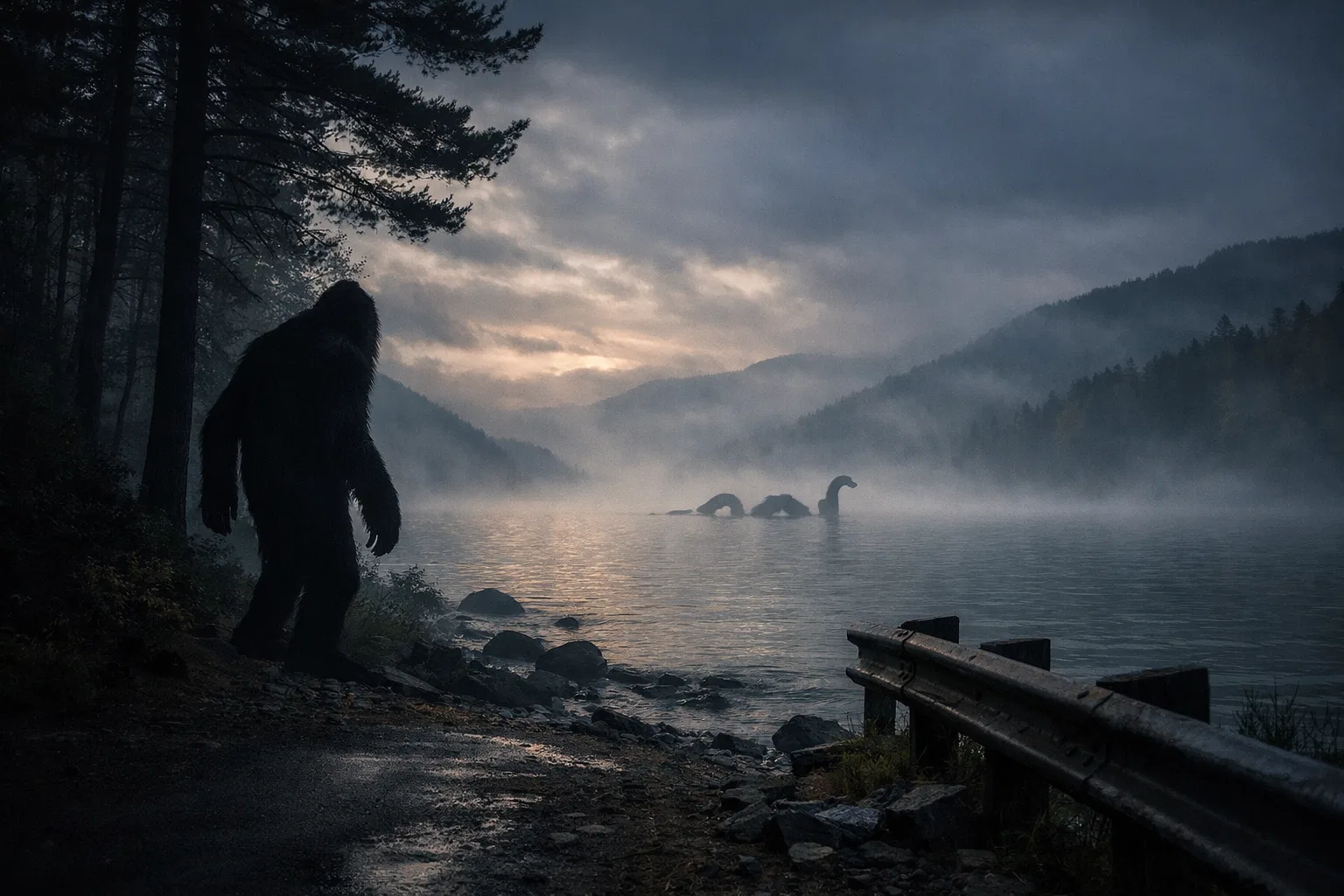
New York’s cryptid map is not built around one monster but around a pattern: big water, deep forest, old newspaper hoaxes, Indigenous and settler folklore, and modern internet carcass panics. The state’s best-known mystery creature is Champ, the Lake Champlain monster, whose legend clusters around Port Henry, Plattsburgh and the New York–Vermont border.
Page outline Jump by section
Introduction
New York’s cryptid map is not built around one monster but around a pattern: big water, deep forest, old newspaper hoaxes, Indigenous and settler folklore, and modern internet carcass panics. The state’s best-known mystery creature is Champ, the Lake Champlain monster, whose legend clusters around Port Henry, Plattsburgh and the New York–Vermont border. Its strongest “evidence” is still disputed, but the story has become a genuine part of North Country identity and tourism. Whitehall, near the southern end of Lake Champlain, adds a land-based counterpart: a Bigfoot tradition shaped by alleged 1970s police-linked sightings and later civic branding. Elsewhere, New York’s monsters often turn out to be revealing in a different way: the Silver Lake Sea Serpent and Cardiff Giant were deliberate hoaxes, while the Montauk Monster and Manhattan Monster show how decomposition can turn ordinary animals into viral beasts.[lakechamplainregion.com]lakechamplainregion.comOpen source on lakechamplainregion.com.
The useful way to read New York cryptid lore is not to ask, “Which monster is real?” first. It is to ask what kind of story each case is. Champ is a lake-monster tradition with tourism afterlives; Whitehall Bigfoot is a witness-and-place legend; the sewer alligator is an urban legend fed by occasional real abandoned reptiles; the Montauk Monster is a carcass misidentification story; and the Cardiff Giant is a classic American fraud. That mix makes New York unusually good for comparing folklore, eyewitness claim, hoax, misidentified wildlife and local identity in one state.
Why New York is such fertile monster country
New York has the right geography for mystery-beast stories. The Adirondacks and Catskills provide large forested regions where brief, poor-light sightings can feel plausible; Lake Champlain and the Finger Lakes give the state long, cold, visually deceptive bodies of water; and New York City adds dense urban folklore, from sewer alligators to mutant-rat jokes. The New York State Department of Environmental Conservation estimates at least 6,000 to 8,000 black bears in areas open to hunting, with the largest share in the Adirondacks and another major population in the Catskills, which matters because bears can be mistaken for upright “hairy” figures in quick or frightened encounters.[Department of Environmental Conservation]dec.ny.govDepartment of Environmental Conservation Black BearDepartment of Environmental Conservation Black Bear
The same logic applies to phantom cats. People still report “mountain lions” or “catamounts” in New York, but the DEC says eastern cougars do not have a native, self-sustaining population in the state and have been absent since the late nineteenth century; confirmed cases are rare and tend to involve escaped captive animals or non-native individuals rather than a hidden breeding population. That does not make every witness dishonest. It does mean that bobcats, dogs, coyotes, fishers, domestic cats, distance and expectation often do a lot of work in mystery-animal reports.[Department of Environmental Conservation]dec.ny.govDepartment of Environmental Conservation Eastern Cougar SightingsDepartment of Environmental Conservation Eastern Cougar Sightings
Water creates its own distortions. Logs, wave trains, swimming birds, large fish and forced perspective can briefly resemble a head, neck or humped back. Lake sturgeon are particularly relevant to New York lake-monster discussion because they are large, ancient-looking fish found in the region, though threatened in New York and much reduced by overharvest, dams and habitat changes. They do not “explain” every lake monster, but they show why a real animal can feed an exaggerated legend when glimpsed in odd conditions.[Department of Environmental Conservation]dec.ny.govDepartment of Environmental Conservation Lake SturgeonDepartment of Environmental Conservation Lake Sturgeon
Champ: New York’s headline lake monster
Champ, also called Champy, is said to inhabit Lake Champlain, the long lake shared by New York, Vermont and Quebec. On the New York side, the legend is especially tied to Port Henry, Bulwagga Bay, Plattsburgh and the wider Lake Champlain Region. Local tourism material treats Champ with a knowing wink: real or not, the monster appears in statues, signs, souvenirs, children’s books and regional branding. A William G. Pomeroy Foundation folklore marker in Plattsburgh states that more than 300 alleged sightings have been reported since 1819 and calls Champ a regional icon used in tourism.[lakechamplainregion.com]lakechamplainregion.comOpen source on lakechamplainregion.com.
The classic Champ timeline is a blend of folklore, nineteenth-century newspaper culture and modern cryptozoology. Many popular tellings begin with early Indigenous traditions and the 1609 writings of Samuel de Champlain, though sceptical accounts often note that Champlain may have been describing large fish rather than a monster. The more recognisable “lake serpent” tradition developed through nineteenth-century reports, including the often-cited 1819 Captain Crum account and later “great serpent” stories around Lake Champlain.[EBSCO]ebsco.comOpen source on ebsco.com.
The most famous alleged evidence is the Sandra Mansi photograph, taken in 1977. For years it was promoted by some cryptozoologists as unusually strong lake-monster evidence because it appeared to show a dark neck and body rising from the water. Sceptical investigators have pointed to major problems: the negative was unavailable, the exact location was not established at first, and later analysis raised the possibility that the object could have been a floating log or tree trunk rather than an animal. Joe Nickell’s work for Skeptical Inquirer is central to that sceptical reassessment, especially because size and distance estimates become weak without the original negative and exact site.[Skeptical Inquirer]skepticalinquirer.orgOpen source on skepticalinquirer.org.
Champ also shows how a cryptid can become protected folklore. Port Henry declared its waters a safe haven for Champ in 1981; Vermont passed a protective resolution in 1982; and New York’s legislature followed with resolutions in 1983 encouraging serious inquiry and protection from intentional harm or harassment. These measures should not be read as proof of a hidden animal. They are better understood as civic folklore: a playful but official recognition that the legend matters to the region.[lakechamplainregion.com]lakechamplainregion.comOpen source on lakechamplainregion.com.

Whitehall Bigfoot and the “Beast of Abair Road”
If Champ belongs to New York’s water, Whitehall Bigfoot belongs to its forest edge. Whitehall sits near the southern end of Lake Champlain, between the Adirondacks and the Vermont border, which gives it a useful monster-story setting: rural roads, wooded hills, water corridors and a long tradition of outdoorspeople swapping strange encounters. The town’s best-known case is the August 1976 Abair Road incident, in which teenagers reportedly saw a large upright hairy figure and police later investigated the area. A contemporary newspaper clipping summarised by Newspapers.com describes officers tracking an unidentified creature near Whitehall.[newspapers.com]newspapers.comOpen source on newspapers.com.
Later retellings gave the case its staying power. Officer Brian Gosselin is often named as a key witness, and the story expanded into a local Bigfoot identity rather than remaining a one-night report. In 2004, Whitehall passed a law prohibiting the hunting of Bigfoot, and the William G. Pomeroy Foundation marker now presents the town as a “Bigfoot Sanctuary”. The village also leaned into the creature as a tourist emblem: in 2018, local reporting noted a resolution naming Sasquatch the village’s official animal, alongside statues and events that draw visitors interested in the legend.[William G. Pomeroy Foundation]wgpfoundation.orgbigfoot sanctuarybigfoot sanctuary
Sceptically, Whitehall Bigfoot sits in the same problem space as most Sasquatch reports. The testimony is memorable, but there is no verified body, DNA, breeding population, or clear physical evidence accepted by mainstream zoology. New York’s bear population gives one ordinary explanation for at least some large, dark, upright-looking figures, especially at night or at distance. That does not neatly solve the Abair Road story, because witness claims involve behaviour and details that believers see as more than a bear. It does, however, show why the case remains folklore and witness tradition rather than zoological evidence.[Department of Environmental Conservation]dec.ny.govDepartment of Environmental Conservation Black BearDepartment of Environmental Conservation Black Bear
Whitehall’s wider importance is cultural. The town has turned a frightening roadside claim into a civic mascot, a festival-friendly identity and a point of regional pride. That is a recurring New York pattern: a monster may begin as uncertainty, but it survives because a community finds a use for the story.
Finger Lakes serpents and the difference between legend and hoax
New York’s Finger Lakes have their own water monsters, but the stories are less famous than Champ. Cayuga Lake’s “Old Greeny” is usually described as a greenish serpent-like creature, with reports said to cluster in the nineteenth and early twentieth centuries. A 2026 Tompkins County Public Library page for the Old Greeny Fringe Fest describes the figure as Ithaca’s own lake cryptid, while regional accounts preserve older claims of recurring sightings, later reports and local performance culture around the beast.[Tompkins County Public Library]tcpl.orgOpen source on tcpl.org.
Old Greeny is a good example of a legend that persists even when sightings fade. Its modern life is not as a serious zoological case but as a local symbol that can support theatre, humour, lake identity and regional storytelling. The creature does not need to be believed literally to function as folklore. It gives Cayuga Lake a monster of its own and lets Ithaca play with the idea of being strange, artistic and self-aware.
Silver Lake, in Wyoming County, gives a sharper lesson because its monster was exposed. In 1855, hotelier Artemus B. Walker helped create a sea-serpent scare on Silver Lake, reportedly using a constructed serpent to draw attention and visitors. The hoax ended after Walker’s hotel burned in 1857 and the remains of the fake creature were found in the wreckage. Local accounts and a Pomeroy marker treat the episode as a celebrated piece of folklore rather than an unresolved cryptid case.[William G. Pomeroy Foundation]wgpfoundation.orgsea serpent legendsea serpent legend
That difference matters. Old Greeny is a thin but enduring local lake legend; the Silver Lake Sea Serpent is a known publicity hoax with a physical reveal. Both belong on New York’s monster map, but they should not be treated as the same kind of evidence.
The Cardiff Giant: New York’s greatest “monster” fraud
The Cardiff Giant was not a cryptid in the usual sense, but it belongs in New York’s mystery-creature tradition because it shows how spectacle, money and belief can manufacture a monster. In October 1869, workers digging a well on William Newell’s farm in Cardiff, south of Syracuse, uncovered a 10-foot “petrified man”. Crowds paid to see it, newspapers amplified it, and P. T. Barnum produced a rival copy after failing to buy the original.[Onondaga Historical Association]cnyhistory.orgOnondaga Historical Association This Month in History: The Cardiff GiantOnondaga Historical Association This Month in History: The Cardiff Giant
The giant was a hoax created by George Hull, a cigar-maker who had a gypsum figure carved, aged and buried. Its success depended on a perfect nineteenth-century mix: biblical giant speculation, showmanship, paid exhibition, newspaper excitement and public appetite for marvels. The fraud was soon exposed, but the Cardiff Giant remained famous because it revealed something uncomfortable: people often enjoy the possibility of a wonder even when the evidence is already crumbling.[brucemuseum.org]brucemuseum.orgthe cardiff giantthe cardiff giant
For modern cryptid readers, the Cardiff Giant is a useful caution. Hoaxes do not merely fool people; they create afterlives. Even exposed fakes can become beloved roadside history, museum exhibits and local lore. New York’s monster tradition is full of that double life: debunked, but not dead.
Montauk Monster, Manhattan Monster and the carcass effect
The Montauk Monster is one of the clearest modern examples of how an ordinary animal can become a cryptid through decomposition, photography and the internet. In July 2008, a strange carcass reportedly washed ashore near Montauk on Long Island. A side-view photograph circulated widely, and theories quickly ranged from an unknown species to a Plum Island experiment. Zoologist Darren Naish later argued that the visible anatomy, including the dentition, skull shape and paws, pointed strongly towards a raccoon altered by decomposition and water action.[Tetrapod Zoology]tetzoo.commontauk monster a look backmontauk monster a look back
The “monster” looked uncanny because dead animals change fast. Fur slips, soft tissue swells or erodes, lips pull back from teeth, and paws can look disturbingly hand-like. Once an image loses scale and context, the viewer’s imagination fills the gaps. The Montauk case became famous not because it was the strongest mystery, but because it arrived at exactly the right moment for blogs, tabloids and early viral sharing.
New York City produced a similar mini-panic in 2012 with the so-called Manhattan Monster, a carcass photographed on the East River shoreline. Explanations varied: the Parks Department reportedly treated it as a cooked pig, while a New York State wildlife expert told New York Magazine that the body appeared to be a raccoon, though not with certainty without a physical examination. Cornell naturalist Paul Curtis, consulted by Gothamist, thought the body looked more like a small dog that had drowned and decomposed.[6abc.com]6abc.comOpen source on 6abc.com.
These cases are not boring just because they are probably not monsters. They are valuable because they show a repeatable mechanism behind many “mystery beast” stories: a real corpse, an unusual state of decay, no immediate expert examination, a dramatic nickname and rapid media spread.
Sewer alligators: the city legend that keeps resurfacing
The New York sewer alligator is one of America’s great urban animal legends. The classic version says baby alligators were brought north as pets, flushed or abandoned, and grew into pale, aggressive adults in the city’s underground system. Fully grown sewer populations remain unproven, and sewer workers have repeatedly rejected the idea of a hidden breeding colony. But the legend survives because it is built around a small truth: real alligators do occasionally turn up in New York, usually as abandoned or escaped pets.[Wikipedia]WikipediaSewer alligatorSewer alligator
That small truth resurfaced in February 2023, when a four-foot alligator was rescued from Prospect Park Lake in Brooklyn. The Associated Press reported that the animal was lethargic and cold-shocked, likely an abandoned pet, and was taken for care; officials also warned that releasing animals in city parks is illegal. The case did not prove the sewer legend, but it gave the folklore fresh oxygen: New Yorkers really can encounter an alligator where one should not be.[AP News]apnews.comAP News Cold-blooded: Abandoned alligator rescued from Brooklyn lakeAP News Cold-blooded: Abandoned alligator rescued from Brooklyn lake
The sewer alligator works because it turns the city itself into a wilderness. Instead of a monster hiding in the Adirondacks, it imagines one beneath the pavement, feeding on rats and adapting to the hidden infrastructure of modern life. It is less a zoological claim than a story about urban anxiety, illegal pets and the feeling that New York always has another layer underneath.
Indigenous and regional folklore: when “cryptid” is not the right word
Some New York monster pages casually fold Indigenous beings into cryptid lists, but that needs care. The Flying Head, for example, belongs to Haudenosaunee and Wyandot tradition rather than to modern animal-hunting cryptozoology. It is usually described as a ravenous disembodied head with hair, eyes, fangs and sometimes wings or talons. Some versions connect the story to the Adirondack region near the source of the Hudson River or Sacandaga Lake.[Wikipedia]WikipediaFlying HeadFlying Head
That distinction matters because a being from a living cultural tradition is not the same as a blurry lake photograph or a roadside Bigfoot report. It may still appear in monster guides, folklore collections and regional spooky tourism, but treating it merely as a “creature sighting” flattens its meaning. In a New York cryptid context, the Flying Head is best handled as folklore that influenced the state’s monster imagination, not as an animal claim to be tested by trail cameras.
The same caution applies more broadly to borrowed names and legends. New York’s creature folklore has Indigenous roots, settler hoaxes, nineteenth-century newspapers, roadside tourism and internet culture all layered together. A responsible page should keep those layers visible rather than blending every strange being into one category.
What the record supports about New York’s cryptid traditions
New York has strong evidence for monster stories, but not strong evidence for unknown large animals. That sounds like a contradiction, but it is the key to the state’s cryptid history. There is good evidence that people told Champ stories, built a Silver Lake serpent, displayed the Cardiff Giant, photographed the Montauk carcass, reported Whitehall Bigfoot encounters and rescued abandoned alligators. There is not comparable mainstream evidence that Lake Champlain contains a breeding population of giant unknown reptiles, that Whitehall hosts an undiscovered ape, or that New York City sewers hold adult alligator colonies.
The most plausible explanations vary by case:
- Champ and the Finger Lakes monsters: waves, logs, large fish, birds, wakes, forced perspective, folklore inheritance and regional promotion.
- Whitehall Bigfoot and Adirondack Sasquatch reports: misidentified bears, night conditions, witness expectation, hoaxes, sincere but mistaken testimony and unresolved personal experiences.
- Phantom cats: bobcats, dogs, coyotes, fishers, escaped captives or rare wandering individuals rather than a native breeding cougar population.
- Montauk and Manhattan carcasses: ordinary animals made strange by decomposition, water damage and missing context.
- Sewer alligators: abandoned pets, not a hidden underground species.
- Cardiff Giant and Silver Lake Sea Serpent: deliberate hoaxes that became folklore after exposure.
That evidence-aware reading does not make the stories worthless. It makes them more interesting. New York’s monsters reveal how landscapes acquire personalities: Lake Champlain becomes deep enough for Champ, Whitehall becomes Bigfoot country, Ithaca gets Old Greeny, Silver Lake celebrates a known fake, and New York City turns infrastructure into myth.

The changing story around New York’s cryptid traditions
New York’s monster stories tend to move through stages. First comes a sighting, rumour, object or performance: a lake shape, a roadside figure, a strange carcass, a buried giant, a constructed serpent. Then comes amplification through newspapers, local talk, tourism, television, blogs or social media. Finally, the story either collapses into explanation or survives as identity.
Champ survived because it became a regional mascot. Whitehall Bigfoot survived because the town embraced it. The Silver Lake Sea Serpent survived because the hoax itself became the fun. The Cardiff Giant survived because American culture loves a famous fraud. The Montauk Monster survived because a raccoon-like carcass became an internet-era image. Even the sewer alligator survives because occasional real abandoned reptiles keep the premise from feeling entirely impossible.[lakechamplainregion.com]lakechamplainregion.comOpen source on lakechamplainregion.com.
That is the real New York pattern: monsters rarely vanish when explained. They change jobs. They stop being evidence and become landmarks, jokes, festivals, warnings, mascots or local shorthand. In a state with vast lakes, old forests, dense cities and a genius for publicity, that afterlife may be the most New York thing about them.
Amazon book picks
Further Reading
Books and field guides related to What Makes New York Monster Country?. Use these as the next step if you want deeper reading beyond the article.
American Monsters
Covers many creature traditions that mirror New York's diverse monster culture.
The United States of Cryptids
Places New York stories within the wider American cryptid landscape.

Monsters of New York
Directly surveys New York monster stories including Champ and Bigfoot traditions.
eBay marketplace picks
Marketplace Samples
Live-tested eBay searches with available results related to this page.

Endnotes
1.
Source: lakechamplainregion.com
Link:https://www.lakechamplainregion.com/heritage/champ
2.
Source: ebsco.com
Link:https://www.ebsco.com/research-starters/social-sciences-and-humanities/champ-cryptozoology
3.
Source: newspapers.com
Link:https://www.newspapers.com/article/the-post-star-abair-rd/18069108/
4.
Source: Wikipedia
Link:https://en.wikipedia.org/wiki/Bigfoot
5.
Source: Wikipedia
Title: Cardiff Giant
Link:https://en.wikipedia.org/wiki/Cardiff_Giant
6.
Source: brucemuseum.org
Title: the cardiff giant
Link:https://brucemuseum.org/discover/the-cardiff-giant/
7.
Source: Wikipedia
Title: Montauk Monster
Link:https://en.wikipedia.org/wiki/Montauk_Monster
8.
Source: 6abc.com
Link:https://6abc.com/archive/8749048/
9.
Source: gothamist.com
Link:https://gothamist.com/news/animal-expert-tells-us-east-river-monster-was-a-dog
10.
Source: Wikipedia
Title: Sewer alligator
Link:https://en.wikipedia.org/wiki/Sewer_alligator
11.
Source: Wikipedia
Title: Flying Head
Link:https://en.wikipedia.org/wiki/Flying_Head
12.
Source: Wikipedia
Title: Champ (folklore)
Link:https://en.wikipedia.org/wiki/Champ_%28folklore%29
13.
Source: Wikipedia
Title: Hoaxes and legends of upstate New York
Link:https://en.wikipedia.org/wiki/Hoaxes_and_legends_of_upstate_New_York
14.
Source: Wikipedia
Title: Cayuga Lake
Link:https://en.wikipedia.org/wiki/Cayuga_Lake
15.
Source: Wikipedia
Title: Eastern cougar
Link:https://en.wikipedia.org/wiki/Eastern_cougar
16.
Source: adirondack.net
Link:https://www.adirondack.net/wildlife/black-bears/
17.
Source: lakechamplainregion.com
Title: journey through history and stories of the lcr
Link:https://www.lakechamplainregion.com/story/2024/journey-through-history-and-stories-of-the-lcr
18.
Source: wgpfoundation.org
Title: bigfoot sanctuary
Link:https://www.wgpfoundation.org/historic-markers/bigfoot-sanctuary/
19.
Source: wgpfoundation.org
Title: sea serpent legend
Link:https://www.wgpfoundation.org/historic-markers/sea-serpent-legend/
20.
Source: tetzoo.com
Title: montauk monster a look back
Link:https://tetzoo.com/blog/2021/10/23/montauk-monster-a-look-back
21.
Source: dec.ny.gov
Title: Department of Environmental Conservation Black Bear
Link:https://dec.ny.gov/nature/animals-fish-plants/black-bear
22.
Source: dec.ny.gov
Title: Department of Environmental Conservation Eastern Cougar Sightings
Link:https://dec.ny.gov/nature/animals-fish-plants/eastern-cougar/sightings
23.
Source: dec.ny.gov
Title: Department of Environmental Conservation Eastern Cougar
Link:https://dec.ny.gov/nature/animals-fish-plants/eastern-cougar
24.
Source: dec.ny.gov
Title: Department of Environmental Conservation Lake Sturgeon
Link:https://dec.ny.gov/nature/animals-fish-plants/lake-sturgeon
25.
Source: dec.ny.gov
Link:https://dec.ny.gov/sites/default/files/2024-08/lakesturgeon.pdf
26.
Source: wgpfoundation.org
Link:https://www.wgpfoundation.org/historic-markers/10700-2/
27.
Source: timesunion.com
Title: Champ Hook line and sinker 4150130
Link:https://www.timesunion.com/local/article/Champ-Hook-line-and-sinker-4150130.php
28.
Source: skepticalinquirer.org
Link:https://skepticalinquirer.org/2013/05/new-information-surfaces-on-worlds-best-lake-monster-photo-raising-question/
29.
Source: timesunion.com
Title: Whitehall names sasquatch as village s official 13050743
Link:https://www.timesunion.com/news/article/Whitehall-names-sasquatch-as-village-s-official-13050743.php
30.
Source: tcpl.org
Link:https://www.tcpl.org/node/63835
31.
Source: cnyhistory.org
Title: Onondaga Historical Association This Month in History: The Cardiff Giant
Link:https://www.cnyhistory.org/2014/10/cardiff-giant/
32.
Source: publicdomainreview.org
Title: cardiff giant
Link:https://publicdomainreview.org/collection/cardiff-giant/
33.
Source: nymag.com
Title: east river monster racoon dog rat or monster
Link:https://nymag.com/intelligencer/2012/07/east-river-monster-racoon-dog-rat-or-monster.html
34.
Source: apnews.com
Title: AP News Cold-blooded: Abandoned alligator rescued from Brooklyn lake
Link:https://apnews.com/article/f5914137cc03e5bfc1b88ca1a836c142
35.
Source: cryptidz.fandom.com
Title: New York
Link:https://cryptidz.fandom.com/wiki/New_York
36.
Source: cryptidz.fandom.com
Title: Old Greeny
Link:https://cryptidz.fandom.com/wiki/Old_Greeny
37.
Source: cryptidz.fandom.com
Title: Flying Head
Link:https://cryptidz.fandom.com/wiki/Flying_Head
38.
Source: facebook.com
Link:https://www.facebook.com/vermontexplored/photos/did-you-know-whether-champ-makes-his-home-in-lake-champlain-or-only-in-our-imagi/1644312861037486/
39.
Source: timesunion.com
Title: new york mysterious creatures folklore 22302735
Link:https://www.timesunion.com/living/article/new-york-mysterious-creatures-folklore-22302735.php
40.
Source: timesunion.com
Title: Call of the cougar long gone from the East 1043286
Link:https://www.timesunion.com/local/article/Call-of-the-cougar-long-gone-from-the-East-1043286.php
41.
Source: nyhistory.org
Link:https://www.nyhistory.org/blogs/cardiff-giant
42.
Source: nyghosts.com
Title: the montauk monster
Link:https://nyghosts.com/the-montauk-monster/
43.
Source: dsimanek.vialattea.net
Link:https://dsimanek.vialattea.net/cardiff.htm
44.
Source: roc55.com
Title: the silver lake sea serpent
Link:https://roc55.com/the-silver-lake-sea-serpent/
45.
Source: laceywillowdale.com
Title: Sea Serpent
Link:https://www.laceywillowdale.com/sea-serpent.html
Additional References
46.
Source: fws.gov
Link:https://www.fws.gov/species/lake-sturgeon-acipenser-fulvescens
47.
Source: youtube.com
Link:https://www.youtube.com/watch?v=H57Q2KZS_Qw
Source snippet
NTIYT: Sasquatch, the official animal of Whitehall...
48.
Source: facebook.com
Link:https://www.facebook.com/groups/317843086751551/posts/1513559613846553/
49.
Source: catskillmountaineer.com
Link:https://www.catskillmountaineer.com/pdf/bears-DEC.pdf
50.
Source: adirondackwildlife.org
Link:https://www.adirondackwildlife.org/Bears.html
51.
Source: facebook.com
Link:https://www.facebook.com/groups/402724958101648/posts/1292818089092326/
52.
Source: earthisland.org
Link:https://www.earthisland.org/journal/index.php/magazine/entry/cat_eyes/
53.
Source: facebook.com
Link:https://www.facebook.com/theithacavoice/posts/cayuga-lake-monster-expected-to-resurface-for-old-greeny-fringe-fest/1578388960954771/
54.
Source: hmdb.org
Link:https://www.hmdb.org/m.asp?m=109078
55.
Source: facebook.com
Link:https://www.facebook.com/NYLegalHistory/posts/beware-of-watery-monsters-this-halloweennestled-between-new-york-and-vermont-lak/946886884152318/
Topic Tree
Follow this branch
Related pages 49
- Rhode Island Monsters
- Hawaii Monsters
- Illinois Cryptids
- Nebraska Cryptids
- Alabama Cryptids
- +44 more in sidebar