Within Maryland Monsters
What Was Seen in the Chesapeake Bay?
Chessie turns a long dark shape in the Chesapeake into a sea-serpent story shaped by video, wildlife and Bay identity.
On this page
- The 1982 Kent Island video
- Sea serpent sightings and Bay identity
- Sturgeon, dolphins, whales and manatees
Page outline Jump by section
Introduction
Chessie is the Chesapeake Bay’s home-grown sea-serpent story: a long, dark, undulating shape said to move through Maryland and Virginia waters like a living rope. The legend matters because it sits at the meeting point of three things the Bay already has in abundance: murky water, large real animals, and a powerful sense of regional identity. The best-known claim is the 1982 Kent Island video, filmed by Robert and Karen Frew near the Bay Bridge, which helped turn scattered reports into a Maryland monster tradition. Yet the strongest explanations remain ordinary rather than monstrous: Atlantic sturgeon, dolphins, whales, manatees, swimming chains of animals, floating debris, wakes and optical effects. Maryland’s own Department of Natural Resources treats Chessie as folklore shaped by possible wildlife encounters, not as evidence for a confirmed unknown animal.[upi.com]upi.comRobert Frew of Love Point on Maryland's Eastern Shore made the videotape on Memorial Day. Frew said it shows a 30-foot-long serpent sw…
What Was Seen in the Chesapeake Bay?
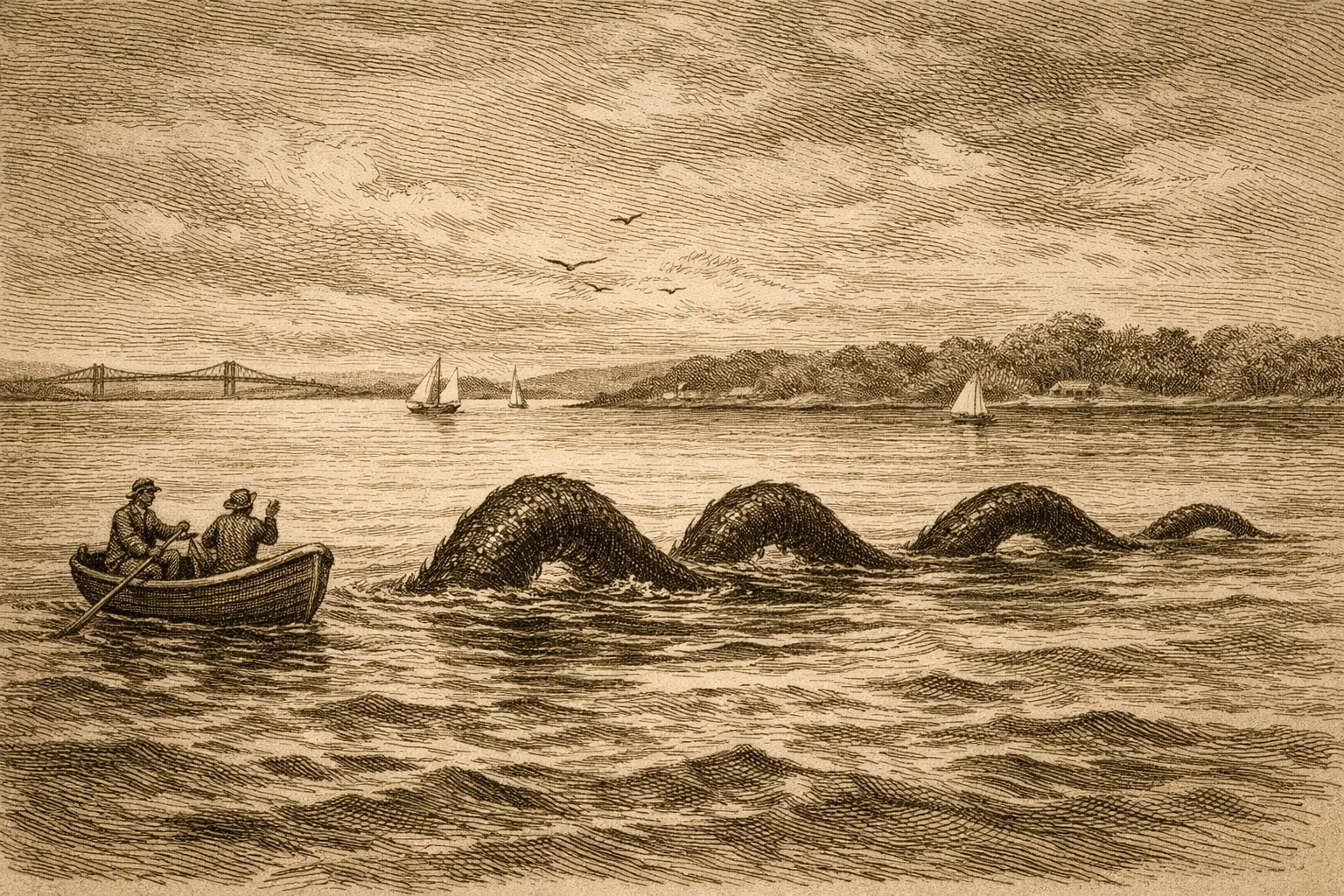
Chessie reports usually describe a creature that is long, dark, and low in the water. Witnesses have compared it to a serpent, a telephone pole, a line of humps, or something moving with a side-to-side motion. That description is vivid enough to feel memorable, but it is also broad enough to overlap with several Bay realities: a large fish just below the surface, a dolphin pod seen at a distance, a manatee rolling up for air, a whale or large marine mammal out of expected context, or an object being pushed by waves and current.
The Chesapeake is a particularly good setting for this kind of story because it is not a clear mountain lake. It is a large estuary with tidal movement, boat traffic, shifting light, floating logs, crab-pot lines, fish runs and seasonal marine visitors. A witness may honestly see something strange and still not have enough information to identify it. That is the key to reading Chessie fairly: the reports are not worthless just because the monster is unproven, but the reports do not become proof of a new species simply because the witness was sincere.
Some accounts are older or shakier than others. A commonly repeated “1936 helicopter” origin story is problematic because the timeline does not fit early helicopter history well, so it is safer to treat the modern Chessie phenomenon as a late-1970s and early-1980s story rather than a firmly documented pre-war case. The better-supported public rise of the legend begins with reports in 1978 around the lower Potomac and Chesapeake region, then gathers force after later sightings and media attention. Historian Eric Cheezum’s recent cultural history places the creature’s rise in the 1970s–1990s, linking the sightings not only to mystery-beast claims but also to changing waterfront communities and environmental anxiety around the Bay.[Wikipedia]WikipediaChessie (sea monsterChessie (sea monster
The 1982 Kent Island video
The case that made Chessie famous was not just a campfire tale. On Memorial Day 1982, Robert Frew of Love Point on Kent Island filmed a long, dark object moving in the Chesapeake Bay near his home. Contemporary reporting described the object as a possible 30-foot creature, and Frew’s claim drew wide attention because it appeared to offer what most monster stories lack: moving footage.[upi.com]upi.comRobert Frew of Love Point on Maryland's Eastern Shore made the videotape on Memorial Day. Frew said it shows a 30-foot-long serpent sw…
That video did two things at once. For believers, it gave the legend a centrepiece: Chessie was no longer merely “something my neighbour saw from a boat”. For sceptics, it created a test case in how little a distant surface video can settle. The object appeared serpentine, but the footage did not provide a clear head, fins, scale, anatomy, or behaviour that would separate an unknown animal from known explanations. A long shape on water can look more creature-like when distance, camera movement, waves and expectation are all working together.
The Kent Island setting also helped the story stick. Kent Island is not an abstract location; it is tied to the Bay Bridge, Eastern Shore traffic, marinas, waterfront homes and everyday Chesapeake life. A monster filmed there felt local, visible and shareable. Later anniversary coverage kept returning to Frew and Love Point because the sighting had become part of Maryland’s public memory, not merely a cryptozoology footnote.[WBAL]wbaltv.comlegend of chessie alive well in marylandlegend of chessie alive well in maryland
The video remains important, but not because it proves a sea serpent. Its real value is cultural and evidential: it shows how a single ambiguous piece of footage can organise a scattered set of reports into a named legend. In Maryland cryptid history, Chessie’s role is therefore different from a purely newspaper-made monster. The story was not only printed; it was watched, replayed, debated and attached to a specific stretch of Bay water.

Why Chessie became a Bay identity story
Chessie became Maryland’s water monster because the Chesapeake Bay is more than scenery. It is a working, contested and beloved landscape: crabbers, sailors, commuters, waterfront homeowners, conservationists, tourists and scientists all share the same water, but often see it differently. A strange shape in the Bay can therefore become a symbol as well as a sighting.
Cheezum’s work is useful here because it treats Chessie as a social phenomenon, not simply a “real or fake” puzzle. Public descriptions of the book emphasise that Chessie’s appearances coincided with dramatic changes in Chesapeake communities, including development pressure, shifting waterfront life and environmental debates. That does not mean witnesses invented everything as metaphor. It means the legend found an audience because it gave the Bay a character at a moment when people were already worrying about what the Bay was becoming.[Hopkins Press]press.jhu.eduHopkins Press Explore the Chesapeake with ChessieHopkins Press Explore the Chesapeake with Chessie
By the mid-1980s, Chessie had also been softened into an environmental mascot. The U.S. Fish and Wildlife Service published Chessie: A Chesapeake Bay Story in 1986, using the friendly monster to teach children about pollution and Bay protection. Later conservation writing still describes Chessie as an environmental icon rather than a threatening beast.[HathiTrust]catalog.hathitrust.orgOpen source on hathitrust.org.
That shift matters. Many sea-serpent legends are framed as danger: a monster below the boat, a beast in the dark water. Chessie became something gentler and more regional. The creature was mysterious, but also oddly affectionate — a mascot for a Bay that people feared losing. In that sense, Chessie belongs beside Maryland’s other cryptids, but with a distinct personality. The Goatman is a roadside warning. The Snallygaster is a mountain terror with newspaper-hoax energy. Chessie is the Bay looking back at Maryland.
Sturgeon, dolphins, whales and manatees
The most useful sceptical question is not “Could one witness have been wrong?” but “What real animals in the Chesapeake could produce a long, strange, memorable sight?” Maryland DNR’s current public explanation names several possibilities, including sturgeon, dolphins, whales and occasional wandering manatees. That list is not a debunking catch-all; each animal explains a different part of the legend.[Maryland News]news.maryland.govs cryptids and the wildlife that may have inspired thems cryptids and the wildlife that may have inspired them
Atlantic sturgeon are probably the most monster-like native candidate. They are large, ancient-looking fish with long bodies, bony scutes and shark-like tails. NOAA notes that Atlantic sturgeon can reach about 14 feet and 800 pounds, while the Chesapeake Bay Program describes them as capable of growing very large and bearing rows of bony plates. They are endangered and now rare compared with their historic abundance, but their size and shape make them credible candidates for at least some “prehistoric creature” impressions.[NOAA Fisheries]fisheries.noaa.govOpen source on noaa.gov.
Recent Maryland sturgeon work makes the point neatly. Maryland DNR’s sturgeon conservation page describes active tagging and monitoring in the Nanticoke River watershed, including Marshyhope Creek, where spawning is considered “Highly Likely” based on captures of adult males and egg-bearing females. In 2025, Maryland biologists reportedly tagged a female Atlantic sturgeon nicknamed “Chessie” that measured just under 7 feet 10 inches and weighed more than 200 pounds. That fish was not the monster, of course, but it shows why a large, rarely seen sturgeon can feel legendary when it breaks the surface.[Maryland Department of Natural Resources]dnr.maryland.govDepartment of Natural Resources Sturgeon ConservationDepartment of Natural Resources Sturgeon Conservation
Dolphins are a better explanation for some moving “humps” or repeated surface breaks. Bottlenose dolphins are not freak intruders in Chesapeake waters. A 2021 study using citizen-science sightings and passive acoustic detections found a clear seasonal pattern, with dolphins most often reported in summer and peaking in July. The Potomac-Chesapeake Dolphin Project has also documented dolphins through the middle Chesapeake and up the Potomac, with most sightings in warm months. A small group surfacing in sequence can easily create the impression of one long animal, especially from shore or from a moving boat.[NOAA Institutional Repository]repository.library.noaa.govOpen source on noaa.gov.
Whales are less likely for classic Chessie reports but important for perspective. Humpbacks are not common in the Chesapeake, yet the Chesapeake Bay Program notes that there are usually at least a couple of sightings each year, and modern video reports have shown humpbacks near places such as Solomons, Maryland. A whale is not a serpent, but a rare large animal appearing inside familiar water can reset what local observers think is possible.[Chesapeake Bay Program]chesapeakebay.netChesapeake Bay Program Humpback whale While humpback whales aren't common in the Chesapeake, there are usually at least a couple of sightChesapeake Bay Program Humpback whale While humpback whales aren't common in the Chesapeake, there are usually at least a couple of sight
Manatees are the most charming complication because one real manatee actually became “Chessie”. In 1994, a male manatee was found in the Chesapeake Bay near Kent Narrows as cold weather approached, rescued, rehabilitated and returned to Florida. USGS later confirmed the same animal in Calvert County, Maryland, in July 2011 by matching photographs to its scar pattern. Manatees do not look like sea serpents at close range, but a rolling back, head, wake or partial glimpse in murky water can produce a strange report, especially because manatees are unexpected so far north.[USGS]usgs.govOpen source on usgs.gov.
Why the explanations do not all fit equally
No single ordinary animal explains every Chessie account. That is not a weakness in sceptical explanation; it is exactly what should be expected from a legend built from many sightings over decades. “Chessie” is probably not one repeated misidentification. It is a label that gathers together different uncertain encounters: one person sees a sturgeon, another sees dolphins, another sees a manatee, another sees a wake, another sees something they cannot classify quickly enough before it disappears.
That helps explain why the descriptions vary. A sturgeon could account for a long, dark, prehistoric-looking body but not a chain of evenly spaced humps travelling together. Dolphins can account for rhythmic surfacing but not a single telephone-pole-like object gliding at the surface. A manatee can explain a rounded back and odd wake but not a fast snake-like motion. A whale can explain size and shock but not the classic narrow serpent form. Floating debris can explain a dark object, but not purposeful movement unless current, wind and waves cooperate.
The best evidence-aware position is therefore layered:
- Some reports may be sincere sightings of known animals in poor viewing conditions.
- Some may be ordinary objects or wakes given creature-like form by distance and expectation.
- Some may be retellings that grew sharper over time, especially once the name Chessie was available.
- A few remain unresolved as stories, but unresolved does not mean zoologically extraordinary.
This is also why the 1982 video still attracts interest. It is not strong enough to establish an unknown animal, but it is not so empty that readers simply forget it. It occupies the classic cryptid middle ground: suggestive, local, atmospheric and insufficient.
The changing story around Chessie
Chessie’s public life has gone through several phases. The first phase was the rise of sightings in the late 1970s and early 1980s, when the Bay monster became a press story and the Kent Island video gave it a concrete hook. The second phase was domestication: Chessie became cute, teachable and useful for conservation messaging. The third phase is the modern heritage phase, where the creature functions as a local legend people can revisit through books, museums, tourism writing, mascots and seasonal Halloween-style cryptid features.
The manatee named Chessie blurred these phases in a delightful way. A real, documented marine mammal borrowed the sea monster’s name and then became famous in its own right. USGS treated that animal scientifically, using photographs, scars and tracking context, yet the public affection around the manatee was clearly helped by the older monster legend. In one sense, Maryland got two Chessies: the unproven serpent and the very real travelling manatee.[USGS]usgs.govOpen source on usgs.gov.
Modern official writing tends to keep that distinction clear. Maryland DNR can celebrate Chessie as a cryptid while also pointing to sturgeon and marine mammals as possible inspirations. That is a healthier model for local monster lore than either scoffing at every witness or pretending the creature has been confirmed. The Bay is strange enough without forcing the evidence further than it goes.[Maryland News]news.maryland.govs cryptids and the wildlife that may have inspired thems cryptids and the wildlife that may have inspired them
What Chessie tells us about Maryland
Chessie endures because it is perfectly fitted to Maryland’s Chesapeake imagination. The Bay is broad, brown-green, tidal, busy and alive. It has real animals large enough to surprise people, and it has enough visual ambiguity to turn a brief sighting into a story. It also has communities deeply invested in what the water means: livelihood, recreation, conservation, memory and identity.
As a cryptid, Chessie is not Maryland’s strongest case for an unknown animal. The evidence is too ambiguous, too dependent on partial views, and too well supplied with ordinary explanations. As folklore, though, Chessie is one of Maryland’s most revealing monsters. It shows how a place can turn ecological uncertainty into character. A long dark shape appears near Kent Island, the Bay Bridge or a Potomac shoreline; someone watches it move; the water closes over it; and Maryland gains another story about the mystery living just below the surface.
Amazon book picks
Further Reading
Books and field guides related to What Was Seen in the Chesapeake Bay?. Use these as the next step if you want deeper reading beyond the article.
Field Guide to Lake Monsters, Sea Serpents, and Other Mystery...
Directly relates to sea-serpent traditions like Chessie.
Abominable Science!
Explains how sea-serpent reports can emerge from misidentification and folklore.

Monsters of Maryland
Includes Maryland monster traditions such as Chessie and related folklore.
eBay marketplace picks
Marketplace Samples
Live-tested eBay searches with available results related to this page.

Endnotes
1.
Source: upi.com
Link:https://www.upi.com/Archives/1982/08/31/The-30-foot-long-creature-Chessie-videotaped-in-the-Chesapeake-Bay/2874399614400/
Source snippet
Robert Frew of Love Point on Maryland's Eastern Shore made the videotape on Memorial Day. Frew said it shows a 30-foot-long serpent sw...
2.
Source: news.maryland.gov
Title: s cryptids and the wildlife that may have inspired them
Link:https://news.maryland.gov/dnr/2024/10/04/marylands-cryptids-and-the-wildlife-that-may-have-inspired-them/
3.
Source: Wikipedia
Title: Chessie (sea monster)
Link:https://en.wikipedia.org/wiki/Chessie_%28sea_monster%29
4.
Source: wbaltv.com
Title: legend of chessie alive well in maryland
Link:https://www.wbaltv.com/article/legend-of-chessie-alive-well-in-maryland/13126354
5.
Source: catalog.hathitrust.org
Link:https://catalog.hathitrust.org/Record/007409459
6.
Source: fisheries.noaa.gov
Link:https://www.fisheries.noaa.gov/species/atlantic-sturgeon
7.
Source: dnr.maryland.gov
Title: Department of Natural Resources Sturgeon Conservation
Link:https://dnr.maryland.gov/fisheries/pages/hatcheries/sturgeon.aspx
8.
Source: repository.library.noaa.gov
Link:https://repository.library.noaa.gov/view/noaa/47234
9.
Source: usgs.gov
Link:https://www.usgs.gov/programs/cmhrp/news/famous-manatee-chessie-sighted-chesapeake-bay-after-long-absence
10.
Source: uncommonwealth.lva.virginia.gov
Title: the legend of chessie
Link:https://uncommonwealth.lva.virginia.gov/blog/2025/11/26/the-legend-of-chessie/
11.
Source: mrc.virginia.gov
Link:https://mrc.virginia.gov/education/Chessie.pdf
12.
Source: dwr.virginia.gov
Title: atlantic sturgeon
Link:https://dwr.virginia.gov/wildlife/information/atlantic-sturgeon/
13.
Source: spo.nmfs.noaa.gov
Title: TM106 FINAL
Link:https://spo.nmfs.noaa.gov/sites/default/files/TM106%20FINAL.pdf
14.
Source: fisheries.noaa.gov
Title: supporting endangered atlantic sturgeon chesapeake bay
Link:https://www.fisheries.noaa.gov/feature-story/supporting-endangered-atlantic-sturgeon-chesapeake-bay
15.
Source: fisheries.noaa.gov
Title: common bottlenose dolphin
Link:https://www.fisheries.noaa.gov/species/common-bottlenose-dolphin
16.
Source: fisheries.noaa.gov
Title: 2016 2026 humpback whale unusual mortality event along atlantic coast
Link:https://www.fisheries.noaa.gov/national/marine-life-distress/2016-2026-humpback-whale-unusual-mortality-event-along-atlantic-coast
17.
Source: media.fisheries.noaa.gov
Title: f2020 AtlGmexSARs NmigBottlenoseDolphin
Link:https://media.fisheries.noaa.gov/2021-07/f2020_AtlGmexSARs_NmigBottlenoseDolphin.pdf?null=
18.
Source: fisheries.noaa.gov
Link:https://www.fisheries.noaa.gov/inport/item/55161
19.
Source: media.fisheries.noaa.gov
Title: f2020 AtlGmexSARs SmigBottlenoseDolphin
Link:https://media.fisheries.noaa.gov/2021-07/f2020_AtlGmexSARs_SmigBottlenoseDolphin.pdf?null=
20.
Source: fisheries.noaa.gov
Title: celebrating 15 years surveying protected species northwest atlantic
Link:https://www.fisheries.noaa.gov/feature-story/celebrating-15-years-surveying-protected-species-northwest-atlantic
21.
Source: usgs.gov
Title: chessie manatee
Link:https://www.usgs.gov/media/images/chessie-manatee
22.
Source: dnr.maryland.gov
Title: Cryptid Activity Book
Link:https://dnr.maryland.gov/wildlife/Documents/Cryptid-Activity-Book.pdf
23.
Source: news.maryland.gov
Link:https://news.maryland.gov/dnr/2026/05/28/public-asked-to-report-marine-mammal-and-turtle-sightings-and-strandings-to-dnr-this-summer/
24.
Source: potomac.org
Title: baby dolphins potomac river
Link:https://potomac.org/blog/2022/06/baby-dolphins-potomac-river
25.
Source: chesapeake-bay.org
Title: massive atlantic sturgeon caught during survey
Link:https://www.chesapeake-bay.org/2025/12/14/massive-atlantic-sturgeon-caught-during-survey/
26.
Source: press.jhu.edu
Link:https://www.press.jhu.edu/books/title/53727/chessie?srsltid=AfmBOootFswvzAodouyxi99RNzMxcP7Br1-BVx_bMH3vdo40-Su8iEkk
27.
Source: books.google.com
Link:https://books.google.com/books/about/Chessie.html?id=ancFEQAAQBAJ
28.
Source: press.jhu.edu
Title: Hopkins Press Explore the Chesapeake with Chessie
Link:https://www.press.jhu.edu/newsroom/explore-chesapeake-chessie?srsltid=AfmBOooYHnfhm0qmAAiLE_qm_dxJmQzMBKt8vgoiemPKXWnfDzZUHx7_
29.
Source: chesapeakebay.net
Link:https://www.chesapeakebay.net/discover/field-guide/entry/atlantic-sturgeon?mkevt=1&mkcid=1&mkrid=710-53481-19255-0&campid=5339151051&customid=endnote-source&toolid=10001
30.
Source: chesapeakebay.net
Link:https://www.chesapeakebay.net/discover/field-guide/entry/humpback-whale?mkevt=1&mkcid=1&mkrid=710-53481-19255-0&campid=5339151051&customid=endnote-source&toolid=10001
31.
Source: chesapeakebay.net
Link:https://www.chesapeakebay.net/files/documents/BMP-Guide_Full.pdf?mkevt=1&mkcid=1&mkrid=710-53481-19255-0&campid=5339151051&customid=endnote-source&toolid=10001
32.
Source: chesapeakebay.net
Title: Beyond 2025 Report Comments
Link:https://www.chesapeakebay.net/files/Beyond-2025-Report-Comments.pdf?mkevt=1&mkcid=1&mkrid=710-53481-19255-0&campid=5339151051&customid=endnote-source&toolid=10001
33.
Source: chesapeakebay.net
Title: 2023 Strategy Review System Biennial Meeting Report FINAL
Link:https://www.chesapeakebay.net/files/documents/2023-Strategy-Review-System-Biennial-Meeting-Report-FINAL.pdf?mkevt=1&mkcid=1&mkrid=710-53481-19255-0&campid=5339151051&customid=endnote-source&toolid=10001
34.
Source: chesapeakebay.net
Title: cbp 16926
Link:https://www.chesapeakebay.net/content/publications/cbp_16926.pdf?mkevt=1&mkcid=1&mkrid=710-53481-19255-0&campid=5339151051&customid=endnote-source&toolid=10001
35.
Source: bol.com
Link:https://www.bol.com/nl/nl/f/chessie/9300000157450127/
36.
Source: jones-massey.com
Title: chesapeake bay
Link:https://www.jones-massey.com/index.php/en/public-downloads?catid=475&id=1691%3Achessie-a-chesapeake-bay-story-and-activity-book&task=download.send
37.
Source: cryptidz.fandom.com
Link:https://cryptidz.fandom.com/wiki/Chessie
38.
Source: cryptid.fandom.com
Link:https://cryptid.fandom.com/wiki/Chessie
39.
Source: press.jhu.edu
Title: explore chesapeake chessie
Link:https://www.press.jhu.edu/newsroom/explore-chesapeake-chessie?srsltid=AfmBOoo615t7dbUcnaIXF0nKMkQg4H9NhIT-xXeRJ_D-CIfDg_Wtq2aC
40.
Source: sustainability.jhu.edu
Title: manatees in the chesapeake
Link:https://sustainability.jhu.edu/event/manatees-in-the-chesapeake/
41.
Source: press.jhu.edu
Title: explore chesapeake chessie
Link:https://www.press.jhu.edu/newsroom/explore-chesapeake-chessie?srsltid=AfmBOooSIy9HqHLBAU_I2MTVWjrfRm1vrlzzHZZPlLv7vhy8UOm2apIy
42.
Source: washingtonindependentreviewofbooks.com
Link:https://www.washingtonindependentreviewofbooks.com/bookreview/chessie
Additional References
43.
Source: youtube.com
Title: Dr. Eric Cheezum Explores The Legacy Of The Mysterious Sea Serpent, Chessie
Link:https://www.youtube.com/watch?v=XmDRmcFSe4Q
Source snippet
Something In The Bay; The Tale Of Chessie. The Chesapeake's Loch Ness...
44.
Source: youtube.com
Title: Chessie: A Cultural History of the Chesapeake Bay Sea Monster
Link:https://www.youtube.com/watch?v=wcnNrUYuHiI
Source snippet
Dr. Eric Cheezum Explores The Legacy Of The Mysterious Sea Serpent, Chessie...
45.
Source: nrc.gov
Link:https://www.nrc.gov/docs/ML1424/ML14245A009.pdf
46.
Source: userpages.umbc.edu
Link:https://userpages.umbc.edu/~frizzell/chessie.html
47.
Source: facebook.com
Link:https://www.facebook.com/ChesapeakeConservancy/posts/a-humpback-whale-was-spotted-in-the-mouth-of-the-potomac-river-wow/1106026538236096/
48.
Source: facebook.com
Link:https://www.facebook.com/MarylandDNRFisheries/posts/atlantic-sturgeon-in-marshyhope-creekyesterday-dnr-biologists-caught-two-atlanti/961769617195686/
49.
Source: savethemanatee.org
Link:https://savethemanatee.org/adopt-a-manatee/chessie/
50.
Source: cbmm.org
Link:https://cbmm.org/tag/chessie/
51.
Source: greensmartlinks.com
Link:https://www.greensmartlinks.com/index.php/public-downloads?catid=299&id=264%3Achessie-returns-a-chesapeake-bay-story-and-activity-book&task=download.send
52.
Source: facebook.com
Link:https://www.facebook.com/chesapeakebay/posts/chessie-is-back-after-seven-months-of-unknown-whereabouts-the-bays-favorite-mana/10159580312060943/
Topic Tree