Tracing the Creature Reports of South Dakota
South Dakota’s monster lore is not built around one famous state mascot in the way New Jersey has the Jersey Devil or West Virginia has Mothman.
Page outline Jump by section
Why South Dakota’s monster map looks different
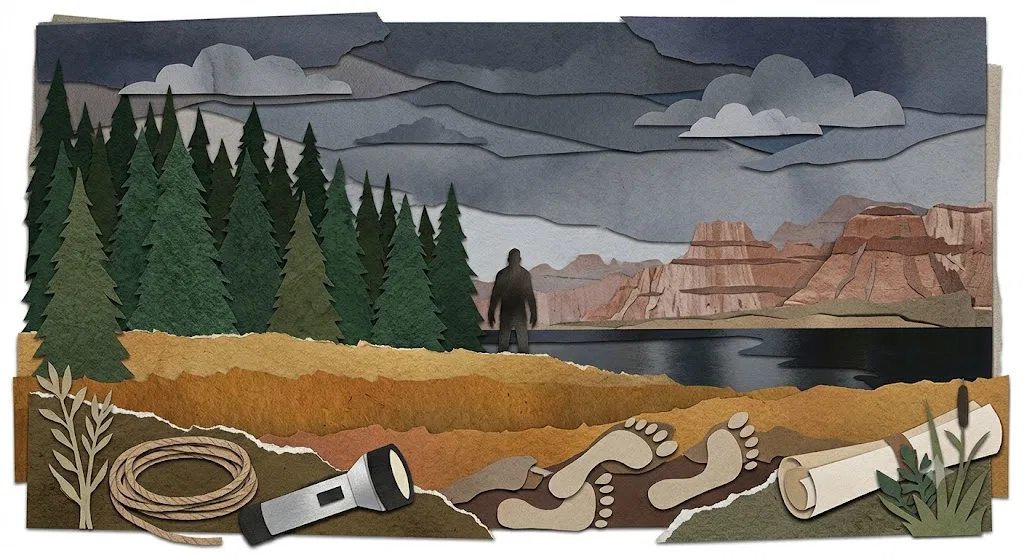
South Dakota is a state of sharp habitat contrasts. The Black Hills in western South Dakota and north-eastern Wyoming cover about 1.2 million acres of forested hills and mountains, a size and terrain profile that helps explain why the region attracts Bigfoot-style stories more readily than open prairie does. The name Black Hills comes from the Lakota Paha Sapa, referring to the dark appearance of the pine-covered hills from a distance.[US Forest Service]fs.usda.govUS Forest Service Home | Black Hills National Forest | Forest ServiceUS Forest Service Home | Black Hills National Forest | Forest Service
That terrain matters. Forested ridges, canyons, night roads, campgrounds, and scattered wildlife all create ideal conditions for ambiguous sightings: a glimpse in headlights, a sound in timber, a shape moving at the edge of a meadow. South Dakota also has real large predators. South Dakota Game, Fish and Parks says mountain lions have an established breeding population in the Black Hills; the species was removed from the state threatened list in 2003 and has been managed as a big game animal since the mid-2000s.[gfp.sd.gov]gfp.sd.govMountain Lion | South Dakota Game, Fish, and ParksMountain Lion | South Dakota Game, Fish, and Parks
The eastern part of the state offers a different kind of monster setting. Around Watertown and the glacial lakes, older water stories attach to named places, shorelines, and local traditions. Lake Kampeska, for example, is a natural lake of about 5,250 surface acres within Watertown’s city limits, connected to the Big Sioux River and managed mainly as a smallmouth bass and walleye fishery.[gfp.sd.gov]gfp.sd.govLake KampeskaLake Kampeska That is not the profile of a deep, remote Loch Ness-style lake, but it is exactly the kind of busy local water where nineteenth-century “lake serpent” talk could circulate among boat-builders, fishermen, holiday visitors, and newspaper readers.
Bigfoot in South Dakota: more Black Hills rumour than Pacific Northwest epic
South Dakota Bigfoot lore is best understood as a regional offshoot of the wider North American Sasquatch tradition. The state is not a top-tier Bigfoot hotspot by volume, but it has enough recurring claims to make the creature part of its modern monster culture. The Bigfoot Field Researchers Organization lists 21 South Dakota entries, with recent items including a June 2025 Class A report near Sturgis, a March 2025 Class B sound report near Custer State Park, and a June 2019 possible howl report north of Rochford in the Black Hills.[BFRO]bfro.netReports for South DakotaReports for South Dakota
Those listings should not be read as verified zoological evidence. BFRO is a Bigfoot-research organisation, not a wildlife agency, and its reports are witness-claim records. They are still useful as a folklore map because they show where people are placing the story: Lawrence, Custer, Pennington, and other counties with forest, rough country, or strong outdoor recreation cultures.[BFRO]bfro.netReports for South DakotaReports for South Dakota
The Black Hills setting gives these stories their local flavour. A night-time howl near Rochford, a roadside glimpse near Sturgis, or strange sounds near Custer State Park all fit the familiar Sasquatch script: partial sensory evidence, brief encounters, and places where ordinary wildlife is also active. Mountain lions, deer, elk, livestock, bears passing through, human pranksters, and the acoustics of wooded valleys all offer mundane possibilities. The point is not that every report has a neat explanation; it is that South Dakota’s best Bigfoot stories live in the gap between a real wild landscape and a culturally familiar monster shape.
The Standing Rock and McLaughlin monster flaps
The most interesting South Dakota Bigfoot material is not just a lone forest sighting. It is the way the story periodically becomes local news. South Dakota Magazine notes that the state’s most publicised Bigfoot “brouhaha” came in Corson County on the northern border, where reports around McLaughlin and Little Eagle drew attention from local and statewide media.[South Dakota Magazine]southdakotamagazine.comSouth Dakota Magazine Keystone's BigfootSouth Dakota Magazine Keystone's Bigfoot
The 1990s McLaughlin-area wave shows how a creature story can escalate. Merle Lofgren, editor of the weekly McLaughlin Messenger, wrote about rumours and sightings, and the Sioux Falls Argus Leader later sent a team to investigate. One reported description was of a seven- to eight-foot hairy creature with long arms and a strong odour; another account involved large tracks east of Little Eagle, said to be deeper than a size-13 boot impression made beside them.[South Dakota Magazine]southdakotamagazine.comSouth Dakota Magazine Keystone's BigfootSouth Dakota Magazine Keystone's Bigfoot
Older material also clusters around Corson County. BFRO’s Corson County page lists media articles with titles such as “Two Bigfoots Sighted Near Little Eagle”, “Monster Publicity Floods Little Eagle”, and “Sasquatch Getting Much Publicity”, including items from the McLaughlin Messenger and Sioux Falls Argus-Leader.[BFRO]bfro.netCorson County, South Dakota – Reports & ArticlesCorson County, South Dakota – Reports & Articles The titles alone show how quickly a claim can become a public event: sightings become publicity, publicity becomes community response, and community response becomes part of the legend.
For readers, the key question is not simply “was it Bigfoot?” A better question is: what kind of evidence survived? In these cases, much of the material is mediated through newspaper summaries, later retellings, and investigator databases. That makes the stories valuable as South Dakota folklore and media history, but weak as biological evidence. No accepted physical specimen, DNA result, body, or repeatable scientific record has established a hidden North American ape population. The South Dakota reports therefore sit in the category of persistent witness claims rather than confirmed animal history.
Spirit Mound and the little people tradition
Spirit Mound, north of Vermillion, is one of South Dakota’s most important creature-lore sites because its story is old, place-specific, and unusually well documented in early Euro-American travel records. The National Park Service says Lewis and Clark and ten of their men walked to Spirit Mound in August 1804 after hearing it described as a “hill of little people” and a place of dangerous spirits. Sioux, Omaha, and Otoe accounts described 18-inch humans with large heads who were armed with arrows and attacked those who approached.[National Park Service]nps.govNational Park Service Spirit MoundNational Park Service Spirit Mound
This is not a “cryptid sighting” in the modern Bigfoot sense. It belongs more properly to Indigenous spiritual geography and place-lore. The expedition reportedly found no little people, but did observe bison, prairie, and large flocks of birds; Clark suggested that steady wind and insect activity around the mound might help explain the unusual concentration of birds.[National Park Service]nps.govNational Park Service Spirit MoundNational Park Service Spirit Mound South Dakota Game, Fish and Parks likewise notes that the expedition visited on 25 August 1804 because they had heard of little people with big heads, but found instead a striking landscape.[gfp.sd.gov]gfp.sd.govSpirit Mound Historic Prairie | South Dakota Game, Fish, and ParksSpirit Mound Historic Prairie | South Dakota Game, Fish, and Parks
That does not make the tradition “just a mistake”. It means Spirit Mound works on more than one level. For Lewis and Clark, it became an episode in exploration: a reported mystery investigated and rationalised. For Indigenous communities, the site carried older meanings that should not be flattened into a monster-hunting anecdote. For modern strange-story readers, Spirit Mound is a reminder that not every small humanoid tradition should be treated as a search for an undiscovered species. Some beings belong to sacred landscape, warning story, trickster tradition, or moral geography rather than zoology.
Lake Kampeska and South Dakota’s water monsters
South Dakota’s water-monster tradition is quieter than the famous lake-serpent lore of places such as Lake Champlain or Okanagan Lake, but Lake Kampeska gives the state a local version. The lake sits near Watertown, is large by South Dakota standards, and has long been part of local recreation and storytelling. South Dakota Game, Fish and Parks describes it as a natural lake of roughly 5,250 acres, with excellent public access and a fishery built around species such as smallmouth bass, walleye, crappie, bluegill, channel catfish, northern pike, and white bass.[gfp.sd.gov]gfp.sd.govLake KampeskaLake Kampeska
The lake already had strong folklore associations before any modern “monster” branding. South Dakota Magazine’s account of Lake Kampeska focuses on the Maiden’s Isle legend at Stony Point, where low water reveals a rocky island tied to the story of Minnecotah, a young woman left on the island and rescued through the help of a white pelican. The story became part of Watertown culture, including Ki-Yi Days, the city’s homecoming celebration.[South Dakota Magazine]southdakotamagazine.comSouth Dakota Magazine Lake LegendsSouth Dakota Magazine Lake Legends
The Lake Kampeska Monster itself is harder to pin down from high-quality sources. Later summaries describe it as a nineteenth-century lake-serpent or giant-fish story, sometimes linked to the possibility of a very large sturgeon. That explanation is plausible in broad terms because many North American lake-monster stories grow from large fish, floating logs, waves, low-light viewing, and the desire to give a familiar lake a dramatic local mystery. In Kampeska’s case, the lake’s modest mean depth, heavy recreation use, and known managed fishery make a surviving unknown monster unlikely, but they do not erase the story’s value as a Watertown legend.
River monsters, sturgeon, and the Missouri imagination
South Dakota’s big river system gives another route for monster stories. The Missouri River is wide, powerful, altered by dams, and full of places where boaters can experience sudden current, submerged debris, strange wakes, and very large fish. River-monster tales often feel more physically plausible than deep-lake monsters because the animal does not have to remain in one small basin forever; it can move, appear briefly, and vanish into muddy water.
That is where giant-fish explanations become important. In many Midwestern and Plains states, “river monster” does not necessarily mean a reptile or serpent. It may mean a sturgeon, catfish, paddlefish, or an ordinary object made uncanny by current and fear. South Dakota’s official Lake Kampeska fishery material lists northern pike and channel catfish among the lake’s important species, while broader Missouri River folklore often reaches for sturgeon-like explanations when a line pulls hard, a wake forms oddly, or something large brushes a boat.[gfp.sd.gov]gfp.sd.govLake KampeskaLake Kampeska
The sceptical reading is not boring here; it is part of the fun. A sturgeon or catfish does not need to be supernatural to become monstrous in a small-boat encounter. A heavy fish, snagged rope, submerged log, or current shift can produce a story that feels alive. Once repeated in a local paper, bait shop, campfire circle, or radio segment, the event becomes less about the original object and more about the shared question: what exactly was under the water?
Fossil monsters and older-than-human strangeness
South Dakota also has a rare advantage in monster storytelling: some of its “sea monsters” were absolutely real, just not alive today. Badlands National Park material from the National Park Service explains that mosasaurs, large marine lizards from the Cretaceous Period, lived in the Badlands area about 75–69 million years ago. Some reached around 50 feet in length and were top predators of the oceans.[National Park Service]nps.govOpen source on nps.gov.
This fossil context matters because the state’s badlands and prairie are not merely empty backdrops for modern legends. They preserve evidence of an ancient inland sea. The Western Interior Seaway once covered the Badlands area, leaving marine fossils such as mosasaurs, ammonites, and baculites rather than dinosaur bones in those particular rocks.[National Park Service]nps.govOpen source on nps.gov.
For cryptid readers, fossils create a tempting but risky bridge. It is easy to say, “ancient sea monsters lived here, so perhaps lake monsters survived here.” The evidence does not support that leap. Mosasaurs disappeared at the end of the Cretaceous, and South Dakota’s modern lakes and rivers are not hidden refuges for prehistoric reptiles. The better connection is imaginative and cultural: fossil country makes monster stories feel geologically charged. South Dakota can point to real prehistoric giants while still treating modern lake-serpent claims as folklore rather than palaeontology.
Walking Sam and the limits of the cryptid label
Walking Sam, sometimes folded into South Dakota “cryptid” lists, needs careful handling. The figure is usually described in modern retellings as a tall, shadowy or faceless being associated with Pine Ridge and with despair or death. That makes it adjacent to monster folklore, but it is not an animal mystery in the way Bigfoot or a lake creature is. It belongs closer to spirit, urban legend, trauma narrative, and internet-era horror.
The real-world context is serious. In 2015, Education Week reported that schools, community leaders, and mental-health professionals were responding to a cluster of teen suicides on the Pine Ridge Indian Reservation, where seven teenagers had died in recent months.[Education Week]edweek.orgOpen source on edweek.org. The University of Chicago Divinity School’s Sightings publication, discussing the same crisis, cited nine deaths among people aged 12 to 24 and 103 known suicide attempts between December and March, based on federal Indian Health Service reporting.[University of Chicago Divinity]divinity.uchicago.edusioux suicidessioux suicides
Because of that context, Walking Sam should not be treated as a spooky attraction or a simple “South Dakota monster”. The useful reader takeaway is that legends can attach themselves to grief, social stress, and community fear. In some retellings, the figure becomes a way to talk about vulnerability and danger; in others, internet horror imagery reshapes the story into a tall-man creepypasta. Either way, the legend is part of South Dakota’s strange-creature landscape only if handled with respect for the living community and the crisis around which many modern references cluster.
Tourism, pop culture, and the friendly Bigfoot
South Dakota has also turned monster lore into roadside fun. Keystone, already close to Mount Rushmore and other Black Hills attractions, is home to a giant wooden Bigfoot sculpture promoted as the world’s largest Bigfoot. Atlas Obscura describes it as a chainsaw-carved Sasquatch: a 23-foot seated figure holding a flagpole that would make it 54 feet tall if standing.[Atlas Obscura]atlasobscura.comAtlas Obscura World's Largest Bigfoot in KeystoneAtlas Obscura World's Largest Bigfoot in Keystone
That sculpture is important because it shows how a frightening or uncertain creature claim becomes a friendly tourism object. The Keystone Bigfoot is not evidence for Sasquatch; it is evidence for Sasquatch as a cultural brand. South Dakota Magazine connected Keystone’s Bigfoot event to the wider history of Bigfoot making news in the state, from BFRO listings to Corson County reports.[South Dakota Magazine]southdakotamagazine.comSouth Dakota Magazine Keystone's BigfootSouth Dakota Magazine Keystone's Bigfoot
This is a common pattern in American cryptid culture. A creature begins as rumour, witness report, spiritual warning, or newspaper oddity. Later it becomes a festival, statue, T-shirt, roadside stop, podcast episode, or local joke. South Dakota’s version is comparatively modest, but it fits the national pattern: the monster survives not because it has been proved, but because people enjoy having a strange local story to point at.
What evidence actually exists?
The evidence for South Dakota cryptids is uneven, and that unevenness is the main story.[bfro.net]bfro.netReports for South DakotaReports for South Dakota
For Bigfoot-style claims, the evidence consists mostly of witness reports, newspaper accounts, investigator listings, alleged tracks, and repeated descriptions. BFRO’s database is useful for finding claim clusters, but it is not equivalent to scientific confirmation.[BFRO]bfro.netReports for South DakotaReports for South Dakota The Corson County and McLaughlin stories are historically interesting because they entered local journalism and community conversation, not because they produced accepted biological proof.[BFRO]bfro.netCorson County, South Dakota – Reports & ArticlesCorson County, South Dakota – Reports & Articles
For Spirit Mound, the evidence is much stronger that the tradition existed and was recorded early, but that is a different kind of evidence. National Park Service and state material document what Lewis and Clark heard, where they went, and how they interpreted the site.[National Park Service]nps.govNational Park Service Spirit MoundNational Park Service Spirit Mound That supports the importance of the little-people tradition as place-lore, not the existence of a hidden population of tiny archers.
For lake and river monsters, the evidence is weakest as zoology and strongest as local storytelling. Lake Kampeska is well documented as a real lake, public recreation site, and fishery, but the monster tradition is mostly a later local legend attached to a place already rich in named stories.[South Dakota Magazine]southdakotamagazine.comSouth Dakota Magazine Lake LegendsSouth Dakota Magazine Lake Legends
For Walking Sam, the evidence supports the presence of a modern legend and the reality of the Pine Ridge youth suicide crisis, but not the existence of a literal predatory entity. Treating the figure as folklore, grief-language, or modern legend is more responsible than presenting it as a creature to be hunted.[Education Week]edweek.orgOpen source on edweek.org.
The most likely explanations
South Dakota’s monster stories probably do not have one explanation. They come from several overlapping sources:
Misidentified wildlife. Mountain lions, deer, elk, coyotes, large birds, and occasional bear reports can all become strange in poor light or under stress. The Black Hills’ established mountain lion population is especially relevant to night sounds, tracks, and fleeting movement.[gfp.sd.gov]gfp.sd.govMountain Lion | South Dakota Game, Fish, and ParksMountain Lion | South Dakota Game, Fish, and Parks
Landscape effects. The Black Hills create shadows, echoes, and obstructed sightlines; lakes and rivers create wakes, floating debris, and distorted scale. A reader should be wary of any claim based on a brief night-time glimpse, a sound without a visual source, or a track without a clear chain of custody.
Newspaper amplification. The McLaughlin and Little Eagle material shows how quickly a local rumour can become a regional story. Once an editor, broadcaster, or investigator gives a name to a flap, the legend becomes easier to repeat.[South Dakota Magazine]southdakotamagazine.comSouth Dakota Magazine Keystone's BigfootSouth Dakota Magazine Keystone's Bigfoot
Older place-lore. Spirit Mound and Lake Kampeska show that some South Dakota creature stories are rooted in named places and inherited narratives. These are not failed wildlife reports; they are cultural stories that attach meaning to hills, islands, lakes, and dangerous ground.[National Park Service]nps.govNational Park Service Spirit MoundNational Park Service Spirit Mound
Tourism and playful identity. Keystone’s giant Bigfoot shows the afterlife of cryptid culture: once a creature becomes recognisable, it can become a roadside attraction whether or not anyone believes in it literally.[Atlas Obscura]atlasobscura.comAtlas Obscura World's Largest Bigfoot in KeystoneAtlas Obscura World's Largest Bigfoot in Keystone

The South Dakota takeaway
South Dakota’s cryptid tradition is strongest when read as a landscape of claims rather than a catalogue of confirmed creatures. The Black Hills give the state its Sasquatch terrain. Standing Rock and McLaughlin give it a newspaper-era monster flap. Spirit Mound gives it a deep, place-based little-people tradition recorded during the Lewis and Clark expedition. Lake Kampeska and the Missouri add water-monster possibilities shaped by fish, current, local memory, and old storytelling. Walking Sam shows how modern legends can become entangled with grief and social crisis.
The result is a state monster map that feels quieter than the Pacific Northwest or Appalachia, but in some ways more revealing. South Dakota’s legends are not just about what might be hiding in the trees or under the water. They are about how people explain strange places, how communities handle rumour, how old traditions are reframed by outsiders, and how a dark shape at the edge of the road can become part of a state’s folklore long after the original sighting has faded.
Amazon book picks
Further Reading
Books and field guides related to What Haunts South Dakota's Wild Places?. Use these as the next step if you want deeper reading beyond the article.
The United States of Cryptids
Helps place South Dakota legends among state cryptids nationwide.
eBay marketplace picks
Marketplace Samples
Live-tested eBay searches with available results related to this page.
Endnotes
1.
Source: gfp.sd.gov
Title: Mountain Lion | South Dakota Game, Fish, and Parks
Link:https://gfp.sd.gov/mountain-lion/
2.
Source: gfp.sd.gov
Title: Lake Kampeska
Link:https://gfp.sd.gov/UserDocs/nav/Lake_Kampeska.pdf
3.
Source: bfro.net
Title: Reports for South Dakota
Link:https://www.bfro.net/GDB/state_listing.asp?state=sd
4.
Source: bfro.net
Title: Corson County, South Dakota – Reports & Articles
Link:https://www.bfro.net/GDB/show_county_reports.asp?county=Corson&state=sd
5.
Source: gfp.sd.gov
Title: Spirit Mound Historic Prairie | South Dakota Game, Fish, and Parks
Link:https://gfp.sd.gov/parks/detail/spirit-mound-historic-prairie/
6.
Source: gfp.sd.gov
Link:https://gfp.sd.gov/
7.
Source: gfp.sd.gov
Link:https://gfp.sd.gov/news/detail/1637/
8.
Source: gfp.sd.gov
Title: BH Beaver Action Plan 2025 2029
Link:https://gfp.sd.gov/UserDocs/nav/BH_Beaver_Action_Plan_2025_2029.pdf
9.
Source: bfro.net
Title: show report.asp
Link:https://www.bfro.net/GDB/show_report.asp?id=78786
10.
Source: bfro.net
Title: show report.asp
Link:https://www.bfro.net/gdb/show_report.asp?id=65588
11.
Source: bfro.net
Title: show county reports.asp
Link:https://www.bfro.net/GDB/show_county_reports.asp?county=Lawrence&state=SD
12.
Source: bfro.net
Link:https://www.bfro.net/gdb/
13.
Source: bfro.net
Title: show report.asp
Link:https://www.bfro.net/GDB/show_report.asp?id=1445
14.
Source: bfro.net
Title: show county reports.asp
Link:https://www.bfro.net/GDB/show_county_reports.asp?county=Custer&state=sd
15.
Source: bfro.net
Title: show report.asp
Link:https://www.bfro.net/gdb/show_report.asp?id=29455
16.
Source: bfro.net
Title: show report.asp
Link:https://www.bfro.net/gdb/show_report.asp?id=1098
17.
Source: bfro.net
Link:https://www.bfro.net/GDB/newart.asp
18.
Source: fs.usda.gov
Title: US Forest Service Home | Black Hills National Forest | Forest Service
Link:https://www.fs.usda.gov/r02/blackhills
19.
Source: southdakotamagazine.com
Title: South Dakota Magazine Keystone’s Bigfoot
Link:https://southdakotamagazine.com/2020/12/11/keystone-bigfoot-bash/
20.
Source: nps.gov
Title: National Park Service Spirit Mound
Link:https://www.nps.gov/lecl/learn/historyculture/spirit-mound.htm
21.
Source: southdakotamagazine.com
Title: South Dakota Magazine Lake Legends
Link:https://southdakotamagazine.com/2015/09/14/lake-legends/
22.
Source: nps.gov
Link:https://www.nps.gov/articles/000/mosasaur.htm
23.
Source: edweek.org
Link:https://www.edweek.org/leadership/schools-leaders-respond-to-teen-suicide-cluster-on-pine-ridge-indian-reservation/2015/04
24.
Source: divinity.uchicago.edu
Title: sioux suicides
Link:https://divinity.uchicago.edu/sightings/articles/sioux-suicides
25.
Source: atlasobscura.com
Title: Atlas Obscura World’s Largest Bigfoot in Keystone
Link:https://www.atlasobscura.com/places/worlds-largest-bigfoot-south-dakota
26.
Source: Wikipedia
Title: Lake Kampeska
Link:https://en.wikipedia.org/wiki/Lake_Kampeska
27.
Source: southdakotamagazine.com
Title: A Spirited Place
Link:https://southdakotamagazine.com/2024/09/23/a-spirited-place/
28.
Source: southdakotamagazine.com
Title: Our Water Stories
Link:https://southdakotamagazine.com/2017/11/28/our-water-stories/
29.
Source: weirddarkness.com
Title: walking sam
Link:https://weirddarkness.com/walking-sam/
30.
Source: b1027.com
Title: south dakota cryptids
Link:https://b1027.com/ixp/482/p/south-dakota-cryptids/
31.
Source: hot1047.com
Title: south dakota cryptids
Link:https://hot1047.com/south-dakota-cryptids/
Additional References
32.
Source: youtube.com
Title: Spirit Mound, S.D. & The Legend Of The Evil Little Ones
Link:https://www.youtube.com/watch?v=ogEYMpPLrvg
Source snippet
This Walking Sam Legend Video provides an in-depth look at South Dakota's local folklore, specifically focusing on the regional context o...
33.
Source: youtube.com
Title: A Scary State: Ep.188 South Dakota’s Haunted Hallows and Grim Gulches
Link:https://www.youtube.com/watch?v=UWUX-AmQZbc
Source snippet
South Dakota Unsolved Ancient Mysteries Science Can't Explain...
34.
Source: youtube.com
Title: South Dakota Unsolved Ancient Mysteries Science Can’t Explain
Link:https://www.youtube.com/watch?v=0DGGCXkcraI
Source snippet
Walking Sam: South Dakota's Top Hat Wearing Bigfoot or Demonic Entity?...
35.
Source: sdlegislature.gov
Link:https://sdlegislature.gov/Rules/Administrative/41%3A06%3A61
36.
Source: youtube.com
Title: Walking Sam: South Dakota’s Top Hat Wearing Bigfoot or Demonic Entity?
Link:https://www.youtube.com/watch?v=fGHFRoj-RWc
Source snippet
Did Lewis and Clark find the Demon People?...
37.
Source: facebook.com
Link:https://www.facebook.com/61574128795532/posts/a-legendary-monster-gave-its-name-to-one-of-south-dakotas-most-stunning-views-/122152500590804293/
38.
Source: visitrapidcity.com
Link:https://www.visitrapidcity.com/parks-and-monuments/black-hills-national-forest/
39.
Source: nationalforests.org
Link:https://www.nationalforests.org/forest/black-hills-national-forest/
40.
Source: blackhillsbadlands.com
Link:https://www.blackhillsbadlands.com/places/parks-monuments/black-hills-national-forest/
41.
Source: blackhillsparks.org
Link:https://blackhillsparks.org/conservation-at-black-hills-national-forest-how-bhnf-stays-wild/?srsltid=AfmBOoo4xmtWsZMX6laJ3B36AXO5yoZYwfiB_WDC0Yqot5PaCKhn0W9f
Topic Tree
Follow this branch
Related pages 49
- Rhode Island Monsters
- Hawaii Monsters
- Illinois Cryptids
- Nebraska Cryptids
- Alabama Cryptids
- +44 more in sidebar