Within Kentucky Cryptids
Is Kentucky Bigfoot a Bear in the Dark?
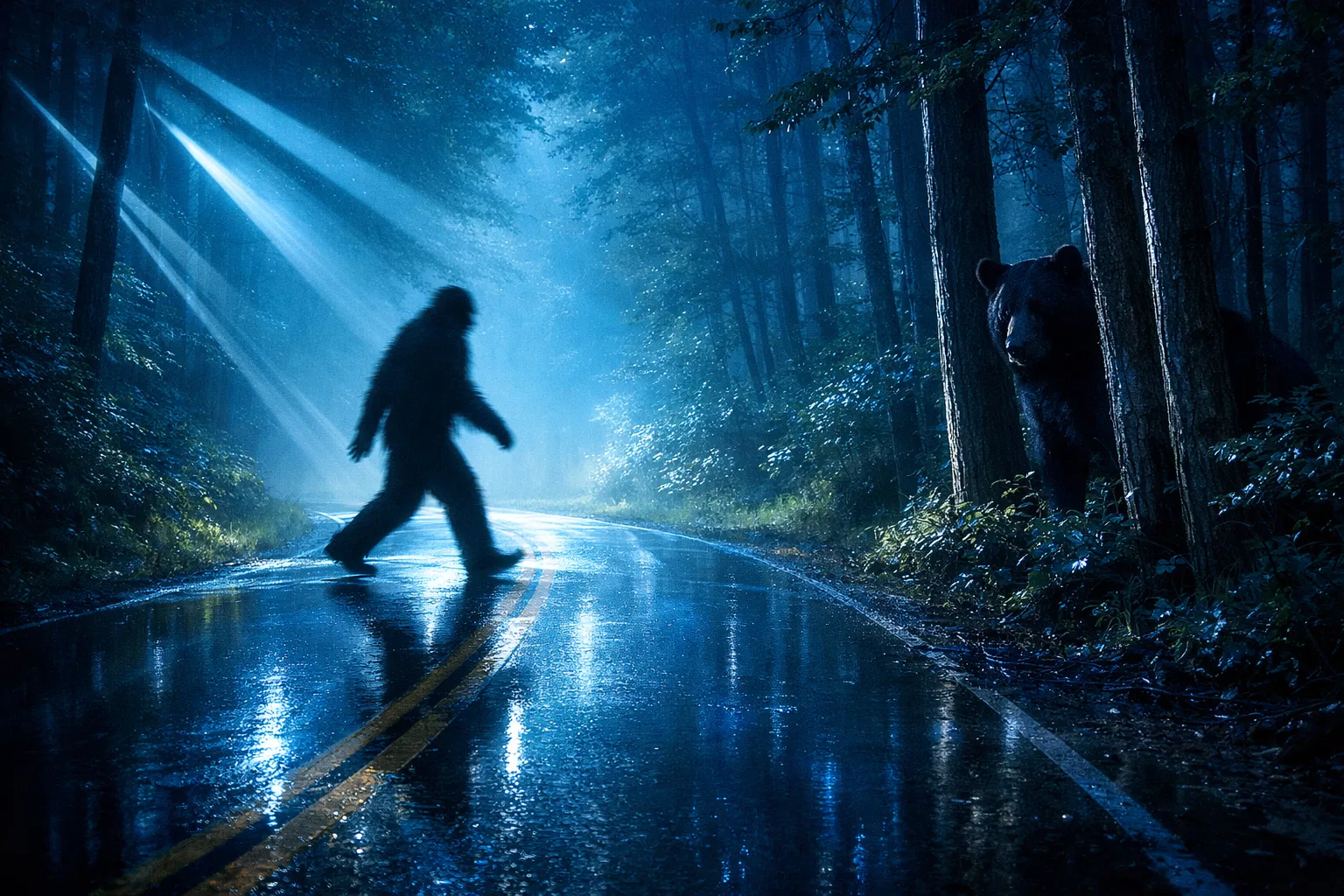
Kentucky's Sasquatch reports cluster around woods, road crossings and outdoor culture, but black bears remain a major sceptical comparison.
On this page
- Where Kentucky Bigfoot reports appear
- Hunters, hollows and forest edge sightings
- Black bears, tracks and expectation
Page outline Jump by section
Introduction
Kentucky Bigfoot is best understood as a woodland sighting tradition rather than a single famous monster case. Reports tend to come from hunters, campers, motorists and rural residents describing a large, dark, upright figure near woods, hollows, lakes, farms or road edges. The awkward question is whether some of these encounters are really black bears seen briefly, at odd angles, or in poor light. That is not a throwaway sceptical answer: Kentucky’s recovering bear population, especially in the eastern mountains and forest corridors, overlaps with some of the very landscapes where Bigfoot stories feel most plausible. Kentucky Bigfoot researchers catalogue hundreds of reports, while wildlife agencies and sceptical investigators point to bears, human expectation, darkness and fleeting observation as powerful explanation engines. The result is a state legend that sits in the half-lit space between outdoor folklore, witness memory, animal behaviour and the return of a very real large mammal.[kentuckybigfoot.com]kentuckybigfoot.comGraph of Kentucky Bigfoot SightingsGraph of Kentucky Bigfoot Sightings
Where Kentucky Bigfoot reports appear
Kentucky’s Bigfoot reports are not evenly spread across the state, and they do not simply copy the Pacific Northwest image of Sasquatch in old-growth rainforest. In Kentucky, the typical setting is more Appalachian and Bluegrass: wooded ridges, creek bottoms, farm margins, lake country, deer stands, rural roads and the edges of public forest. The Bigfoot Field Researchers Organization, one of the main public databases used by enthusiasts, lists 117 Kentucky reports and shows recent examples from Anderson, Lawrence and Elliott counties, including a daylight hunter sighting near Taylorsville Lake and activity reported around hollows south of Grayson.[BFRO]bfro.netReports for KentuckyReports for Kentucky
The Kentucky Bigfoot Research Organization presents a larger state tally, listing 398 Kentucky sightings on its sightings map: 313 KBRO visual encounters and 85 BFRO visual or “Class B” reports involving indirect evidence such as tracks or sounds. The same page cautions that the number includes some confidential reports and does not include every credible report collected by all Kentucky researchers, which makes it useful as a folklore-and-claim map rather than a verified biological survey.[kentuckybigfoot.com]kentuckybigfoot.comGraph of Kentucky Bigfoot SightingsGraph of Kentucky Bigfoot Sightings
The locations matter because they show what Kentucky’s version of Bigfoot is doing in the imagination. It is not usually presented as an urban monster. It is seen at the threshold: crossing a road, watching from a treeline, moving behind a barn, appearing near a campsite, vanishing into a hollow, or startling a hunter who thought he knew what belonged in those woods. That pattern makes the stories memorable, but it also makes them vulnerable to ordinary misidentification. A witness often has only seconds to process size, colour, movement and posture before the figure disappears.
Daniel Boone National Forest gives the legend a particularly strong habitat frame. The U.S. Forest Service describes the forest as spread across 21 eastern Kentucky counties, with more than 708,000 acres of national forest system land, more than 600 miles of trails, two federally recognised wildernesses and more than 250 recreation sites. In plain terms, it is exactly the sort of rugged, visitor-filled, story-friendly landscape where ambiguous animal encounters can become enduring local tales.[US Forest Service]fs.usda.govUS Forest Service Home | Daniel Boone National Forest | Forest ServiceUS Forest Service Home | Daniel Boone National Forest | Forest Service

Hunters, hollows and forest-edge sightings
Many Kentucky Bigfoot accounts lean on the credibility of outdoor witnesses. Hunters, farmers and campers are often treated as better observers because they know deer, coyotes, raccoons, dogs and bears. That argument has emotional force: a hunter in a tree stand who says “that was not a deer” sounds more persuasive than a tourist glimpsing something from a moving car. BFRO’s recent Kentucky listing includes several examples that fit this pattern, including Anderson County reports involving deer hunters near Lawrenceburg and a 2021 daylight report by a hunter southeast of Louisville.[BFRO]bfro.netshow county reports.aspshow county reports.asp
But outdoor experience cuts both ways. A skilled hunter may be good at recognising familiar animals under normal conditions, yet Bigfoot reports often happen under abnormal conditions: low light, adrenaline, partial obstruction, distance, fatigue, surprise, rain, fog, gun-season expectation or a very brief view through trees. The moment is then retold after the witness has already decided that the animal was unusual. Once the phrase “Bigfoot” enters the story, memory can become more organised than the original glimpse.
Kentucky’s geography encourages this kind of encounter. A person in a blind, stand or tent is often stationary, staring into layered woodland. A dark animal moving behind trunks may appear taller or more upright than it really is. A bear lifting itself to smell, look, reach, rub or step over an obstacle can look startlingly human for a second. A person walking in dark clothing, a large dog, a bear, a stump-shadow combination, or several animals glimpsed together can all become one large “figure” when the view is broken and the witness is primed by local stories.
The holler setting adds another ingredient: sound. Kentucky reports often include knocks, howls, screams, heavy footsteps, brush movement or “something watching” from the treeline. None of these details is worthless, but none is diagnostic on its own. Foxes, owls, coyotes, livestock, bears, deer and human pranksters can make noises that sound uncanny at night. In a steep hollow, echoes and distance are hard to judge. A sound that seems huge may simply be close, amplified or unfamiliar.
Black bears, tracks and expectation
The bear explanation is not a lazy way to dismiss every Kentucky Bigfoot witness. It is a serious comparison because black bears are real, large, dark, increasingly visible in Kentucky, and capable of postures that can look briefly bipedal. Kentucky Fish and Wildlife has described black bears as primarily found in the eastern part of the state, and recent Kentucky reporting has emphasised that the population has grown as forests recovered and bears moved back in from West Virginia, Virginia and Tennessee.[fw.ky.gov]fw.ky.govBlack BearsBlack Bears
That return is historically important. Kentucky’s black bears were virtually eliminated in the early twentieth century through logging and unregulated hunting, according to Kentucky Fish and Wildlife as quoted by WKYT. As forests grew back, bears recolonised suitable habitat, and the agency now describes Kentucky as having a resident bear population increasing in both numbers and range.[https://www.wkyt.com]wkyt.comOpen source on wkyt.com.
The University of Kentucky’s Hannah B. Harris, in a doctoral dissertation on the return of black bears to eastern Kentucky, describes the species as part of a reproducing population in the southeastern Cumberland Mountain region. Her research focused on human-bear conflict and tolerance in Harlan and Letcher counties, including the role of human food sources in bringing bears closer to people. That is relevant to Bigfoot interpretation because it shows that some “impossible” large-animal encounters in eastern Kentucky are now perfectly possible bear encounters.[UKnowledge]uknowledge.uky.eduTHE RETURN OF THE BLACK BEAR TO EASTERN KENTUCKY: CONFLICT AND TOLERAN" by Hannah B. Harris…
The Forest Service also treats bears as a practical fact of life in Daniel Boone National Forest. Its safety guidance states that “black bears are back” and links that return to food-storage restrictions designed to reduce odours that attract them. That phrasing is more useful than any campfire argument: in some of Kentucky’s most Bigfoot-friendly terrain, the official visitor advice is already built around avoiding bears.[US Forest Service]fs.usda.govOpen source on usda.gov.
Tracks are another place where expectation matters. A clear bear track usually shows claws and a different foot shape from the long, humanlike footprint associated with Bigfoot casts. But mud, slippage, overstepping, melting snow, partial prints and repeated stepping can distort tracks. A bear’s hind foot can look oddly human at a glance, especially if the front print is faint or overlaps. A person already thinking about Bigfoot may read ambiguity as anatomy.
Why the bear explanation fits some reports but not all
The strongest version of the bear explanation is not “every witness saw a bear”. It is “bears can account for a meaningful share of reports that involve large, dark, hairy figures in wooded places, especially at distance or in poor light”. Sceptical investigator Joe Nickell argued in Skeptical Inquirer that standing bears are among North America’s best lookalikes for the bipedal, hairy figures described as Bigfoot, while also noting that not all reports must be bears; some may be other misidentifications or hoaxes.[skepticalinquirer.org]skepticalinquirer.orgBigfoot Lookalikes: Tracking Hairy Man-Beasts | Skeptical InquirerBigfoot Lookalikes: Tracking Hairy Man-Beasts | Skeptical Inquirer
A 2024 Journal of Zoology study by Floe Foxon gives the bear comparison a statistical frame. The study examined sasquatch or Bigfoot sightings alongside black bear populations across the United States and Canada, extending earlier Pacific Northwest work. ScienceAlert’s summary of the paper reports that sightings increased by about 4 per cent for every additional 1,000 black bears in a given state or province, after accounting for human population and forest area.[ZSL Publications]zslpublications.onlinelibrary.wiley.comZSL Publications Bigfoot: If it's there, could it be a bear?ZSL Publications Bigfoot: If it's there, could it be a bear?
That does not prove that Kentucky Bigfoot equals bear. Correlation is not a photograph, a DNA sample or a confession from a hoaxer. It does, however, make a useful prediction: in places where people, forest and bears overlap, some people will report seeing something large, dark and strange. Kentucky increasingly has all three ingredients in parts of the state.
There are still reports that a simple bear explanation does not neatly satisfy. Witnesses may describe long arms, a flat face, a smooth two-legged walk, unusual speed, repeated vocalisations, or a figure taller than a typical black bear. Those details deserve to be recorded accurately. Yet the problem remains that dramatic details are often produced under the weakest observation conditions. A witness can be sincere and still wrong about height, distance, gait or species.
For a careful reader, the most honest position is layered:
- Some Kentucky reports are likely bears. This is especially plausible in eastern forest country, near bear travel corridors, campsites, rubbish, orchards, roads and rural homes.
- Some reports may be people, dogs, livestock, shadows or hoaxes. Bigfoot stories are famous enough that expectation and prank behaviour cannot be ignored.
- Some reports remain unresolved as stories. “Unresolved” means the account lacks enough information for identification, not that it proves an unknown animal.
- The legend persists because the setting is convincing. Kentucky’s woods, hollows and road crossings give the story a believable stage even when the evidence is thin.
Why more bear sightings may mean more Bigfoot stories
Kentucky’s bear recovery changes the folklore environment. A hundred years ago, a large dark animal in many parts of the state was less likely to be a bear simply because bears had been pushed out of so much of their former range. Today, the situation is different. WKYT reported in June 2026 that recent bear sightings were being driven by both a growing bear population and the spread of cameras, including home security cameras that catch animals at night when residents may not otherwise know they passed through.[https://www.wkyt.com]wkyt.comOpen source on wkyt.com.
That camera point matters for cryptid culture. Trail cameras and doorbell cameras can reduce mystery by documenting known animals, but they can also increase mystery by producing blurry, infrared, partial or low-angle clips. A bear crossing a driveway at 3 a.m. may look obvious in one frame and uncanny in another. The same technology that proves bears are present also gives people more strange images to share.
Seasonal bear behaviour also overlaps with sighting patterns. Kentucky coverage notes that bears emerge from winter inactivity in late March or early April and become especially active in June and July during breeding season, when males may travel long distances. Those are also months when people camp, hike, fish, drive rural roads at dusk, check trail cameras and spend long evenings outdoors.[https://www.wkyt.com]wkyt.comOpen source on wkyt.com.
This does not drain the fun from Kentucky Bigfoot. In fact, it makes the legend more interesting. A state does not need an undiscovered ape for its monster stories to matter. The return of bears means Kentucky residents are renegotiating what “wild” looks like in places where large predators and omnivores had been absent from everyday memory. Bigfoot becomes one way of talking about that return: bigger, stranger and more human-shaped than a normal wildlife bulletin.
How to read a Kentucky Bigfoot report carefully
A useful Kentucky Bigfoot report is not one that shouts the loudest. It is one that lets readers separate observation from interpretation. “I saw a seven-foot Bigfoot” is less useful than “I saw a dark figure for three seconds at 60 yards, crossing a logging road at dusk, near a creek, during bear breeding season.” The second version gives sceptics, believers and wildlife experts something to test.
The most important questions are practical rather than paranormal. Was the sighting in known bear range? Was it near food, rubbish, corn, apples, livestock feed or a campsite? Was the figure seen clearly from the front, or only as a silhouette? Did it walk upright continuously, or merely rise and drop? Were there tracks, and were they photographed with scale? Were there multiple independent witnesses, or did one person’s interpretation shape the group memory?
For Kentucky specifically, the bear comparison should be strongest when a report has several features at once: eastern or south-eastern location, forest edge, night or dusk, dark shaggy body, brief view, possible food attractant, ambiguous tracks, and no clear facial or limb detail. It should be weaker when a report includes a long, well-lit view at close range, multiple independent descriptions before discussion, clear photographs, measurable tracks with a trackway, or physical evidence that can be examined outside the witness story.
Even then, “weaker bear explanation” is not the same as “confirmed Bigfoot”. It simply means the account has not been easily reduced to the most obvious animal candidate. That distinction keeps the subject honest. Kentucky’s Bigfoot tradition is strongest when treated as a living case family: a body of claims shaped by landscape, outdoor culture, local investigators, wildlife recovery and the human habit of turning a startling glimpse into a story worth retelling.
What Kentucky Bigfoot says about the state
Kentucky’s Bigfoot reports work because they belong to recognisable places. A sighting near a deer stand, a lake road, a Daniel Boone National Forest trail, a farm hollow or the edge of a small town feels local in a way that a generic monster tale does not. The story is not just “a hairy creature exists”; it is “something huge crossed that road” or “something watched from those woods”.
That local texture explains why bear misidentification will never fully kill the legend. For sceptics, bears are a strong explanation because they are real animals returning to real Kentucky habitats. For believers, bears explain only the easy cases and leave the stranger reports untouched. For everyone else, the tension is the point. Kentucky Bigfoot lives where folklore and field marks overlap: in the space between a known black bear on a dark ridge and the witness who comes home convinced that what they saw was standing too straight, moving too quietly, and looking back too much like a person.
eBay marketplace picks
Marketplace Samples
Live-tested eBay searches with available results related to this page.



Endnotes
1.
Source: kentuckybigfoot.com
Title: Graph of Kentucky Bigfoot Sightings
Link:https://kentuckybigfoot.com/sightings_map.htm
2.
Source: bfro.net
Title: Reports for Kentucky
Link:https://www.bfro.net/GDB/state_listing.asp?state=ky
3.
Source: wkyt.com
Link:https://www.wkyt.com/2026/06/16/good-question-why-are-there-so-many-bear-sightings-recently-kentucky/
4.
Source: bfro.net
Title: show county reports.asp
Link:https://www.bfro.net/GDB/show_county_reports.asp?county=Anderson&state=KY
5.
Source: bfro.net
Title: show report.asp
Link:https://www.bfro.net/GDB/show_report.asp?id=71884
6.
Source: fw.ky.gov
Title: Black Bears
Link:https://fw.ky.gov/Wildlife/pages/Black-Bears.aspx
7.
Source: uknowledge.uky.edu
Link:https://uknowledge.uky.edu/gradschool_diss/830/
Source snippet
"THE RETURN OF THE BLACK BEAR TO EASTERN KENTUCKY: CONFLICT AND TOLERAN" by Hannah B. Harris...
8.
Source: skepticalinquirer.org
Title: Bigfoot Lookalikes: Tracking Hairy Man-Beasts | Skeptical Inquirer
Link:https://skepticalinquirer.org/2013/09/bigfoot-lookalikes-tracking-hairy-man-beasts/
9.
Source: sciencealert.com
Link:https://www.sciencealert.com/for-some-reason-bigfoot-sightings-keep-showing-up-around-bear-hangouts
10.
Source: kybigfoot.com
Link:https://www.kybigfoot.com/
11.
Source: kybigfoot.com
Link:https://www.kybigfoot.com/video.htm
12.
Source: kybigfoot.com
Title: Pioneer News
Link:https://www.kybigfoot.com/counties/bullitt/PioneerNews.htm
13.
Source: kybigfoot.com
Link:https://kybigfoot.com/counties/henry.htm
14.
Source: fw.ky.gov
Title: Kentucky Fish and Wildlife helps public become BearWise 2025.aspx
Link:https://fw.ky.gov/News/Pages/Kentucky-Fish-and-Wildlife-helps-public-become-BearWise-2025.aspx
15.
Source: fw.ky.gov
Title: Kentucky Fish and Wildlife offers suggestions to be bear wise.aspx
Link:https://fw.ky.gov/News/Pages/Kentucky-Fish-and-Wildlife-offers-suggestions-to-be-bear-wise.aspx
16.
Source: fw.ky.gov
Title: Sightings of young black bears increase with summer roaming.aspx
Link:https://fw.ky.gov/News/Pages/Sightings-of-young-black-bears-increase-with-summer-roaming.aspx
17.
Source: fw.ky.gov
Link:https://fw.ky.gov/Kentucky-Afield/Documents/KAwinter16kentuckys%20bears.pdf
18.
Source: skepticalinquirer.org
Title: bigfoot roundup some regional variants identified as bears
Link:https://skepticalinquirer.org/newsletter/bigfoot-roundup-some-regional-variants-identified-as-bears/
19.
Source: skepticalinquirer.org
Title: hidden in plain sight discovering the bigfoot bear
Link:https://skepticalinquirer.org/2021/12/hidden-in-plain-sight-discovering-the-bigfoot-bear/
20.
Source: skepticalinquirer.org
Link:https://skepticalinquirer.org/2024/10/journal-of-zoology-cites-skeptical-inquirer-if-bigfoot-is-there-it-could-be-a-bear/
21.
Source: bfro.net
Link:https://www.bfro.net/gdb/
22.
Source: bfro.net
Title: show report.asp
Link:https://www.bfro.net/GDB/show_report.asp?id=50746
23.
Source: bfro.net
Title: show report.asp
Link:https://www.bfro.net/GDB/show_report.asp?ID=78723&PrinterFriendly=True
24.
Source: kentuckybigfoot.com
Link:https://www.kentuckybigfoot.com/counties/jackson.htm
25.
Source: kentuckybigfoot.com
Link:https://www.kentuckybigfoot.com/reports.htm
26.
Source: kentuckybigfoot.com
Title: Red River Gorge Encounter Thanks for your interest. “
Link:https://www.kentuckybigfoot.com/counties/powell.htm
27.
Source: kentuckybigfoot.com
Link:https://www.kentuckybigfoot.com/new.htm
28.
Source: trace.tennessee.edu
Link:https://trace.tennessee.edu/entities/publication/9d892d00-ec4e-44d3-94bb-1515dc1884c5
29.
Source: kentucky.com
Title: Stanton, KY hosts the first Red River Gorge Bigfoot Festival
Link:https://www.kentucky.com/entertainment/article302080064.html
30.
Source: fs.usda.gov
Title: US Forest Service Home | Daniel Boone National Forest | Forest Service
Link:https://www.fs.usda.gov/r08/danielboone
31.
Source: fs.usda.gov
Link:https://www.fs.usda.gov/r08/danielboone/safety-ethics
32.
Source: zslpublications.onlinelibrary.wiley.com
Title: ZSL Publications Bigfoot: If it’s there, could it be a bear?
Link:https://zslpublications.onlinelibrary.wiley.com/doi/abs/10.1111/jzo.13148
33.
Source: zslpublications.onlinelibrary.wiley.com
Link:https://zslpublications.onlinelibrary.wiley.com/doi/10.1111/jzo.13148
34.
Source: fs.usda.gov
Title: forest service emphasizes safety when hiking bear country
Link:https://www.fs.usda.gov/r08/newsroom/releases/forest-service-emphasizes-safety-when-hiking-bear-country
35.
Source: fs.usda.gov
Link:https://www.fs.usda.gov/r08/danielboone/recreation/opportunities/picnicking
36.
Source: reddit.com
Title: Kentucky Bigfoot
Link:https://www.reddit.com/r/bigfoot/comments/1ooqpag/kentucky_bigfoot_red_river_gorge_area/
37.
Source: kentuckylantern.com
Title: kentucky bigfoot research organization
Link:https://kentuckylantern.com/tag/kentucky-bigfoot-research-organization/
38.
Source: scholars.uky.edu
Title: population growth and expansion of the black bear in eastern kent 5
Link:https://scholars.uky.edu/en/projects/population-growth-and-expansion-of-the-black-bear-in-eastern-kent-5/
39.
Source: Wikipedia
Link:https://en.wikipedia.org/wiki/Bigfoot
Additional References
40.
Source: youtube.com
Title: Something’s Watching in the Red River Gorge | Actual Bigfoot Encounters
Link:https://www.youtube.com/watch?v=nPZLnddjaoQ
Source snippet
The Terrifying Reality Of Kentucky Bigfoot Sightings...
41.
Source: in.gov
Link:https://www.in.gov/dnr/fish-and-wildlife/wildlife-resources/animals/black-bear/
42.
Source: researchgate.net
Link:https://www.researchgate.net/publication/367247671_If_it%27s_there_could_it_be_a_bear
43.
Source: facebook.com
Link:https://www.facebook.com/lex18/posts/spotlight-on-anderson-county-anderson-county-has-long-been-a-hotspot-for-bigfoot/1430029099168643/
44.
Source: facebook.com
Link:https://www.facebook.com/groups/1294386217413894/posts/2535251949993975/
45.
Source: facebook.com
Link:https://www.facebook.com/kdfwr/posts/-bear-sightings-are-increasing-across-kentucky-this-time-of-year-young-black-bea/1115890037239252/
46.
Source: reddit.com
Link:https://www.reddit.com/r/bigfoot/comments/1etx7ms/bigfoot_and_bears/
47.
Source: academia.edu
Link:https://www.academia.edu/143645742/Bigfoot_in_American_Folklore_Regional_Variations_and_Cultural_Significance_Literature_Review
48.
Source: facebook.com
Link:https://www.facebook.com/groups/539212830075035/posts/1517943735535268/
49.
Source: wymt.com
Link:https://www.wymt.com/2026/06/25/black-bears-wandering-into-kentucky-neighborhoods-during-breeding-season/
Topic Tree