Within Washington Cryptids
Did Ape Canyon Create Washington's Bigfoot Legend?
The 1924 Ape Canyon story remains Washington's defining Bigfoot case, even though its evidence is disputed.
On this page
- The 1924 cabin attack claim
- Newspaper drama and sceptical doubts
- Mount St Helens after the legend
Page outline Jump by section
Introduction
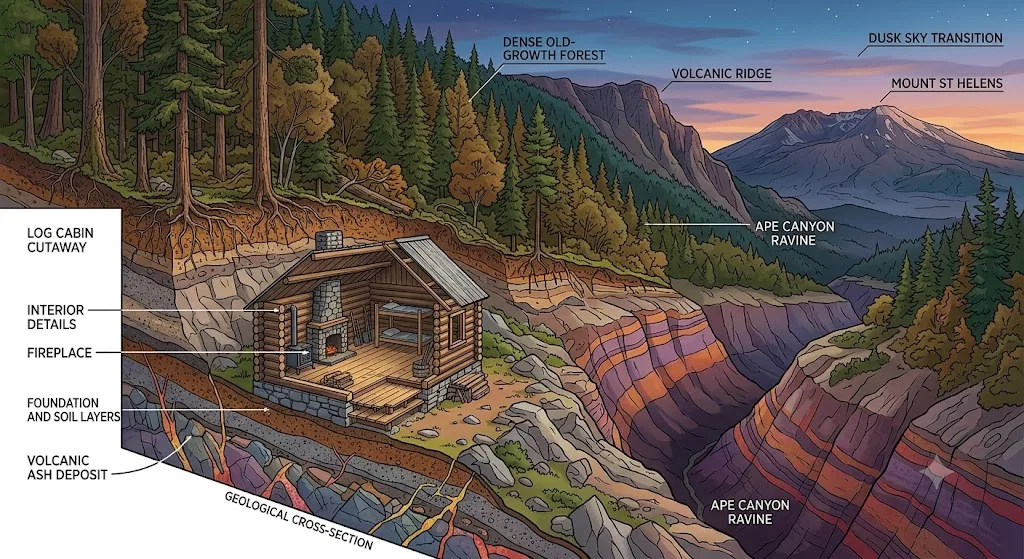
Ape Canyon is the Mount St Helens ravine that helped turn Washington into Bigfoot country. In July 1924, five prospectors near the volcano claimed that large, hairy, ape-like beings had harassed them, thrown rocks at their cabin, and left oversized tracks. The episode became a newspaper sensation, attracted a Forest Service investigation, and later settled into Sasquatch folklore as one of the classic “Bigfoot attack” stories. Yet the case is also famous because its evidence is weak: investigators found no body, no convincing physical proof, and later sceptical accounts tied the story to pranksters and hoaxed footprints.[wa.gov]sos.wa.govDEVIL! G THE 1924 APE CANYON ATTACK & ITS AFTERMATH pes Declared 10… CANYON RE-ENACTMENT IN "SASQUATCH, LEGEND OF. BIGFOOT" ON KPTV, C…
That tension is why Ape Canyon still matters. It is not a clean proof-of-creature case. It is a case study in how a remote Washington landscape, a dramatic witness claim, press excitement, local humour, and later Bigfoot culture combined to make one volcanic canyon feel haunted by something larger than the evidence itself.
The 1924 cabin attack claim
The standard Ape Canyon story begins with a small group of miners prospecting on or near the south-eastern shoulder of Mount St Helens, close to what was then remote forest and volcanic terrain. The men most often named in later accounts include Fred Beck, who decades afterwards published a short account of the incident, I Fought the Apemen of Mt. St. Helens. In that version, the group had already noticed large tracks, heard odd whistles and thumping sounds, and felt watched before the confrontation escalated.[Believer]believerpodcast.combonus i fought the apemenBelieverBonus Episode: Fred Beck's 1924 Sasquatch EncounterFred Beck, later wrote a book recounting his version of the story. The book is…
According to the miners’ account, the decisive moment came when one of the men fired at a large, hairy figure seen near a canyon. The creature was said to have fallen or disappeared into the ravine. That night, the story goes, the cabin was pelted with stones by several “ape men” or “mountain devils”, while the men inside fired their guns and waited for morning. The tale was unusually active for an early Bigfoot-type report: not just a sighting, but a siege, with gunfire, thrown rocks, footprints and a frightened retreat from the claim site.[The Columbia County Historian Home Page]twrps.comOpen source on twrps.com.
The names used in the early story matter. “Bigfoot” was not yet the familiar national label it would become after the late-1950s California footprint publicity. Newspapers and retellings used terms such as “mountain devils”, “ape men” and “gorilla men”, giving the story a pulp-adventure flavour rather than the later, more standardised Sasquatch vocabulary. That makes Ape Canyon a bridge between older “wild man” and “hairy giant” tales and the modern Bigfoot tradition.[Wikipedia]WikipediaOpen source on wikipedia.org.
What makes the claim memorable is also what makes it difficult to assess. The story is dramatic, internally vivid and tied to real people and a real place. But it rests almost entirely on testimony, newspaper retelling and later memoir. The reported physical clues — tracks, rocks, possible cabin damage and the alleged creature shot into the canyon — did not produce a specimen, a body, clear photographs or evidence that mainstream science could evaluate.

Why this canyon became the stage
Ape Canyon is not just a spooky name on a map. The modern trail lies in the Gifford Pinchot National Forest on the Mount St Helens landscape, where the U.S. Forest Service describes Ape Canyon Trail #234 as a popular route for hikers and mountain bikers. The trailhead is reached from the Cougar, Washington side via Forest Service roads near Lava Canyon, placing the legend within the south and south-eastern recreation zone of the volcano rather than in an abstract “deep woods” nowhere.[US Forest Service]fs.usda.govUS Forest ServiceGifford Pinchot National Forest | Trail #234 Ape CanyonApe Canyon Trail #234 is a popular trail for both hikers and moun…
The physical setting helps explain why the story stuck. Mount St Helens offers steep ravines, volcanic debris, old-growth remnants, rough access roads and sudden changes in visibility. Washington Trails Association describes the Ape Canyon hike as climbing through dense old-growth forest towards a more open volcanic plateau with views towards other Cascade peaks. That movement from enclosed forest to exposed volcanic ground suits the legend perfectly: it feels like a place where a witness could be startled, disoriented or persuaded that something was moving just beyond clear sight.[Washington Trails Association]wta.orgOpen source on wta.org.
The place-name itself appears to have been shaped by the story. A Washington State Library-hosted zine by researcher Marc Myrsell notes that before the 1924 incident the canyon was known by names such as 1000 Foot Canyon or Jump Off Canyon, and that the later “Ape Canyon” label followed the fame of the attack story.[WA Secretary of State]sos.wa.govDEVIL! G THE 1924 APE CANYON ATTACK & ITS AFTERMATH pes Declared 10… CANYON RE-ENACTMENT IN "SASQUATCH, LEGEND OF. BIGFOOT" ON KPTV, C…
That matters for Washington cryptid history because the landscape and the legend reinforced each other. A frightening story gave the canyon its enduring public identity; the named canyon then made the story feel more official, more local and more visitable. In folklore terms, the map became part of the evidence, even though a place-name is not proof that the event happened as described.
Newspaper drama and sceptical doubts
The Ape Canyon claim spread because newspapers knew exactly what to do with it. Period coverage presented the returning miners as men shaken by strange, hairy beings near Mount St Helens, and later summaries preserve the way the story travelled through local and regional papers. The Columbia County Historian’s reprint of a 1924 Rainier Review item, for example, frames the report as a sensation that had Kelso, south-west Washington and nearby Oregon “agog” over its truth or falsity.[The Columbia County Historian Home Page]twrps.comOpen source on twrps.com.
The press made the creatures theatrical. “Mountain devils” sounded older and more frightening than an unidentified animal. “Ape men” made the story easy to picture. The miners’ remote cabin made it feel like a frontier survival tale, even though by the 1920s the newspaper machine could rapidly turn a local report into a regional entertainment. That mixture of isolation and mass publicity is one reason the case became foundational: it felt like a wilderness secret bursting into modern print culture.
Sceptical doubts arrived early. Accounts of the Forest Service follow-up say rangers J. H. Huffman and William Welch investigated and found no convincing evidence of a creature attack. Later summaries report that they regarded the tracks as easy to fake and the story as likely fabricated or exaggerated.[Wikipedia]WikipediaApe CanyonApe Canyon
The sceptical case has several parts:
- No body or biological remains. If a creature was shot and fell into the canyon, no carcass or remains were recovered.
- Questionable tracks. Oversized footprints have always been a vulnerable form of Bigfoot evidence because they can be carved, stamped or misread.
- Limited cabin evidence. Reports of rocks and disturbance did not establish that unknown animals, rather than people, caused the event.
- A story shaped by publicity. The language of “ape men” and “mountain devils” grew in a newspaper environment that rewarded drama.
None of this proves that every witness was lying. It does mean the Ape Canyon case is much stronger as folklore history than as zoological evidence. It shows how a claim can be sincere, exaggerated, misunderstood, hoaxed, or some combination of those things — and still become culturally powerful.

The hoax problem
The most damaging later claim came from Rant Mullens, a retired Toledo logger, who was reported in 1982 to have said he helped create Bigfoot-related legends around Mount St Helens. A 2007 Chronicle retrospective says Mullens claimed that he and others had played tricks in the region, and later Bigfoot-history discussions connect him with the Ape Canyon hoax tradition and with carved wooden feet used to make false tracks.[Chronicle]chronline.comtoledo retiree admits bigfoot hoax in 1982,212478ChronicleToledo Retiree Admits Bigfoot Hoax in 198211 Apr 2007 — This week in 1982, a retired Toledo logger said he helped create the leg…
This is not a neat courtroom ending. Mullens’ claim came decades after the 1924 event, and late confessions to famous folklore episodes can themselves become part of the legend. Still, the hoax explanation fits several awkward features of the case: thrown rocks, ambiguous tracks, no recovered animal and a local culture in which practical jokes, logging-camp stories and monster rumours could overlap.
The wider Bigfoot record makes the hoax issue harder to ignore. Sceptical writers have repeatedly pointed out that famous footprint traditions include known fakes, carved feet and publicity stunts. Joe Nickell’s Skeptical Inquirer account of Bigfoot mythmaking treats hoaxing as one of the recurring engines of the legend, while later discussions of Washington and California Bigfoot history often link wooden feet, prank tracks and local showmanship into the creature’s modern rise.[Skeptical Inquirer]skepticalinquirer.orgOpen source on skepticalinquirer.org.
For Ape Canyon, the fairest conclusion is cautious rather than triumphant. The case has not been proven as an unknown animal encounter. It has plausible hoax explanations. It also has enough conflicting retellings, later embellishment and fragmentary early reporting that any confident “case closed” version should be handled carefully. The strongest evidence is not for Bigfoot; it is for the story’s ability to survive each debunking by becoming a better story.
How Fred Beck changed the legend
Fred Beck’s later account helped move Ape Canyon from newspaper oddity into Bigfoot canon. His short 1967 booklet, usually known as I Fought the Apemen of Mt. St. Helens, retold the 1924 incident in the voice of a participant, giving later enthusiasts a witness-centred version to quote and circulate. Book listings and transcript sources describe it as a brief pamphlet rather than a conventional full-length memoir, but its influence has been much larger than its size.[Goodreads]goodreads.com31368211 i fought the apemen of mt st helens31368211 i fought the apemen of mt st helens
Beck’s version added texture that later Bigfoot readers recognise instantly: strange whistles, large footprints, wood-knocking-like sounds, repeated unease before the main encounter, and multiple hairy beings rather than a single monster. Modern listeners may notice how closely these details resemble later Sasquatch motifs, but that similarity cuts both ways. Believers can see it as consistency across time; sceptics can see later Bigfoot culture reading its favourite patterns back into an older tale.[Believer]believerpodcast.combonus i fought the apemenBelieverBonus Episode: Fred Beck's 1924 Sasquatch EncounterFred Beck, later wrote a book recounting his version of the story. The book is…
The booklet also helped detach the story from its original newspaper moment. Instead of being only a 1924 “ape men” scare near Kelso and Mount St Helens, Ape Canyon became part of a longer witness tradition. The miners were no longer merely characters in a sensational headline; they became early participants in what later readers understood as the Sasquatch mystery.
That shift matters because Washington’s Bigfoot identity is built from repetition. One sighting can be dismissed. A named canyon, a famous attack, a participant memoir, later hikes, documentaries, local articles and anniversary coverage create a case family. Ape Canyon became less a single night and more a recurring way to imagine Mount St Helens: wild, volcanic, forested and never quite emptied of the thing people said was there.

Mount St Helens after the legend
Mount St Helens became globally famous for a very different reason on 18 May 1980, when the volcano erupted catastrophically. The U.S. Geological Survey describes the eruption as a hugely destructive event involving debris avalanche, lateral blast and mudflows, while NASA notes that the north flank collapse produced the largest landslide in recorded history.[U.S. Geological Survey Publications]pubs.usgs.govOpen source on usgs.gov.
The eruption did not erase the Ape Canyon story; it gave it a changed landscape. The modern Mount St Helens visitor encounters a place shaped by geology, recovery ecology, Forest Service access, trail culture and disaster memory. The U.S. Forest Service now presents the south side of the mountain as an area of lava flows, forests and year-round recreation, with Ape Canyon Trail part of that public landscape.[US Forest Service]fs.usda.govmount st helens national volcanic monument surrounding areamount st helens national volcanic monument surrounding area
This afterlife changes how the legend feels. In 1924, the story was a frightening report from a remote mining camp. Today, it is also a trail story. Hikers and mountain bikers can move through a landscape where official recreation information, volcanic science and Bigfoot folklore sit side by side. The canyon’s “ape” identity is now part of the region’s texture, even for visitors who treat the monster claim as a campfire tale rather than a credible animal report.
Nearby names add to the effect. Ape Cave, south of Mount St Helens, is a lava tube whose name is usually linked to the St Helens Apes, a local group associated with early exploration of the cave, with some accounts noting possible links to “brush apes” or regional Bigfoot lore. The cave is not evidence for the 1924 cabin attack, but together Ape Canyon and Ape Cave show how the “ape” label became attached to the Mount St Helens recreation landscape.[Visit Mt St Helens]visitmtsthelens.comOpen source on visitmtsthelens.com.
Did Ape Canyon create Washington’s Bigfoot legend?
Ape Canyon did not create every part of Washington’s Bigfoot tradition. Stories of hairy wild beings, giant tracks and forest presences predate the 1924 newspaper episode, and the word “Sasquatch” has its own Pacific Northwest history. But Ape Canyon gave Washington one of its most dramatic early Bigfoot-style set pieces: named witnesses, a remote Mount St Helens cabin, alleged tracks, gunfire, rock-throwing creatures, official scepticism and a place-name that carried the story forward.[Wikipedia]WikipediaOpen source on wikipedia.org.
Its importance is historical rather than biological. As evidence for an undiscovered primate, the case is poor: no specimen, no verified remains, no secure tracks, and serious hoax allegations. As folklore, however, it is remarkably strong. It explains how Washington’s forests became a stage on which people could project fear, humour, frontier adventure, Indigenous-adjacent misunderstandings, newspaper spectacle and later cryptid enthusiasm.
The most useful way to read Ape Canyon is not “proof or nonsense” but “legend under pressure”. The claim is vivid enough to endure, weak enough to doubt, local enough to visit, and flexible enough to be retold in each new Bigfoot era. That is why, a century later, Ape Canyon remains Washington’s defining Mount St Helens Bigfoot story: not because it settled the Sasquatch question, but because it helped teach the Pacific Northwest what a Bigfoot story could sound like.
Amazon book picks
Further Reading
Books and field guides related to Did Ape Canyon Create Washington's Bigfoot Legend?. Use these as the next step if you want deeper reading beyond the article.
Sasquatch: Legend Meets Science
Provides the broader evidence-and-footprints context behind classic cases like Ape Canyon.
Where Bigfoot Walks
Explores the same south-west Washington landscape that frames Ape Canyon folklore.
Abominable Science!
Useful for evaluating famous but evidentially weak monster cases like Ape Canyon.
Bigfoot!
Places early dramatic Bigfoot attack stories inside the wider American Sasquatch tradition.
eBay marketplace picks
Marketplace Samples
Live-tested eBay searches with available results related to this page.


Endnotes
1.
Source: goodreads.com
Title: 31368211 i fought the apemen of mt st helens
Link:https://www.goodreads.com/en/book/show/31368211-i-fought-the-apemen-of-mt-st-helens
2.
Source: Wikipedia
Link:https://en.wikipedia.org/wiki/Bigfoot
3.
Source: Wikipedia
Title: Ape Canyon
Link:https://en.wikipedia.org/wiki/Ape_Canyon
4.
Source: science.nasa.gov
Link:https://science.nasa.gov/earth/earth-observatory/world-of-change/mt-st-helens/
5.
Source: Wikipedia
Title: 1980 eruption of Mount St. Helens
Link:https://en.wikipedia.org/wiki/1980_eruption_of_Mount_St._Helens
6.
Source: Wikipedia
Title: Mount St. Helens National Volcanic Monument
Link:https://en.wikipedia.org/wiki/Mount_St._Helens_National_Volcanic_Monument
7.
Source: sos.wa.gov
Link:https://www.sos.wa.gov/sites/default/files/2022-05/SL_MtDevilMyrsell-001.pdf
Source snippet
DEVIL! G THE 1924 APE CANYON ATTACK & ITS AFTERMATH pes Declared 10... CANYON RE-ENACTMENT IN "SASQUATCH, LEGEND OF. BIGFOOT" ON KPTV, C...
8.
Source: chronline.com
Title: toledo retiree admits bigfoot hoax in 1982,212478
Link:https://www.chronline.com/stories/toledo-retiree-admits-bigfoot-hoax-in-1982%2C212478
Source snippet
ChronicleToledo Retiree Admits Bigfoot Hoax in 198211 Apr 2007 — This week in 1982, a retired Toledo logger said he helped create the leg...
9.
Source: fs.usda.gov
Link:https://www.fs.usda.gov/r06/giffordpinchot/recreation/trails/trail-234-ape-canyon
Source snippet
US Forest ServiceGifford Pinchot National Forest | Trail #234 Ape CanyonApe Canyon Trail #234 is a popular trail for both hikers and moun...
10.
Source: believerpodcast.com
Title: bonus i fought the apemen
Link:https://believerpodcast.com/transcripts/bonus-i-fought-the-apemen
Source snippet
BelieverBonus Episode: Fred Beck's 1924 Sasquatch EncounterFred Beck, later wrote a book recounting his version of the story. The book is...
11.
Source: twrps.com
Link:https://twrps.com/history/news-from-the-past/bigfoot/
12.
Source: fs.usda.gov
Link:https://www.fs.usda.gov/r06/giffordpinchot/recreation/trailhead-ape-canyon
13.
Source: wta.org
Link:https://www.wta.org/go-hiking/hikes/ape-canyon
14.
Source: skepticalinquirer.org
Link:https://skepticalinquirer.org/2017/09/bigfoot-as-big-myth-seven-phases-of-mythmaking/
15.
Source: pubs.usgs.gov
Link:https://pubs.usgs.gov/gip/msh/impact.html
16.
Source: fs.usda.gov
Title: mount st helens national volcanic monument surrounding area
Link:https://www.fs.usda.gov/r06/giffordpinchot/recreation/mount-st-helens-national-volcanic-monument-surrounding-area
17.
Source: visitmtsthelens.com
Link:https://www.visitmtsthelens.com/mt-st-helens-ape-caves/
18.
Source: reddit.com
Title: Fred Beck
Link:https://www.reddit.com/r/bigfoot/comments/8udp04/fred_beck_i_fought_the_ape_men_of_mt_st_helens/
19.
Source: bigfootencounters.com
Link:https://www.bigfootencounters.com/classics/beck.htm
20.
Source: usgs.gov
Link:https://www.usgs.gov/volcanoes/mount-st.-helens/science/geology-and-history
21.
Source: pubs.usgs.gov
Link:https://pubs.usgs.gov/publication/pp175028
22.
Source: skepticalinquirer.org
Link:https://skepticalinquirer.org/2023/12/is-bigfoot-dead/
23.
Source: skepticalinquirer.org
Link:https://skepticalinquirer.org/2021/12/hidden-in-plain-sight-discovering-the-bigfoot-bear/
24.
Source: skepticalinquirer.org
Title: the bigfoot obsession
Link:https://skepticalinquirer.org/2017/07/the-bigfoot-obsession/
25.
Source: skepticalinquirer.org
Link:https://skepticalinquirer.org/2023/12/bigfoot-is-dead/
26.
Source: oregonhikers.org
Title: Ape Canyon Hike
Link:https://www.oregonhikers.org/field_guide/Ape_Canyon_Hike
27.
Source: usda.gov
Title: past present and future research mount st helens
Link:https://www.usda.gov/about-usda/news/blog/past-present-and-future-research-mount-st-helens
28.
Source: zoo-tycoon-movie.fandom.com
Link:https://zoo-tycoon-movie.fandom.com/wiki/Bigfoot
29.
Source: kids.kiddle.co
Title: Ape Canyon
Link:https://kids.kiddle.co/Ape_Canyon
30.
Source: hikeoftheweek.com
Title: ape canyon
Link:https://www.hikeoftheweek.com/2019/10/02/ape-canyon/
31.
Source: atlasobscura.com
Title: ape canyon
Link:https://www.atlasobscura.com/places/ape-canyon
32.
Source: dokumen.pub
Link:https://dokumen.pub/bigfoot-the-life-and-times-of-a-legend-9780226079790-9780226079806-0226079791-0226079805.html
Additional References
33.
Source: youtube.com
Link:https://www.youtube.com/watch?v=T-AUTaveatM
Source snippet
Ep. 46: Ape Canyon's Mountain Devils with Cryptozoologist Eric Altman...
34.
Source: wa100.dnr.wa.gov
Link:https://wa100.dnr.wa.gov/south-cascades/ape-cave
35.
Source: researchgate.net
Link:https://www.researchgate.net/publication/284756627_The_Pleistocene_eruptive_history_of_Mount_St_Helens_Washington_from_300000_to_12000_years_before_present
36.
Source: nwhiker.com
Link:https://www.nwhiker.com/GPNFHike33.html
37.
Source: facebook.com
Link:https://www.facebook.com/groups/997777793705334/posts/2927183700764724/
38.
Source: bigfootencounters.com
Link:https://www.bigfootencounters.com/articles/mullens.htm
39.
Source: burnsiderarebooks.com
Link:https://www.burnsiderarebooks.com/pages/books/140948691/fred-beck-everett-davenport-r-a-beck-artist/i-fought-the-apemen-of-mt-st-helens
40.
Source: picclick.co.uk
Link:https://picclick.co.uk/CRYPTID-Research-Team-Badge-Black-Big-Foot-Loch-267640151802.html
41.
Source: nationalforests.org
Link:https://www.nationalforests.org/article/exploring-mount-st-helens/
42.
Source: lewiscountytribune.com
Link:https://lewiscountytribune.com/the-true-legend-of-toledos-bigfoot.html
Topic Tree