Within Missouri Monsters
What Is Screaming in the Ozarks?
The Ozark Howler blends horned-beast imagery, eerie screams and travelling folklore into one of Missouri's strangest creature traditions.
On this page
- Horned beast, black dog or night cry
- How the legend travels across the Ozarks
- Wildlife sounds and folklore explanations
Page outline Jump by section
Introduction
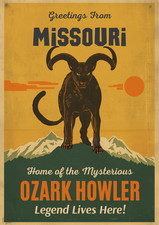
The Ozark Howler is one of Missouri’s strangest night-creature legends because it is less a neat “monster sighting” than a bundle of sounds, fears and travelling folklore. In its usual form, the Howler is a dark, shaggy animal said to roam the Ozarks of southern Missouri and northern Arkansas, sometimes as large as a bear, sometimes cat-like, sometimes horned, and almost always known by a cry that witnesses compare to a wolf’s howl, an elk’s bugle, a woman’s scream or something half-human.[Unlock The Ozarks]unlocktheozarks.orgOpen source on unlocktheozarks.org.
That uncertainty is the point. Unlike Mo Mo, Missouri’s 1972 Bigfoot-style flap, the Howler does not rest on one famous dated encounter. It lives in repeated retellings: hunters hearing something beyond the tree line, families passing down a warning about the woods, online accounts reshaping older black-dog and big-cat motifs, and sceptics pointing to bobcats, foxes, bears, elk and hoaxes. The best way to read the Ozark Howler is therefore not as a confirmed unknown animal, but as a Missouri-Ozarks night-sound legend: a story about what people hear when familiar woodland noises become unfamiliar in the dark.
Horned beast, black dog or night cry?
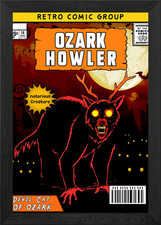
The Howler’s body changes from telling to telling. Some versions describe a bear-sized animal with a thick body, stocky legs, black shaggy hair and prominent horns; others lean towards a huge cougar-like beast, a wolf-goat-cat hybrid or a black “devil cat”.[Unlock The Ozarks]unlocktheozarks.orgOpen source on unlocktheozarks.org. This instability matters. A creature with horns, cat features, bear size and a wolf-like voice is not a straightforward zoological claim. It is a composite image, built from recognisable threats and old symbolic animals.
The horned version gives the Howler a demonic or fairy-tale look, making it feel less like a misidentified bear and more like a warning figure. The black-dog version links it to a wider English-language tradition of spectral hounds and death omens, which later writers have compared with stories carried by settlers into the Ozarks. Unlock the Ozarks, for example, draws a line between Howler stories and old British and Celtic hound traditions in which a terrifying baying animal appears as a supernatural warning.[Unlock The Ozarks]unlocktheozarks.orgOpen source on unlocktheozarks.org. That does not prove a direct origin, but it does explain why the Howler so often feels like more than wildlife.
The cat-like version is more practical. Missouri and Arkansas residents do sometimes report large, dark cats, and “black panther” stories are common across the rural South and Midwest. The Howler folds neatly into that tradition: a fleeting animal shape, glowing eyes, a scream in the woods, and a witness who knows it was not an ordinary dog. Yet Missouri wildlife guidance urges caution. Mountain lions do make a loud screaming call known as a caterwaul, but the Missouri Department of Conservation notes that mountain lions rarely vocalise and that many scream-like noises heard in woods are more often bobcats or foxes.[Missouri Department of Conservation]mdc.mo.govOpen source on mo.gov.
That is why the sound is more stable than the shape. Many Howler accounts keep returning to a cry that is “deep and guttural”, “high-pitched”, “half-human” or like a woman screaming.[Unlock The Ozarks]unlocktheozarks.orgOpen source on unlocktheozarks.org. A night noise can travel through a valley, bounce from bluffs, lose its source and become harder to place. In a region of hollows, timber, caves, pasture edges and river country, the ear often gets the story before the eye does.

How the legend travels across the Ozarks
The Howler is associated with the Ozarks rather than with one Missouri town. That makes it different from a local monster with a single home base. The Ozarks are a cross-border upland region, and modern Howler writing routinely places the creature across southern Missouri, northern Arkansas and sometimes into Oklahoma and Texas.[Unlock The Ozarks]unlocktheozarks.orgOpen source on unlocktheozarks.org. For a Missouri reader, the important point is that the legend belongs to the same cultural and ecological zone as the state’s southern hills, not to a tidy county boundary.
Missouri’s share of that setting is well suited to a sound-based legend. The Missouri Department of Conservation describes the Ozark Highlands as the main cave-bearing ecoregion in the state, with caves formed in soluble limestone and dolomite.[Missouri Department of Conservation]mdc.mo.govOpen source on mo.gov. Caves are not evidence for the Howler, but they help explain the atmosphere of the stories: broken ground, bluffs, sinkholes, wooded slopes and places where sound can seem to come from nowhere. A scream heard across a hollow at night does not need a monster to feel monstrous.
The cultural ground is just as important. Vance Randolph, one of the best-known collectors of Ozark folklore, lived in the Missouri-Arkansas Ozarks and recorded songs, stories and beliefs passed down orally through isolated communities.[SHSMO Historic Missourians]historicmissourians.shsmo.orgHistoric Missourians Vance RandolphHistoric Missourians Vance Randolph The Howler fits that oral setting even when individual claims are modern or internet-shaped. It behaves like a tale that can be adapted to whoever is telling it: a hunter’s warning, a child’s spooky local legend, a camper’s unexplained noise, a cryptid entry, a Halloween article, or a regional identity marker.
This travelling quality also helps explain why the origin story is murky. Some retellings claim the earliest Howler story involves Daniel Boone encountering a strange creature in what is now Missouri in the early nineteenth century, but accessible modern sources usually present this as legend rather than as a documented primary account.[Only In Arkansas]onlyinark.comOnly In Arkansas Ozark HowlerOnly In Arkansas Ozark Howler That distinction is crucial. Boone gives the tale frontier flavour and Missouri anchoring, but the claim should be treated as part of the legend’s afterlife unless a strong contemporary source is produced.
The legend’s modern spread has also been shaped by television, web articles and cryptid culture. A 2015 Arkansas case shows how quickly a supposed Howler image can become part of the record even when it is weak evidence: photographs allegedly taken at Devil’s Den State Park were sent to local media, but Arkansas Game and Fish reportedly dismissed them as a hoax.[Only In Arkansas]onlyinark.comOnly In Arkansas Ozark HowlerOnly In Arkansas Ozark Howler That episode is useful not because it proves or disproves every Howler story, but because it shows the modern mechanism: a dramatic image, a familiar cryptid label, a burst of attention, then a sceptical correction.
Wildlife sounds and folklore explanations
The most useful sceptical question is not “what single animal is the Ozark Howler?” but “which ordinary animals can produce extraordinary impressions at night?” Several Missouri animals can account for pieces of the legend without matching the whole creature.
Bobcats are a strong candidate for scream reports. They are found statewide in Missouri, formerly concentrated in the Ozarks and Bootheel but now expanded northward and westward, and they favour heavy cover broken by clearings, glades and rocky outcrops.[Missouri Department of Conservation]mdc.mo.govMissouri Department of Conservation Bobcat | Missouri Department of ConservationMissouri Department of Conservation Bobcat | Missouri Department of Conservation The Missouri Department of Conservation specifically says scream-like noises in the woods are often bobcats or foxes rather than mountain lions.[Missouri Department of Conservation]mdc.mo.govOpen source on mo.gov. A bobcat does not explain horns or a bear-sized body, but it can explain a frightening, human-like cry coming from dark cover.
Mountain lions explain another part of the picture: the large-cat outline and the caterwaul. Missouri has confirmed mountain lion records from time to time, but the state’s own guidance emphasises that mountain lions rarely make noise and that their loud caterwaul is mostly associated with the winter breeding season.[Missouri Department of Conservation]mdc.mo.govOpen source on mo.gov. That makes a mountain lion possible in some specific reports, especially if there are tracks, images or a clear long-tailed cat sighting, but it is too blunt an explanation for every Howler cry.
Black bears explain the size, shaggy darkness and heavy-bodied silhouette. Bears are native to Missouri, and recent University of Missouri Extension guidance says the state’s black bear population has been gradually increasing, with bears from Arkansas dispersing northward into Ozark habitat and mixing with Missouri’s remnant population.[MU Extension]extension.missouri.eduMU Extension Ecology and Management of Black Bears in Missouri | MU ExtensionMU Extension Ecology and Management of Black Bears in Missouri | MU Extension The Department of Conservation describes black bears as one of Missouri’s largest wild mammals and notes that they are usually silent but can grunt, roar, huff, bellow, moan and make other sounds.[Missouri Department of Conservation]mdc.mo.govOpen source on mo.gov. A startled bear in poor light could become a “black beast”; a bear sound heard without a clear sighting could become something stranger.
Elk add an especially interesting sound clue. Missouri’s restored elk are found in portions of Carter, Reynolds and Shannon counties, and the Department of Conservation describes the male’s call as a screaming “bugle”, along with grunts, mews and barks.[Missouri Department of Conservation]mdc.mo.govMissouri Department of Conservation Elk | Missouri Department of ConservationMissouri Department of Conservation Elk | Missouri Department of Conservation Many Howler descriptions compare the cry to a wolf howl mixed with an elk bugle, so elk show how real Ozark soundscapes can already contain noises that feel uncanny to someone hearing them out of context.
The folklore explanation does not cancel the wildlife explanation. They work together. A fox, bobcat, bear or elk may provide the original sound; local tradition supplies the meaning; later retellings add horns, glowing eyes, death-omen associations or “devil cat” language. That is how a noise becomes a named creature.
What counts as evidence here?
The evidence for the Ozark Howler is thin if the question is “does a new animal exist?” There is no widely accepted specimen, no verified biological population, and no strong mainstream evidence for a horned, bear-sized, screaming predator in Missouri. The available record is mostly folklore, witness anecdotes, secondary retellings, contested photographs and modern media interest. Even enthusiast-oriented summaries acknowledge that the creature’s exact origin is hard to pin down and that the first sighting records are often lost, disputed or legendary.[Only In Arkansas]onlyinark.comOnly In Arkansas Ozark HowlerOnly In Arkansas Ozark Howler
The evidence is stronger if the question is “does Missouri have a meaningful Howler tradition?” Yes. The Howler is now a recognisable Ozark legend, and Missouri is part of its natural range in the cultural sense. It appears in regional folklore writing, local legend pages, cryptid discussions and travel-oriented storytelling about the Ozarks. Garden & Gun’s 2024 profile treats the Howler as a creature whose ambiguity suits the Ozarks’ borderland identity, noting reported sightings across the region and the way descriptions blur between cougar, wolf, goat and cat.[Garden & Gun]gardenandgun.comOpen source on gardenandgun.com.
A sensible credibility scale looks like this:
- Best supported: the Ozarks have a long oral storytelling culture, and the Howler is now a recognised regional night-creature legend.
- Plausible in individual cases: witnesses may have heard bobcats, foxes, elk, bears or, more rarely, mountain lions and interpreted the sound through local legend.
- Weakly supported: claims of a consistent unknown animal matching all Howler traits.
- Actively suspect: dramatic photographs or internet claims that appear suddenly, lack provenance or have already been dismissed by wildlife officials or local reporting as hoaxes.
That does not make the Howler worthless as a story. It makes it more interesting. Some cryptids are built around a body; the Howler is built around uncertainty itself.
Why the Howler belongs in Missouri monster lore
Missouri’s monster tradition often grows where real habitats meet imperfect evidence. Mo Mo belongs to a named 1972 flap near Louisiana, Missouri. Black panther stories belong to the uneasy line between real big-cat biology and persistent rural testimony. The Ozark Howler belongs to the southern hills, where a sound may be enough to start the story and where the same tale can move from family memory to local tourism to online cryptid culture.
Its Missouri significance is not that it has been proven to live in the woods. It has not. Its significance is that it captures a particular Ozark fear: the moment when the night is familiar, then suddenly not. A bobcat scream, elk bugle or bear noise can be biologically ordinary and still be emotionally extraordinary when heard from a porch, deer stand, campsite or lonely road.
That is why the Howler keeps changing shape. A fixed animal would need fixed evidence. A folklore creature only needs a recognisable pattern: dark woods, a cry no one can place, a rumour that someone’s grandfather heard it too, and a name ready to receive the next strange noise. In Missouri, the Ozark Howler is best understood as that pattern — not a confirmed beast, but a durable night-sound legend with one paw in wildlife, one paw in old black-dog folklore, and its voice echoing through the hills.
Amazon book picks
Further Reading
Books and field guides related to What Is Screaming in the Ozarks?. Use these as the next step if you want deeper reading beyond the article.
Ozark Magic and Folklore
The Howler is fundamentally an Ozark folklore creature shaped by local storytelling.
Mysterious America
Provides context for recurring regional monster legends and mystery animals.
Ozark Superstitions
Helps explain how sounds, fears, and traditions become enduring legends.
eBay marketplace picks
Marketplace Samples
Live-tested eBay searches with available results related to this page.

Endnotes
1.
Source: historicmissourians.shsmo.org
Title: Historic Missourians Vance Randolph
Link:https://historicmissourians.shsmo.org/vance-randolph/
2.
Source: extension.missouri.edu
Title: MU Extension Ecology and Management of Black Bears in Missouri | MU Extension
Link:https://extension.missouri.edu/publications/g9458
3.
Source: youtube.com
Title: The Ozark Howler | The Omen of the Ozarks
Link:https://www.youtube.com/watch?v=m3AkvhmYnsc
Source snippet
The Beast of the Ozark Shadows! | Expedition X S3 E6 | Discovery Channel...
4.
Source: youtube.com
Title: Ozark Howler Identity Revealed! | Mysterious Creatures With Forrest Galante
Link:https://www.youtube.com/watch?v=lWgyg4d7jTI
Source snippet
The Ozark Howler...
5.
Source: youtube.com
Title: The Ozark Howler
Link:https://www.youtube.com/watch?v=es1Pm7y5mqM
6.
Source: unlocktheozarks.org
Link:https://www.unlocktheozarks.org/stories/folklore-legends-and-myths/ozark-howler/
7.
Source: gardenandgun.com
Link:https://gardenandgun.com/meet-the-ozark-howler-the-souths-most-cryptic-cryptid
8.
Source: mdc.mo.gov
Link:https://mdc.mo.gov/wildlife/report-wildlife-sightings/mountain-lion-reports/mountain-lion-signs
9.
Source: mdc.mo.gov
Link:https://mdc.mo.gov/discover-nature/habitats/caves-karst
10.
Source: onlyinark.com
Title: Only In Arkansas Ozark Howler
Link:https://onlyinark.com/culture/ozark-howler/
11.
Source: mdc.mo.gov
Title: Missouri Department of Conservation Bobcat | Missouri Department of Conservation
Link:https://mdc.mo.gov/discover-nature/field-guide/bobcat
12.
Source: mdc.mo.gov
Link:https://mdc.mo.gov/discover-nature/field-guide/american-black-bear
13.
Source: mdc.mo.gov
Title: Missouri Department of Conservation Elk | Missouri Department of Conservation
Link:https://mdc.mo.gov/discover-nature/field-guide/elk
14.
Source: facebook.com
Link:https://www.facebook.com/FOX2Now/posts/the-missouri-department-of-conservation-is-offering-a-rare-glimpse-into-the-wint/1504634314586527/
15.
Source: mdc.mo.gov
Title: sounds fall
Link:https://mdc.mo.gov/blogs/discover-nature-notes/sounds-fall
16.
Source: mdc.mo.gov
Title: something bugle about
Link:https://mdc.mo.gov/magazines/xplor/2011-02/something-bugle-about
17.
Source: mdc.mo.gov
Title: missouri caves
Link:https://mdc.mo.gov/magazines/missouri-conservationist/2023-03/missouri-caves
18.
Source: mdc.mo.gov
Title: govcaves and karst
Link:https://mdc.mo.gov/sites/default/files/2026-06/Conserving-MO-Caves-Karst.pdf
19.
Source: Wikipedia
Title: Ozark Howler
Link:https://en.wikipedia.org/wiki/Ozark_Howler
20.
Source: cryptidz.fandom.com
Title: Ozark Howler
Link:https://cryptidz.fandom.com/wiki/Ozark_Howler
21.
Source: itsmth.fandom.com
Title: Ozark Howler
Link:https://itsmth.fandom.com/wiki/Ozark_Howler
22.
Source: missourihistorymoments.com
Title: The Ozark Howler
Link:https://www.missourihistorymoments.com/featured-article/the-ozark-howler-legend-of-the-ozark-howler-continues-to-echo-through-the-hills-of-missouri
23.
Source: legendsofwindemere.com
Title: the ozark howler
Link:https://legendsofwindemere.com/2024/10/04/the-ozark-howler/
24.
Source: libraries.uark.edu
Link:https://libraries.uark.edu/specialcollections/research/guides/folklore/randolph.php
25.
Source: exploresouthernhistory.com
Title: The Ozark Howler
Link:https://www.exploresouthernhistory.com/ozarkhowler.html
Additional References
26.
Source: youtube.com
Title: The UNSETTLING Cry of the Ozark Howler
Link:https://www.youtube.com/watch?v=OMTP4ZRz7qk
Source snippet
Ozark Howler Identity Revealed! | Mysterious Creatures With Forrest Galante...
27.
Source: facebook.com
Link:https://www.facebook.com/ksdktv/videos/black-bears-on-the-move-in-missouri/1626047268354018/
28.
Source: facebook.com
Link:https://www.facebook.com/groups/342207959638340/posts/1158749747984153/
29.
Source: facebook.com
Link:https://www.facebook.com/moconservation/posts/bobcats-heres-an-animal-few-people-see-and-yet-theyre-more-common-in-missouri-th/10159679797662962/
30.
Source: reddit.com
Link:https://www.reddit.com/r/missouri/comments/1s625wn/black_bear_mom_den_check_in_the_ozarks/
31.
Source: facebook.com
Link:https://www.facebook.com/groups/telecomarchaeology/posts/3334622463497560/
32.
Source: facebook.com
Link:https://www.facebook.com/moconservation/videos/discover-elk-in-the-ozarks/186188922314029/
33.
Source: howlergourmetproducts.com
Link:https://www.howlergourmetproducts.com/discover-the-legend
34.
Source: mospeleo.org
Link:https://www.mospeleo.org/educational-resources/
35.
Source: facebook.com
Link:https://www.facebook.com/TheFolklorePodcast/posts/emerging-from-the-folklore-of-arkansas-the-ozark-howler-is-a-legendary-bear-like/1424341476373435/
Topic Tree