Within Massachusetts Monsters
When Real Animals Become Massachusetts Monsters
Bears, bobcats, coyotes, fishers, owls and water animals help explain why ordinary sightings can become monster encounters.
On this page
- Forest animals and roadside sightings
- Birds, water animals and sea serpent effects
- Why dusk, fog and headlights change perception
Page outline Jump by section
Introduction
Many Massachusetts monster reports begin with a real animal seen badly: a bear crossing a road at dusk, a bobcat mistaken for a larger cat, a fisher turned into a sinister night-creature, an owl caught in headlights, or a marine animal reshaped by waves and distance. That does not make the stories worthless. It explains why Massachusetts is such fertile monster country: the state has forests, wetlands, harbours, dunes, suburban edges and old rural roads where ordinary wildlife can appear briefly unfamiliar.
The key point is not that every strange report has a neat answer. Some accounts are too vague, too old or too culturally transformed to identify with confidence. But the best sceptical explanations usually do not require an invented beast. They rely on known Massachusetts wildlife, poor viewing conditions, excited retelling, and the human habit of turning a fleeting animal encounter into a creature story. MassWildlife’s own pages show why this happens: black bears are expanding eastward, bobcats are the state’s only established wild cat, coyotes and fishers are widespread, and mountain-lion reports often arrive without confirmable evidence.[mass.gov]mass.govachusetts GovernmentLearn about black bearsThe statewide population of bears is estimated to be over 4,500 animals and is growing and…
Forest animals and roadside sightings
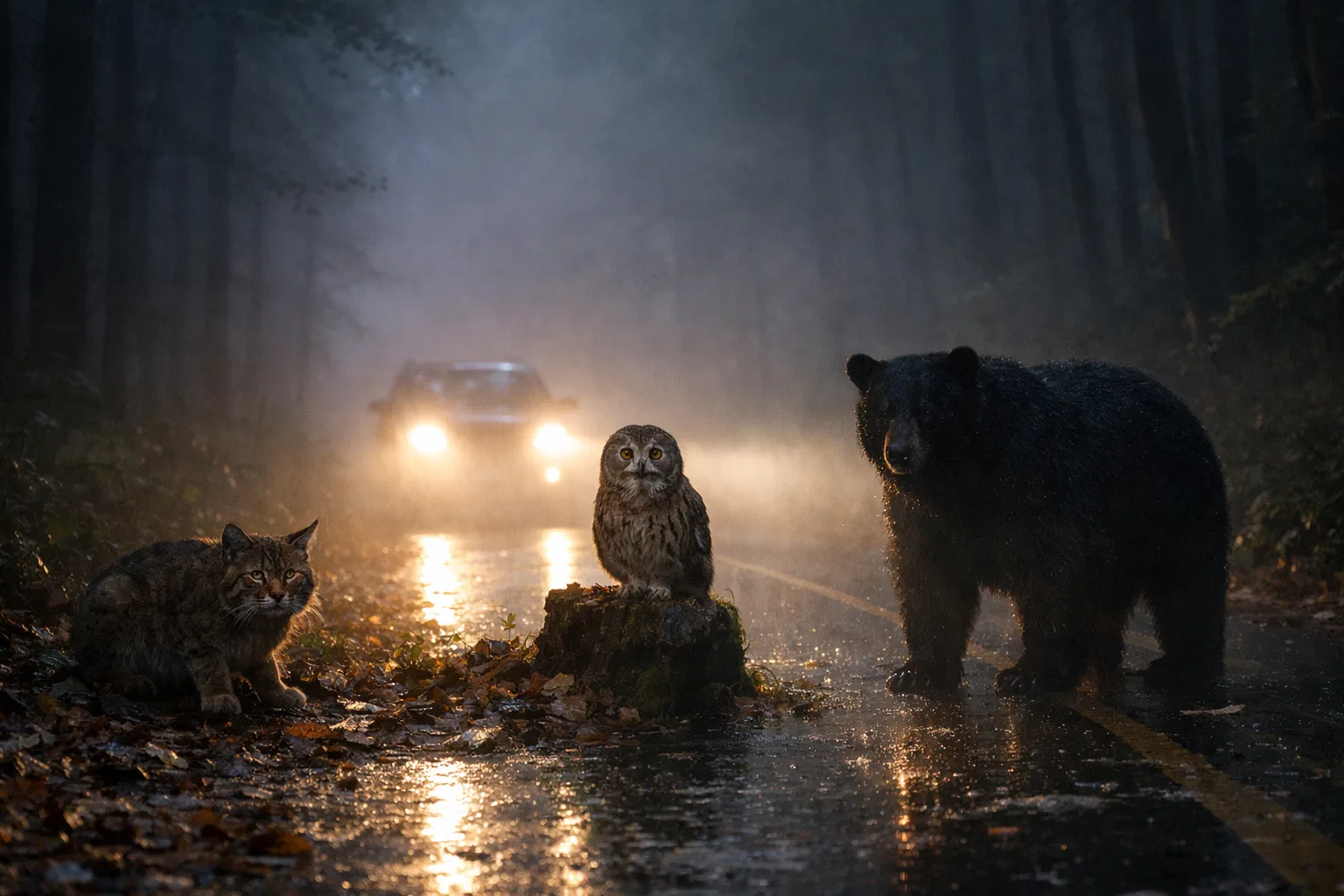
A surprising number of “monster” sightings are not deep-wilderness events. They happen from cars, garden edges, campsites, woodland roads and suburban backyards. That matters because roadside sightings are often short, angled and emotionally loaded: the animal appears suddenly, the observer is moving, headlights flatten colour and shape, and the mind has only a few seconds to decide what it saw.
Massachusetts is especially good at producing this kind of uncertainty because real predators and large mammals now overlap with developed landscapes. Black bears are common in western and central Massachusetts and are expanding eastward; MassWildlife estimates the statewide population at more than 4,500 animals.[Massachusetts Government]mass.govachusetts GovernmentLearn about black bearsThe statewide population of bears is estimated to be over 4,500 animals and is growing and… A bear seen briefly on two legs, half-hidden by brush, or crossing a road in poor light can read as something far stranger than a familiar mammal. This is one reason Bigfoot-style reports in wooded parts of New England often invite bear explanations: a black bear’s bulk, dark coat, and ability to stand or move awkwardly upright for short moments can create a “hairy humanoid” impression without requiring an unknown primate.
Bobcats produce a different kind of confusion. MassWildlife says the bobcat is the only wild cat currently found in Massachusetts, common in central and western parts of the state, present in the northeast, and expanding into other areas.[Strange & Twisted]strangeandtwisted.comthe dover demon unmasking massachusetts most terrifying legendStrange & TwistedDover Demon: The Mysterious Creature of Massachusetts24 Oct 2025 — Theories range from it being an alien-like creature… Yet residents still report larger cats, especially “panthers” or mountain lions. This is where Massachusetts’ phantom-cat folklore meets a real identification problem. A bobcat glimpsed at distance can seem larger than it is; its tail may not be seen clearly; and a moving animal in grass, brush or headlights can be mentally enlarged after the fact.
Mountain-lion reports show the tension between witness confidence and physical evidence. MassWildlife says it receives dozens of mountain-lion reports a year, but most are sightings without evidence that can be investigated or confirmed.[Massachusetts Government]mass.govOpen source on mass.gov. Its “distinguishing fiction from facts” material notes that observers are often adamant they can tell a mountain lion from a bobcat, yet photographs submitted as proof have turned out to show other animals.[Massachusetts Government]mass.govOpen source on mass.gov. That does not mean a lone transient cougar could never pass through southern New England, but it does mean that most Massachusetts “big cat” claims sit in the gap between strong personal certainty and weak physical confirmation.
Coyotes add another layer. The eastern coyote can look surprisingly wolf-like to people expecting a lean western coyote, and town wildlife pages commonly describe it as medium-dog-sized with a bushy, black-tipped tail.[westfordma.gov]westfordma.govOpen source on westfordma.gov. A coyote slipping through a cemetery, cranberry bog edge or woodlot at night may become a “wolf”, “hellhound” or unnamed dark animal in retelling. This matters for Massachusetts because the state’s monster geography is often suburban-rural rather than remote wilderness. A strange animal does not have to be in the deep Berkshires to become a story; it only has to appear where people are not expecting it.
Fishers are perhaps the most folklore-ready of the ordinary animals. MassWildlife calls fishers one of Massachusetts’ most misunderstood creatures and notes the common nickname “fisher cat”, even though fishers are not cats.[Massachusetts Government]mass.govfishers fact vs fictionfishers fact vs fiction They are dark, long-bodied, secretive and fast, with a weasel-like shape many people rarely see well. That makes them excellent candidates for reports of low, black, unnatural-looking animals moving through yards, stone walls and woodland margins. Their reputation is also inflated by sound folklore: the famous “fisher scream” is often repeated as a fact, but wildlife educators and naturalists frequently point instead to foxes, bobcats, owls or other night sounds as more likely sources.[Center for Humans & Nature]humansandnature.orgCenter for Humans & Nature The Fisher's ScreamCenter for Humans & Nature The Fisher's Scream
Birds, water animals and sea-serpent effects
Massachusetts monster reports are not only about mammals on roads. The state’s strongest historic creature tradition is maritime, and the same misidentification problem applies offshore. A large animal seen from a boat or shoreline is distorted by waves, scale, glare, distance and expectation. A seal’s head, a line of swimming birds, a sturgeon-like fish, a basking shark, a whale back, floating debris or a decomposing carcass can all become more serpentine when the observer is primed for a sea monster.
The Gloucester sea serpent is the classic Massachusetts example. In 1817, reports from Cape Ann became so prominent that the Linnaean Society of New England investigated and classified the supposed animal as a new species, Scoliophis atlanticus.[Massachusetts Historical Society]masshist.orgit appeared so strange and wonderfulit appeared so strange and wonderful That history is important because it shows that “misidentification” is not just a modern debunking reflex. The Gloucester case came from a period when natural history, newspaper sensation and genuine uncertainty overlapped. People were not necessarily lying; they were trying to interpret something dramatic with the tools and expectations available to them.
Sea-serpent effects often come from ordinary marine perception. The Library of Congress notes that nineteenth-century sea-serpent interest grew in a world where legend and science were colliding, and it specifically points out that basking sharks are among the animals regularly mistaken for sea serpents or sea monsters.[The Library of Congress]blogs.loc.govgreat american sea serpentgreat american sea serpent Basking sharks are not a perfect explanation for every Gloucester report, but they illustrate the mechanism: a large animal with a strange surface profile can be read as a long, single creature. A series of humps may be one animal, several animals, waves passing over a back, or a moving line of birds.
Carcasses create another route from wildlife to monster. Once a shark, whale, seal or large fish decomposes, loses soft tissue, or is damaged by scavengers, its familiar anatomy can vanish. A Harvard Crimson report from 1970 described a supposed sea-serpent carcass identified as a mangled basking shark by New England Aquarium staff, showing how a real marine animal can look monstrous after death.[The Harvard Crimson]thecrimson.comsea serpent exposed as sunning shark pcecilsea serpent exposed as sunning shark pcecil This is directly relevant to coastal Massachusetts folklore because beaches and harbours do not only produce sightings of living animals; they also produce washed-up remains that invite dramatic naming before experts inspect them.
Birds can be just as misleading inland. Mass Audubon lists eight owl species that may be spotted in Massachusetts, across habitats including forests, swamps, marshes and residential neighbourhoods.[Mass Audubon]massaudubon.orgOpen source on massaudubon.org. Owls matter because many monster reports emphasise glowing eyes, silent movement, sudden flight, pale bodies or strange calls. A barred owl or great horned owl seen from below, caught in headlights, or heard calling at night can feel far larger and more uncanny than it is. Large owls do not explain every winged-creature story, but they are among the first animals to consider when a report involves night, trees, eye-shine and a brief glimpse.
This is especially useful when thinking about the Dover Demon, although that case sits partly outside simple wildlife identification. The 1977 Dover reports describe a small, pale, odd-bodied creature seen by teenage witnesses over two nights. Later sceptical suggestions have included a foal, a young moose, and a snowy owl; the owl proposal tries to explain the apparent glowing eyes, pale colour and strange limbs as headlight reflections and wing shapes.[Wikipedia]WikipediaDover DemonDover Demon None of those explanations is universally accepted, and the case remains famous partly because it is so brief and visually strange. But it still demonstrates the same Massachusetts mechanism: an animal-like encounter becomes more durable when it happens at night, involves young witnesses, and leaves behind vivid drawings rather than physical evidence.
Why dusk, fog and headlights change perception
Monster reports often begin in the least reliable conditions for identification. Dusk, fog, rain, snow, glare, headlights and partial cover remove the details that usually let people recognise animals: tail length, ear shape, gait, proportions, colour boundaries and scale. What remains is a silhouette and a feeling.
Research on eyewitness perception is mostly conducted in legal rather than wildlife settings, but the basic lesson transfers carefully: distance, lighting and viewing conditions reduce accuracy. A study on eyewitness distance found that increased distance reduces identification accuracy, and broader National Academies work on eyewitness identification emphasises that accurate recognition depends on the limits of sensation, perception and memory.[PubMed]pubmed.ncbi.nlm.nih.govOpen source on nih.gov. A roadside animal seen for three seconds is not the same as a suspect in a line-up, but both situations show how confident memory can grow from incomplete perception.
Headlights add their own weirdness. Many nocturnal animals have a reflective layer in the eye, the tapetum lucidum, which produces eye-shine when illuminated by a torch or car lights.[Cool Green Science]blog.nature.orgCool Green Science Why Do Some Animals' Eyes Glow in the Dark?Cool Green Science Why Do Some Animals' Eyes Glow in the Dark? That simple biological fact explains one of the most common monster details: “glowing eyes”. In folklore, glowing eyes feel supernatural. In wildlife biology, they are often a normal result of light hitting a nocturnal or crepuscular animal at the right angle.
Scale is another trap. In open daylight, a bobcat is clearly not a cougar and a coyote is clearly not a wolf. At night, across a field or through trees, scale has to be inferred from nearby objects. If there is no fence, person, car or building beside the animal, the mind guesses. Fear, surprise and later retelling can enlarge the animal. This is one reason photographs, tracks, scat, hair and trail-camera footage matter so much in wildlife investigations: they give experts something more stable than a memory.
The Massachusetts landscape also encourages partial sightings. Stone walls, wetland edges, cranberry bogs, dune grass, wooded roads and suburban tree lines break animals into fragments. A witness may see a head and shoulders, then a tail, then movement through brush. The brain joins those fragments into one imagined whole. That whole may be mostly accurate, or it may become a creature assembled from panic, expectation and missing information.
How ordinary animals become local monsters
Misidentification is not a boring explanation. In Massachusetts monster lore, it is often the engine that turns a wildlife encounter into a tradition. The process usually has four stages.
First comes the sighting. Someone sees or hears something that does not immediately fit their mental catalogue: a fisher crossing a garden wall, a bear at the edge of a road, an owl dropping through the trees, a seal head offshore, a coyote moving through fog.
Second comes the label. The observer reaches for the nearest dramatic category: big cat, wolf, Bigfoot, sea serpent, demon, swamp creature. The label may be cautious at first — “I don’t know what it was” — but friends, newspapers, podcasts and local folklore often sharpen it into something more memorable.
Third comes repetition. Other people remember similar moments, or reinterpret past sightings through the new label. This is how a town can acquire a “thing” without ever producing a body, clear photograph or trackway. The creature becomes a shared explanation for ambiguous animal encounters.
Fourth comes cultural survival. The story may remain a local warning, become a Halloween feature, appear in cryptid lists, or attach itself to a place already rich in mystery, such as Cape Ann, Cape Cod, the Berkshires or Hockomock Swamp country. At that point, the original animal — if there was one — matters less than the story’s usefulness. It gives a landscape a mood.
This does not mean every witness is careless. Many reports come from sincere people who know local wildlife reasonably well. The problem is that unusual angle, distance, light and surprise can make even familiar animals look wrong. MassWildlife’s mountain-lion guidance is a useful model: it does not mock reports, but it asks for evidence that can be checked, because even confident identifications can fail.[Massachusetts Government]mass.govOpen source on mass.gov.
Reading Massachusetts monster reports with better questions
The most useful question is not “Was it real or fake?” A better question is: “What real animal, viewing condition or local story could have shaped this report?” That keeps the strange story intact while giving the reader tools to think clearly.
For a Massachusetts land-animal report, the strongest first checks are:
- Where was it? A Berkshire forest road, a Worcester County backyard, a Cape Cod dune path and a Boston suburb do not have the same wildlife likelihoods.
- When was it seen? Dawn, dusk and night increase the odds of coyotes, foxes, bobcats, fishers, owls and bears being misread.
- How long did the sighting last? A three-second glimpse from a moving car is very different from a clear, stationary view.
- Was there physical evidence? Tracks, scat, hair, a clear photograph or trail-camera footage can change a story from anecdote to evidence.
- Could size have been misjudged? Without a reference object, people commonly overestimate animals seen in fear or surprise.
- Does the description mix animal features? A cat-like body with a dog-like gait, glowing eyes, huge size and no clear tail may indicate a memory assembled from partial cues.
For coastal and water reports, the checks change. A “serpent” shape may be a line of animals, a wave pattern, a basking shark, a seal, a whale, a large fish, floating gear or a decomposing carcass. The Gloucester tradition is powerful because it shows how seriously earlier observers took such reports, but it also shows how quickly natural history can become folklore when the animal is distant, moving and hard to examine.[Massachusetts Historical Society]masshist.orgit appeared so strange and wonderfulit appeared so strange and wonderful
The point is not to drain Massachusetts monster lore of wonder. It is to put the wonder in the right place. The state’s cryptid stories are fascinating partly because they sit so close to real ecology. Bears are returning eastward. Bobcats and coyotes live nearer to people than many residents expect. Fishers look stranger than their reputation suggests. Owls can sound and appear eerie in darkness. The sea can turn a known animal into a serpent with nothing more than distance, surf and imagination.
That is why misidentified wildlife belongs at the centre of Massachusetts monster history. It is not the dull alternative to folklore; it is one of the main ways folklore is made.
Amazon book picks
Further Reading
Books and field guides related to When Real Animals Become Massachusetts Monsters. Use these as the next step if you want deeper reading beyond the article.
Abominable Science!
Focuses on how misidentification and folklore create monster claims.
Peterson Field Guide To Mammals Of North America
Useful for understanding bear, bobcat, coyote, and fisher sightings.
National Audubon Society Field Guide to North American Mammals
Helps identify real animals often mistaken for monsters.
Why People Believe Weird Things
Explores perception, belief, and interpretation of unusual experiences.
eBay marketplace picks
Marketplace Samples
Live-tested eBay searches with available results related to this page.
Endnotes
1.
Source: mass.gov
Link:https://www.mass.gov/info-details/learn-about-black-bears
Source snippet
achusetts GovernmentLearn about black bearsThe statewide population of bears is estimated to be over 4,500 animals and is growing and...
2.
Source: mass.gov
Link:https://www.mass.gov/info-details/are-there-mountain-lions-in-massachusetts
3.
Source: mass.gov
Link:https://www.mass.gov/black-bears-in-massachusetts
4.
Source: mass.gov
Link:https://www.mass.gov/doc/mountain-lions-in-massachusetts-distinguishing-fiction-from-the-facts/download
5.
Source: westfordma.gov
Link:https://www.westfordma.gov/151/Information-on-Common-Wildlife-Species
6.
Source: mass.gov
Title: fishers fact vs fiction
Link:https://www.mass.gov/news/fishers-fact-vs-fiction
7.
Source: Wikipedia
Title: Dover Demon
Link:https://en.wikipedia.org/wiki/Dover_Demon
8.
Source: blog.nature.org
Title: Cool Green Science Why Do Some Animals’ Eyes Glow in the Dark?
Link:https://blog.nature.org/2026/04/14/why-do-some-animals-eyes-glow-in-the-dark-the-science-of-eyeshine/
9.
Source: mass.gov
Link:https://www.mass.gov/how-to/report-unusual-wildlife-sightings
10.
Source: mass.gov
Link:https://www.mass.gov/info-details/learn-about-bobcats
11.
Source: mass.gov
Link:https://www.mass.gov/lists/massachusetts-wildlife-library
12.
Source: mass.gov
Link:https://www.mass.gov/learn-about-wildlife
13.
Source: Wikipedia
Title: Gloucester sea serpent
Link:https://en.wikipedia.org/wiki/Gloucester_sea_serpent
14.
Source: Wikipedia
Title: Great horned owl
Link:https://en.wikipedia.org/wiki/Great_horned_owl
15.
Source: audubon.org
Link:https://www.audubon.org/field-guide/bird/barred-owl
16.
Source: blog.nature.org
Title: a field guide to commonly misidentified mammals
Link:https://blog.nature.org/2019/08/20/a-field-guide-to-commonly-misidentified-mammals/
17.
Source: arboretum.harvard.edu
Title: owls of the arboretum
Link:https://arboretum.harvard.edu/stories/owls-of-the-arboretum/
18.
Source: strangeandtwisted.com
Title: the dover demon unmasking massachusetts most terrifying legend
Link:https://strangeandtwisted.com/blogs/stories/the-dover-demon-unmasking-massachusetts-most-terrifying-legend?srsltid=AfmBOorz6D5PfnLltqXXNIDjoa9zEli0YO5IgjMNTAnpt06jlO6nV9T9
Source snippet
Strange & TwistedDover Demon: The Mysterious Creature of Massachusetts24 Oct 2025 — Theories range from it being an alien-like creature...
19.
Source: humansandnature.org
Title: Center for Humans & Nature The Fisher’s Scream
Link:https://humansandnature.org/the-fishers-scream/
20.
Source: masshist.org
Title: it appeared so strange and wonderful
Link:https://www.masshist.org/beehiveblog/2019/10/it-appeared-so-strange-and-wonderful/
21.
Source: blogs.loc.gov
Title: great american sea serpent
Link:https://blogs.loc.gov/folklife/2016/08/great-american-sea-serpent/
22.
Source: thecrimson.com
Title: sea serpent exposed as sunning shark pcecil
Link:https://www.thecrimson.com/article/1970/11/17/sea-serpent-exposed-as-sunning-shark-pcecil/
23.
Source: massaudubon.org
Link:https://www.massaudubon.org/nature-wildlife/birds/owls
24.
Source: pubmed.ncbi.nlm.nih.gov
Link:https://pubmed.ncbi.nlm.nih.gov/31294577/
25.
Source: pmc.ncbi.nlm.nih.gov
Link:https://pmc.ncbi.nlm.nih.gov/articles/PMC8918724/
26.
Source: pubmed.ncbi.nlm.nih.gov
Link:https://pubmed.ncbi.nlm.nih.gov/18253819/
27.
Source: massaudubon.org
Title: 3 shy animals you re not likely to find
Link:https://www.massaudubon.org/news/latest/3-shy-animals-you-re-not-likely-to-find
28.
Source: massaudubon.org
Link:https://www.massaudubon.org/nature-wildlife/mammals-in-massachusetts
29.
Source: massaudubon.org
Link:https://www.massaudubon.org/nature-wildlife
30.
Source: massaudubon.org
Title: owling 101
Link:https://www.massaudubon.org/news/latest/owling-101
31.
Source: cryptidz.fandom.com
Title: Dover Demon
Link:https://cryptidz.fandom.com/wiki/Dover_Demon
32.
Source: cryptidz.fandom.com
Title: Sea Serpents
Link:https://cryptidz.fandom.com/wiki/Sea_Serpents
33.
Source: mythfolks.com
Title: gloucester sea serpent
Link:https://www.mythfolks.com/gloucester-sea-serpent
34.
Source: public.ukp.informatik.tu-darmstadt.de
Title: wikipedia word frequencies.txt
Link:https://public.ukp.informatik.tu-darmstadt.de/reimers/embeddings/wikipedia_word_frequencies.txt
Additional References
35.
Source: middleboroughma.gov
Link:https://www.middleboroughma.gov/DocumentCenter/View/5290/Living-with-Bobcats
36.
Source: pembroke-ma.gov
Link:https://www.pembroke-ma.gov/1820/Black-Bears-in-Massachusetts
37.
Source: assets.bouldercounty.gov
Link:https://assets.bouldercounty.gov/wp-content/uploads/2017/03/nature-detectives-2004c.pdf
38.
Source: youtube.com
Title: What Was the Gloucester Sea Serpent?
Link:https://www.youtube.com/watch?v=5aFf3bPDhIA
Source snippet
On the Trail of the Dover Demon | Possible Encounter Sites of Massachusetts' Mysterious Creature...
39.
Source: youtube.com
Link:https://www.youtube.com/watch?v=sYXXKJQ5H8s
Source snippet
Cryptid Deep-Dive: THE PUKWUDGIE...
40.
Source: researchgate.net
Link:https://www.researchgate.net/publication/342378804_Witnessing_an_Unfamiliar_Person_The_Effects_of_Distance_Lighting_Age_Line-up_Type_and_Line-up_Position_on_Eyewitness_Accuracy
41.
Source: instagram.com
Link:https://www.instagram.com/p/DTJDjMqErxJ/
42.
Source: reddit.com
Link:https://www.reddit.com/r/Thetruthishere/comments/7xkgtc/can_someone_help_identitfy_this_cryptid/
43.
Source: facebook.com
Link:https://www.facebook.com/groups/1037951190395191/posts/2177746926415606/
44.
Source: reddit.com
Link:https://www.reddit.com/r/westernmass/comments/1eosbeg/cougarbig_cat_sightings/
Topic Tree