Within South Dakota Monsters
What Were Spirit Mound's Little People?
Spirit Mound is less a modern cryptid case than a powerful place-lore tradition about dangerous little people, travel, and sacred geography.
On this page
- What Lewis and Clark recorded
- Indigenous place lore versus cryptid hunting
- How landscape shaped the tradition
Page outline Jump by section
Introduction
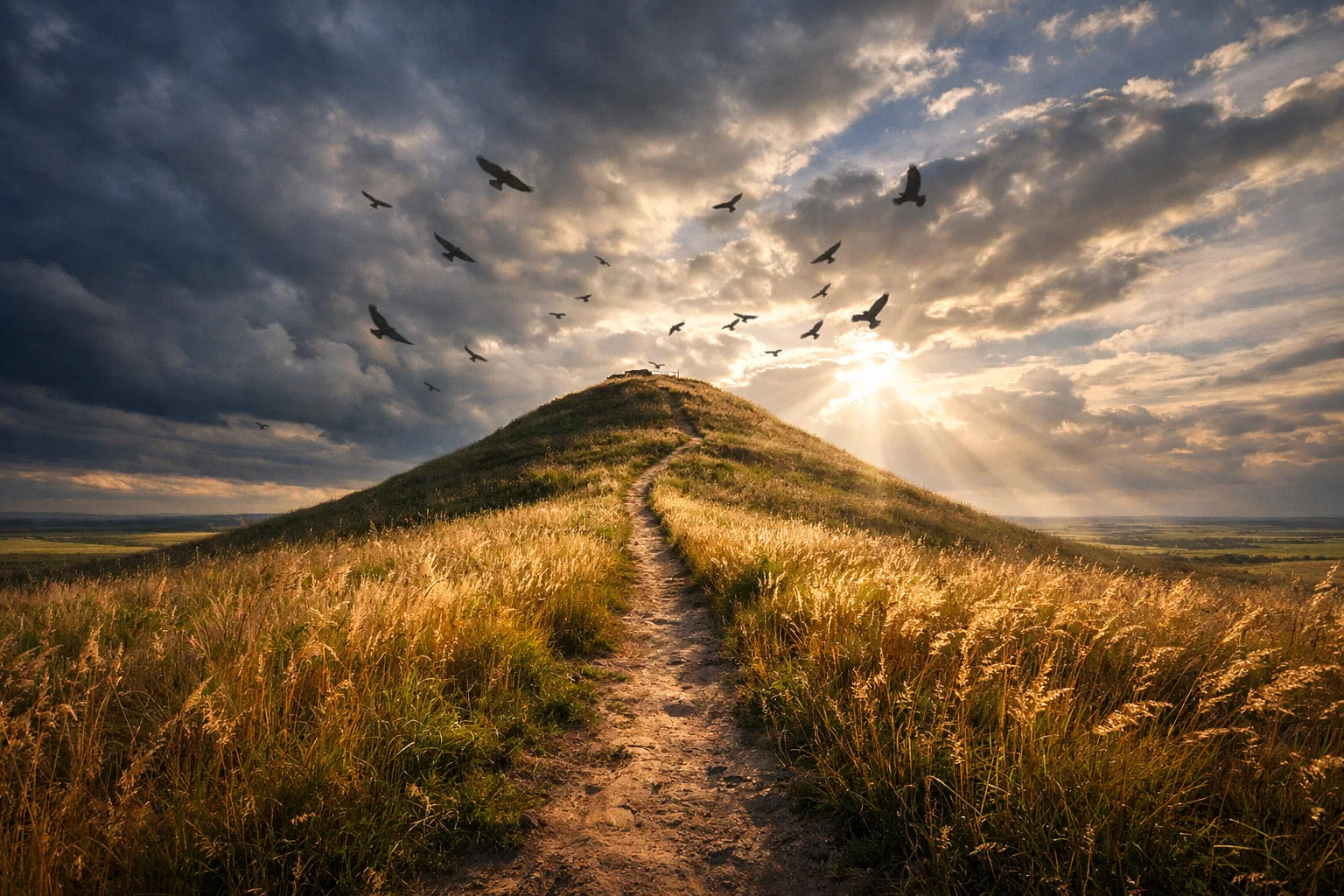
Spirit Mound’s “Little People” are not best understood as a modern South Dakota cryptid in the Bigfoot sense. They are part of a much older place-lore tradition tied to a specific hill north of Vermillion, where Indigenous sacred geography, Lewis and Clark’s 1804 journals, prairie ecology, and later heritage tourism all overlap. The basic story recorded by the expedition was that dangerous small beings or spirits lived at the mound and kept people away with deadly arrows. The more careful reading is richer: Spirit Mound was a meaningful sacred landscape before it became a Lewis and Clark landmark, and the “creature” story is only one doorway into that wider significance.[Game, Fish, and Parks]gfp.sd.govGame, Fish, and Parks
That makes Spirit Mound one of South Dakota’s most distinctive strange-place traditions. It has the outline of a monster tale — small dangerous beings, a forbidden hill, deaths remembered in oral tradition — but it also resists being flattened into “little devils” folklore for entertainment. The best question is not simply “were they real?” but why this isolated prairie mound carried such power, why Lewis and Clark cared enough to walk there in dangerous heat, and how modern visitors can read the legend without turning a sacred place into a cryptid-hunting prop.[lewisandclarkjournals.unl.edu]lewisandclarkjournals.unl.eduOpen source on unl.edu.
What Lewis and Clark recorded
On 25 August 1804, Meriwether Lewis, William Clark and a party from the Corps of Discovery left the Missouri River near the mouth of the White Stone River, now the Vermillion River, to visit a striking isolated hill on the open prairie. Clark’s journal says local people called it the “Mountain of little people or Spirits”. The mound appeared conical from a distance, and the party crossed a wide, exposed landscape in intense heat before reaching it around midday.[lewisandclarkjournals.unl.edu]lewisandclarkjournals.unl.eduOpen source on unl.edu.
The more dramatic description appears in the expedition’s account of what they had been told before going there. According to South Dakota’s trail interpretation, Lewis and Clark reported that Omaha, Otoe and Yankton people believed the mound was occupied by little people who shot any human who came near. The beings were described as human in form, with unusually large heads, about eighteen inches high, watchful, armed with sharp arrows, and able to kill at a great distance. The story also said that several people, including three Maha men, had died because of them, and that neighbouring nations were unwilling to approach the hill.[Game, Fish, and Parks]gfp.sd.govGame, Fish, and Parks
That is the closest Spirit Mound comes to a classic monster account. It has a named place, a repeated warning, a physical description, a danger boundary, and a memory of earlier casualties. Yet even in the expedition record, the account is filtered through Euro-American ears, translation chains, and the language of the early nineteenth century. Words such as “devils” and “superstition” tell us as much about the explorers’ assumptions as they do about the Indigenous traditions they were hearing. The National Park Service notes that the mound was variously labelled a “mountain of evel spirits”, a “hill of little people”, and a “place of Deavels”, showing how quickly sacred or dangerous beings were reframed in the explorers’ vocabulary.[National Park Service]nps.govNational Park Service Spirit MoundNational Park Service Spirit Mound
When the party reached the summit, they did not find small armed beings. What they did find was a landscape that made the place feel unlike ordinary prairie. Clark measured the mound at roughly 65 to 70 feet above the surrounding plain and noted its striking regularity, although he concluded it was natural rather than human-made. The men saw broad views, open prairie, herds of buffalo, birds, insects, fruit, and very little timber away from the river corridors.[lewisandclarkjournals.unl.edu]lewisandclarkjournals.unl.eduOpen source on unl.edu.

Why the story is not just a cryptid case
Spirit Mound sits awkwardly in cryptid catalogues because the tradition is not built around modern eyewitness reports of an undiscovered animal. It is instead a place-based sacred tradition that became partially recorded because Lewis and Clark were curious about it. Modern readers may recognise familiar cryptid ingredients — small humanoids, warnings, a dangerous territory, possible deaths — but the tradition’s meaning is broader than “a creature lives here”.
The National Park Service describes Spirit Mound as both a physical location and a spiritual place, a point of contact between natural and supernatural worlds for American Indian traditions. Its “Little People” associations are presented alongside Mandan, Yankton and Lakota meanings, not as a single standardised monster legend. In that account, Mandan tradition connects the mound with sacred Turtle Drums, Lone Man, flood survival, and a shrine; Yankton tradition connects it with the Little Tree Dwellers; and Lakota tradition connects it with beings who could mislead humans but later became spiritual helpers.[National Park Service]nps.govNational Park Service Spirit Mound (U.S. National Park ServiceNational Park Service Spirit Mound (U.S. National Park Service
That difference matters. A modern cryptid investigation often asks whether a witness saw an unknown animal or misidentified a known one. Spirit Mound asks a different set of questions: how a landmark becomes sacred, how warnings regulate movement through a landscape, how oral tradition protects the power of a place, and how outsiders transform Indigenous meanings when they write them down.
There is also a risk of over-simplification. The most quotable version — tiny beings with arrows killing intruders — is vivid, but it can become sensational if detached from the cultural frame. The same problem appears across many Lewis and Clark heritage sites. A Great Plains Quarterly study of interpretation along the Lewis and Clark National Historic Trail argues that many trail presentations have historically centred the expedition and given too little voice to Native peoples, even though the route passed through lands shaped and understood by Native communities long before the Corps arrived.[lewisandclarkjournals.unl.edu]lewisandclarkjournals.unl.eduOpen source on unl.edu.
For a South Dakota mystery-beast page, the useful takeaway is this: Spirit Mound belongs in the state’s strange-lore map, but it should be handled as sacred place-lore first and cryptid material second.
Indigenous place-lore versus cryptid hunting
The phrase “Little People” can sound familiar to folklore readers, because many North American traditions include small powerful beings who live in particular landscapes. At Spirit Mound, however, the important thing is not to lump every such story into one generic “fairy” or “little people” category. The local associations are specific, and the sources preserve multiple Indigenous meanings rather than one tidy monster profile.
For the Yankton, the National Park Service links Spirit Mound with the Can O’ti na, described as Little Tree Dwellers or Little People. One version says two tribes sought help from the spirits at the mound during a stalemated conflict, tried to use those powers for their own purposes, and brought two types of spirits into the world. In that telling, larger spirits moved west and the Can O’ti na remained in the area.[National Park Service]nps.govNational Park Service Spirit Mound (U.S. National Park ServiceNational Park Service Spirit Mound (U.S. National Park Service
In Lakota tradition, the mound is also associated with the Can O’ti la. The NPS account describes them through a story involving Iktomi, Raccoon people, upright-walking children, mischief, danger to humans, and eventual transformation into spirit helpers. Spirit Mound is identified as the origin point for the Little Tree Dweller’s Medicine Bundle, which the NPS says remains in use among Lakota people of the Dakotas and Nebraska.[National Park Service]nps.govNational Park Service Spirit Mound (U.S. National Park ServiceNational Park Service Spirit Mound (U.S. National Park Service
Those details change the tone of the page. The beings are not simply “monsters”. They are dangerous in some accounts, mischievous in others, and spiritually significant in still others. Some traditions connect them with misdirection and death; others with medicine and help. That range is exactly why Spirit Mound should not be treated as a place to “hunt” for proof of tiny humanoids. The living issue is cultural interpretation, not field capture.
Lewis and Clark’s arrival also carries symbolic weight. The NPS notes that, for some, the expedition’s visit to Spirit Mound marks the beginning of the end of Lakota traditional lifeways, because the meeting of American Indian and Euro-American worlds at the site had consequences far beyond a day’s walk to a hill. That does not mean every visitor must read the place only through tragedy, but it does mean the story is not a harmless campfire curiosity detached from land, power and colonisation.[National Park Service]nps.govNational Park Service Spirit Mound (U.S. National Park ServiceNational Park Service Spirit Mound (U.S. National Park Service
How landscape shaped the tradition
Spirit Mound’s power begins with its shape and position. It stands as an isolated rise on otherwise open prairie, making it visually prominent from a long distance. Clark noticed that oddness immediately: the mound’s regular form seemed almost artificial at first, but its materials matched nearby natural features, leading him to conclude it was a natural formation. He also noted that its isolation was the most remarkable thing about it.[lewisandclarkjournals.unl.edu]lewisandclarkjournals.unl.eduOpen source on unl.edu.
South Dakota’s trail guide gives the geological explanation more directly: Spirit Mound is described as a roche moutonée, a bedrock knob shaped but not levelled by the last Pleistocene glacier around 13,000 years ago. In plain language, it is the kind of leftover hill that can feel intentionally placed because the surrounding country is so open. That does not explain the sacred tradition away, but it helps explain why this particular rise became a focus of attention.[Game, Fish, and Parks]gfp.sd.govGame, Fish, and Parks
The prairie also shaped what Lewis and Clark thought they saw. Clark reasoned that wind sweeping across the open plain drove insects towards the leeward side of the mound, which in turn drew large numbers of small birds. He wrote that the bird gatherings were one of the signs local people used to identify the place as the home of unusual spirits, and he interpreted this as a natural cause behind the belief. The NPS repeats the same basic observation: the explorers found no little people, but they did see birds, insects, bison and a vast prairie view.[lewisandclarkjournals.unl.edu]lewisandclarkjournals.unl.eduOpen source on unl.edu.
That explanation is important, but it has limits. Clark’s insect-and-bird theory may explain one visible feature of the mound, especially to an outsider looking for a rational mechanism. It does not account for the full sacred geography, the Mandan and Lakota associations, medicine-bundle traditions, or the social power of warnings around the hill. A sceptical reading can say “there is no zoological evidence for tiny armed humanoids” without pretending that a bird-feeding pattern is the complete meaning of the place.
The landscape also helps explain why the story endures. A lone hill on open prairie naturally invites approach and avoidance. It can be seen, named, circled, warned against, climbed, and remembered. Unlike a vague creature glimpsed on a dark road, Spirit Mound is still there. That physical continuity gives the legend an anchor that many cryptid stories lack.

The 1804 visit as a South Dakota mystery moment
As a strange-history episode, the Lewis and Clark visit has an unusually strong paper trail. Many cryptid stories rely on late newspaper retellings or anonymous anecdotes; Spirit Mound has direct expedition journal entries from August 1804, later edited expedition accounts, and modern interpretation by South Dakota and National Park Service sources. That does not verify the beings. It verifies that the tradition was important enough to be reported to the expedition and that the explorers made a deliberate side trip to investigate it.[lewisandclarkjournals.unl.edu]lewisandclarkjournals.unl.eduOpen source on unl.edu.
The day itself reads almost like an anti-climax, which makes it more interesting rather than less. The party expected, or at least had heard of, danger. Instead, they encountered heat, thirst, prairie exposure and natural abundance. Lewis was already weakened by a recent poisoning scare involving mineral substances, several men suffered from thirst, and the dog Seaman had to be sent back because of the heat. The expedition then rested, looked over the landscape, gathered fruit and returned towards the river.[lewisandclarkjournals.unl.edu]lewisandclarkjournals.unl.eduOpen source on unl.edu.
For readers of monster lore, that anti-climax is familiar. People go to a feared place and find no monster, but they do find a setting that explains why stories cluster there. In Spirit Mound’s case, the ordinary details are not boring. The heat, wind, birds, insects, buffalo, lack of timber, exposed horizon and isolated hill all help build the “feel” of the tradition. This is not a dark forest creature tale; it is a prairie visibility tale, where the strange thing is not hidden in trees but raised above an enormous open plain.
The episode also shows how quickly outsiders convert sacred geography into curiosity. Lewis and Clark were not paranormal investigators, but they were explorers trained to observe, measure, classify and report. They treated the mound as an object of inquiry: how high, how shaped, how far from the river, whether natural or artificial, whether the stories had an observable cause. That habit produced valuable records, but it also changed the tradition by fixing one outsider-readable version of it in a national exploration narrative.
How the mound became a preserved historic prairie
Spirit Mound today is not an untouched survival from 1804. It is a restored historic landscape, and that modern restoration is part of the story. The National Park Service says the locally formed Spirit Mound Trust worked with the Land and Water Conservation Fund to purchase a 320-acre site from private owners, donate it to South Dakota, and restore and preserve it. Spirit Mound Historic Prairie was established as a state park in 2001, and the Spirit Mound Summit Trail became a national recreation trail in 2004.[National Park Service]nps.govNational Park Service Spirit Mound (U.S. National Park ServiceNational Park Service Spirit Mound (U.S. National Park Service
South Dakota Game, Fish and Parks describes the restoration as an attempt to give visitors an experience closer to what Lewis and Clark encountered, with prairie grasses and native plants being re-established. The agency also stresses that restoration began in 2001 and will take decades before the site becomes a strong representation of the prairie seen by the expedition. That long timescale is useful: Spirit Mound is not just being “displayed”; it is being ecologically repaired.[Game, Fish, and Parks]gfp.sd.govOpen source on sd.gov.
The trail guide adds what restoration had to undo. Before the preservation effort, the mound area had been privately owned, farmed and used for pasture; it included a farmhouse, cattle feedlot, concrete trench silo and shelterbelt trees. The 320-acre site was then purchased, cleared and seeded with prairie species with the aim of restoring conditions closer to those of two centuries earlier.[Game, Fish, and Parks]gfp.sd.govGame, Fish, and Parks
That matters for the legend because sacred landscape is not only a story. It is also a material place that can be fenced, farmed, planted, interpreted, protected or misunderstood. Visitors walking the present trail are not entering a pristine frozen past. They are walking through a modern compromise: a public historic prairie that tries to honour Lewis and Clark history, Indigenous meaning, ecological restoration and public access at the same time.

What counts as evidence here?
The evidence for Spirit Mound’s Little People tradition is strong as folklore and place history, but weak as zoology. That distinction keeps the page honest.
The strongest evidence is documentary and cultural:
- Lewis and Clark’s journals show that the story was already attached to the mound in 1804.
- The tradition was associated with multiple neighbouring peoples in the expedition record, including Omaha, Otoe, Yankton and Sioux references as preserved in interpretation.
- Modern NPS interpretation records Mandan, Yankton and Lakota meanings that go beyond the expedition’s “little devils” framing.
- The mound itself is a real, identifiable place, still preserved north of Vermillion.[sd.gov]gfp.sd.govGame, Fish, and ParksGame, Fish, and Parks
The evidence for a flesh-and-blood hidden species is a different matter. There are no modern wildlife-agency records, specimens, tracks, photographs, repeatable observations or biological evidence supporting eighteen-inch armed humanoids at Spirit Mound. Even the 1804 expedition, after going to the summit, recorded that they found none of the beings and proposed a natural explanation for at least one reported sign: unusual bird activity around the mound.[National Park Service]nps.govNational Park Service Spirit MoundNational Park Service Spirit Mound
That does not make the story worthless. It means it belongs in the category of sacred place-lore, oral tradition and historical interpretation rather than confirmed cryptozoology. In South Dakota’s wider monster map, Spirit Mound provides a useful contrast with Bigfoot reports, lake monster stories and phantom-animal rumours. Those are usually framed around sightings. Spirit Mound is framed around a place that people already knew to treat with caution, power and respect.
Why Spirit Mound still matters to South Dakota folklore
Spirit Mound matters because it shows that South Dakota’s strange-creature traditions are not all modern roadside rumours. Some are rooted in older relationships between people and land. The Little People story is memorable because it sounds like a creature legend, but its deeper importance is that it marks a hill as spiritually charged, socially meaningful and dangerous to approach casually.
It also complicates the Lewis and Clark story. For many visitors, Spirit Mound is appealing because it is one of the rare places where historians can say with confidence that the expedition stood. The Spirit Mound Trust calls it one of the most significant Lewis and Clark sites in South Dakota for that reason. But if the site is treated only as a “where the explorers stood” viewpoint, the older Indigenous meanings become background decoration.[spiritmound.org]spiritmound.orgStory of Spirit MoundStory of Spirit Mound
The better interpretation holds both facts at once. Lewis and Clark’s visit gives modern readers a dated documentary window into the tradition. Indigenous place-lore gives the hill its deeper cultural life. Prairie restoration gives present-day visitors a way to see the landscape as more than a backdrop. The Little People sit at the centre of those layers, not as a solved animal mystery, but as a reminder that “monster” stories often preserve rules about attention, humility and place.
In that sense, Spirit Mound is one of the most important South Dakota entries in a state cryptid and folklore project precisely because it is not a simple cryptid case. It asks readers to slow down. The story is strange, but the strangeness is not just the possibility of tiny beings with arrows. It is the survival of a sacred landscape through exploration journals, altered land, restoration, tourism, and continuing debate over whose meanings are allowed to lead.
Amazon book picks
Further Reading
Books and field guides related to What Were Spirit Mound's Little People?. Use these as the next step if you want deeper reading beyond the article.
The Journals of Lewis and Clark
Contains the expedition's original Spirit Mound references.
The United States of Cryptids
Connects Spirit Mound to broader American mystery traditions.
eBay marketplace picks
Marketplace Samples
Live-tested eBay searches with available results related to this page.


Endnotes
1.
Source: gfp.sd.gov
Title: Game, Fish, and Parks
Link:https://gfp.sd.gov/userdocs/spiritmound_overviewtrails.pdf
2.
Source: nps.gov
Title: National Park Service Spirit Mound (U.S. National Park Service)
Link:https://www.nps.gov/places/spirit-mound.htm
3.
Source: lewisandclarkjournals.unl.edu
Link:https://lewisandclarkjournals.unl.edu/item/lc.jrn.1804
4.
Source: lewisandclarkjournals.unl.edu
Link:https://lewisandclarkjournals.unl.edu/item/lc.sup.blake.01
5.
Source: nps.gov
Title: National Park Service Spirit Mound
Link:https://www.nps.gov/lecl/learn/historyculture/spirit-mound.htm
6.
Source: nps.gov
Title: spirit mound south dakota
Link:https://www.nps.gov/places/spirit-mound-south-dakota.htm
7.
Source: spiritmound.org
Title: Story of Spirit Mound
Link:https://www.spiritmound.org/story-of-spirit-mound/
8.
Source: lewisandclarkjournals.unl.edu
Link:https://lewisandclarkjournals.unl.edu/search?places=Spirit+Mound
9.
Source: lewisandclarkjournals.unl.edu
Link:https://lewisandclarkjournals.unl.edu/item/lc.jrn.1804
10.
Source: lewisandclarkjournals.unl.edu
Link:https://lewisandclarkjournals.unl.edu/item/lc.sup.johnsgard.01
11.
Source: lewisandclarkjournals.unl.edu
Link:https://lewisandclarkjournals.unl.edu/item/lc.sup.clarke.01
12.
Source: lewisandclarkjournals.unl.edu
Link:https://lewisandclarkjournals.unl.edu/item/lc.sup.ronda.01
13.
Source: lewisandclarkjournals.unl.edu
Link:https://lewisandclarkjournals.unl.edu/item/lc.sup.lavender.01.07
14.
Source: lewisandclarkjournals.unl.edu
Link:https://lewisandclarkjournals.unl.edu/item/lc.sup.lavender.01
15.
Source: nps.gov
Title: Spirit Mound
Link:https://www.nps.gov/mnrr/learn/historyculture/spiritmound.htm
16.
Source: nps.gov
Title: Spirit Mound
Link:https://www.nps.gov/mnrr/learn/historyculture/spiritmound.htm?fullweb=1
17.
Source: spiritmound.org
Link:https://www.spiritmound.org/spirit-mound-today/
18.
Source: spiritmound.org
Title: History of the Trust
Link:https://www.spiritmound.org/history-of-the-trust/
19.
Source: spiritmound.org
Link:https://www.spiritmound.org/
20.
Source: spiritmound.org
Link:https://www.spiritmound.org/wp-content/uploads/2022/03/SpiritMoundTrails.pdf
21.
Source: spiritmound.org
Link:https://www.spiritmound.org/staging/6418/wp-content/uploads/2022/03/2001.pdf
22.
Source: spiritmound.org
Link:https://www.spiritmound.org/spirit-mound-trust/
23.
Source: lewisandclark.travel
Link:https://www.lewisandclark.travel/listing/spirit-mound-historic-prairie-south-dakota/
24.
Source: gfp.sd.gov
Link:https://gfp.sd.gov/parks/detail/spirit-mound-historic-prairie/
25.
Source: Wikipedia
Title: Spirit Mound Historic Prairie
Link:https://en.wikipedia.org/wiki/Spirit_Mound_Historic_Prairie
26.
Source: hikingsiouxfalls.blogspot.com
Title: spirit mound historic prairie
Link:https://hikingsiouxfalls.blogspot.com/2013/05/spirit-mound-historic-prairie.html
27.
Source: southeastsouthdakota.com
Title: spirit mound historic prairie
Link:https://www.southeastsouthdakota.com/united-states/vermillion/our-communities/spirit-mound-historic-prairie
28.
Source: allstateparks.com
Link:https://www.allstateparks.com/south-dakota/spirit-mound-historic-prairie
29.
Source: tripadvisor.com
Title: Spirit Mound
Link:https://www.tripadvisor.com/Attraction_Review-g54838-d609532-Reviews-Spirit_Mound-Vermillion_South_Dakota.html
Additional References
30.
Source: youtube.com
Title: Hiking Spirit Mound Historic Prairie, Vermillion, South Dakota
Link:https://www.youtube.com/watch?v=xAQS0oY2Eeo
Source snippet
Spirit Mound South Dakota #1 Bottom - May 15, 2017 - Travels With Phil - Unedited...
Published: May 15, 2017
31.
Source: nationsreportcard.gov
Link:https://www.nationsreportcard.gov/
32.
Source: youtube.com
Title: Spirit Mound, S.D. & The Legend Of The Evil Little Ones
Link:https://www.youtube.com/watch?v=ogEYMpPLrvg
Source snippet
Did Lewis and Clark find the Demon People?...
33.
Source: youtube.com
Title: Did Lewis and Clark find the Demon People?
Link:https://www.youtube.com/watch?v=hBElFR8N4Zg
Source snippet
Hiking Spirit Mound Historic Prairie, Vermillion, South Dakota...
34.
Source: hmdb.org
Link:https://www.hmdb.org/m.asp?m=222055
35.
Source: travelsouthdakota.com
Link:https://www.travelsouthdakota.com/trip-ideas/exploring-spirit-mound
36.
Source: facebook.com
Link:https://www.facebook.com/groups/870159800117422/posts/2469632650170121/
37.
Source: merriam-webster.com
Link:https://www.merriam-webster.com/dictionary/national
38.
Source: nationalgridus.com
Link:https://www.nationalgridus.com/
39.
Source: aclu.org
Link:https://www.aclu.org/issues/privacy-technology/national-id
Topic Tree