Within Idaho Monsters
Why Idaho Feels Like Bigfoot Country
Idaho Bigfoot stories grow from remote forests where real wildlife, tracks and night sounds already feel larger than life.
On this page
- Where Idaho reports tend to cluster
- Bears, cougars and other real wildlife
- Tracks, calls and the Pacific Northwest tradition
Page outline Jump by section
Introduction
Idaho feels like Bigfoot country because its reports are tied less to carnival-style monster lore than to the state’s real forest geography: dark timber, old logging roads, mountain lakes, river corridors, campsites and long gaps between witnesses. The creature being claimed is the familiar Pacific Northwest Sasquatch or Bigfoot: a large, upright, hair-covered figure, sometimes reported with heavy footfalls, strange calls, wood knocks or oversized tracks. Idaho has no verified biological evidence for such an animal, but it has a strong pattern of witness claims in places where a brief glimpse can feel plausible: the Panhandle, the McCall and Payette National Forest area, the Stanley country, Priest Lake, Upper Priest River and other wooded mountain zones.
The useful way to read Idaho Bigfoot stories is not as proof of a hidden ape, but as forest folklore built from three things at once: sincere testimony, difficult viewing conditions and a landscape already full of large animals. The Bigfoot Field Researchers Organization lists Idaho reports by county, with Bonner County in the north showing a particularly large cluster, and Valley County around McCall and Payette country showing repeated reports from the late 1960s through the 2020s. Those reports sit inside a wider Pacific Northwest tradition, but Idaho gives the legend its own setting: quieter, less famous than Washington or Oregon, and often rooted in backcountry recreation rather than roadside spectacle.[bfro.net]bfro.netReports for IdahoReports for Idaho
Where Idaho reports tend to cluster
The clearest Idaho Bigfoot pattern is geographic. Reports gather in the wooded north and in central mountain country, rather than spreading evenly across the state. That makes sense even before anyone believes the creature claim: these are the parts of Idaho where forests, rivers, hunting camps, berry patches, logging roads and remote cabins create the classic conditions for a Sasquatch story.
The Panhandle is the most obvious example. The U.S. Forest Service says the Idaho Panhandle National Forests include about 2.5 million acres of public lands, and describes northern Idaho as roughly 80 per cent forested. It is also lake-and-river country, with recreation, hunting, fishing, snowmobiling and hundreds of miles of trails and streams. In other words, it is exactly the kind of landscape where people spend time at the edge of visibility: walking through timber, hearing animals at night, driving logging roads or camping near water.[US Forest Service]fs.usda.govOpen source on usda.gov.
BFRO’s Bonner County page illustrates the northern pattern well. Its listed claims include reported tracks near Clark Fork, possible vocalisations near Priest Lake, a late-afternoon sighting on Upper Priest River, a daylight sighting near Hellroaring Ridge, a reported road crossing near Spirit Lake, and older Selkirk Mountain accounts. These are not laboratory data; they are curated witness reports from a Bigfoot-believer organisation. Still, as folklore geography, they show where Idaho’s Sasquatch imagination settles: wooded ridges, lake country, mining and logging corridors, and the borderland forests that blur into Washington, Montana and British Columbia.[bfro.net]bfro.netBonner County, Idaho – Reports & ArticlesBonner County, Idaho – Reports & Articles
Valley County provides the other strong centre of gravity. BFRO’s Valley County listings include reports around McCall, Little Payette Lake, Payette Lake, Warm Lake, Loon Lake, Tamarack, the Payette River meadows and Deadwood Dam. The spread is striking because it is not one famous “monster site” repeated endlessly; it is a cluster of recreation and backcountry locations around the same forested mountain region. Reports range from alleged 1969 encounters near McCall to a 2024 paddleboarder claim near the Payette River and a 2026 hiker claim near Deadwood Dam.[bfro.net]bfro.netValley County, Idaho – Reports & ArticlesValley County, Idaho – Reports & Articles
That does not mean Idaho’s central forests are unusually full of unknown primates. It means the setting is unusually good at producing stories that feel Bigfoot-shaped. A large dark form seen in broken timber is different from the same form seen in a supermarket car park. A scream heard by elk hunters at dusk has a different emotional force from a sound heard beside a motorway. Idaho’s reports gain their power from being just far enough from easy verification.

Why the forest setting matters
Bigfoot stories depend on ambiguity, and Idaho’s forest country supplies it in abundance. The forests are not empty wilderness in a romantic sense; they are working and recreational landscapes used by hunters, anglers, loggers, hikers, Scouts, cabin owners and snow travellers. That matters because the witnesses in Idaho reports are often people who are already outdoors for ordinary reasons. The story does not need a paranormal frame. It begins with someone crossing a trail, checking a cabin, walking near a lake, driving a logging road or hearing something beyond the firelight.
The Payette National Forest is a good example of why this works. The Forest Service describes it as habitat for about 300 species of mammals and birds, including deer, elk, mountain lion, bear, coyote, moose, mountain sheep and mountain goat. Its plant zones run from lower-elevation ponderosa pine and Douglas-fir through western larch, grand fir, lodgepole pine, Engelmann spruce and subalpine fir. That mix gives Bigfoot stories a physical vocabulary: dense cover, ridges, meadows, alpine lakes, animal trails, broken sightlines and large wildlife that can startle even experienced people.[US Forest Service]fs.usda.govUS Forest Service Payette National Forest | Animals and Plants | Forest ServiceUS Forest Service Payette National Forest | Animals and Plants | Forest Service
The same habitat also complicates interpretation. In a city, a seven-foot hairy figure would be extraordinary and probably filmed clearly by many people. In a forest, the conditions are stacked against certainty. A witness may see movement for only a few seconds. Scale is hard to judge without a nearby object. Wet bark, shadow and fur can merge into a single dark shape. At dusk, the brain fills gaps quickly, especially when the observer is tired, frightened or expecting wildlife.
This is why many Idaho reports are not simply “I saw Bigfoot”. They are built from fragments: a road crossing, a dark upright body, long arms, heavy steps, a scream, a track, a campsite disturbance, a feeling of being watched. For believers, the fragments add up to a pattern. For sceptics, the same fragments are exactly what one would expect from misidentification, memory inflation or a story retold after the fact.
What the reports actually describe
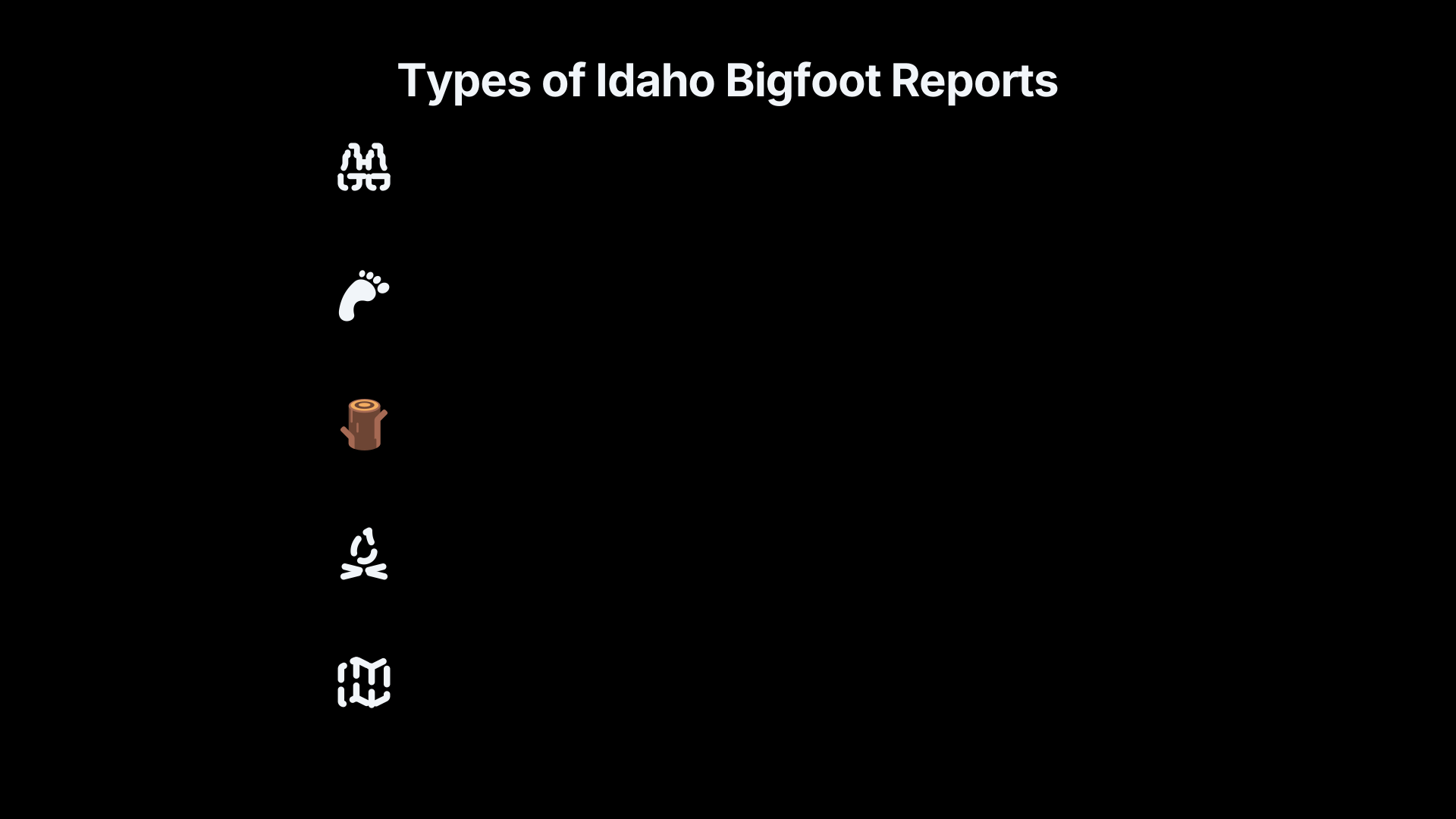
Idaho’s Bigfoot reports tend to fall into three broad types: visual sightings, track or sign reports, and sound-based encounters. The most dramatic are daylight or near-daylight sightings, because they give the witness a creature-shaped image rather than only a noise or footprint.
One useful example is the BFRO report from Custer County involving former Boy Scouts near Cape Horn Lakes north of Stanley. The witness said the original event took place in July 1980 while a group from a Scout camp walked towards a third lake through denser forest. According to the report, three of the six saw a large two-footed creature cross the trail roughly 75 feet away, moving from left to right. The witness later described it as tall, broad, agile and around seven to eight feet high. The value of this account, from a reader’s point of view, is not that it proves Bigfoot. It shows the classic Idaho setting: young hikers, a lightly used trail, lakes, dense timber and a brief crossing sightline.[bfro.net]bfro.netshow report.aspshow report.asp
Bonner County’s listings show the same pattern in miniature. Some reports are visual: a woman picking berries near Clark Fork, a woodcutter on a logging road east of Nordman, a road-crossing near Spirit Lake, a family account between 1975 and 1977. Others are sign-based: tracks near Buckles Mountain, a trail of footprints near Clark Fork, possible footprints and knuckle prints near Priest Lake. Others are auditory: roaring howls, vocals at camp, knocks or rock-banging. The result is not one neat case file but a folklore cluster: repeated claims of “something large and not quite bear-like” in a heavily forested region.[bfro.net]bfro.netBonner County, Idaho – Reports & ArticlesBonner County, Idaho – Reports & Articles
Valley County’s list adds a McCall-area flavour. It includes alleged sightings near Payette Lake and Little Payette Lake, mountain-lake encounters, bow-hunters hearing an unusual scream, Boy Scouts hearing possible vocalisations at Loon Lake, and later claims near Tamarack, Warm Lake and the Payette River. That mixture is important: Idaho Bigfoot country overlaps with the same places used for camping, hunting, paddling, fishing and youth trips. The legend is not separate from outdoor culture; it rides along with it.[bfro.net]bfro.netValley County, Idaho – Reports & ArticlesValley County, Idaho – Reports & Articles
Bears, cougars and other real wildlife
The strongest sceptical explanation for many Bigfoot reports is not that witnesses are lying. It is that Idaho forests contain real animals capable of producing frightening, confusing impressions. Bears are the central issue, especially because a bear standing briefly on its hind legs can look startlingly human at a distance, and a bear moving through brush can sound much larger than expected.
Idaho is bear country. Idaho Fish and Game’s bear-identification materials are aimed at hunters precisely because mistaken identity between bear species is a real wildlife-management concern, and the state required black-bear hunters from 1 January 2025 to show proof of completing a bear identification test. That official concern is not about Bigfoot, but it supports a broader point: even trained or motivated outdoor users can struggle with animal identification under field conditions.[Idaho Fish and Game]idfg.idaho.govFish and Game Bear Identification and Test RequirementFish and Game Bear Identification and Test Requirement
The Payette National Forest’s own wildlife list includes bear, mountain lion, moose, elk and coyote among its larger animals. Mountain lions add another layer because they are secretive and rarely seen clearly, yet their screams and sudden movements can be deeply unsettling. Idaho Fish and Game has repeatedly reminded residents that mountain lions may appear near communities and outdoor areas, including McCall, while also noting in another account that seeing them during field investigations remains uncommon because they are typically shy and secretive.[usda.gov]fs.usda.govUS Forest Service Payette National Forest | Animals and Plants | Forest ServiceUS Forest Service Payette National Forest | Animals and Plants | Forest Service
A 2024 paper in the Journal of Zoology tested the idea that Bigfoot reports correlate with black bear populations across the United States and Canada. The study did not prove that every report is a bear, but it did support the broader sceptical argument that bear distribution helps explain where many Sasquatch claims appear. For Idaho, that matters because the same forests that feel like plausible Bigfoot habitat are also legitimate bear habitat. The more time people spend in bear country, the more chances there are for brief, ambiguous encounters with large, dark, mobile animals.[ZSL Publications]zslpublications.onlinelibrary.wiley.comZSL Publications Bigfoot: If it's there, could it be a bear?ZSL Publications Bigfoot: If it's there, could it be a bear?
Other explanations sit beside bears rather than replacing them. Elk and moose can make heavy sounds in timber. Owls, foxes, coyotes and cougars can create night calls that do not match a casual listener’s expectations. Humans in dark clothing, hunters in camouflage, tree shadows, burned stumps, wet logs and poor distance judgement can all contribute. A track in mud or snow may expand, melt, overlap or lose detail. The honest answer is usually not “this was definitely a bear” or “this was definitely a Sasquatch”. It is that Idaho’s forest conditions make certainty unusually fragile.

Tracks, calls and the Pacific Northwest tradition
Idaho’s Bigfoot stories do not stand alone. They belong to the wider Pacific Northwest Sasquatch tradition, a cultural zone stretching through British Columbia, Washington, Oregon, northern California, Montana’s western forests and Idaho’s Panhandle and mountain interior. Idaho’s role is quieter than Washington’s, but it is geographically natural: the same mountain chains, conifer forests, river systems and backcountry recreation patterns cross state and national borders.
The BFRO database itself reflects that regional continuity. It describes its own classification system as a way of sorting reports by the potential for misinterpretation: Class A for clearer sightings where the organisation believes misidentification can be ruled out with more confidence, Class B for poorer views, distant observations, sound-only reports or other circumstances with greater room for misinterpretation, and Class C for second-hand or weaker accounts that are rarely displayed. This classification is not a scientific confirmation system, but it is useful for readers because it shows that even Bigfoot investigators recognise ambiguity as a core problem.[bfro.net]bfro.netBFR O Database History and Report Classification SystemBFR O Database History and Report Classification System
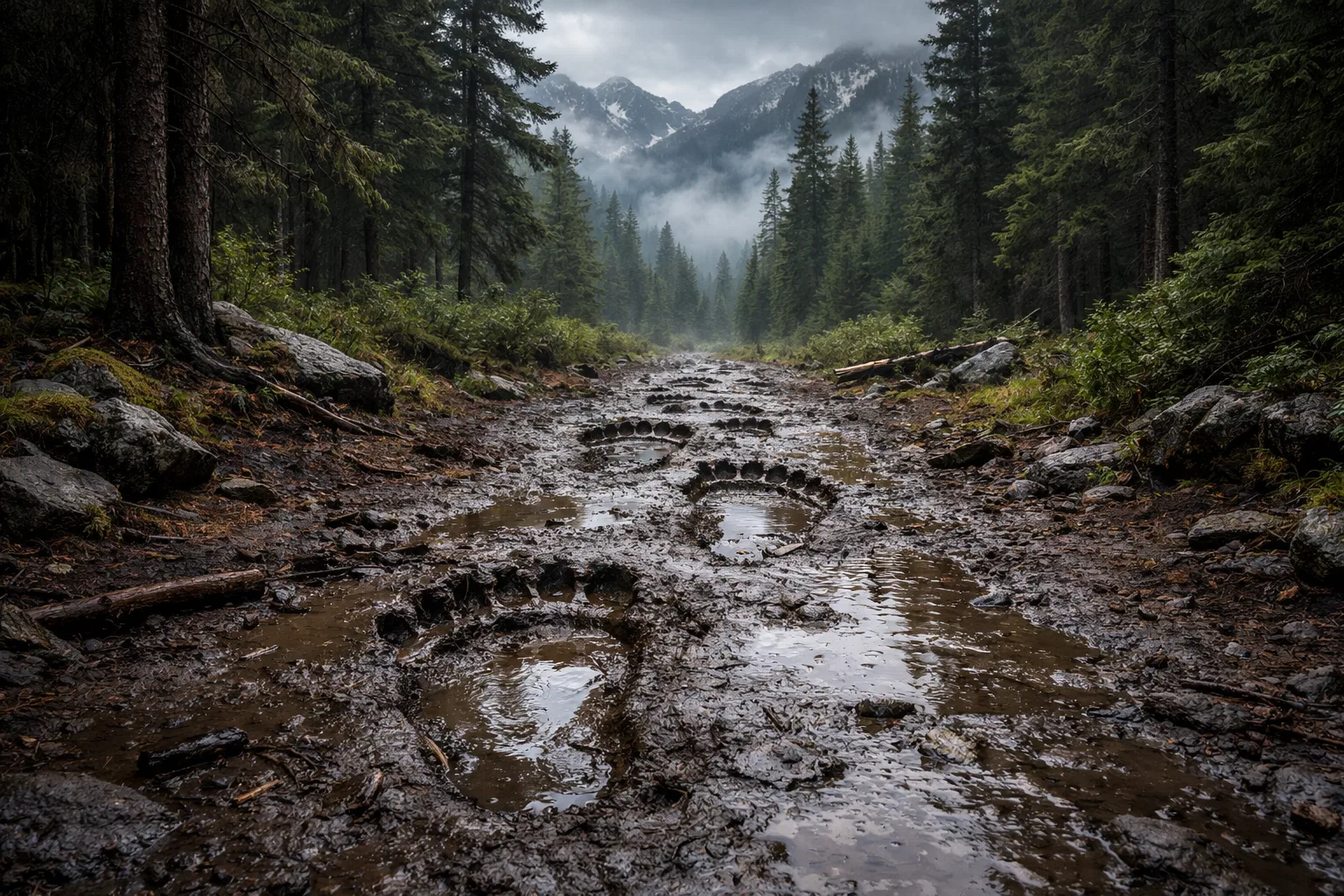
Tracks are especially powerful in Idaho stories because the state has a strong hunting and outdoor-tracking culture. A footprint in snow near Clark Fork, a large track near Priest Lake, or possible tracks followed by a Fish and Game employee near Little Payette Lake sounds more grounded than a vague monster sighting. Yet tracks are also vulnerable evidence. Snow melts. Mud slumps. Bear tracks can overlap in ways that appear elongated. Human-made prints can be hoaxed. Photographs without scale, location control and chain of custody rarely settle anything.
Calls and knocks work the same way. In Bigfoot culture, long howls, wood knocks and rock-banging are often treated as behavioural clues. In Idaho reports, these sounds show up around camps, hunting areas and wooded lakes. The difficulty is that sound travels strangely in mountain country. Echo, wind, water, ravines and timber can distort direction and distance. A sound that feels close may be far away; a known animal may sound unfamiliar; a human noise may seem non-human once fear takes over.
That is why Idaho Bigfoot reports are best read as layered evidence rather than a single yes-or-no proposition. A clear sighting claim is more interesting than a distant howl. A track with photographs, scale and multiple witnesses is stronger than a memory told decades later. A repeated cluster in the same valley may be culturally significant even if it never becomes biological evidence. The tradition survives because each layer is weak on its own but evocative together.
Local collectors and the private-story problem
One reason Idaho Bigfoot lore feels larger than the public databases is that many stories circulate privately. East Idaho News profiled writer Becky Cook in 2020, reporting that she had collected nearly 60 Idaho Bigfoot stories, including accounts from Menan, Palisades, Bannock Creek, Mount Putnam, Malad and Swan Valley. Cook told the outlet she found people who had never shared their sightings because they feared being thought odd or foolish.[East Idaho News]eastidahonews.comOpen source on eastidahonews.com.
That private-story problem cuts both ways. On one hand, it explains why folklore can be widespread even when the formal record looks thin. People may tell family members, local writers, hunting partners or friends long before they file a report with any organisation. In rural and outdoor communities, reputation matters; a person may be willing to say “I saw something I cannot explain” only to someone they trust.
On the other hand, private circulation makes verification harder. A story repeated years later may be sincere but altered by memory. Details can sharpen over time. A vague “big dark thing” can become an eight-foot figure once it is retold inside a Bigfoot frame. When a collector selects only the most vivid accounts, readers get a compelling book or article, not a controlled sample of everything people misheard, mis-saw or dismissed.
This is where Idaho’s Bigfoot tradition becomes most human. The important fact may not be that a hidden creature exists, but that many people in Idaho’s forest and farming communities have had outdoor experiences that they remember as strange, embarrassing, frightening or meaningful. Bigfoot gives those experiences a shared name.
Why Idaho keeps the legend alive
Idaho’s Bigfoot legend persists because it fits the state’s landscape without needing much decoration. It does not require a ruined castle, a cursed road or a laboratory accident. It needs a forest, a witness, poor visibility and the knowledge that bears, cougars and moose really do move through the same country.
The legend also has a social function. It turns ordinary outdoor places into story places. A trail near Priest Lake becomes more than a trail. A McCall-area campsite becomes part of a chain of claims. A strange scream while elk hunting becomes something told every autumn. For visitors, Bigfoot adds mystery to recreation; for locals, it can become a half-serious marker of place. Idaho’s lake monsters may be more tourist-friendly, especially Sharlie at Payette Lake, but Bigfoot is better suited to the private mood of forest country: less mascot, more campfire question.
The evidence-aware view is simple. Idaho has many Bigfoot reports, some vivid and locally persistent, but none provide the physical proof needed to establish an unknown large primate in the state. The strongest explanations include misidentified bears, other wildlife, humans, tracks distorted by ground conditions, uncertain sounds, hoaxes and memory effects. Yet the stories remain worth studying because they show how people interpret wild landscapes. Idaho Bigfoot is not just a creature claim; it is a way of talking about forests that still feel deep enough to hide something.
How to read an Idaho Bigfoot report
A good Idaho Bigfoot report should be read with curiosity and caution at the same time. The most useful questions are practical rather than mocking: where exactly did it happen, what was the light like, how long did the witness see it, what known animals live there, was there a track or photograph, how soon was the account recorded, and did independent witnesses report the same details?
The strongest reports usually have several features: a named location or narrow area, a short delay between event and report, multiple witnesses whose accounts can be compared, clear conditions, physical context such as distance and scale, and a willingness to consider ordinary wildlife. The weakest reports rely on dramatic description without location detail, were recorded decades later, or consist only of sounds interpreted through Bigfoot expectations.
For Idaho specifically, the forest setting should always be part of the assessment. A claim from Bonner County, Valley County, the Stanley area or the Payette National Forest region gains atmosphere from the landscape, but that same landscape also creates the uncertainty. Trees hide bodies. Snow changes tracks. Rivers carry sound. Bears stand, climb, dig, run and leave confusing sign. Cougars scream. Moose crash through cover. Humans misjudge size in poor light.
That tension is the heart of Idaho Bigfoot country. The forests make the story believable enough to endure, but also uncertain enough that the legend stays a legend.
Amazon book picks
Further Reading
Books and field guides related to Why Idaho Feels Like Bigfoot Country. Use these as the next step if you want deeper reading beyond the article.
Sasquatch: Legend Meets Science
Directly addresses Sasquatch evidence, tracks and Pacific Northwest reports.
Where Bigfoot Walks
Strong Pacific Northwest forest context similar to Idaho landscapes.
eBay marketplace picks
Marketplace Samples
Live-tested eBay searches with available results related to this page.


Endnotes
1.
Source: bfro.net
Title: Reports for Idaho
Link:https://www.bfro.net/GDB/state_listing.asp?state=id
2.
Source: bfro.net
Title: Bonner County, Idaho – Reports & Articles
Link:https://www.bfro.net/GDB/show_county_reports.asp?county=Bonner&state=id
3.
Source: bfro.net
Title: Valley County, Idaho – Reports & Articles
Link:https://www.bfro.net/GDB/show_county_reports.asp?county=Valley&state=ID
4.
Source: bfro.net
Title: BFR O Database History and Report Classification System
Link:https://www.bfro.net/gdb/classify.asp
5.
Source: bfro.net
Title: show report.asp
Link:https://www.bfro.net/GDB/show_report.asp?id=3085
6.
Source: idfg.idaho.gov
Title: Fish and Game Bear Identification and Test Requirement
Link:https://idfg.idaho.gov/hunt/bear-identification
7.
Source: idfg.idaho.gov
Title: fg continues monitor mountain lion activity mccall
Link:https://idfg.idaho.gov/article/fg-continues-monitor-mountain-lion-activity-mccall
8.
Source: idfg.idaho.gov
Title: fg wildlife technician films mountain lion encounter owyhees
Link:https://idfg.idaho.gov/article/fg-wildlife-technician-films-mountain-lion-encounter-owyhees
9.
Source: bfro.net
Title: state listing.asp
Link:https://www.bfro.net/GDB/state_listing.asp?state=mt
10.
Source: bfro.net
Link:https://www.bfro.net/gdb/
11.
Source: bfro.net
Title: show county reports.asp
Link:https://www.bfro.net/GDB/show_county_reports.asp?county=Kootenai&state=id
12.
Source: bfro.net
Title: RECEN T: A group of teenage campers stalked by
Link:https://www.bfro.net/GDB/show_report.asp?id=81202
13.
Source: bfro.net
Title: show county reports.asp
Link:https://www.bfro.net/GDB/show_county_reports.asp?county=Idaho&state=ID
14.
Source: bfro.net
Title: show report.asp
Link:https://www.bfro.net/GDB/show_report.asp?id=78583
15.
Source: bfro.net
Title: show report.asp
Link:https://www.bfro.net/GDB/show_report.asp?id=5767
16.
Source: idfg.idaho.gov
Title: draft black bear plan 2025 30v1
Link:https://idfg.idaho.gov/sites/default/files/draft_black_bear_plan_2025-30v1.pdf
17.
Source: idfg.idaho.gov
Title: mountain lion sightings serve reminder use caution
Link:https://idfg.idaho.gov/press/mountain-lion-sightings-serve-reminder-use-caution
18.
Source: idfg.idaho.gov
Title: mountain lion plan 2024 2029 final
Link:https://idfg.idaho.gov/sites/default/files/mountain-lion-plan_2024-2029-final.pdf
19.
Source: idfg.idaho.gov
Link:https://idfg.idaho.gov/sites/default/files/rulemaking/comments/public_comment_wolf_baiting_2017_06_05_08082017_online_input_bait_for_hunting_wolves_req_opt.pdf
20.
Source: idfg.idaho.gov
Title: draft mountain lion plan 2024 2029
Link:https://idfg.idaho.gov/sites/default/files/draft-mountain-lion-plan-2024-2029.pdf
21.
Source: idfg.idaho.gov
Link:https://idfg.idaho.gov/old-web/docs/fgNews/2009may.pdf
22.
Source: idfg.idaho.gov
Title: reports mountain lions increase wood river valley communities
Link:https://idfg.idaho.gov/press/reports-mountain-lions-increase-wood-river-valley-communities
23.
Source: idfg.idaho.gov
Link:https://idfg.idaho.gov/old-web/docs/wolves/plan02.pdf
24.
Source: idfg.idaho.gov
Title: trail users are encourage safely enjoy and share idahos trails wildlife
Link:https://idfg.idaho.gov/press/trail-users-are-encourage-safely-enjoy-and-share-idahos-trails-wildlife
25.
Source: idfg.idaho.gov
Title: seasons rules big game 2024 2
Link:https://idfg.idaho.gov/sites/default/files/seasons-rules-big-game-2024_2.pdf
26.
Source: idfg.idaho.gov
Title: safety tips when living close proximity mountain lions
Link:https://idfg.idaho.gov/press/safety-tips-when-living-close-proximity-mountain-lions
27.
Source: idfg.idaho.gov
Title: black bears and mountain lions frequent wood river valley trails
Link:https://idfg.idaho.gov/press/black-bears-and-mountain-lions-frequent-wood-river-valley-trails
28.
Source: idfg.idaho.gov
Title: 02012023 DRAFT 2023 IDFG Wolf Management Plan
Link:https://idfg.idaho.gov/sites/default/files/02012023%20DRAFT%202023%20IDFG%20Wolf%20Management%20Plan.pdf
29.
Source: idfg.idaho.gov
Title: safety tips when living close proximity mountain lions 0
Link:https://idfg.idaho.gov/press/safety-tips-when-living-close-proximity-mountain-lions-0
30.
Source: idfg.idaho.gov
Title: Approved Elk Management Plan Body
Link:https://idfg.idaho.gov/old-web/docs/wildlife/elkPlan/ApprovedElkManagementPlan_Body.pdf
31.
Source: idfg.idaho.gov
Title: game species
Link:https://idfg.idaho.gov/hunt/game-species
32.
Source: idfg.idaho.gov
Title: mountain lions continue be sighted throughout wood river valley
Link:https://idfg.idaho.gov/press/mountain-lions-continue-be-sighted-throughout-wood-river-valley
33.
Source: idfg.idaho.gov
Title: plan Middle Fork Predation
Link:https://idfg.idaho.gov/old-web/docs/wildlife/planMiddleForkPredation.pdf
34.
Source: people.com
Title: idaho wildlife technician films close encounter with mountain lion 11842298
Link:https://people.com/idaho-wildlife-technician-films-close-encounter-with-mountain-lion-11842298
35.
Source: fs.usda.gov
Link:https://www.fs.usda.gov/r01/idahopanhandle/about-area
36.
Source: fs.usda.gov
Title: US Forest Service Payette National Forest | Animals and Plants | Forest Service
Link:https://www.fs.usda.gov/r04/payette/animals-plants
37.
Source: zslpublications.onlinelibrary.wiley.com
Title: ZSL Publications Bigfoot: If it’s there, could it be a bear?
Link:https://zslpublications.onlinelibrary.wiley.com/doi/10.1111/jzo.13148
38.
Source: zslpublications.onlinelibrary.wiley.com
Title: ZSL Publications Bigfoot: If it’s there, could it be a bear?
Link:https://zslpublications.onlinelibrary.wiley.com/doi/abs/10.1111/jzo.13148
39.
Source: eastidahonews.com
Link:https://www.eastidahonews.com/2020/08/local-woman-collects-more-than-accounts-of-bigfoot-sightings-in-idaho/
40.
Source: fs.usda.gov
Link:https://www.fs.usda.gov/media/229769
41.
Source: fs.usda.gov
Link:https://www.fs.usda.gov/r04/payette
42.
Source: eastidahonews.com
Link:https://www.eastidahonews.com/2025/10/former-police-officers-create-organization-for-first-responders-who-encounter-the-unexplained/
43.
Source: Wikipedia
Title: Idaho Panhandle National Forests
Link:https://en.wikipedia.org/wiki/Idaho_Panhandle_National_Forests
44.
Source: Wikipedia
Title: Payette National Forest
Link:https://en.wikipedia.org/wiki/Payette_National_Forest
45.
Source: Wikipedia
Link:https://en.wikipedia.org/wiki/Bigfoot
46.
Source: truwe.sohs.org
Link:https://truwe.sohs.org/files/bigfoot.html
47.
Source: harvester.lib.uidaho.edu
Title: payette national forest
Link:https://harvester.lib.uidaho.edu/posts/2021/01/06/payette-national-forest.html
48.
Source: visitmccall.org
Title: Payette National Forest
Link:https://visitmccall.org/directory/listing/payette-national-forest/
49.
Source: buyidahorealestate.com
Title: payette national forest
Link:https://www.buyidahorealestate.com/blog/payette-national-forest/
50.
Source: hiiker.app
Title: Payette National Forest
Link:https://hiiker.app/parks/payette-national-forest/valley-county/payette-national-forest
51.
Source: earthisland.org
Title: idaho fish and game report says trapped black wolf not s
Link:https://www.earthisland.org/journal/index.php/articles/entry/idaho_fish_and_game_report_says_trapped_black_wolf_not_s/
Additional References
52.
Source: youtube.com
Link:https://www.youtube.com/watch?v=uB-v2jdY_kQ
Source snippet
Jack Osbourne's Night of Terror: Bigfoot | Official Trailer | discovery+...
53.
Source: youtube.com
Title: Jack Osbourne’s Night of Terror: Bigfoot | Official Trailer | discovery+
Link:https://www.youtube.com/watch?v=lED-pSCQfW0
Source snippet
105 Bigfoot sightings in Idaho: Creature has excellent taste in real estate...
54.
Source: youtube.com
Title: 105 Bigfoot sightings in Idaho: Creature has excellent taste in real estate
Link:https://www.youtube.com/watch?v=famGqGvBNDU
Source snippet
Bigfoot caught on camera by high school students in Idaho?...
55.
Source: blm.gov
Link:https://www.blm.gov/about/what-we-manage/idaho
56.
Source: youtube.com
Title: Sasquatch in northern Idaho
Link:https://www.youtube.com/watch?v=cg55UH2fEBk
Source snippet
Is Bigfoot Real? | Sasquatch Researcher and Idaho State Anthropologist Dr. Jeff Meldrum | Ep. 009...
57.
Source: researchgate.net
Link:https://www.researchgate.net/publication/367247671_If_it%27s_there_could_it_be_a_bear
58.
Source: threads.com
Link:https://www.threads.com/%40dexerto/post/DaInZQHlVzC/a-lifelong-bigfoot-skeptic-has-reported-seeing-what-he-believes-was-a-sasquatch/
59.
Source: instagram.com
Link:https://www.instagram.com/p/DaLsfE5pljv/
60.
Source: facebook.com
Link:https://www.facebook.com/amormusicaeflores/posts/bigfoot-caught-on-trail-cam-what-this-mechanic-filmed-in-idaho-shocked-the-world/1271912778300323/
61.
Source: pocketmags.com
Link:https://pocketmags.com/us/skeptical-inquirer-magazine/julyaugust-2026/articles/bigfoot-documentary-s-devastating-debunking?srsltid=AfmBOopLxLuhPMtgT_kZfwx0oxqxnHwSCY3blep4FJtIlvfZJmgCiKc9
Topic Tree