Within Oregon Monsters
Did Colossal Claude Really Haunt Oregon's Coast?
Colossal Claude turns Oregon's coast into sea-monster country, with lightship witnesses, strange carcasses and uncertain explanations.
On this page
- The 1934 Columbia River Bar sighting
- Later coast reports and sea serpent features
- Old Hairy, Marvin the Monster and ocean misidentification
Page outline Jump by section
Introduction
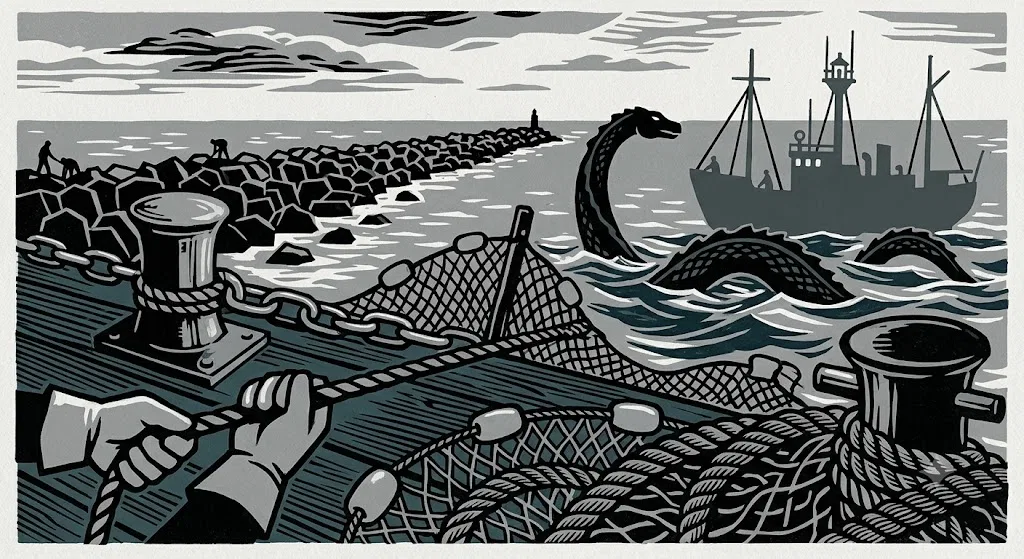
Colossal Claude is the name usually given to Oregon’s best-known sea-serpent legend: a large, long-necked creature reported around the Columbia River Bar and elsewhere along the Oregon coast from the 1930s into the mid-twentieth century. The strongest answer is not that Claude has been proven real, but that the legend grew from a small cluster of vivid maritime reports in a dangerous, wildlife-rich setting where strange shapes, surf, fog, fishing gear, seals, sea lions, carcasses and old newspaper storytelling could all help turn an uncertain sighting into a monster. The key case began in March 1934, when crew associated with the lightship tender Rose reported an unknown creature near the South Jetty at the mouth of the Columbia River. Later reports added horse-like heads, camel-like faces, hairy bodies, fish-stealing behaviour and strange carcasses, giving Oregon a coastal monster tradition distinct from its better-known Bigfoot lore.[Oregon Encyclopedia]oregonencyclopedia.orgSea Serpent Lore…
The 1934 Columbia River Bar sighting
The origin point for Colossal Claude is unusually specific for a sea-monster story. The Oregon Encyclopedia places the decisive report in March 1934, when the crew of the lightship tender Rose saw an unidentified creature near the South Jetty at the mouth of the Columbia River. Newspaper accounts quoted by that entry described a long body, estimated at least forty feet, with the head initially under water. The Salem Capital Journal version, as summarised there, said Captain J. F. Jensen reported that all crew members saw the serpent and that it had an eight-foot neck and large head.[Oregon Encyclopedia]oregonencyclopedia.orgSea Serpent Lore…
That detail matters because the story was not framed as a lone beachcomber’s glimpse. It was a maritime sighting by people whose work put them around the bar, the jetties and anchored vessels. Offbeat Oregon’s account adds that crew members watched the animal through field glasses and wanted to launch a small boat for a closer look, but officers refused because the creature seemed large enough to swamp them. The same account identifies the Columbia lightship LV-88 as the lightship associated with the 1934 claim, noting that it served from 1909 until 1939 before being replaced.[Offbeat Oregon]offbeatoregon.comOpen source on offbeatoregon.com.
The location also shaped the legend. The Columbia River Bar is not a calm lake or a decorative stretch of coastline; it is the meeting point of the Pacific Ocean and the Columbia River. Oregon State Parks describes the bar as a place where the river slows, drops sand and silt, and builds a fan-shaped sandbar extending more than six miles into the ocean. Strong river discharge can collide with heavy Pacific waves, making the crossing dangerous, with weather and waves that change quickly.[Oregon State Parks]stateparks.oregon.govState ParksState Parks
That combination gives the 1934 report its character. A long object seen in broken water at a hazardous river mouth is not the same kind of evidence as a specimen, photograph or body. But it is exactly the sort of experience that can feel persuasive to witnesses: a shared glimpse, a professional setting, a recognisable place, and just enough detail to become a named creature.

Why Claude belonged to the Columbia mouth
Colossal Claude became associated with Oregon because the Columbia River mouth provided both a dramatic setting and a plausible feeding-ground in the imagination of witnesses and later writers. The bar sits at the state’s north-western edge, near Astoria, where river traffic, fishing, salmon runs, jetties, lightships and dangerous water all met in one highly visible place. The Columbia River Maritime Museum in Astoria still foregrounds this maritime context, including the Lightship Columbia and exhibits about the dangerous Columbia River Bar.[Columbia River Maritime Museum]crmm.orgColumbia River Maritime Museum HomeColumbia River Maritime Museum Home
The salmon connection is one reason the legend has had staying power. Offbeat Oregon argues that the main “confirmed” Claude reports clustered around the spring Chinook salmon season near the river mouth, when large numbers of fish would have been moving through the area. That observation does not prove a monster, but it does explain why a large predator story would make intuitive sense to fishermen and newspaper readers.[Offbeat Oregon]offbeatoregon.comOpen source on offbeatoregon.com.
There is also a real ecological baseline behind the idea that predators gather where fish are concentrated. A NOAA Fisheries report on pinnipeds and salmonids notes that predation on free-swimming salmonids is more likely in nearshore areas and rivers where fish are concentrated, including bays and river systems. That supports a mundane version of the same logic: known animals such as seals and sea lions have good reason to be near fish runs and fishing activity.[NOAA Fisheries]fisheries.noaa.govOpen source on noaa.gov.
So Claude’s “habitat” is partly physical and partly narrative. The Columbia Bar supplies rough water, partial views, intense maritime labour and abundant fish. Those ingredients are enough to make a strange animal report memorable even if the animal itself remains unidentified.
Later coast reports and sea-serpent features
After 1934, Oregon’s sea-serpent reports spread beyond the Columbia Bar and picked up a more elaborate set of features. In 1937, Captain Charles E. Graham of the troller Viv reported a long, hairy, tan-coloured creature with the head of an overgrown horse, about forty feet long and four feet thick. Later that year, a couple near Devil’s Churn by Yachats described a fifty-five-foot animal with a long neck and tail and a horselike head.[Oregon Encyclopedia]oregonencyclopedia.orgSea Serpent Lore…
The 1939 Argo report is one of the most colourful episodes. Captain Chris Anderson of the halibut schooner Argo said a monster came within ten feet of the vessel, lifted its head and neck above the waves, and took a twenty-pound fish from the crew’s line. In Offbeat Oregon’s retelling, Anderson described a camel-like head, coarse grey fur, glassy eyes and a bent snout.[Offbeat Oregon]offbeatoregon.comOpen source on offbeatoregon.com.
The reports were not identical, which is one reason scepticism is warranted. Some witnesses saw a long neck; others emphasised a horse, camel or cow-like head. Some accounts mention hair or fur, while others describe smooth skin, scales or a snakelike form. The Oregon Encyclopedia notes reports near Tillamook Bay, Bandon, Nelscott, Newport and Empire, with a recurring tendency to describe camel-like or horse-like heads but inconsistent body surfaces.[Oregon Encyclopedia]oregonencyclopedia.orgSea Serpent Lore…
Those inconsistencies do not make the stories worthless. They make them more interesting as folklore and witness history. Claude was not a neatly standardised monster at first. He became a composite: part Columbia Bar serpent, part fishing-boat encounter, part Oregon coast mystery animal, part newspaper creature.
Old Hairy, Marvin the Monster and ocean misidentification
The Claude tradition did not depend only on live sightings. Strange carcasses and underwater oddities also fed Oregon’s sea-monster imagination. In 1950, a strange animal nicknamed “Old Hairy” washed up at Delake, now associated with the Lincoln City area. The Oregon Encyclopedia records that local Town Marshal Andy Allum described it as hairy, cow-bodied and about a thousand pounds. Expert opinions differed: E. W. Gudger of the American Museum of Natural History thought it was a whale shark, the Oregon Department of Fish and Wildlife suggested whale blubber, and Fred J. Kohlruss of the University of Portland thought it was an elasmobranch, meaning a cartilaginous fish such as a shark or ray. It was never definitively identified.[Oregon Encyclopedia]oregonencyclopedia.orgSea Serpent Lore…
In 1963, Shell Oil Company underwater cameras filmed another strange-looking animal during offshore oil exploration. The Oregon Encyclopedia says the creature was about fifteen feet long, had barnacled ridges along its body, moved with a corkscrew motion, and became known as Marvin the Monster. There was no scientific consensus on its identity, and the entry treats it as part of the same coastal sea-monster tradition rather than proof of a new animal.[Oregon Encyclopedia]oregonencyclopedia.orgSea Serpent Lore…
These cases show why carcasses are tricky. A dead animal can look far stranger than it did alive. Decomposing sharks, whales and other marine animals can lose key identifying features, leaving “necks”, fibres, ridges or flipper-like structures that invite monster interpretations. A recent Guardian discussion of the Pacific Northwest’s Cadborosaurus debate notes that decomposing basking sharks can create a “pseudo-plesiosaur” effect, because the collapse of shark tissues may leave a long neck-like structure, small head and apparently furry or feathered fins.[The Guardian]theguardian.comOpen source on theguardian.com.
That does not solve Old Hairy or Marvin with certainty. It does, however, provide a cautionary rule for Oregon’s sea-serpent reports: the ocean is good at making ordinary remains look extraordinary.
What Claude may have been
The most evidence-aware reading is that Colossal Claude is a legend built from uncertain reports, not a confirmed species. Still, several explanations are worth separating because they answer different parts of the story.
Misidentified known marine animals are the most grounded explanation. Oregon’s coast has seals, sea lions, whales, sharks, fish and floating carcasses, any of which can look strange at distance, in rough water or in poor light. Sea lions are especially relevant because they form surface “rafts” and can gather where prey is abundant. Jim Rice of the Oregon Marine Mammal Stranding Network told YachatsNews that California sea lions often raft on the surface to rest, that the behaviour is seen more often in spring, and that male California sea lions are present in Oregon waters for much of the year.[Lincoln Chronicle]lincolnchronicle.orgOpen source on lincolnchronicle.org.
Predator-at-the-fish-run logic also points towards known animals. NOAA’s pinniped report explains that salmonid predation is more likely where fish are concentrated, including nearshore and river areas. In other words, if witnesses saw something large and active around fishing lines or salmon runs, a seal, sea lion or other known predator is a serious candidate before any unknown species is required.[NOAA Fisheries]fisheries.noaa.govOpen source on noaa.gov.
Optical and environmental effects matter at the Columbia Bar. Oregon State Parks describes the bar’s violent, fast-changing waves and weather, while its map and brochure emphasise the dangerous meeting of river, sandbar and Pacific swell. Broken surf can reveal and hide parts of an animal or floating object, turning several glimpsed shapes into one long creature.[Oregon State Parks]stateparks.oregon.govState ParksState Parks
Hoax, exaggeration and waterfront storytelling cannot be ruled out. Offbeat Oregon openly raises the possibility that some stories were fishermen amusing one another or feeding newspapers a good yarn. The number of group sightings complicates a simple hoax explanation, but group testimony is still not physical evidence.[Offbeat Oregon]offbeatoregon.comOpen source on offbeatoregon.com.
The surviving prehistoric reptile idea is the least plausible. Some cryptid retellings imagine Claude as a plesiosaur-like survivor, but Offbeat Oregon itself treats that theory as far-fetched and points out the obvious problems: plesiosaurs were air-breathing animals, would need to surface and rest, and would be extremely difficult to hide along a worked coastline for millions of years.[Offbeat Oregon]offbeatoregon.comOpen source on offbeatoregon.com.
How Claude changed from report to Oregon legend
Colossal Claude’s story changed because the evidence never narrowed into one clear identity. The 1934 Columbia River Bar report gave the legend a birthplace. The 1937 and 1939 accounts gave it a body: long neck, horse or camel-like head, hair or fur, large size and bold behaviour around fishing boats. The 1950 Old Hairy carcass and 1963 Marvin footage extended the tradition into the realm of physical oddities, even though neither produced a settled scientific answer.[Oregon Encyclopedia]oregonencyclopedia.orgSea Serpent Lore…
The name also helped. “Colossal Claude” is oddly homely for a sea monster, which may be why it stuck. It sounds less like a demon of the deep than a local character: something the coast might half-fear, half-joke about and keep alive in newspaper columns, museum-adjacent maritime memory and cryptid round-ups. Oregon’s Bigfoot stories belong mostly to forests and mountains; Claude belongs to jetties, lightships, fishing lines, rough bars and fogbound water.
The Oregon Encyclopedia suggests sightings of Claude or similar creatures appear to have ended by about 1960, with Marvin the Monster reviving interest in 1963 rather than continuing a steady run of reports. That tapering matters. A living population of large unknown marine animals should leave more than anecdotes: repeated clear photographs, biological samples, strandings, sonar records, genetic traces or remains. Instead, Claude survives as a case family: a set of reports clustered by place, period and imagery, not a verified animal.[Oregon Encyclopedia]oregonencyclopedia.orgSea Serpent Lore…
Did Colossal Claude really haunt Oregon’s coast?
The fairest answer is that Colossal Claude really did haunt Oregon’s coastal imagination, but there is no strong evidence that a single unknown sea-serpent species haunted the water. The 1934 lightship-associated sighting, the Viv and Argo reports, the Devil’s Churn account, Old Hairy and Marvin the Monster are valuable as folklore evidence and local history. They show how working seascapes produce monster stories: people see something strange, newspapers preserve the moment, later writers connect scattered accounts, and a regional creature emerges.[Oregon Encyclopedia]oregonencyclopedia.orgSea Serpent Lore…
Claude remains Oregon’s most distinctive non-Bigfoot monster because the story is inseparable from the state’s coast. It needs the Columbia River Bar’s rough water, Astoria’s maritime culture, the salmon runs, the old lightship world and the long Oregon shoreline where carcasses and animals can appear suddenly and vanish just as fast. As a biological claim, Claude is weak. As an Oregon legend, he is unusually well placed: a sea serpent born where one of America’s great rivers meets the Pacific, seen just clearly enough to be remembered and never clearly enough to be resolved.
Amazon book picks
Further Reading
Books and field guides related to Did Colossal Claude Really Haunt Oregon's Coast?. Use these as the next step if you want deeper reading beyond the article.
Mysterious America
Includes numerous American monster traditions and mystery-animal reports.
Abominable Science!
Explains how sea-serpent legends can emerge from misidentification and folklore.
Field Guide to Lake Monsters, Sea Serpents, and Other Mystery...
Focused specifically on sea-serpent and aquatic-monster traditions.
The United States of Cryptids
Places Colossal Claude among regional American cryptid legends.
eBay marketplace picks
Marketplace Samples
Live-tested eBay searches with available results related to this page.
Endnotes
1.
Source: oregonencyclopedia.org
Title: Oregon Encyclopedia
Link:https://www.oregonencyclopedia.org/articles/sea-serpent-lore/
Source snippet
Sea Serpent Lore...
2.
Source: stateparks.oregon.gov
Title: State Parks
Link:https://stateparks.oregon.gov/index.cfm?do=main.loadFile&load=_siteFiles%2Fpublications%2F%2F46058_Graveyard_of_Pacific_2020%28web%29101052.pdf
3.
Source: fisheries.noaa.gov
Link:https://www.fisheries.noaa.gov/s3//dam-migration/pinniped-rpt.pdf
4.
Source: fisheries.noaa.gov
Title: conservation management
Link:https://www.fisheries.noaa.gov/species/california-sea-lion/conservation-management
5.
Source: offbeatoregon.com
Link:https://offbeatoregon.com/20-02.columbia-river-bar-sea-serpent-colossal-claude.html
6.
Source: crmm.org
Title: Columbia River Maritime Museum Home
Link:https://www.crmm.org/
7.
Source: theguardian.com
Link:https://www.theguardian.com/environment/2026/may/07/basking-shark-sea-monster-canada-marine-mystery-90-years-on
8.
Source: lincolnchronicle.org
Link:https://lincolnchronicle.org/see-those-sea-lion-rafts-offshore-heres-an-experts-explanation-and-more/
9.
Source: Wikipedia
Title: Columbia Bar
Link:https://en.wikipedia.org/wiki/Columbia_Bar
10.
Source: Wikipedia
Title: Columbia River Maritime Museum
Link:https://en.wikipedia.org/wiki/Columbia_River_Maritime_Museum
11.
Source: Wikipedia
Link:https://en.wikipedia.org/wiki/Cadborosaurus
12.
Source: crmm.org
Title: lightship columbia
Link:https://www.crmm.org/lightship-columbia.html
13.
Source: cryptidz.fandom.com
Title: Colossal Claude
Link:https://cryptidz.fandom.com/wiki/Colossal_Claude
14.
Source: redmondspokesman.com
Title: offbeat oregon colossal claude the great columbia bar sea serpent
Link:https://redmondspokesman.com/2020/05/13/offbeat-oregon-colossal-claude-the-great-columbia-bar-sea-serpent/
15.
Source: youtube.com
Title: Colossal Claude
Link:https://www.youtube.com/watch?v=Kw6XUlYQPxM
16.
Source: tripadvisor.com
Title: Columbia River Maritime Museum
Link:https://www.tripadvisor.com/Attraction_Review-g60806-d107660-Reviews-Columbia_River_Maritime_Museum-Astoria_Oregon.html
17.
Source: casago.com
Title: Columbia River Maritime Museum
Link:https://casago.com/north-coast-oregon/things-to-do/columbia-river-maritime-museum/
Additional References
18.
Source: loc.gov
Link:https://www.loc.gov/pictures/item/or0583/
19.
Source: journal.wildlife.ca.gov
Link:https://journal.wildlife.ca.gov/2024/06/06/trends-in-pinniped-interactions-with-commercial-passenger-fisheries-vessels-in-california/
20.
Source: reddit.com
Link:https://www.reddit.com/r/Cryptozoology/comments/uxdf9a/marvin_the_monster_an_unclassified_15_ft_marine/
21.
Source: facebook.com
Link:https://www.facebook.com/Timesnow/posts/a-rotting-carcass-of-a-bizarre-sea-creature-washed-ashore-on-a-coast-in-the-unit/10167148561095311/
22.
Source: facebook.com
Link:https://www.facebook.com/ktvznews/posts/as-the-season-turns-darker-oregon-lotterys-new-oregon-monsters-scratch-it-will-s/1109694214212490/
23.
Source: facebook.com
Link:https://www.facebook.com/groups/seadooforum/posts/2106449379707302/
24.
Source: facebook.com
Link:https://www.facebook.com/groups/thetricities/posts/5845688425472690/
25.
Source: dailyastorian.com
Link:https://dailyastorian.com/2019/04/05/in-one-ear-did-you-see-that-3/
26.
Source: facebook.com
Link:https://www.facebook.com/groups/museumships/posts/1572549933352883/
27.
Source: facebook.com
Link:https://www.facebook.com/groups/617358921680788/posts/24474917888831557/
Topic Tree