Within Montana Monsters
Was the Ringdocus a Monster or a Wolf?
The Shunka Warak'in story blends Indigenous folklore, ranchland fear and a strange mounted canid from the Madison Valley.
On this page
- The carries off dogs folklore thread
- The Madison Valley carcass story
- Taxidermy, memory and the wolf explanation
Page outline Jump by section
Introduction
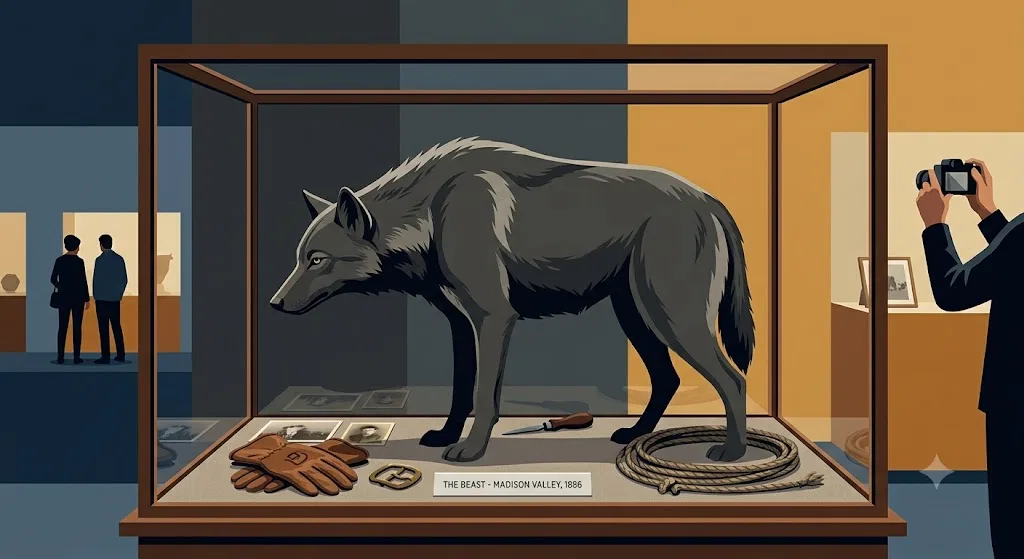
The Ringdocus is Montana’s most famous “monster with a body”: a mounted, wolf-like canid said to have been shot in the Madison Valley in 1886, preserved by a taxidermist, lost for decades, rediscovered in storage, and eventually displayed at the Madison Valley History Museum in Ennis. The mystery is not that Montana proves an unknown beast existed. It is that this particular specimen sits at the crossroads of three stories: an Indigenous “carries off dogs” folklore thread, a ranchland account of a strange predator killing livestock, and a taxidermy mount whose odd shape keeps inviting the question, “wolf, wolf-dog, bad mount, or something stranger?”[Atlas Obscura]atlasobscura.comAtlas Obscura Beware Montana’s Shunka Warak’in, the 'Rocky Mountain HyenaAtlas Obscura Beware Montana’s Shunka Warak’in, the 'Rocky Mountain Hyena
The cautious answer is that the Ringdocus was probably a known canid, most plausibly a grey wolf, wolf-dog, or unusually mounted wolf-like animal. Montana’s own wildlife records show that grey wolves in the state can be large, dark, and variable in appearance, which is enough to explain many “not quite a wolf” impressions without inventing a new species. But as a Montana legend, the Ringdocus matters because it gives an unusually physical centrepiece to an old predator fear: the night animal that slips into camp, takes dogs, worries livestock, screams in the dark, and leaves people arguing over what they saw.[Montana Field Guide]fieldguide.mt.govGray Wolf - Montana Field Guide…
The carries-off-dogs folklore thread
The name usually attached to the creature is translated in modern retellings as “carries off dogs”. Native Languages of the Americas presents the figure as a nocturnal monster from Ioway folklore, said to prey on family dogs at night and resemble a large wolf with human-like cries. That matters because the folklore element is not simply “big scary wolf”. The striking detail is behavioural: the animal is remembered as a camp-raider, something bold enough to come close to people and take valued domestic animals.[Native Languages]native-languages.orgOpen source on native-languages.org.
That dog-stealing motif makes the Shunka Warak’in feel different from a generic wilderness monster. Dogs are boundary animals: they guard the edge between the human camp and the dark beyond it. A creature that carries them off is therefore not just a predator but a trespasser. In later cryptid writing, that image fitted neatly with ranchland stories from Montana, where wolves, dogs, livestock and isolated homesteads already supplied the emotional grammar of fear.
The link between the Ioway folklore name and the Montana mount should be treated carefully. Atlas Obscura reports that Lance Foster, a historic site preservationist and member of the Ioway tribe, suggested that the mounted animal might be connected with the folklore creature; the name was then popularised in cryptozoological writing, including Loren Coleman’s work. In other words, the name did not necessarily begin as a Madison Valley ranch term. It became attached later because the story of the Ringdocus looked like a physical echo of the “carries off dogs” tradition.[Atlas Obscura]atlasobscura.comAtlas Obscura Beware Montana’s Shunka Warak’in, the 'Rocky Mountain HyenaAtlas Obscura Beware Montana’s Shunka Warak’in, the 'Rocky Mountain Hyena
That distinction helps keep the story honest. The Shunka Warak’in is a folklore figure with its own cultural setting. The Ringdocus is a Montana taxidermy specimen with a settler-ranching backstory. The modern legend fuses them, but the fusion is part of the history rather than proof that both stories originally described the same animal.

The Madison Valley carcass story
The Montana part of the tale centres on Israel Ammon Hutchins and the Madison Valley north of Ennis. The standard account says that in 1886 Hutchins shot a strange, dark, wolf-like predator after it had been attacking or worrying local domestic animals. Atlas Obscura’s account places the incident in the Madison Valley and describes the animal as canine-like, dark, and associated with night screams that witnesses did not interpret as ordinary wolf or dog sounds.[Atlas Obscura]atlasobscura.comAtlas Obscura Beware Montana’s Shunka Warak’in, the 'Rocky Mountain HyenaAtlas Obscura Beware Montana’s Shunka Warak’in, the 'Rocky Mountain Hyena
The story then becomes wonderfully specific. Hutchins is said to have traded the carcass to Joseph Sherwood, a businessman and taxidermist, in exchange for a new cow. Sherwood mounted the animal and displayed it in his combined grocery store and museum at Henry Lake, Idaho, calling it the Ringdocus for reasons that remain unclear. The mount reportedly remained on display into the 1980s before vanishing from public view.[Atlas Obscura]atlasobscura.comAtlas Obscura Beware Montana’s Shunka Warak’in, the 'Rocky Mountain HyenaAtlas Obscura Beware Montana’s Shunka Warak’in, the 'Rocky Mountain Hyena
For many years, the strongest trace of the specimen was not the mount itself but a photograph. Ross Hutchins, a naturalist and grandson of Israel Hutchins, published a black-and-white image of the animal in his 1977 autobiography, where the creature was captioned “Guyasticutus”. Later writers have treated that odd caption variously: as another local name, a joke, or a showman’s label for an animal already being turned into a curiosity.[Atlas Obscura]atlasobscura.comAtlas Obscura Beware Montana’s Shunka Warak’in, the 'Rocky Mountain HyenaAtlas Obscura Beware Montana’s Shunka Warak’in, the 'Rocky Mountain Hyena
The rediscovery is one reason the Ringdocus has stayed alive as a Montana cryptid rather than fading into a campfire tale. According to the widely repeated modern account, Jack Kirby, another Hutchins descendant, traced Sherwood’s taxidermy collection to the Idaho Museum of Natural History, where it had been placed in storage after Sherwood’s museum closed. The mounted animal was found there and later loaned to the Madison Valley History Museum in Ennis. Atlas Obscura gives its measurements as about four feet long and twenty-eight inches at the shoulder, with a dark grey colour, low head and sloping back.[Atlas Obscura]atlasobscura.comAtlas Obscura Beware Montana’s Shunka Warak’in, the 'Rocky Mountain HyenaAtlas Obscura Beware Montana’s Shunka Warak’in, the 'Rocky Mountain Hyena
This is the point at which the Ringdocus becomes unusually compelling for a cryptid page. Most mystery-beast stories have only testimony. This one has testimony, a family tradition, an old photograph, a chain of display history, and a surviving mount. That does not make it an unknown species. It does mean the debate can focus on a real object rather than only on memory.
Why does it look so strange?
The Ringdocus is usually described as wolf-like but not quite wolf-shaped: a low head, sloping back, narrow-looking face and “hyena-like” profile. Travel and museum-oriented descriptions of the Madison Valley History Museum likewise emphasise a dark-brown or greyish wolf-like creature with a sloped back, odd head, narrow snout and lighter markings or stripes on the side.[Backroad to Yellowstone]backroadtoyellowstone.comBackroad to Yellowstone Madison Valley History MuseumBackroad to Yellowstone Madison Valley History Museum
There are several ways to read that oddness without leaping straight to an unknown predator.
A real wolf can look more variable than people expect. The Montana Field Guide describes the grey wolf as the largest wild dog, with adult Montana males averaging about 104 pounds and females about 80 pounds. It also notes that about half of Montana’s grey wolves are black and half grey, with both colour phases appearing in the same pack or even the same litter. A large dark wolf, especially if seen briefly, at night, or in the middle of livestock conflict, could easily become something more uncanny in memory.[Montana Field Guide]fieldguide.mt.govGray Wolf - Montana Field Guide…
Taxidermy can distort an animal. The Ringdocus is not a fresh carcass laid out for modern forensic examination; it is a historic mount made by a local taxidermist and displayed as a curiosity. A mount can exaggerate posture, head shape, back slope, leg length and facial expression. If the skin was stretched over an imperfect form, or if the taxidermist intentionally posed it for drama, the finished object may say as much about display culture as anatomy.
Wolf-dog or domestic-dog ancestry is plausible but unproven. Odd proportions, unusual coat patterning, or a less typical head could point towards domestic-dog influence. But without confirmed DNA testing or a formal anatomical study, “wolf-dog” remains an explanation rather than a conclusion.
The hyena comparison is visually tempting but biologically weak. North America really did once have hyenas: the extinct genus Chasmaporthetes is known from Pleistocene fossils, and a 2019 peer-reviewed paper reported Chasmaporthetes teeth from the Old Crow Basin in Yukon, filling an important gap between Old World and New World records. That deep-time fact is fascinating, but it does not provide evidence that hyenas survived into historic Montana. It mainly explains why the idea of an “American hyena” has such storytelling pull.[Open Quaternary]openquaternary.comOpen source on openquaternary.com.
The simplest reading is therefore not “case closed” but “known animal first”. A wolf-like mount from wolf country does not need to be a new species to look eerie. The question is whether the odd features are biological, the result of taxidermy, or a mixture of both.
Taxidermy, memory and the wolf explanation
The Ringdocus has a stronger material anchor than most Montana monster stories, but its evidential value is still limited. The mount has not been publicly identified through a widely reported, peer-reviewed anatomical or genetic analysis. Popular articles repeatedly note the lack of conclusive testing, and modern discussion often turns on whether the mystery should be solved by DNA or preserved as part of the object’s appeal.[Treasure State Lifestyles]treasurestatelifestyles.comTreasure State Lifestyles Meet Montana's Monsters!Treasure State Lifestyles Meet Montana's Monsters!
The wolf explanation is strengthened by Montana’s real ecology. Grey wolves are native to the region, and the Montana Field Guide states that wolves were essentially extirpated from Montana and the western United States in the early twentieth century because of conflict with people, before recolonisation and later reintroduction helped restore them to much of western Montana. That history matters because the Ringdocus story belongs to the older world of settlement-era predator conflict, when wolves were both real animals and loaded symbols of danger to stock, dogs and livelihoods.[Montana Field Guide]fieldguide.mt.govGray Wolf - Montana Field Guide…
A useful modern comparison comes from a different Montana “mystery canine” episode. In 2018, an odd wolf-like animal shot in Montana drew national speculation because its appearance did not seem to fit people’s expectations. DNA testing by the U.S. Fish and Wildlife Service forensic laboratory later identified it as a grey wolf from the northern Rocky Mountains. That case does not identify the Ringdocus, but it shows how quickly an unusual-looking canid can become a monster story before genetic evidence pulls it back into the ordinary wildlife record.[CBS News]cbsnews.comCBS News DNA test solves mystery of wolf-like creature shot in MontanaCBS News DNA test solves mystery of wolf-like creature shot in Montana
The strongest sceptical position is therefore straightforward: the Ringdocus is probably a wolf, wolf-dog, or damaged/awkwardly mounted canid whose strange look was amplified by family lore, taxidermy display, and cryptid culture. The strongest mystery-friendly position is narrower: because the specimen exists and has not been conclusively tested in public, the exact identity remains unresolved at the level of the individual animal.
That is a better mystery than “an unknown species roams Montana”. It is a smaller, more interesting question: what exactly is this mount, and how much of its monster status comes from the body itself rather than the stories layered over it?
How later accounts reshaped Ringdocus
The Ringdocus story has passed through several identities. First it was a ranch predator: a troublesome animal in a livestock landscape. Then it became a roadside or store-museum curiosity: a mounted oddity with a strange name. After the mount disappeared from view, it became a rumour with a photograph. Once rediscovered and displayed in Ennis, it became a local museum attraction and one of Montana’s most tangible cryptid traditions.[Atlas Obscura]atlasobscura.comAtlas Obscura Beware Montana’s Shunka Warak’in, the 'Rocky Mountain HyenaAtlas Obscura Beware Montana’s Shunka Warak’in, the 'Rocky Mountain Hyena
The names trace that evolution. “Ringdocus” feels like a showman’s label, attached to a specimen by the man who displayed it. “Guyasticutus” appears in the Ross Hutchins photograph caption and has the feel of a whimsical or invented monster name. “Shunka Warak’in” brings in the carries-off-dogs folklore frame. “Rocky Mountain hyena” turns the animal into a regional cryptid category. “The Beast”, the museum-friendly nickname, keeps the attraction simple for visitors.[Atlas Obscura]atlasobscura.comAtlas Obscura Beware Montana’s Shunka Warak’in, the 'Rocky Mountain HyenaAtlas Obscura Beware Montana’s Shunka Warak’in, the 'Rocky Mountain Hyena
That naming history is not trivial. Each name tells readers what kind of story they are being invited to hear. Ringdocus is a curiosity. Shunka Warak’in is folklore. Rocky Mountain hyena is cryptozoology. The Beast is tourism and local memory. The animal itself may not have changed at all, but the story’s meaning has shifted every time it entered a new setting.
Was the Ringdocus a monster or a wolf?
The most evidence-aware answer is: probably a wolf-like canid, not a confirmed monster, but one with an unusually rich afterlife. The Ringdocus does not prove that Montana had a hidden hyena-like species in the nineteenth century. The fossil record shows that hyenas once lived in North America, but the known evidence places them in deep prehistory, not in recent Madison Valley ranchland. Montana’s real wolves, by contrast, are large, colour-variable and historically entangled with livestock conflict, which makes them the strongest baseline explanation.[Open Quaternary]openquaternary.comOpen source on openquaternary.com.
What keeps the case alive is the specimen. If the mount were conclusively tested and shown to be a wolf, the folklore would not disappear; it would simply become a story about how a wolf became a monster through fear, memory and display. If testing showed wolf-dog ancestry, the story would gain a neat biological twist. If it showed something unexpected within Canidae, that would be genuinely interesting, though still far from proving the wider cryptid tradition.
Until then, the Ringdocus is best understood as Montana’s perfect mystery-beast object: strange enough to make visitors stop, physical enough to separate it from pure rumour, and ordinary enough that the most likely explanation may still be a wolf wearing a century of stories.
Amazon book picks
Further Reading
Books and field guides related to Was the Ringdocus a Monster or a Wolf?. Use these as the next step if you want deeper reading beyond the article.
Of Wolves and Men
The Ringdocus mystery revolves around wolf-like animals and human perceptions of them.
American Wolf
Provides modern context for wolf legends and conflicts in the American West.
Abominable Science!
Useful for evaluating whether unusual specimens indicate unknown animals.
eBay marketplace picks
Marketplace Samples
Live-tested eBay searches with available results related to this page.

Endnotes
1.
Source: fieldguide.mt.gov
Title: Montana Field Guide
Link:https://fieldguide.mt.gov/speciesDetail.aspx?elcode=amaja01030
Source snippet
Gray Wolf - Montana Field Guide...
2.
Source: native-languages.org
Link:https://www.native-languages.org/morelegends/shunka-warekin.htm
3.
Source: wolf.org
Link:https://wolf.org/wow/united-states/montana/
4.
Source: montana.edu
Link:https://www.montana.edu/extension/sanders/Wolf%20Identification.pdf
5.
Source: atlasobscura.com
Title: Atlas Obscura Beware Montana’s Shunka Warak’in, the ‘Rocky Mountain Hyena’
Link:https://www.atlasobscura.com/articles/shunka-warakin-cryptid-ocker
6.
Source: backroadtoyellowstone.com
Title: Backroad to Yellowstone Madison Valley History Museum
Link:https://backroadtoyellowstone.com/attraction/madison-valley-history-museum/
7.
Source: openquaternary.com
Link:https://openquaternary.com/articles/10.5334/oq.64
8.
Source: treasurestatelifestyles.com
Title: Treasure State Lifestyles Meet Montana’s Monsters!
Link:https://treasurestatelifestyles.com/meet-montanas-monsters/
9.
Source: cbsnews.com
Title: CBS News DNA test solves mystery of wolf-like creature shot in Montana
Link:https://www.cbsnews.com/news/dna-test-reveals-identity-of-mysterious-wolf-creature-shot-in-montana/
10.
Source: fieldguide.mt.gov
Link:https://fieldguide.mt.gov/ca/?Species=Canis+lupus
11.
Source: fwp.mt.gov
Link:https://fwp.mt.gov/conservation/wildlife-management/wolf
12.
Source: cryptidz.fandom.com
Title: Shunka Warak’in
Link:https://cryptidz.fandom.com/wiki/Shunka_Warak%27in
13.
Source: cryptidarchives.fandom.com
Title: American hyena
Link:https://cryptidarchives.fandom.com/wiki/American_hyena
14.
Source: thecreaturecodex.wordpress.com
Link:https://thecreaturecodex.wordpress.com/2017/09/20/ringdocus/
15.
Source: Wikipedia
Link:https://en.wikipedia.org/wiki/Chasmaporthetes
16.
Source: w.montanatrappers.org
Link:https://w.montanatrappers.org/furbearers/managed/wolf.html
17.
Source: encyclopediaofthesnakeriverplain.substack.com
Link:https://encyclopediaofthesnakeriverplain.substack.com/p/ringdocus
18.
Source: catalog.hathitrust.org
Link:https://catalog.hathitrust.org/Record/001683325
19.
Source: terrireid.com
Link:https://terrireid.com/ringdocus/
Additional References
20.
Source: youtube.com
Title: American Hyenas and the Legend of the Shunka Warakin
Link:https://www.youtube.com/watch?v=QFohraio3-s
Source snippet
The Shunka Warakin & The Devil Monkey - Bonus Cryptid Adventure...
21.
Source: instagram.com
Link:https://www.instagram.com/p/CVsogbsLTae/
22.
Source: researchgate.net
Link:https://www.researchgate.net/publication/333855527_First_Fossils_of_Hyenas_Chasmaporthetes_Hyaenidae_Carnivora_from_North_of_the_Arctic_Circle
23.
Source: reddit.com
Link:https://www.reddit.com/r/Cryptozoology/comments/1fnr28d/american_hyenas_and_the_legend_of_the_shunka/
24.
Source: inaturalist.org
Link:https://www.inaturalist.org/taxa/1235878-Chasmaporthetes-lunensis
25.
Source: reddit.com
Link:https://www.reddit.com/r/Cryptozoology/comments/1j20n89/chasmaporthetes_ossifragus_is_a_hyena_species/
26.
Source: instagram.com
Link:https://www.instagram.com/p/DZgX2HLt9Fs/
27.
Source: facebook.com
Link:https://www.facebook.com/NaturalHabitatAdventures/posts/enjoy-these-interesting-and-unique-characteristics-about-the-worlds-most-majesti/1114018710754602/
28.
Source: hangar1publishing.com
Link:https://hangar1publishing.com/blogs/cryptids/shunka-warakin?srsltid=AfmBOooq0hp8V7vjROJ3rylGH1-Wu7L-ycAIUznCB-BBKMcdXFDtrkoK
29.
Source: hangar1publishing.com
Link:https://hangar1publishing.com/blogs/cryptids/shunka-warakin?srsltid=AfmBOooYXzpu4xOuyCQU_p7UPxQecAyISuxUfe97chg3UG4SgWRLm84I
Topic Tree