What Lurks in Missouri's Monster Country?
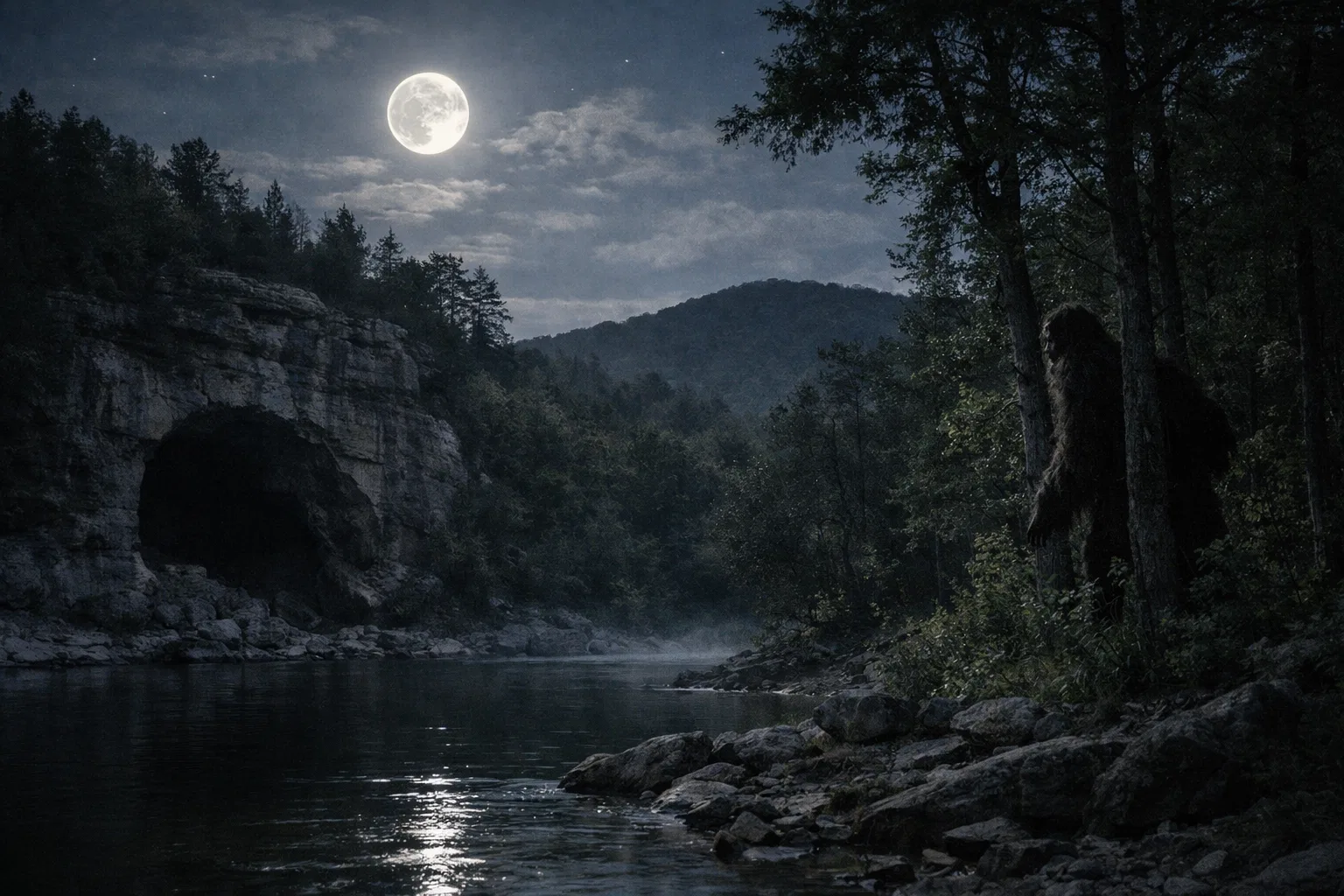
Missouri’s cryptid tradition is strongest where wooded hills, river bluffs, old newspapers and small-town storytelling meet. The state’s best-known mystery beast is Mo Mo, the Missouri Monster, a foul-smelling Bigfoot-like figure reported around Louisiana, Missouri, in 1972.
Page outline Jump by section
Why Missouri makes good monster country
Missouri is especially well suited to creature stories because its landscape gives the imagination places to hide things. Southern Missouri’s Ozark forests and woodlands are rugged, broken by deep valleys, rocky soils, moist bottomlands, dry hilltops, caves, springs and sinkholes. The Missouri Department of Conservation describes the Ozarks as an old eroded highland region with extensive karst topography, where oak woods are typical and shortleaf pine remnants survive in the east. That mixture of dense summer vegetation, bluffs, hollows and cave country helps explain why so many Missouri mystery-beast stories are set not in open prairie, but in wooded edges and rough country where a brief glimpse can become a legend.[Missouri Department of Conservation]mdc.mo.govOpen source on mo.gov.
The state also has real large animals that can feed mystery reports. Black bears, now returning in Missouri, are the only bear species in the state; most live south of Interstate 44, while wandering individuals, especially young males, can appear outside that core range. Mountain lions are also confirmed from time to time, though Missouri does not have a large settled breeding population comparable to western states. Bobcats are present too, often secretive and active at night or twilight, and their range has expanded beyond the Ozarks and Bootheel in recent decades. These real animals do not explain every story, but they do provide a practical baseline before turning a night sound or distant shape into a monster.[Missouri Department of Conservation]mdc.mo.govOpen source on mo.gov.
A second reason Missouri’s cryptids last is cultural rather than biological. The Ozarks have a strong tradition of oral storytelling, tall tales and local newspaper curiosities. In an Ozarks Alive article on the Blue Man, local historian Sharon Sanders describes past storytellers as “kidders”, while another historian notes that people told tall tales partly because there was little entertainment. That does not mean every witness is lying; it means Missouri monster stories often grew in an environment where joking, exaggeration, family lore and genuine fright could all occupy the same tale.[Ozarks Alive]ozarksalive.comOpen source on ozarksalive.com.
Mo Mo: Missouri’s signature monster flap
Mo Mo is the centrepiece of Missouri cryptid history because it has a precise place, a memorable moment and a media afterlife. The story is tied to Louisiana, Missouri, in Pike County, especially Marzolf Hill, now often referred to as Star Hill, near Allen Street. Missouri Life places the legend’s emergence in July 1972 and identifies the Harrison home at 1004 Allen Street as the usual starting point for the best-known account.[Missouri Life]missourilife.comOpen source on missourilife.com.
The core version is vivid. On 11 July 1972, Doris Harrison, then a teenager, reportedly looked out after hearing her younger brothers scream and saw a large, hairy creature near the edge of the woods. Later retellings describe a roughly seven-foot figure, a putrid smell, bloody or unkempt fur, and a dead dog carried or clutched by the creature. These details made Mo Mo instantly more cinematic than a vague “something in the woods” report: it had a location, young witnesses, a smell, a threatening object and a name-ready identity as “the Missouri Monster”.[Muddy River News]muddyrivernews.comMuddy River News Missouri Life magazine looks anew at 50-year-old MoMuddy River News Missouri Life magazine looks anew at 50-year-old Mo
The evidence, however, never rose beyond witness claims, searches and story fragments. Missouri Life reports that news accounts described a three-hour search of roughly 100 acres by law enforcement and volunteers. Searchers found disturbed dog graves and scattered bones, but no monster; the quoted conclusion from the search leader was that nothing resembling a monster was on Marzolf Hill. The Missouri Department of Conservation’s Nature Boost transcript likewise treats Mo Mo as a story with believers and sceptics rather than a verified animal, noting that the searchers looked for tracks and animal remains but found only questionable dog graves.[Missouri Life]missourilife.comOpen source on missourilife.com.
What made Mo Mo bigger than a backyard scare was the speed of the media and commercial response. Missouri Life notes that the creature’s name seems to have emerged after the initial report, and that by early August 1972 local merchants were using Mo Mo for sidewalk sales, special food items and town promotion. The Conservation Department transcript also records that Mo Mo inspired books, television, a film and music, including Bill Whyte’s 1972 “Mo Mo The Missouri Monster”. In other words, even if the creature was never proven, “Mo Mo mania” was real.[Missouri Life]missourilife.comOpen source on missourilife.com.
The strongest sceptical reading is that Mo Mo was probably a prank or a misidentified person or animal, amplified by press attention. Missouri Life’s later reflection says there is “overwhelming evidence” that Mo Mo, at least as a continuing monster phenomenon, was a hoax, while also allowing that Doris Harrison may genuinely have seen something. That distinction matters: folklore analysis does not need to call witnesses fools. It can recognise a frightening perception, a possible prank, a media event and a town legend all at once.[Missouri Life]missourilife.comMissouri Life The enduring legend of Mo MoMissouri Life The enduring legend of Mo Mo

The Blue Man of Spring Creek and Missouri’s older wild-men stories
Mo Mo was not Missouri’s first hairy humanoid. The Blue Man of Spring Creek is a much older Ozark “wild man” tradition tied mainly to Douglas County and neighbouring Ozark and Howell counties. Ozarks Alive reports that alleged experiences were not confined to one county, with stories appearing in places such as Ozark and Howell as well as Douglas County. The legend includes an 1874 experience, later sightings into the 1890s, and a 1911 tale in which a posse supposedly raided the Blue Man’s den and found animal remains.[Ozarks Alive]ozarksalive.comOpen source on ozarksalive.com.
The Blue Man’s 1915 newspaper burst is especially useful because it shows how older monster lore moved before television or the internet. Several newspapers picked up the story after loggers near Willow Springs reportedly saw him near Blue Rock Mountain. Papers described the “mysterious Blue Man of Spring Creek” returning to his old haunts, while another called him a “wild man at large”. These accounts sound like proto-Bigfoot material, but they are also newspaper entertainment: the monster becomes a roaming headline, reshaped for readers far from the hills where he supposedly lived.[Ozarks Alive]ozarksalive.comOpen source on ozarksalive.com.
Just as important is the local pushback. Ozarks Alive cites 1915 residents who denied the Blue Man’s existence and objected that such stories made the region look dangerous and backward. That reaction is easy to miss in monster round-ups, but it is central to understanding Missouri folklore. Creature stories can be fun for outsiders, yet embarrassing or irritating for locals who dislike seeing their home reduced to armed posses, wild men and hill-country menace.[Ozarks Alive]ozarksalive.comOpen source on ozarksalive.com.
The Blue Man also demonstrates how legends can be revived by later media. Ozarks Alive reports that the tale resurfaced in the 1920s and eventually became entangled with modern Bigfoot television. Researcher Vincent Anderson, who was involved when Finding Bigfoot filmed in the area, warned that reality television did not reflect reality and said he disagreed with some interview choices. That is a useful caution for any Missouri cryptid page: a legend can be local history, family memory, entertainment product and dubious television material at the same time.[Ozarks Alive]ozarksalive.comOpen source on ozarksalive.com.
The Ozark Howler: horned beast, night scream or travelling folklore?
The Ozark Howler is less securely anchored in Missouri than Mo Mo, but it belongs in the state’s creature tradition because the Ozarks cross the Missouri-Arkansas line. Modern descriptions usually present it as a dark, bear-sized or large-cat-like animal with a terrifying cry; some versions add horns, glowing eyes or a shaggy coat. Public folklore pages describe its territory as southern Missouri and northern Arkansas, while a 2024 Garden & Gun feature notes that reported sightings cluster across the Ozarks and that origin claims range from frontier-era Daniel Boone stories to Indigenous or immigrant folklore influences.[Unlock The Ozarks]unlocktheozarks.orgUnlock The Ozarks Ozark HowlerUnlock The Ozarks Ozark Howler
The Howler is a good example of a cryptid with unstable anatomy. In one telling it is bear-like; in another, a horned panther; in another, a black dog or devil cat; in another, chiefly a sound heard in deep woods. That instability weakens the case for a single unknown animal but strengthens the case for a flexible regional legend. The Howler can absorb real night sounds, hunting anxiety, cougar rumours, bear sightings and older supernatural animal motifs without needing one fixed biological form.[Garden & Gun]gardenandgun.commeet the ozark howler the souths most cryptic cryptidmeet the ozark howler the souths most cryptic cryptid
Plausible explanations include bobcats, foxes, coyotes, dogs, owls, bears, livestock, distorted echoes and simple hoaxes. Bobcats are especially relevant because they are secretive, can travel several miles within their range, and are not rare in Missouri, even though many people seldom see them. Black bears add a second layer because they are large, dark, increasingly present in southern Missouri and capable of startling people in wooded country. A mystery scream in the Ozarks is therefore not automatically a monster; it may be an ordinary animal heard under extraordinary conditions.[Missouri Department of Conservation]mdc.mo.govOpen source on mo.gov.
The Howler still matters because it expresses something real about the Ozark night: sound carries strangely through hollows, known animals are often unseen, and a half-heard cry can feel bigger than its source. Its value as folklore is not that it proves a horned predator is roaming Missouri, but that it preserves the feeling of being in country where the dark is alive with noises one cannot immediately name.

Black panthers and phantom cats
“Black panther” reports are among the most persistent mystery-animal claims in Missouri. They are also where official wildlife explanation is clearest. The Missouri Department of Conservation says its Mountain Lion Response Team receives black panther reports, but that no species of large black cat occurs naturally in the United States. The department’s mountain-lion guide states that melanistic, or all-black, large cats are known in leopards and jaguars, not documented mountain lions, and concludes that such reports are cases of mistaken identity or escaped exotic pets.[Missouri Department of Conservation]mdc.mo.govMissouri Department of Conservation Mountain Lions in MissouriMissouri Department of Conservation Mountain Lions in Missouri
That official position does not mean all cat reports are nonsense. Mountain lions do pass through Missouri, and the state maintains a confirmed-reports page. MDC guidance also explains why evidence is difficult: photos may be common house cats without scale, images attributed to Missouri may have been taken in other states, and tracks, prey remains and sighting locations require careful verification. In the same guide, MDC illustrates the size difference between mountain lions, bobcats and domestic cats and notes that the team uses life-sized cut-outs and site visits to judge scale.[Missouri Department of Conservation]mdc.mo.govOpen source on mo.gov.
For readers, the best way to treat Missouri black panther stories is as a three-part problem. First, a witness may honestly see a large, dark animal in poor light. Second, Missouri does have bobcats, occasional mountain lions and many domestic or feral cats. Third, the specific claim of a breeding population of large black panthers is not supported by mainstream wildlife evidence. This makes the black panther one of Missouri’s most plausible-feeling but least zoologically secure cryptid traditions.
Bigfoot reports beyond Mo Mo
Missouri also has a broader Bigfoot map beyond the 1972 Mo Mo flap. The Bigfoot Field Researchers Organization lists Missouri reports by county, including modern entries from places such as Butler, Clinton and Crawford counties. As a private sighting database, BFRO is not proof of an undiscovered primate, but it does show that Missouri remains active in the national Bigfoot-reporting culture and that many reports are set near rivers, woods, farms and rural roads.[BFRO]bfro.netReports for MissouriReports for Missouri
This wider Bigfoot pattern helps explain why Mo Mo is sometimes folded into Sasquatch lore and sometimes treated as its own creature. Mo Mo’s foul smell, upright shape and hairiness resemble Bigfoot motifs. Yet its short, localised media burst, dead-dog detail, named town setting and possible prank tradition make it feel more like a specific Missouri flap than a routine Sasquatch sighting. Missouri Life even notes that some local discussion separates Mo Mo from Bigfoot, whether either is real or imagined.[Missouri Life]missourilife.comMissouri Life The enduring legend of Mo MoMissouri Life The enduring legend of Mo Mo
Other Missouri humanoid legends, such as the Beaman Monster near Pettis County, belong to this same broad family, although the evidence is much thinner. Missouri Life summarises the Beaman story as a local tale involving a supposed circus train derailment and an escaped gorilla in the early 1900s, a classic origin device for American ape-man legends. The idea is memorable, but it works better as folklore than biology: no credible chain of evidence supports a hidden ape lineage in central Missouri.[Missouri Life]missourilife.comMissouri Life The enduring legend of Mo MoMissouri Life The enduring legend of Mo Mo
What evidence would actually change the picture?
Most Missouri cryptid stories rest on eyewitness claims, local memory, newspaper retellings, podcasts, commercial promotion and later paranormal media. Those are valuable sources for folklore, but weak sources for proving an unknown animal. A credible biological case would need more than a dramatic sighting: clear photographs or video with location and scale, physical samples gathered under controlled conditions, independently verified tracks, carcasses, DNA, or repeated documentation by wildlife professionals.
Missouri’s official handling of mountain lions shows what better evidence looks like. MDC verifies reports through photographs, site checks, tracks, prey remains and other material signs, and it updates public records when a mountain lion’s presence is confirmed. It also explains common errors, such as out-of-state trail-camera images being circulated as Missouri photos or dog and coyote damage being mistaken for mountain-lion evidence. That process is not perfect, but it is far stronger than a campfire story or a blurry silhouette.[Missouri Department of Conservation]mdc.mo.govOpen source on mo.gov.
The same standard cuts both ways. Sceptics should not sneer at every witness, because people do encounter real bears, bobcats and wandering mountain lions in Missouri. Believers, however, should not treat every unexplained shape as a new species. The middle ground is the most useful: accept that witnesses may have experienced something startling, then ask what ordinary animal, lighting condition, distance, hoax, media pressure or memory shift could account for it.
How Missouri’s monsters changed over time
Missouri’s creature lore has moved through several phases. The older “wild man” stories, such as the Blue Man of Spring Creek, travelled through oral tradition and newspapers. They were local, moral, comic and regional, often tied to rough country and outsider ideas about the Ozarks. By 1972, Mo Mo showed how radio, newspapers, television and local business could turn a brief scare into a branded monster almost immediately. By the 2010s and 2020s, Bigfoot databases, podcasts, social media, reality television and road-trip culture kept old stories alive while adding new reports.[ozarksalive.com]ozarksalive.comOpen source on ozarksalive.com.
Tourism and pop culture softened the monsters too. Mo Mo was once frightening enough to prompt searches and rumours, but later became a costume, a Chamber of Commerce curiosity, a song subject and a documentary-horror figure. Missouri Life describes local Mo Mo promotions such as sidewalk sales and themed food, while the Conservation Department transcript notes later books, television, film and music. The monster changed from threat to mascot without losing all of its mystery.[Missouri Life]missourilife.comOpen source on missourilife.com.
That transformation is common in American cryptid culture, but Missouri gives it a particularly local flavour. The state’s legends are rarely just about the creature. They are about a hill near Allen Street, a coffee-shop “liar’s table”, a Douglas County newspaper quarrel, a night sound in the Ozarks, a disputed cat crossing a road, or a town deciding whether a monster is embarrassing, useful, funny or true.
The best way to read Missouri cryptid lore
Missouri’s monsters are most rewarding when treated as layered stories rather than failed zoology. Mo Mo is a 1972 Pike County media flap with a strong eyewitness centre and a strong hoax suspicion. The Blue Man is an older Ozark wild-man legend preserved by newspapers, denial, humour and memory. The Ozark Howler is a cross-border mountain beast whose shifting description fits folklore better than field biology. Black panthers are persistent witness claims that collide with clear conservation evidence about large cats in the United States. Bigfoot reports continue, but databases of claims are not the same as confirmed animals.
The result is not a debunked empty page. It is a lively state tradition in which real wildlife, difficult terrain, newspaper theatre, small-town commerce and human fear of the unseen all work together. Missouri’s cryptids are best understood as stories that ask a familiar question in a local accent: when something moves at the edge of the woods, how much of the monster is out there, and how much do we bring with us?
Amazon book picks
Further Reading
Books and field guides related to What Lurks in Missouri's Monster Country?. Use these as the next step if you want deeper reading beyond the article.
Weird U.S.
Readers interested in Missouri monsters often seek wider regional oddities.
The United States of Cryptids
Covers the wider American creature tradition that includes Missouri legends.
eBay marketplace picks
Marketplace Samples
Live-tested eBay searches with available results related to this page.


Endnotes
1.
Source: bfro.net
Title: Reports for Missouri
Link:https://www.bfro.net/GDB/state_listing.asp?state=mo
2.
Source: newspapers.com
Title: Article clipped from Daily News
Link:https://www.newspapers.com/article/daily-news/31185167/
3.
Source: newspapers.com
Link:https://www.newspapers.com/clippings/?tag=pterodactyl
4.
Source: bfro.net
Title: show county reports.asp
Link:https://www.bfro.net/GDB/show_county_reports.asp?county=Ozark&state=MO
5.
Source: nature.org
Link:https://www.nature.org/en-us/get-involved/how-to-help/places-we-protect/ozark-karst-program/
6.
Source: missouri.edu
Link:https://missouri.edu/
7.
Source: youtube.com
Title: The Beast of the Ozark Shadows! | Expedition X S3 E6 | Discovery Channel
Link:https://www.youtube.com/watch?v=sKaJ1HDwSQE
Source snippet
The Ozark Howler | The Omen of the Ozarks...
8.
Source: youtube.com
Title: The Ozark Howler | The Omen of the Ozarks
Link:https://www.youtube.com/watch?v=m3AkvhmYnsc
Source snippet
He Was ATTACKED by The Missouri Monster | Plus INTERVIEW w/ Fisherman...
9.
Source: mdc.mo.gov
Link:https://mdc.mo.gov/discover-nature/habitats/forests-woodlands
10.
Source: mdc.mo.gov
Link:https://mdc.mo.gov/discover-nature/habitats/caves-karst
11.
Source: mdc.mo.gov
Link:https://mdc.mo.gov/wildlife/report-wildlife-sightings/bear-reports
12.
Source: mdc.mo.gov
Title: american black bear
Link:https://mdc.mo.gov/discover-nature/field-guide/american-black-bear
13.
Source: mdc.mo.gov
Link:https://mdc.mo.gov/wildlife/report-wildlife-sightings/mountain-lion-reports/confirmed-mountain-lion-reports
14.
Source: mdc.mo.gov
Link:https://mdc.mo.gov/discover-nature/field-guide/bobcat
15.
Source: ozarksalive.com
Link:https://www.ozarksalive.com/stories/blue-man-ozarks-legend-long-told-nearly-forgotten
16.
Source: missourilife.com
Link:https://missourilife.com/the-legend-of-mo-mo-the-missouri-bigfoot/
17.
Source: muddyrivernews.com
Title: Muddy River News Missouri Life magazine looks anew at 50-year-old Mo
Link:https://muddyrivernews.com/top-stories/missouri-life-magazine-looks-anew-at-50-year-old-mo-mo-story-in-pike-county-mo/20220627074900/
18.
Source: mdc.mo.gov
Link:https://mdc.mo.gov/episode-57-legend-mo-mo-missouri-monster-transcript
19.
Source: missourilife.com
Title: Missouri Life The enduring legend of Mo Mo
Link:https://missourilife.com/the-enduring-legend-of-mo-mo/
20.
Source: unlocktheozarks.org
Title: Unlock The Ozarks Ozark Howler
Link:https://www.unlocktheozarks.org/stories/folklore-legends-and-myths/ozark-howler/
21.
Source: gardenandgun.com
Title: meet the ozark howler the souths most cryptic cryptid
Link:https://gardenandgun.com/meet-the-ozark-howler-the-souths-most-cryptic-cryptid
22.
Source: mdc.mo.gov
Title: Missouri Department of Conservation Mountain Lions in Missouri
Link:https://mdc.mo.gov/sites/default/files/2022-03/W00084%202017%20Mountain%20Lions%20in%20Missouri.pdf
23.
Source: Wikipedia
Title: Ozark Howler
Link:https://en.wikipedia.org/wiki/Ozark_Howler
24.
Source: Wikipedia
Link:https://en.wikipedia.org/wiki/Missouri
25.
Source: Wikipedia
Link:https://en.wikipedia.org/wiki/Black
26.
Source: mdc.mo.gov
Title: untain lions missouri
Link:https://mdc.mo.gov/magazines/conservationist/2006-06/mountain-lions-missouri
27.
Source: mo.gov
Link:https://mo.gov/
28.
Source: mdc.mo.gov
Title: untain lion reports
Link:https://mdc.mo.gov/wildlife/report-wildlife-sightings/mountain-lion-reports
29.
Source: mdc.mo.gov
Title: untain lion facts
Link:https://mdc.mo.gov/wildlife/report-wildlife-sightings/mountain-lion-reports/mountain-lion-facts
30.
Source: mdc.mo.gov
Title: nature boost
Link:https://mdc.mo.gov/contact-engage/nature-boost
31.
Source: mdc.mo.gov
Title: bobcat tales
Link:https://mdc.mo.gov/blogs/discover-nature-notes/bobcat-tales
32.
Source: mdc.mo.gov
Title: bobcat prowl
Link:https://mdc.mo.gov/magazines/conservationist/2005-08/bobcat-prowl
33.
Source: mdc.mo.gov
Title: W00090 Black Bears in Missouri
Link:https://mdc.mo.gov/sites/default/files/2023-12/W00090%20Black%20Bears%20in%20Missouri.pdf
34.
Source: mdc.mo.gov
Title: bear necessities
Link:https://mdc.mo.gov/blogs/discover-nature-notes/bear-necessities
35.
Source: mdc.mo.gov
Title: Annual Bear Report 2024 0
Link:https://mdc.mo.gov/sites/default/files/2025-10/Annual_Bear_Report_2024_0.pdf
36.
Source: mdc.mo.gov
Link:https://mdc.mo.gov/sites/default/files/2020-07/BlackBearNuisance2019.pdf
37.
Source: mdc.mo.gov
Title: AnnualBearReport2022 0
Link:https://mdc.mo.gov/sites/default/files/2024-04/AnnualBearReport2022_0.pdf
38.
Source: mdc.mo.gov
Link:https://mdc.mo.gov/hunting-trapping/species/bear
39.
Source: mdc.mo.gov
Title: Black Bear Public Input
Link:https://mdc.mo.gov/sites/default/files/2020-09/BlackBearPublicInput.pdf
40.
Source: mdc.mo.gov
Title: bear us
Link:https://mdc.mo.gov/magazines/conservationist/2016-07/bear-us
41.
Source: mdc.mo.gov
Link:https://mdc.mo.gov/sites/default/files/2022-01/NANewsletter2021.pdf
42.
Source: mdc.mo.gov
Title: discover black bears
Link:https://mdc.mo.gov/blogs/discover-nature-notes/discover-black-bears
43.
Source: mdc.mo.gov
Link:https://mdc.mo.gov/sites/default/files/mdcd7/magazine/2011/06/20110701.pdf
44.
Source: mdc.mo.gov
Title: be bear aware
Link:https://mdc.mo.gov/blogs/discover-nature-notes/be-bear-aware
45.
Source: mdc.mo.gov
Title: CON Feb21 508
Link:https://mdc.mo.gov/sites/default/files/2021-01/MOCON_Feb21_508.pdf
46.
Source: mdc.mo.gov
Title: be bearwise
Link:https://mdc.mo.gov/wildlife/wildlife-facts/be-bearwise
47.
Source: mdc.mo.gov
Title: black bear plan 2008 01 31 11
Link:https://mdc.mo.gov/sites/default/files/2020-03/black_bear_plan_2008_01-31-11.pdf
48.
Source: mdc.mo.gov
Title: get out
Link:https://mdc.mo.gov/magazines/xplor/2017-11/get-out
49.
Source: mdc.mo.gov
Title: 2011 12annualreport
Link:https://mdc.mo.gov/sites/default/files/mdcd7/downloads/2011-12annualreport.pdf
50.
Source: mdc.mo.gov
Title: Annual Bear Report 2023
Link:https://mdc.mo.gov/sites/default/files/2024-09/Annual_Bear_Report_2023.pdf
51.
Source: mdc.mo.gov
Link:https://mdc.mo.gov/
52.
Source: mdc.mo.gov
Title: saic ozark forest
Link:https://mdc.mo.gov/magazines/conservationist/2011-03/mosaic-ozark-forest
53.
Source: missourilife.com
Link:https://missourilife.com/nocturnal-animals-2/
54.
Source: cryptidz.fandom.com
Title: Ozark Howler
Link:https://cryptidz.fandom.com/wiki/Ozark_Howler
55.
Source: cryptidz.fandom.com
Link:https://cryptidz.fandom.com/wiki/Beaman
56.
Source: ozarksalive.com
Title: eight unique ozarks legends
Link:https://www.ozarksalive.com/stories/eight-unique-ozarks-legends
57.
Source: onlyinark.com
Title: ozark howler
Link:https://onlyinark.com/culture/ozark-howler/
58.
Source: folkbestiary.com
Link:https://folkbestiary.com/missouri/
59.
Source: gardenandgun.com
Title: meet the ozark howler the souths most cryptic cryptid
Link:https://gardenandgun.com/articles/meet-the-ozark-howler-the-souths-most-cryptic-cryptid/
Additional References
60.
Source: youtube.com
Title: Mo Mo the Missouri Monster: Louisiana, Missouri’s Bigfoot | Living St. Louis
Link:https://www.youtube.com/watch?v=bRS_s1AZriE
Source snippet
The Beast of the Ozark Shadows! | Expedition X S3 E6 | Discovery Channel...
61.
Source: facebook.com
Link:https://www.facebook.com/AnimalPlanet/posts/a-packed-town-hall-in-the-ozark-hollows-verifies-that-bigfoots-have-been-here-fo/889003626607415/
62.
Source: reddit.com
Link:https://www.reddit.com/r/bigfoot/comments/1pud5ic/anyone_with_encounters_in_the_ozarks_specifically/
63.
Source: merriam-webster.com
Link:https://www.merriam-webster.com/dictionary/black
64.
Source: facebook.com
Link:https://www.facebook.com/moconservation/posts/bobcats-heres-an-animal-few-people-see-and-yet-theyre-more-common-in-missouri-th/10158906945937962/
65.
Source: facebook.com
Link:https://www.facebook.com/moconservation/posts/bobcats-heres-an-animal-few-people-see-and-yet-theyre-more-common-in-missouri-th/10159679797662962/
66.
Source: waltons.com
Link:https://waltons.com/big-cats-in-the-midwest?srsltid=AfmBOoojX4C_OAjq4Dof9PdxRna-YiFLA6P9OP3eRYCzvKxKYyspPyr0
67.
Source: hangar1publishing.com
Link:https://hangar1publishing.com/blogs/cryptids/bigfoot-sightings-in-missouri?srsltid=AfmBOooFjVjuKFQMn_B1o_a1gdCGXld7qinU8GCMX0Ea0mKrnldq3hXg
68.
Source: facebook.com
Link:https://www.facebook.com/groups/1565114127094467/posts/2075274399411768/
69.
Source: bigfootencounters.com
Link:https://www.bigfootencounters.com/creatures/momo.htm
Topic Tree
Follow this branch
Related pages 49
- Rhode Island Monsters
- Hawaii Monsters
- Illinois Cryptids
- Nebraska Cryptids
- Alabama Cryptids
- +44 more in sidebar