Within Alaska Cryptids
Why Kooshdaa Kaa Is Not Bigfoot
Kooshdaa Kaa is best understood as Tlingit land-otter folklore, not simply another Alaska Bigfoot variant.
On this page
- Tlingit coastal setting and language
- Shape shifting land otter stories
- Warnings, water and wilderness fear
Page outline Jump by section
Introduction
Kooshdaa Kaa is best understood as Tlingit land-otter folklore from coastal Alaska, not as another name for Bigfoot. In Tlingit stories, the figure is a powerful shape-shifting being associated with land otters, drowning, getting lost, shamanic danger, and the frightening border between village safety and the cold water or rainforest beyond it. That makes it very different from Alaska’s hairy wild-man traditions, which are usually framed as large, upright, ape-like or human-like creatures seen at a distance. Kooshdaa Kaa belongs to Southeast Alaska’s Tlingit narrative world: beaches, canoes, halibut camps, bays, storms, forest trails and places where people can vanish. The stories are strange enough to attract cryptid readers, but their strongest value is cultural and folkloric rather than zoological. They preserve warnings about water, wilderness, spiritual vulnerability and the peril of mistaking a familiar voice for safety.[sacred-texts.com]sacred-texts.comOpen source on sacred-texts.com.
Why Kooshdaa Kaa is not Bigfoot
The easiest modern mistake is to file every Alaska monster under “Bigfoot”. Kooshdaa Kaa resists that. Alaska does have Bigfoot-like traditions and modern sighting claims, but the land-otter-man is not mainly a shaggy unknown primate leaving tracks in the forest. It is a being whose identity depends on transformation: otter to person, person to otter, dead or lost human to land-otter person, and sometimes a trusted relative’s form used to lure someone away. That is a different kind of story from the usual cryptid question, “Is there an undiscovered animal out there?”[Elakha Alliance]elakhaalliance.orgMoss 2020 sea ottersMoss 2020 sea otters
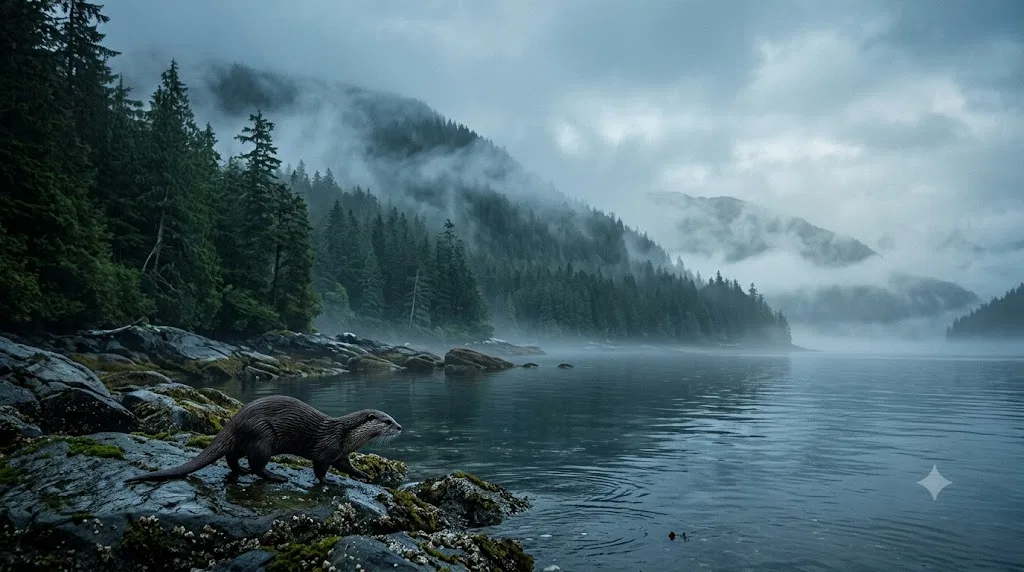
The “otter” part is not incidental decoration. The Alaska Department of Fish and Game notes that the North American river otter is also sometimes called the “land otter” to distinguish it from the sea otter; it is a real animal of Alaska’s waterways, with strong swimming ability, social behaviour, distinctive vocalisations and overland travel between bodies of water.[Alaska Department of Fish and Game]adfg.alaska.govOpen source on alaska.gov. In Tlingit cultural material, however, the land otter is much more than a biological animal. Archaeologist Madonna Moss, discussing otters in Tlingit ancestral use and belief, describes the land otter as the most prominent shamanic animal in Tlingit literature and cites the view that it was regarded as an exceptionally powerful supernatural being.[Elakha Alliance]elakhaalliance.orgMoss 2020 sea ottersMoss 2020 sea otters
That means a sceptical reading should not simply ask whether an otter was misidentified as a monster. Ordinary otters may help explain why such a creature makes sense in this landscape: they move between water and land, appear and disappear quickly, make startling sounds, travel in groups, and leave signs more often than they are seen. But Kooshdaa Kaa is not reducible to a river otter glimpsed in poor light. It is a narrative figure built around transformation, capture, kinship, fear and spiritual consequence. The realistic animal gives the legend texture; it does not exhaust its meaning.[Alaska Department of Fish and Game]adfg.alaska.govOpen source on alaska.gov.
Tlingit coastal setting and language
Kooshdaa Kaa stories belong most naturally to Southeast Alaska, especially Tlingit coastal country where forest, beach, river mouth and open water press closely together. The National Park Service describes Yakutat Tlingit traditional occupation and use around Icy Bay, Disenchantment Bay, the Malaspina Glacier forelands and the present-day community of Yakutat; these are not abstract “wilderness” settings, but culturally known lands and waters with long histories of travel, subsistence and story.[National Park Service]nps.govNational Park Service Yakutat Tlingit Ethnographic StudyNational Park Service Yakutat Tlingit Ethnographic Study Frederica de Laguna’s major Smithsonian study of the Yakutat Tlingit drew on fieldwork from 1949, 1952, 1953 and 1954, which helps explain why Yakutat and neighbouring coastal areas remain important reference points for published accounts of Tlingit land-otter belief.[Smithsonian Research Online]repository.si.eduOpen source on si.edu.
The name appears in several spellings in English-language sources because it is being written from Tlingit into Roman letters. A Way with Words gives variants including “kushtaka”, “kooshdakhaa”, “kushtahkah” and “kooshdaa kaa”, and glosses the figure as a being associated with the land otter. It also notes that related names appear in Alaska place names such as Kushtaka Lake, Kushtaka Mountain, Kushtaka Ridge and Kushtaka Glacier.[waywordradio.org]waywordradio.orgKooshdakhaa: The Land Otter ManKooshdakhaa: The Land Otter Man That place-name pattern matters: it shows that the land-otter figure is not just a spooky campfire import. It is embedded in the geography of Alaska as remembered, named and travelled.
The Tlingit language context also helps guard against flattening the figure into a generic “monster”. In the Dauenhauer Tlingit Oral Literature Collection finding guide, one item summarises a story told entirely in Tlingit by A. P. Johnson, including references to Kooshdaa, land otters making noise around a boat, an oar being taken, and a person recognising a transformed relative. The same summary says Kaakáa is saved by a Kooshdaa Kaa, that the Kooshdaa transforms into his wife, and that another relative had also been taken.[Lingít Yoo X̲ʼatángi]tlingitlanguage.comLingít Yoo X̲ʼatángi Microsoft WordLingít Yoo X̲ʼatángi Microsoft Word Even in a brief catalogue description, the pattern is clear: these are kinship stories and transformation stories, not simple beast-encounter reports.
Shape-shifting land-otter stories
The most useful way to read Kooshdaa Kaa stories is as a cluster of motifs rather than a single fixed monster profile. Some stories stress danger: a being imitates a baby, a loved one or a human helper, then leads a person into the woods, onto the water or towards death. Other accounts are more ambiguous: the lost person may be “saved” from freezing or drowning, but only by being changed into one of the land-otter people. Modern summaries often turn this into a clean horror premise, but older narrative collections show a more complicated world in which land-otter people have homes, spouses, children and social relations.[outdoorlife.com]outdoorlife.comOutdoor Life The Tlingit Legend of the Kóoshdaa Káa | Outdoor LifeOutdoor Life The Tlingit Legend of the Kóoshdaa Káa | Outdoor Life
A striking early published example is “The Land-Otter Sister” in John R. Swanton’s Tlingit Myths and Texts, collected at Sitka and Wrangell in 1904 and published by the Smithsonian’s Bureau of American Ethnology in 1908. In that story, a man travels with his children to a camp to dry halibut. Years earlier, his sister had drowned; the story says she was taken by the land otters, married among them and had children. She later brings food to her brother, but her changed body frightens him: she is both kin and not fully human as he remembers her.[Internet Sacred Text Archive]sacred-texts.comOpen source on sacred-texts.com.
That example is important because it pushes against the cheap “evil otter demon” version. The land-otter sister is unsettling, but she is also a provider. She crosses back towards her human family with food. Her transformation has not erased kinship, but it has made kinship uncanny. For cryptid readers, this is where the Kooshdaa Kaa differs sharply from a mystery animal. The drama is not a hunter spotting an unknown creature through binoculars. The drama is recognition: what if the person at the edge of the camp is family, but altered by the water and by the non-human world?
The Dauenhauer collection summary gives another compact example of that same emotional machinery. Land otters gather around a boat, one takes an oar, and the man understands that the otter is his brother. Later, in the same story summary, a Kooshdaa Kaa transforms into a wife and takes Kaakáa south, where he sees another relative already taken.[Lingít Yoo X̲ʼatángi]tlingitlanguage.comLingít Yoo X̲ʼatángi Microsoft WordLingít Yoo X̲ʼatángi Microsoft Word The horror here is not just death. It is absorption into another people, another household, another condition of being.
Warnings, water and wilderness fear
Kooshdaa Kaa stories work so well in Southeast Alaska because the setting is beautiful but unforgiving. Canoe travel, beach gathering, fishing, halibut drying, hunting and movement through dense wet forest all put people near thresholds: surf line, tide flat, river mouth, camp edge, night water, fog and timber. The figure lives in those thresholds. It warns that the familiar can become unsafe very quickly, especially when someone is alone, disoriented, grieving, hungry or trying to respond to a cry for help.[Internet Sacred Text Archive]sacred-texts.comOpen source on sacred-texts.com.
This is also why the land-otter-man has such force as a wilderness caution. Outdoor Life’s 2025 feature on the legend, centred partly on Thomas Bay in Southeast Alaska, reports a contemporary understanding of Kooshdaa Kaa as a furry shape-shifter able to take the form of a loved one or mimic a crying baby to lure someone into the woods or out to sea. The same account connects the figure with stories of missing people who were thought to have become Kooshdaa Kaa themselves.[Outdoor Life]outdoorlife.comOutdoor Life The Tlingit Legend of the Kóoshdaa Káa | Outdoor LifeOutdoor Life The Tlingit Legend of the Kóoshdaa Káa | Outdoor Life The article is a modern outdoors piece rather than an academic source, but it is useful because it shows how the legend still circulates in regional memory, hunting talk and Alaska mystery writing.
The biological otter again makes the fear feel grounded. River otters in Alaska hunt on land and in fresh and salt water; they travel overland between waters, use repeated trails, dig winter tunnels and produce growls, whines, chirps and other sounds.[Alaska Department of Fish and Game]adfg.alaska.govOpen source on alaska.gov. The National Park Service also stresses a simple behavioural difference between Alaska’s otters: sea otters are clumsy on land and rarely leave the ocean, while river otters move easily between shore and water.[National Park Service]nps.govNational Park Service OttersNational Park Service Otters A creature that belongs to both land and water is naturally suited to stories about crossing boundaries.
The warning is therefore practical and spiritual at once. On the practical side, it tells children and adults not to wander towards water, strange voices or unknown figures. On the spiritual side, it says that becoming lost is not merely a navigational problem. To be lost is to become available to other powers. That is why the Kooshdaa Kaa can feel more frightening than a simple predator. A bear might kill; a land-otter person might change what you are.
Why Thomas Bay became a modern Kooshdaa Kaa hotspot
For many non-Tlingit readers, Kooshdaa Kaa enters Alaska monster lore through Thomas Bay, north-east of Petersburg. The bay has long carried a grim reputation in popular Alaska mystery writing, partly because prospectors gave the area names such as “Devil’s Country” in the early twentieth century and partly because later writers linked the place with vanishings, eerie encounters and land-otter stories. Outdoor Life describes Thomas Bay as one of the best-known modern settings for Kooshdaa Kaa talk and notes that some Tlingit people avoid the area because of its reputation.[Outdoor Life]outdoorlife.comOutdoor Life The Tlingit Legend of the Kóoshdaa Káa | Outdoor LifeOutdoor Life The Tlingit Legend of the Kóoshdaa Káa | Outdoor Life
This modern clustering should be handled carefully. It does not mean Thomas Bay is the “home” of Kooshdaa Kaa in a narrow cryptid-map sense. The wider tradition is Tlingit and coastal, with stories recorded from several places and contexts. Thomas Bay is better understood as a modern focal point where older Tlingit land-otter beliefs, settler-era “Devil’s Country” naming, wilderness tourism and paranormal publishing have overlapped. That overlap makes the bay memorable to outsiders, but it can also distort the tradition by making it seem like a single haunted-location legend rather than part of a broader story system.[waywordradio.org]waywordradio.orgKooshdakhaa: The Land Otter ManKooshdakhaa: The Land Otter Man
The shift is typical of how Indigenous story figures are often pulled into cryptid culture. A being with deep cultural, linguistic and ceremonial associations becomes a “creature profile”: height, habitat, powers, danger level, famous sightings. That format is useful for quick reading, but it can strip away the kinship and moral complexity that older stories preserve. In Kooshdaa Kaa’s case, the loss is especially large because the figure is not simply “out there” in the woods. It is also tied to questions of what happens to people who drown, disappear, marry into another world or return changed.[Internet Sacred Text Archive]sacred-texts.comOpen source on sacred-texts.com.
The shamanic side of the land otter
One reason Kooshdaa Kaa should not be treated as a novelty cryptid is that land otters have a serious place in Tlingit religious and shamanic contexts. Moss’s discussion of sea otters and land otters notes that animals commonly associated with Tlingit shamanism include land otter, devilfish, raven, frog, mountain goat, oystercatcher and crane, with the land otter standing out as especially prominent. The same source says land otters were feared and respected by laypeople but sought by Tlingit shamans as potent spirit helpers.[Elakha Alliance]elakhaalliance.orgMoss 2020 sea ottersMoss 2020 sea otters
That dual status explains why the stories do not always behave like straightforward monster tales. A dangerous being can also be a source of power. A captured or transformed person may be lost to ordinary life, yet the land-otter world is not portrayed as mere animal chaos. It has people, households and relationships. This is closer to a spirit-person tradition than to a zoological rumour.
For modern readers, this is a useful boundary marker. Calling Kooshdaa Kaa a “cryptid” may help place it within an Alaska mystery-beast project, but it should be done with caution. It is not a claim that science has overlooked a half-human otter species. It is a Tlingit story-being that later cryptid culture has adopted because it has creaturely features: shape-shifting, tracks between land and water, frightening cries, disappearances and a named range in Alaska.
What evidence can and cannot show
The evidence for Kooshdaa Kaa is strong as folklore and weak as zoology. There are early twentieth-century Tlingit narrative texts, major ethnographic studies, language resources, oral-literature catalogues and modern regional retellings. Those sources show that land-otter stories are not an internet invention. They are documented in Tlingit narrative traditions and remain alive enough to appear in contemporary Alaska writing and place-based storytelling.[sacred-texts.com]sacred-texts.comOpen source on sacred-texts.com.
What they do not show is a confirmed unknown animal. There is no mainstream biological evidence for a population of otter-human creatures in Southeast Alaska. When real animals enter the discussion, the strongest candidates are known otters: river otters, also called land otters, and sea otters. Alaska’s official wildlife sources describe both as real, widespread or regionally significant animals, with river otters especially suited to the land-water border where many Kooshdaa Kaa stories operate.[Alaska Department of Fish and Game]adfg.alaska.govOpen source on alaska.gov.
A fair assessment therefore separates four layers:
- Folklore: Kooshdaa Kaa is well supported as a Tlingit land-otter story figure recorded in older narrative collections and later cultural sources.
- Cultural warning: The stories teach caution around water, isolation, deceptive appearances and the danger of leaving safe human company.
- Environmental texture: Real otters, coastal forests, cold water, fog and difficult travel make the stories feel rooted in Southeast Alaska rather than interchangeable with monster tales from elsewhere.
- Cryptid claim: As a literal unknown species, Kooshdaa Kaa has no strong public evidence; the better reading is as folklore that modern cryptid culture sometimes reframes as a creature encounter tradition.
That distinction does not make the story less interesting. It makes it sharper. Kooshdaa Kaa is not compelling because it might be “Alaska’s otter Bigfoot”. It is compelling because it shows how a real animal, a dangerous landscape and a deeply developed Indigenous narrative tradition can combine into one of Alaska’s strangest and most durable creature legends.
How the legend changed in modern Alaska
Modern retellings tend to make Kooshdaa Kaa more monstrous, more visual and more portable. The older story world is often relational: a drowned sister, a brother recognised in otter form, a wife-shape, a father’s sister already taken, a shamanic helper. Contemporary accounts, especially those aimed at outdoors readers or paranormal audiences, often stress the scare: a crying baby in the woods, a loved one’s voice on the water, a creature that lures victims away and changes them.[sacred-texts.com]sacred-texts.comOpen source on sacred-texts.com.
This change is not necessarily false; folklore always adapts. But it does shift the emphasis. A Tlingit land-otter story can hold grief, kinship, transformation, food sharing, taboo and spiritual power in the same frame. A cryptid article or campfire version may keep only the hook: “shape-shifting otter monster steals people.” The result is easier to market, but thinner.
Still, Kooshdaa Kaa’s modern afterlife has helped keep the name visible in Alaska mystery culture. Language discussions preserve spelling variants and place-name connections. Outdoor writing keeps the legend tied to Thomas Bay, Juneau-area storytelling and Southeast Alaska’s hunting-and-boating imagination. Ethnographic and oral-literature resources keep the deeper record available for readers who want to understand why the figure mattered before it became a cryptid-page favourite.[waywordradio.org]waywordradio.orgKooshdakhaa: The Land Otter ManKooshdakhaa: The Land Otter Man
The useful way to read the land-otter-man
The best reading of Kooshdaa Kaa holds two ideas together. First, this is a creature legend, and it belongs naturally in Alaska’s wider catalogue of strange beings: hairy men, lake monsters, phantom animals and wilderness warnings. Second, it is not just a monster report. It comes from Tlingit land-otter stories rooted in specific coastal environments and cultural meanings.
That is why “not Bigfoot” is the key correction. Bigfoot stories usually ask whether a hidden animal might be walking through the trees. Kooshdaa Kaa stories ask a more unsettling question: what happens when the boundary between human and non-human, land and water, kin and stranger, rescue and capture, becomes uncertain? In Southeast Alaska, with rainforest behind you and cold water in front of you, that question has teeth.
Amazon book picks
Further Reading
Books and field guides related to Why Kooshdaa Kaa Is Not Bigfoot. Use these as the next step if you want deeper reading beyond the article.
American Indian Myths and Legends
Helps readers understand indigenous narrative traditions and supernatural beings.
The United States of Cryptids
Introduces readers to regional monster traditions beyond Bigfoot.
The Lore of the Land
Illustrates how place-based legends function in traditional cultures.
Tlingit Myths and Texts
Provides authentic Tlingit folklore context relevant to Kooshdaa Kaa traditions.
eBay marketplace picks
Marketplace Samples
Live-tested eBay searches with available results related to this page.




Endnotes
1.
Source: adfg.alaska.gov
Link:https://www.adfg.alaska.gov/index.cfm?adfg=riverotter.main
2.
Source: waywordradio.org
Title: Kooshdakhaa: The Land Otter Man
Link:https://waywordradio.org/kooshdakhaa-land-otter-man/
3.
Source: adfg.alaska.gov
Title: river otter
Link:https://www.adfg.alaska.gov/static/education/wns/river_otter.pdf
4.
Source: adfg.alaska.gov
Link:https://www.adfg.alaska.gov/index.cfm?adfg=wildliferesearch.riverotter
5.
Source: sitka.com
Title: The Land-Otter Son: A Kushtaka Story
Link:https://sitka.com/news/?page_id=191
6.
Source: sacred-texts.com
Link:https://sacred-texts.com/nam/nw/tmt/tmt010.htm
7.
Source: elakhaalliance.org
Title: Moss 2020 sea otters
Link:https://www.elakhaalliance.org/wp-content/uploads/2020/09/Moss-2020-sea-otters.pdf
8.
Source: outdoorlife.com
Title: Outdoor Life The Tlingit Legend of the Kóoshdaa Káa | Outdoor Life
Link:https://www.outdoorlife.com/adventure/tlingit-legend-of-kooshdaa-kaa/
9.
Source: tlingitlanguage.com
Title: Lingít Yoo X̲ʼatángi Microsoft Word
Link:https://tlingitlanguage.com/wp-content/uploads/2018/10/Dauenhauer-Collection-Finding-Guide.pdf
10.
Source: nps.gov
Title: National Park Service Yakutat Tlingit Ethnographic Study
Link:https://www.nps.gov/wrst/learn/historyculture/yakutat-tlingit-ethnographic-study.htm
11.
Source: repository.si.edu
Link:https://repository.si.edu/handle/10088/1354
12.
Source: nps.gov
Title: National Park Service Otters
Link:https://www.nps.gov/subjects/aknatureandscience/wildlifemarineotters.htm
13.
Source: Wikipedia
Link:https://en.wikipedia.org/wiki/Kushtaka
14.
Source: tlingitlanguage.com
Link:https://tlingitlanguage.com/wp-content/uploads/2015/01/TlingitMap.pdf
15.
Source: tlingitlanguage.com
Link:https://tlingitlanguage.com/wp-content/uploads/2015/01/Intermediate-Tlingit-2012.pdf
16.
Source: tlingitlanguage.com
Link:https://tlingitlanguage.com/wp-content/uploads/2015/09/packet-4a.pdf
17.
Source: tlingitlanguage.com
Title: notes Kaakex’wti and his sons Kooshdaa káa–land
Link:https://tlingitlanguage.com/wp-content/uploads/2015/09/packet-3.pdf
18.
Source: tlingitlanguage.com
Link:https://tlingitlanguage.com/wp-content/uploads/2015/01/Dauenhauer-1987-Haa-Shuk%C3%A1.pdf
19.
Source: tlingitlanguage.com
Link:https://tlingitlanguage.com/wp-content/uploads/2018/09/placenames.pdf
20.
Source: tlingitlanguage.com
Link:https://tlingitlanguage.com/wp-content/uploads/2015/01/Dauenhauer-1990-HTY.pdf
21.
Source: tlingitlanguage.com
Link:https://tlingitlanguage.com/wp-content/uploads/2015/09/packet-1.pdf
22.
Source: tlingitlanguage.com
Title: Kaax’ achgdok
Link:https://tlingitlanguage.com/wp-content/uploads/2019/06/khaaxh-achgook.pdf
23.
Source: repository.si.edu
Link:https://repository.si.edu/server/api/core/bitstreams/b3e5f49e-404a-4cd4-9fd3-d587e51e7972/content
24.
Source: facebook.com
Link:https://www.facebook.com/alaskafishandgame/photos/a-sea-otter-trail-heading-back-to-the-water/686707066830364/
25.
Source: ankn.uaf.edu
Link:https://ankn.uaf.edu/curriculum/Tlingit/Salmon/graphics/swanton.pdf
26.
Source: seagrant.uaf.edu
Link:https://seagrant.uaf.edu/research/projects/10/otter/
27.
Source: nps.gov
Title: frederica de laguna
Link:https://www.nps.gov/people/frederica-de-laguna.htm
28.
Source: cryptidz.fandom.com
Link:https://cryptidz.fandom.com/wiki/Kushtaka
29.
Source: obscure.gamepuppet.com
Link:https://obscure.gamepuppet.com/data/kushtaka.htm
30.
Source: alaskasnewssource.com
Link:https://www.alaskasnewssource.com/video/2022/05/27/alaska-department-fish-game-warns-aggressive-river-otters-conners-bog/
31.
Source: sk.sagepub.com
Link:https://sk.sagepub.com/ency/edvol/download/ethnicity/chpt/tlingit.pdf
Additional References
32.
Source: youtube.com
Link:https://www.youtube.com/watch?v=Uc6prRBCpS4
Source snippet
The Kushtaka Legend: Alaska's Deadly Land Otter Man (Tlingit Folk Ballad)...
33.
Source: youtube.com
Title: The Kushtaka Legend: Alaska’s Deadly Land Otter Man (Tlingit Folk Ballad)!
Link:https://www.youtube.com/watch?v=PwsMBGd73GY
Source snippet
Kushtaka: Alaskan Shapeshifter Scars Woman For Life | The Alaska Triangle...
34.
Source: mmc.gov
Link:https://www.mmc.gov/priority-topics/species-of-concern/northern-sea-otters/
35.
Source: alaskasealife.org
Link:https://www.alaskasealife.org/alaska_species
36.
Source: facebook.com
Link:https://www.facebook.com/tim.hatfield.5/posts/alaskan-cryptidthe-kushtaka-k%C3%B3oshdaa-k%C3%A1a-is-a-shape-shifting-creature-from-the-t/26174198095598317/
37.
Source: reddit.com
Link:https://www.reddit.com/r/midjourney/comments/yc0lbu/kushtaka_shapeshifting_landotterman_of_the/
38.
Source: eerieworlds.com
Link:https://www.eerieworlds.com/eerie-world-cards/kushtaka
39.
Source: facebook.com
Link:https://www.facebook.com/groups/281886105961506/posts/991846261632150/
40.
Source: pwssc.org
Link:https://pwssc.org/otters-of-alaska/
41.
Source: onlyinyourstate.com
Link:https://www.onlyinyourstate.com/experiences/alaska/kushtaka-land-otter-legend-ak
Topic Tree