Within Michigan Monsters
Why Do Michigan Lakes Breed Monster Stories?
Michigan's lake monsters draw on Great Lakes scale, fog, old newspaper serpent reports and plausible misreadings of water, logs and animals.
On this page
- Lake Michigan and Lake Superior as inland seas
- Newspaper era serpent reports and resort town publicity
- Sturgeon, escaped animals, logs, waves and mirages
Page outline Jump by section
Introduction
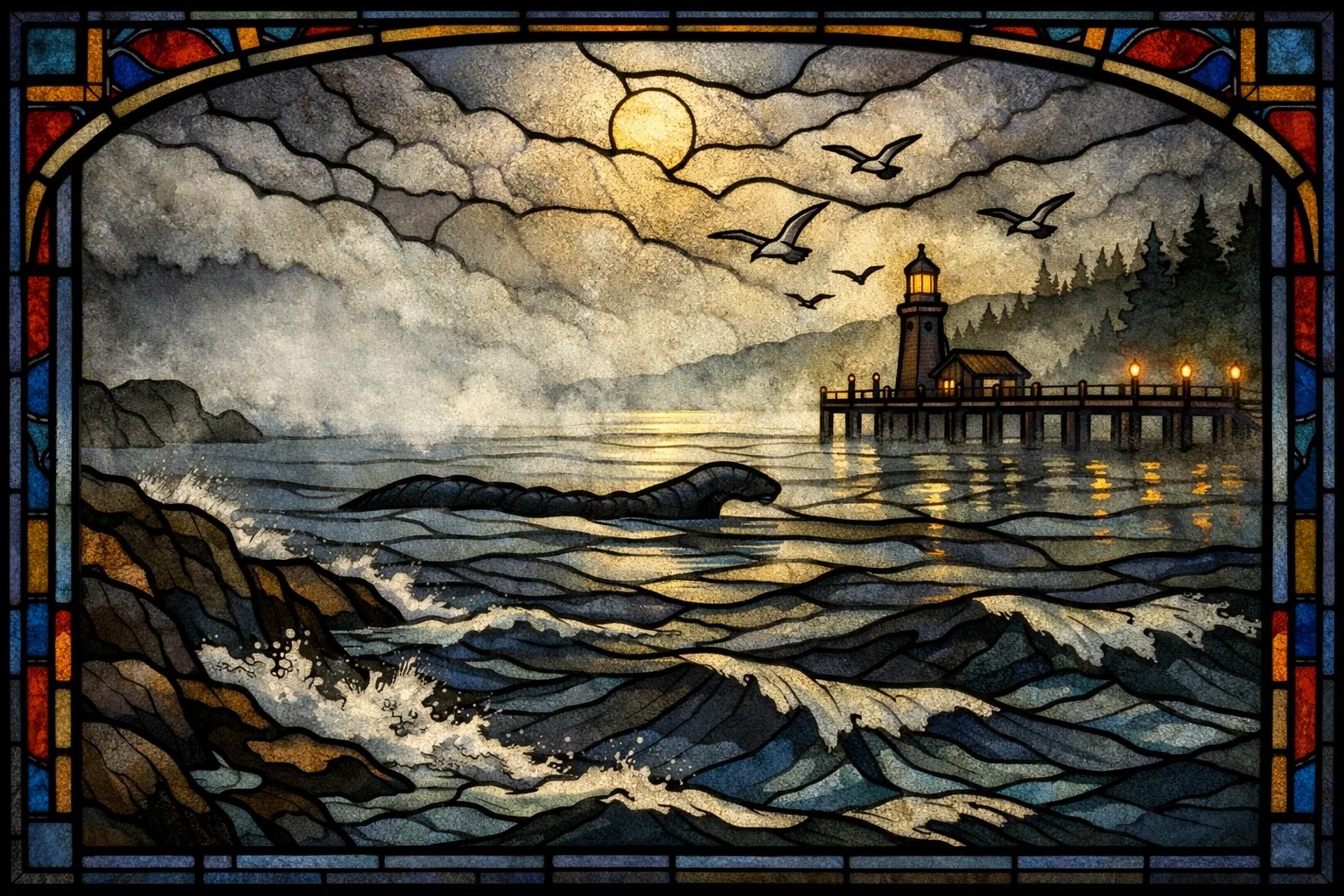
Michigan’s Great Lakes monster stories are not really about one tidy creature. They are a family of claims: old “sea serpent” newspaper reports, resort-town jokes, Lake Michigan sightings, Lake Superior monster lore, and modern clips where waves, logs or shadows briefly look alive. The reason they persist is simple: Michigan borders water that behaves like an inland sea. Lake Michigan alone covers about 22,300 square miles, while Lake Superior is colder, deeper and larger by surface area than any other Great Lake. In fog, storm light or choppy water, a half-seen object can become a creature before the witness has time to check it.[ecowatch.noaa.gov]ecowatch.noaa.govLake Michigan | National Marine Ecosystem Status - NOAALake Michigan is the third largest Great Lake and has a water surface area of 57,5…
That does not make the stories worthless. It makes them revealing. The best Michigan lake-monster material shows how big water, tourism, newspapers, Indigenous water-spirit traditions, real giant fish and optical confusion all feed the same imaginative current. The monsters are not confirmed animals, but they are part of the state’s shoreline culture: a way of giving shape to lakes that are beautiful, dangerous and often hard to read.
Why the Great Lakes Invite Sea-Serpent Thinking
Michigan’s lake-monster tradition begins with scale. The Great Lakes are not ponds with cabins around them; they are a freshwater system so large that government and educational sources regularly describe them as inland seas. The US Environmental Protection Agency says the Great Lakes hold about 21% of the world’s surface fresh water and form one of the world’s largest surface freshwater ecosystems. Michigan Sea Grant gives the system’s combined surface area as about 94,000 square miles, with roughly 11,000 miles of shoreline including islands.[US EPA]epa.govUS EPAGreat Lakes Facts and FiguresUS EPAGreat Lakes Facts and Figures
That scale matters because lake-monster stories thrive where the viewer cannot easily judge distance, size or motion. A dark object half a mile offshore may be a log, a bird raft, a wave shadow, a boat wake, a swimming deer or a large fish. From shore, all of those can flatten into a single black line. Add fog, dusk or high wind, and the lake supplies the rest of the story.
Lake Michigan and Lake Superior are especially good at this. Lake Michigan is the only Great Lake entirely within the United States and is a natural stage for Michigan, Wisconsin, Illinois and Indiana serpent stories. Lake Superior, touching Michigan’s Upper Peninsula, is deeper, colder and more remote; the Great Lakes Commission lists its maximum depth at 1,332 feet and describes much of its basin as sparsely populated and heavily forested.[ecowatch.noaa.gov]ecowatch.noaa.govLake Michigan | National Marine Ecosystem Status - NOAALake Michigan is the third largest Great Lake and has a water surface area of 57,5…
For a reader trying to understand Michigan’s monster claims, that geography is the first clue. These are not stories from small enclosed lakes where every ripple is familiar. They come from open horizons, deep bays, shipping lanes, sudden weather and resort shores where people gather precisely to look out across water that feels larger than ordinary experience.
Lake Michigan and Lake Superior as Inland Seas
Lake Michigan’s sea-serpent tradition is shared across the lake, but it matters to Michigan because the lake defines the state’s western shoreline. Reports and retellings often cluster around busy waterfronts, beaches, piers and resort towns rather than remote scientific survey sites. That is typical of lake-monster folklore: sightings gather where people are watching, waiting and telling stories afterwards.
A Newcity feature on the Lake Michigan sea serpent describes Chicago-area reports stretching across more than a century, with the creature usually described as eel-like, reptile-headed and somewhere between 30 and 60 feet long. The article also notes that nineteenth- and twentieth-century newspapers often treated such stories with amusement rather than firm belief, while still giving them enough attention to keep the legend alive.[New City]newcity.comNew City The Lake Michigan Sea Serpent | NewcityNew City The Lake Michigan Sea Serpent | Newcity
Michigan’s side of the lake produced its own modern examples. Newcity discusses a South Haven video that circulated online, filmed in strong winds, where a dark snake-like shape seemed to move in rough water near the pier. The writer’s sceptical reading is telling: the object could be a log, shadow, turtle or some other ordinary thing, but the video worked because Lake Michigan’s surf made a simple explanation feel momentarily less satisfying.[New City]newcity.comNew City The Lake Michigan Sea Serpent | NewcityNew City The Lake Michigan Sea Serpent | Newcity
Lake Superior adds a different tone. Its monster is often called “Pressie” in modern cryptid writing, a claimed serpent-like creature associated with Superior’s cold, deep water and sometimes with the Presque Isle area. The stronger evidence for Pressie as a zoological claim is thin and mostly secondary, but as folklore it fits Superior perfectly: a lake with shipwreck history, rocky shores, sudden fog and a reputation for swallowing the careless. Popular retellings describe the creature as long-necked, dark and serpentine, but the details vary enough to show that it is more legend cluster than stable eyewitness record.[twistingmyths.substack.com]twistingmyths.substack.comWhat Lurks in Lake SuperiorWhat Lurks in Lake Superior
The important distinction is that Lake Michigan’s serpent often feels newspaper-made and shoreline-modern, while Lake Superior’s monster borrows more heavily from the atmosphere of depth, remoteness and older water-spirit traditions. Both belong to Michigan’s cryptid map, but neither should be treated as a confirmed unknown animal.
The Petoskey Sea Serpent and Resort-Town Publicity
The most useful Michigan case is the Petoskey sea serpent of Little Traverse Bay. It has everything a good lake-monster story needs: summer visitors, newspaper attention, a dramatic shoreline setting, a plausible physical object and a community willing to keep the joke alive after the mystery had been deflated.
The Grand Traverse Journal, summarising northern Michigan newspaper history, says strange water-creature sightings around the turn of the twentieth century were common in the region. The best-known was the Petoskey sea serpent, which appeared in Little Traverse Bay for several summers in the 1890s and became a novelty that resort visitors looked forward to each year. In 1895, the “monster” was reportedly identified as a very crooked tree trunk, blackened with slime, whose shape gave it a serpent-like appearance.[gtjournal.tadl.org]gtjournal.tadl.orggrand traverse bay the loch ness of northern michigangrand traverse bay the loch ness of northern michigan
That explanation did not kill the story. It made it more local. The same account notes that Petoskey continued to celebrate the serpent, including through a baseball team called the Petoskey Sea Serpents and a plaster serpent mascot. In other words, the creature changed category: from possible monster, to solved curiosity, to civic mascot.[gtjournal.tadl.org]gtjournal.tadl.orggrand traverse bay the loch ness of northern michigangrand traverse bay the loch ness of northern michigan
This is one of the clearest mechanisms in Michigan lake-monster lore. A report does not need to remain credible to remain useful. Once a serpent becomes funny, photogenic or good for summer talk, it can survive as local colour. Resort towns had every reason to play along. A monster gives visitors something to repeat on porches, in hotels, on boats and in letters home.
The Grand Traverse Journal also preserves the joking tone of later reports. A June 1898 Daily Eagle item about a sea serpent near Omena treated the creature as an annual summer attraction whose arrival assured the resort business of the north. That kind of writing is not neutral evidence for a monster; it is evidence for a community enjoying the monster story.[gtjournal.tadl.org]gtjournal.tadl.orgOpen source on tadl.org.
Petoskey therefore matters less as a “was it real?” case than as a model for how Michigan lake monsters are made. The process is visible: ambiguous object, public excitement, newspaper performance, social repetition, then affectionate afterlife.
Newspaper Serpents: Claims, Jokes and Copy That Travelled
Nineteenth-century newspapers loved sea serpents. They were perfect filler: dramatic, funny, local, reusable and difficult to disprove from the office. Michigan’s Great Lakes setting gave editors an easy way to import a coastal “sea serpent” tradition into freshwater.
The language often gives the game away. In the Petoskey and Grand Traverse Bay material, reports slide between fright and comedy. A 1903 Boardman River “sea serpent” near Traverse City drew curious locals, but the account noted that it did not move and seemed to stay in the same place; weeds and water grass in the current were offered as an obvious explanation.[gtjournal.tadl.org]gtjournal.tadl.orggrand traverse bay the loch ness of northern michigangrand traverse bay the loch ness of northern michigan
Another Grand Traverse Journal example from 1907 is stranger and more animal-like. Captain Dave Duane reportedly encountered something in West Bay that splashed, barked or grunted, had a dark brown hairy body, a flat head, pointed nose and apparent tusks. The newspaper itself hedged between “sea serpent, sea lion, octopus or whatever it is”, and later discussion considered whether witnesses might have been seeing an escaped or unusual animal rather than a monster.[gtjournal.tadl.org]gtjournal.tadl.orgOpen source on tadl.org.
That uncertainty is important. “Sea serpent” did not always mean “giant snake”. It could be a label slapped onto any surprising aquatic thing before anyone knew what it was. A seal-like animal, a mass of weeds, a floating trunk, a large fish or a theatrical hoax could all pass briefly through the same headline category.
The Lake Michigan tradition beyond Michigan shows the same pattern. Newcity notes a 1903 Chicago-area report that was later associated with an escaped sea lion named Big Ben from Lincoln Park Zoo. It also describes how newspapers repeatedly covered the serpent with a wink, while resort and waterfront communities understood that such stories could attract attention.[New City]newcity.comNew City The Lake Michigan Sea Serpent | NewcityNew City The Lake Michigan Sea Serpent | Newcity
For Michigan readers, the lesson is not that every old account was fake. It is that the newspaper-era “sea serpent” was a flexible media creature. It fed on real ambiguity, but also on humour, tourism and the pleasure of a good waterfront yarn.
Real Animals Behind Monster Shapes
The most plausible Michigan lake-monster explanations begin with real animals, especially when the witness sees only part of the body.
Lake sturgeon are the obvious candidate for many “prehistoric fish” impressions. The Michigan Department of Natural Resources describes lake sturgeon as native fish with bony plates, a shark-like tail profile, barbels around the mouth and long lifespans. The same DNR page says Michigan’s legal state-record sturgeon weighed 193 pounds, while sturgeon over 300 pounds have been observed in the Great Lakes basin.[Michigan.gov]michigan.govOpen source on michigan.gov.
A large sturgeon breaking the surface would not look like a sea serpent in a clean, well-lit photograph. But seen briefly from a boat, especially in rolling water, it could create the right ingredients: dark back, sudden movement, ancient-looking shape and a sense of bulk. The US Fish and Wildlife Service similarly describes lake sturgeon as one of North America’s largest freshwater fish, with old individuals reaching about seven feet and 200–300 pounds.[U.S. Fish and Wildlife Service]fws.govOpen source on fws.gov.
Sea lampreys add another layer to Great Lakes “monster” imagination, though they are much too small to explain giant-serpent claims. They are eel-like, parasitic fish that invaded the Great Lakes and spread into Lakes Michigan, Huron and Superior by the 1930s. The Great Lakes Fishery Commission says a single female can produce as many as 100,000 eggs, while US Fish and Wildlife explains that adults can kill up to 40 pounds of Great Lakes fish during their parasitic life stage.[glfc.org]glfc.orgGreat Lakes Fishery CommissionGreat Lakes Fishery Commission
Lampreys are useful in this story because they show how the Great Lakes really do contain unsettling, snake-like animals. They are not the 60-foot beasts of newspaper lore, but they make the phrase “lake monster” feel less absurd to people who have seen their round, toothed mouths attached to fish.
Other animal explanations are more situational. Swimming deer can look oddly long when only the head and wake are visible. Lines of diving birds can resemble humps. Muskrats, otters or beavers can startle people near shore. Escaped zoo or circus animals were sometimes invoked in old reports, and the 1907 West Bay account’s “sea lion” language shows how quickly witnesses and reporters reached for exotic comparisons when a creature did not match ordinary local expectations.[gtjournal.tadl.org]gtjournal.tadl.orgOpen source on tadl.org.
The sceptical point is not that one species explains every claim. It is that the Great Lakes contain enough real movement to keep producing false monsters.

Logs, Waves, Mirages and the Lake Itself
Some of the strongest explanations are not animals at all. The Petoskey case is the classic Michigan example: a crooked, slime-darkened tree trunk in Little Traverse Bay became serpent-like because shape, colour and motion lined up just well enough.[gtjournal.tadl.org]gtjournal.tadl.orggrand traverse bay the loch ness of northern michigangrand traverse bay the loch ness of northern michigan
Great Lakes water can also move in ways that surprise people who expect ordinary lake behaviour. Michigan Sea Grant explains storm surges and seiches as water movements that can change lake levels dramatically during storms, with water sloshing from one end of a basin to the other “like displaced water in a bathtub”. NOAA defines a seiche as a standing wave in an enclosed or partly enclosed body of water, with the largest vertical oscillations at the ends.[Michigan Sea Grant]michiganseagrant.orgOpen source on michiganseagrant.org.
Meteotsunamis add another mechanism. These are tsunami-like waves generated by fast-moving weather systems rather than earthquakes. A 2016 study in Scientific Reports found an average of 106 meteotsunami events per year across the Great Lakes region, with Lake Michigan experiencing the highest frequency at 51 events per year.[Nature]nature.comOpen source on nature.com.
Most monster sightings are not meteotsunamis, of course. But this research helps explain why the lakes feel animate. Water can surge, rebound, pile up, flatten, flash and throw debris in ways that look purposeful from the wrong angle. A long floating branch in a choppy cross-current can seem to swim. A boat wake can make separate dark objects rise and fall like humps. A line of waves crossing behind a log can create the illusion of undulation.
Fog and mirage effects also matter, especially on large cold lakes. NOAA-linked satellite discussion from the Cooperative Institute for Meteorological Satellite Studies describes how water evaporating from a lake surface into colder, drier air can quickly condense into fog over Lake Superior. When the horizon disappears, ordinary distance cues disappear with it.[CIMSS]cimss.ssec.wisc.eduOpen source on wisc.edu.
That is why the best sceptical reading of Michigan lake monsters is environmental rather than dismissive. The lakes are not passive backdrops for silly stories. They actively distort perception.
Older Water-Spirit Traditions and Modern Monster Talk
Michigan lake-monster claims should not be flattened into one tradition. Newspaper sea serpents, resort jokes and modern cryptid lists are not the same thing as Indigenous Great Lakes water-spirit stories.
Across the Great Lakes, Anishinaabe and related traditions include powerful underwater beings often rendered in English as the Underwater Panther or Great Lynx. The Canadian Encyclopedia describes this being as one of the most important underwater figures for the Ojibwa, a fantastic dragon-like animal associated with deep water, power and danger.[The Canadian Encyclopedia]thecanadianencyclopedia.caOpen source on thecanadianencyclopedia.ca.
Lake Superior is especially important in this context. Tourism Northern Ontario’s account of the Agawa Rock pictographs describes a sacred lakeside site in Lake Superior Provincial Park, north of Sault Ste. Marie, where more than a hundred images include the Great Lynx or Underwater Wildcat figure.[Northern Ontario Travel]northernontario.travelNorthern Ontario Travel The Agawa Rock Pictographs: Ancient Indigenous ArtNorthern Ontario Travel The Agawa Rock Pictographs: Ancient Indigenous Art
These traditions should be handled carefully. They are not simply “cryptid sightings” in the modern sense, and they should not be treated as newspaper monster reports with older costumes. They belong to living cultural and spiritual worlds, not just to entertainment folklore.
Still, they help explain why Lake Superior has long been imagined as inhabited by powers below the surface. Later monster writing sometimes borrows loosely from these traditions when describing Lake Superior’s “Pressie”, but that borrowing can blur categories. A public-facing Michigan monster page should keep the distinction clear: Indigenous water beings are part of Great Lakes cultural history; Pressie-style lake-monster claims are modern folklore and cryptid retelling; the two may overlap in popular imagination, but they are not identical.
How later accounts reshaped Lake Monsters
[michigan]michigan.govSource details in endnotes. ’s Great Lakes monster tradition has moved through several stages.
First came older cultural understandings of dangerous water. Long before resort papers joked about sea serpents, Great Lakes peoples had stories that treated deep water, storms and submerged powers with seriousness. Those traditions do not map neatly onto modern monster-hunting, but they form part of the region’s deeper imaginative landscape.[The Canadian Encyclopedia]thecanadianencyclopedia.caOpen source on thecanadianencyclopedia.ca.
Then came the newspaper sea-serpent era. In the late nineteenth and early twentieth centuries, Michigan resort towns and waterfront papers turned ambiguous sightings into public entertainment. The Petoskey serpent is the clearest case: sighted in the 1890s, explained as a crooked trunk, then preserved as a mascot and local joke.[gtjournal.tadl.org]gtjournal.tadl.orggrand traverse bay the loch ness of northern michigangrand traverse bay the loch ness of northern michigan
After that came regional comparison. Lake Michigan’s nameless serpent, Lake Erie’s “Bessie”, Lake Champlain’s “Champ” and Scotland’s Loch Ness Monster all helped shape how readers interpreted big-water sightings. Once people had a template — long neck, humps, dark body, sudden disappearance — new reports could be slotted into it.
In the internet era, the legend became visual but not necessarily stronger. Short videos from piers or beaches spread quickly because viewers can replay the mystery, argue over shadows and zoom into pixels. The South Haven Lake Michigan clip discussed by Newcity is a good example: the appeal lies in the brief uncertainty, not in clear biological evidence.[New City]newcity.comNew City The Lake Michigan Sea Serpent | NewcityNew City The Lake Michigan Sea Serpent | Newcity
The result is a legend that has become less like a single creature and more like a recurring interpretive habit. When Michigan’s Great Lakes present something long, dark and moving, people still reach for the serpent.
What Would Count as Strong Evidence?
The evidence for Michigan Great Lakes sea serpents is weak if the question is zoological. There is no accepted specimen, no clear body, no verified breeding population, no reliable close-range footage and no mainstream scientific case for an unknown large aquatic animal in Lake Michigan or Lake Superior.
That does not mean every witness invented their experience. It means the evidence remains in the category of claims, anecdotes, jokes, ambiguous images and local tradition. A serious assessment would look for:
- Repeatable observation: multiple independent sightings of the same kind of animal in the same area under good viewing conditions.
- Physical trace: tissue, scales, bones, environmental DNA or other material that can be tested.
- Clear imagery: footage with scale, location, duration and identifiable reference points.
- Ecological plausibility: a population large enough to survive, feed and reproduce without leaving ordinary biological evidence.
- Separation from known causes: careful exclusion of sturgeon, logs, swimming mammals, birds, boat wakes, wave effects and mirages.
At present, Michigan’s Great Lakes lake-monster claims do not meet that standard. Their value is folkloric, historical and environmental. They show how people interpret strange experiences on enormous water, especially when local media and tourism give the story a second life.
Why Michigan Lakes Keep Breeding Monster Stories
Michigan’s lake monsters survive because they sit at the meeting point of real danger and playful invention. The Great Lakes really are vast. They really do produce fog, sudden waves, seiches and storm-driven water movements. They really contain ancient-looking sturgeon and eel-like lampreys. Their shore towns really did use sea-serpent stories as summer entertainment.[michiganseagrant.org]michiganseagrant.orgOpen source on michiganseagrant.org.
The monster itself is usually the least solid part of the story. The setting is solid. The mechanisms are solid. The old newspaper humour is documented. The Petoskey trunk explanation is unusually neat. Lake Superior’s depth and cultural weight are real. Lake Michigan’s horizon can still turn a dark object into a mystery for a few seconds.
That is why the most honest answer is also the most interesting one: Michigan’s Great Lakes do not need confirmed sea serpents to produce sea-serpent stories. The lakes are big enough, strange enough and storied enough to do that on their own.
Amazon book picks
Further Reading
Books and field guides related to Why Do Michigan Lakes Breed Monster Stories?. Use these as the next step if you want deeper reading beyond the article.
Mysterious America
Includes lake monsters, regional legends and unexplained creature reports.
Field Guide to Lake Monsters, Sea Serpents, and Other Mystery...
Strong match for Great Lakes monster traditions.
eBay marketplace picks
Marketplace Samples
Live-tested eBay searches with available results related to this page.


Endnotes
1.
Source: ecowatch.noaa.gov
Link:https://ecowatch.noaa.gov/regions/great-lakes/lake-michigan
Source snippet
Lake Michigan | National Marine Ecosystem Status - NOAALake Michigan is the third largest Great Lake and has a water surface area of 57,5...
2.
Source: epa.gov
Title: US EPAGreat Lakes Facts and Figures
Link:https://www.epa.gov/greatlakes/great-lakes-facts-and-figures
3.
Source: newcity.com
Title: New City The Lake Michigan Sea Serpent | Newcity
Link:https://www.newcity.com/2020/08/07/summer-2020-the-lake-michigan-sea-serpent/
4.
Source: twistingmyths.substack.com
Title: What Lurks in Lake Superior
Link:https://twistingmyths.substack.com/p/revisiting-pressie
5.
Source: gtjournal.tadl.org
Title: grand traverse bay the loch ness of northern michigan
Link:https://gtjournal.tadl.org/2015/grand-traverse-bay-the-loch-ness-of-northern-michigan/
6.
Source: gtjournal.tadl.org
Link:https://gtjournal.tadl.org/features/history/page/4/
7.
Source: michigan.gov
Link:https://www.michigan.gov/dnr/education/michigan-species/fish-species/lake-sturgeon
8.
Source: glfc.org
Title: Great Lakes Fishery Commission
Link:https://www.glfc.org/sea-lamprey.php
9.
Source: oceanservice.noaa.gov
Link:https://oceanservice.noaa.gov/facts/seiche.html
10.
Source: nature.com
Link:https://www.nature.com/articles/srep37832
11.
Source: gtjournal.tadl.org
Title: sea monsters
Link:https://gtjournal.tadl.org/tag/sea-monsters/
12.
Source: gtjournal.tadl.org
Title: grand traverse county
Link:https://gtjournal.tadl.org/tag/grand-traverse-county/
13.
Source: gtjournal.tadl.org
Title: grand traverse bay
Link:https://gtjournal.tadl.org/tag/grand-traverse-bay/
14.
Source: nauticalcharts.noaa.gov
Title: CPB6 C03 WEB
Link:https://nauticalcharts.noaa.gov/publications/coast-pilot/files/cp6/CPB6_C03_WEB.pdf
15.
Source: glerl.noaa.gov
Link:https://www.glerl.noaa.gov/emf/waves/WW3/
16.
Source: coast.noaa.gov
Title: great lakes
Link:https://coast.noaa.gov/states/fast-facts/great-lakes.html
17.
Source: epa.gov
Title: physical features great lakes
Link:https://www.epa.gov/greatlakes/physical-features-great-lakes
18.
Source: dnr.wisconsin.gov
Title: Lake Sturgeon
Link:https://dnr.wisconsin.gov/topic/Fishing/sturgeon/LakeSturgeon.html
19.
Source: theobservermagazine.substack.com
Title: the lure of lake monsters part 2
Link:https://theobservermagazine.substack.com/p/the-lure-of-lake-monsters-part-2
20.
Source: twistingmyths.substack.com
Title: the mythic sea panther of lake superior
Link:https://twistingmyths.substack.com/p/the-mythic-sea-panther-of-lake-superior
21.
Source: michigan.gov
Title: stifling a sea lamprey comeback
Link:https://www.michigan.gov/egle/newsroom/mi-environment/2026/04/15/stifling-a-sea-lamprey-comeback
22.
Source: idnc.library.illinois.edu
Link:https://idnc.library.illinois.edu/?a=d&d=EDJ19020114-01.1.2
23.
Source: glfc.org
Link:https://www.glfc.org/sea-lamprey-research.php
24.
Source: michiganseagrant.org
Link:https://www.michiganseagrant.org/topics/great-lakes-fast-facts/
25.
Source: fws.gov
Link:https://www.fws.gov/species/lake-sturgeon-acipenser-fulvescens
26.
Source: fws.gov
Link:https://www.fws.gov/story/all-about-invasive-sea-lamprey
27.
Source: michiganseagrant.org
Link:https://www.michiganseagrant.org/lessons/lessons/by-broad-concept/earth-science/surges-and-seiches-2/
28.
Source: cimss.ssec.wisc.edu
Link:https://cimss.ssec.wisc.edu/satellite-blog/archives/66716
29.
Source: thecanadianencyclopedia.ca
Link:https://thecanadianencyclopedia.ca/en/article/mishipeshu
30.
Source: northernontario.travel
Title: Northern Ontario Travel The Agawa Rock Pictographs: Ancient Indigenous Art
Link:https://northernontario.travel/best/agawa-pictographs
31.
Source: Wikipedia
Title: Underwater panther
Link:https://en.wikipedia.org/wiki/Underwater_panther
32.
Source: Wikipedia
Title: Great Lakes
Link:https://en.wikipedia.org/wiki/Great_Lakes
33.
Source: Wikipedia
Title: Lake Michigan
Link:https://en.wikipedia.org/wiki/Lake_Michigan
34.
Source: wrkr.com
Title: michigans ugliest fish
Link:https://wrkr.com/michigans-ugliest-fish/
35.
Source: greatlakes.org
Title: great lakes myths
Link:https://greatlakes.org/2020/03/great-lakes-myths/
36.
Source: privatelandswildlife.com
Title: michigan native american legends
Link:https://privatelandswildlife.com/michigan-native-american-legends/
37.
Source: seagrant.wisc.edu
Title: tsunamis from the sky spring is prime time for meteotsunamis in lake michigan
Link:https://www.seagrant.wisc.edu/news/tsunamis-from-the-sky-spring-is-prime-time-for-meteotsunamis-in-lake-michigan/
38.
Source: riverwestcurrents.org
Title: the underwater panther
Link:https://riverwestcurrents.org/2016/01/the-underwater-panther.html
39.
Source: cryptidz.fandom.com
Title: Underwater Panther
Link:https://cryptidz.fandom.com/wiki/Underwater_Panther
40.
Source: ebsco.com
Link:https://www.ebsco.com/research-starters/law/lake-superior
41.
Source: mrcc.purdue.edu
Title: great Lakes
Link:https://mrcc.purdue.edu/living_wx/greatLakes
42.
Source: glisa.umich.edu
Title: great lakes
Link:https://glisa.umich.edu/sustained-assessment/great-lakes/
43.
Source: michigannature.wordpress.com
Title: species spotlight lake sturgeon
Link:https://michigannature.wordpress.com/2017/10/04/species-spotlight-lake-sturgeon/
Additional References
44.
Source: youtube.com
Title: Besse (Not Bessie), The Lake Erie Monster | Tales of the Great Lakes
Link:https://www.youtube.com/watch?v=nusIDURK4Ck
Source snippet
The Lake Erie Monster - Real or imagined? (The Quest for Bessie Ep. 1.)...
45.
Source: youtube.com
Title: Lake Superior Loch Ness Monster?! Really?
Link:https://www.youtube.com/watch?v=FgAXuqRTCpg
Source snippet
Besse (Not Bessie), The Lake Erie Monster | Tales of the Great Lakes...
46.
Source: researchgate.net
Link:https://www.researchgate.net/figure/The-Agawa-Rock-art-depicting-the-Underwater-Panther-a-hybrid-spirit-two-uktena-like_fig1_326353670
47.
Source: facebook.com
Link:https://www.facebook.com/briancalley/posts/39-of-the-lake-superior-watershed-is-the-surface-of-lake-superior-itself/1487507699403280/
48.
Source: reddit.com
Link:https://www.reddit.com/r/ontario/comments/oxj68g/a_mishibizhiw_underwater_panther_two_giant/
49.
Source: researchgate.net
Link:https://www.researchgate.net/profile/Alan_Corbiere2/publication/335988384_Animkii_Miinwaa_Mishibizhiw_Narrative_images_of_the_Thunderbird_and_the_Underwater_Panther/links/5d891e59299bf1996f9e1a6f/Animkii-Miinwaa-Mishibizhiw-Narrative-images-of-the-Thunderbird-and-the-Underwater-Panther.pdf
50.
Source: oklo.org
Link:https://oklo.org/author/greg/
51.
Source: facebook.com
Link:https://www.facebook.com/SLCRescue/posts/a-bigfoot-sighting-on-the-superior-hiking-trail-during-the-800-series-nav-test-y/10156663078687006/
52.
Source: facebook.com
Link:https://www.facebook.com/brilliantmaps/posts/typical-water-surface-elevations-and-comparative-lake-depths-of-the-great-lakesd/1032407959001814/
53.
Source: facebook.com
Link:https://www.facebook.com/groups/250840638956722/posts/1460316978009076/
Topic Tree