Why Alaska Keeps Making Monster Stories
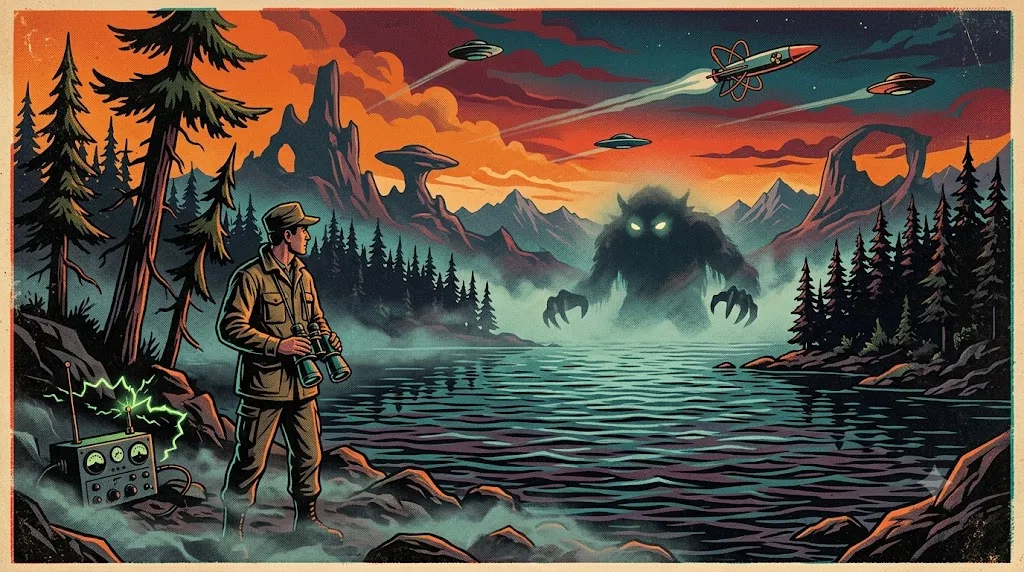
Alaska’s monster lore is unusually rich because the state gives strange stories room to breathe: vast forests, glacial bays, tundra, salmon rivers, deep lakes, coastal storms and long distances between witnesses.
Page outline Jump by section
Why Alaska is such strong cryptid country
Alaska’s creature legends draw power from the state’s scale. A strange shape glimpsed in Southeast rainforest, a dark body moving under Lake Iliamna, or a large figure seen across tundra does not need much embellishment before it becomes a story people repeat. This is not because Alaska is empty, but because its terrain can be hard to verify. Weather changes quickly, visibility can be poor, and many sighting areas are reached by boat, aircraft, snowmachine, four-wheeler or long river travel rather than by ordinary road.
The wildlife context also matters. Alaska is bear country, with brown bears occurring through most of the state and black bears occupying most forested areas; the Alaska Department of Fish and Game notes that brown bears are widespread except in some island and far-western areas, while black bears are common across much of the forested state.[Alaska Department of Fish and Game]adfg.alaska.govAlaska Department of Fish and GameBrown and Black Bear ViewingBrown bears occur throughout Alaska except on islands south of Frederick So… Bears can stand upright briefly, leave impressive tracks, travel along repeated trails, raid camps and appear suddenly in poor light. That does not explain every story, but it gives sceptics a serious baseline: before invoking an unknown ape-like animal, Alaska already has large, intelligent, sometimes dangerous mammals that can look uncanny at distance.
At the same time, reducing every Alaska monster story to “probably a bear” misses the point. Some traditions are not just mistaken animal reports. The Kóoshdaa Káa belongs to Tlingit narrative worlds; Nantiinaq belongs to Suqpiag and local Kenai Peninsula storytelling; Hairy Man reports in the Yukon-Kuskokwim Delta circulate through community memory as well as modern Bigfoot language. These stories can behave like folklore, eyewitness claim, warning tale, media product and local identity marker all at once.
Hairy Man, Urayuli and Alaska’s Bigfoot tradition
Alaska’s Bigfoot-like reports are not one clean legend with one name. “Hairy Man” is often used in the Yukon-Kuskokwim Delta and around Bethel as a local term for the creature that outsiders would call Bigfoot or Sasquatch. The Delta Discovery, a local newspaper, described Hairy Man in 2018 as the regional name for Bigfoot or Sasquatch and connected it with stories around Kwethluk, Kasigluk and the wider Bethel area.[The Delta Discovery, Inc.]deltadiscovery.comhairy man in the y k deltaThe Delta Discovery, Inc.Hairy Man in the Y-K Delta18 Jul 2018 — It's the story of a young boy who ran away from the Children's Home near…
Descriptions vary, but the recurring figure is tall, heavily built, hairy, usually upright, and humanlike enough to be disturbing rather than merely animal. In one Delta Discovery account, a family near Kasigluk reportedly saw a large, dark, hairy creature walking upright while they were out egg hunting on 29 May 2012.[The Delta Discovery, Inc.]deltadiscovery.comlegendary bigfoot sighted near kasigluklegendary bigfoot sighted near kasigluk Another account describes a childhood “stare-down” with a creature remembered as about eight or nine feet tall, light brown, long-armed, and with a face between ape and man.[The Delta Discovery, Inc.]deltadiscovery.comThe Delta Discovery, Inc.Hairy Man and boy have stare-downThe Delta Discovery, Inc.Hairy Man and boy have stare-down These are not laboratory records, but they are useful as examples of how local sighting narratives work: specific places, family witnesses, ordinary subsistence or outdoor activity, then a brief visual encounter that becomes memorable because it does not fit the witness’s usual categories.
“Urayuli” is often presented in cryptid literature as a southwestern Alaska version of the wild man: tall, shaggy, long-armed and sometimes linked with woodland areas near Lake Iliamna. Online summaries commonly describe it as a Yup’ik-associated “Hairy Man” figure, though many popular pages repeat each other and should be treated cautiously unless they lead back to stronger oral-history or local sources.[Wikipedia]WikipediaOpen source on wikipedia.org. For a reader, the key point is that Alaska’s Bigfoot tradition is not merely an imported Pacific Northwest Sasquatch story pasted onto a map. It has been localised through village names, river travel, berry-picking, hunting, children’s warnings and regional language.
Modern media has pulled these accounts into the national Bigfoot economy. In 2014, Alaska Public Media reported that the Animal Planet programme Finding Bigfoot was in Bethel to record eyewitness accounts of the creature known locally as Hairy Man or Miluquyuliq.[Alaska Public Media]alaskapublic.orgAlaska Public Media'Finding Bigfoot' in the Y-K Delta in Search of MiluquyuliqAlaska Public Media'Finding Bigfoot' in the Y-K Delta in Search of Miluquyuliq That kind of visit changes a legend. Local accounts that may once have circulated in families, steam houses, camp conversations or village papers become part of a national entertainment format, complete with night investigations and standard Bigfoot expectations. The result is a hybrid: still local, but increasingly shaped by outside audiences who arrive already knowing what a Bigfoot story is supposed to sound like.
Nantiinaq and the Port Chatham mystery
The most famous Alaska wild-man legend for television audiences is Nantiinaq, the “giant hairy thing” associated with Port Chatham, also known as Portlock, on the southern Kenai Peninsula. Homer News reported in 2021 on Larry Baxter’s book about the legend, explaining that Nantiinaq stories centre on an abandoned settlement and a frightening being said to haunt the area.[Homer News]homernews.comHomer News New book looks at legend of Alaska's 'Nantiinaq,' or 'giantHomer News New book looks at legend of Alaska's 'Nantiinaq,' or 'giant A follow-up Homer News piece in December 2021 described generational tales from the Nanwalek and Port Graham area: a large hairy being, Bigfoot-like in outline, said to uproot trees, make knocking sounds and sometimes cause people to disappear.[Homer News]homernews.comHomer News New reality-TV show explores Nantinaq storiesHomer News New reality-TV show explores Nantinaq stories
This is where the evidence-aware reader has to separate three layers. First, Portlock really was a settlement with a cannery-era history and later abandonment. Secondly, local stories of frightening presences and Nantiinaq circulated in the region. Thirdly, the dramatic version in which a killer Bigfoot essentially drove everyone away is much harder to prove and appears to have grown through later retelling, books and television. A summary of Portlock’s history notes that while some stories connect the abandonment with Nantiinaq, those claims emerged prominently decades later rather than as straightforward contemporary documentation of why the settlement emptied.[Wikipedia]WikipediaPortlock, AlaskaPortlock, Alaska
That does not make Nantiinaq worthless as folklore. It makes it more interesting. The story sits at the meeting point of Indigenous tradition, abandoned-place atmosphere, dangerous terrain, missing-person anxiety and reality-TV packaging. Its appeal comes from a real landscape with ruins and forested mountains, not from strong physical evidence for an unknown primate. A grounded reading treats Nantiinaq as a powerful regional legend with local roots and modern amplification, rather than as a solved zoological case.
Kóoshdaa Káa: the land-otter-man is not just “Alaska’s other Bigfoot”
The Kóoshdaa Káa is often folded into cryptid lists, but it belongs first to Tlingit tradition in Southeast Alaska. The American Museum of Natural History locates Tlingit people along the Southeast Alaska panhandle and nearby islands, from Yakutat south to Ketchikan and across the border into Canada.[American Museum of Natural History]amnh.orgOpen source on amnh.org. Within that coastal world of islands, bays, forests and waterways, the Kóoshdaa Káa is commonly described as a shape-shifting land-otter-man, able to appear as an otter, a person, or something between the two.
Sealaska Heritage educational material includes the land-otter-man in Tlingit literature, and a Tlingit language scope-and-sequence document lists “kóoshdaa” as land otter, showing the term’s grounding in language rather than modern monster branding.[sealaskaheritage.org]sealaskaheritage.orgOpen source on sealaskaheritage.org. Popular outdoor and folklore accounts describe Kóoshdaa Káa stories as warnings about beings that lure people towards water or wilderness, sometimes by imitating human voices or cries.[Outdoor Life]outdoorlife.comtlingit legend of kooshdaa kaatlingit legend of kooshdaa kaa
For cryptid readers, the temptation is to ask whether the Kóoshdaa Káa is “really” a misidentified otter, bear or Bigfoot. That is usually the wrong first question. In many tellings, this is not just an animal report; it is a being from a story system where transformation, danger, loss and boundary-crossing matter. Its habitat is meaningful: shorelines, rivers, fog, woods and sea routes are places where a person can be physically lost and socially transformed. Calling it simply “Alaska’s otter Bigfoot” flattens the tradition.
Thomas Bay shows how the Kóoshdaa Káa and settler monster lore can overlap. The bay northeast of Petersburg became known in English-language legend as “Devil’s Country,” especially through Harry Colp’s early twentieth-century story of prospectors and “devil creatures” near Patterson Glacier. The Juneau Empire summarised Colp-related accounts in which prospectors described beings “neither man nor monkey” and a terrifying flight from Thomas Bay.[Juneau Empire]juneauempire.comJuneau Empire A few strange storiesJuneau Empire A few strange stories Later outdoor writing connects this “Devil’s Country” reputation with Kóoshdaa Káa stories, but careful readers should notice the blending: Indigenous tradition, mining-camp fear, landscape danger and Bigfoot-like interpretation have been layered together over time.[Outdoor Life]outdoorlife.comtlingit legend of kooshdaa kaatlingit legend of kooshdaa kaa
Iliamna Lake Monster: Alaska’s strongest “mystery animal” case
If Alaska has one cryptid that most clearly invites a zoological explanation, it is the Iliamna Lake Monster, often nicknamed “Illie”. Lake Iliamna is not a pond with a ghost story attached; it is Alaska’s largest lake, a huge body of water in the Bristol Bay region, connected through the Kvichak River system. Alaska Department of Fish and Game material describes the broader Kvichak River-Iliamna Lake-Lake Clark drainage as part of the Bristol Bay watershed, with the Kvichak system supporting the world’s largest sockeye salmon run.[Alaska Department of Fish and Game]adfg.alaska.govOpen source on alaska.gov.
Reports usually describe a large dark or greyish fish-like creature, sometimes 10 to 20 feet long, moving fast, surfacing briefly, or travelling in more than one animal. Fish Alaska Magazine summarised the legend as a long-running body of sightings from local residents and visitors, with descriptions often dark, shark-like and large.[Fish Alaska Magazine]fishalaskamagazine.comFish Alaska Magazine Iliamna Lake MonsterFish Alaska Magazine Iliamna Lake Monster A sport-fishing lodge article similarly frames Illie as a creature said to range from 10 to 30 feet, while acknowledging that there is no hard evidence proving the beast’s existence.[fishasl.com]fishasl.comTimeline History of the Iliamna Lake MonsterTimeline History of the Iliamna Lake Monster
The most common explanations are not silly. One possibility is an unusually large fish, perhaps misjudged northern pike, salmon or another known species seen in poor conditions. Another is the white sturgeon hypothesis, popular because white sturgeon can grow to enormous size and have a prehistoric-looking outline. Cryptozoologist Karl Shuker has argued that sturgeon would be a plausible kind of explanation for some North American lake monsters, while also noting that sturgeons have not been confirmed from Lake Iliamna itself.[ShukerNature]karlshuker.blogspot.commonsters of lakes iliamna and clarkmonsters of lakes iliamna and clark That last clause is crucial: a good explanation still needs local evidence.
The other major candidate is even more Alaska-specific: seals. Iliamna Lake contains a rare freshwater seal population. Alaska Department of Fish and Game says Iliamna’s freshwater seals are believed to be harbour seals, though exact species identification remains uncertain, and that some seals live in the lake year-round.[Alaska Department of Fish and Game]adfg.alaska.govOpen source on alaska.gov. Another ADF&G habitat document states that Lake Iliamna contains Alaska’s only known resident freshwater harbour seal population, numbering roughly 50 to 150 animals in that account.[Alaska Department of Fish and Game]adfg.alaska.govDepartment of Fish and Game Alaska's Wildlife and HabitatDepartment of Fish and Game Alaska's Wildlife and Habitat A seal surfacing at distance, especially in rough water or low light, can look like a large unknown animal, and a group of seals could help explain “pod” sightings.
The sleeper shark idea is the most cinematic. Pacific sleeper sharks do occur in cold northern waters, and some enthusiasts have proposed that one might enter the system from Bristol Bay. But this is a bigger leap than the seal explanation because it requires a large marine shark to be present in the lake without leaving clear scientific confirmation. For now, Illie remains best understood as a strong local lake-monster tradition with plausible natural candidates, not a confirmed unknown species.
Winged, little and other strange beings
Alaska’s cryptid map is not only hairy men and lake monsters. Some popular lists include thunderbird-like giant birds, small humanoid beings, phantom cats and sea creatures. These are harder to assess because the sourcing is often thin, repetitive or borrowed from wider North American folklore. The History Channel’s UK site, for example, includes the Ircenrraat among Alaska urban legends, describing them as small human-like beings from Yup’ik tradition that confuse travellers and lure them into danger.[Sky HISTORY TV channel]history.co.ukOpen source on history.co.uk. That kind of story belongs more to folklore and cautionary tradition than to cryptozoology in the narrow “unknown animal” sense.
Phantom cat reports are also possible in a state with vast backcountry and occasional confusion over lynx, dogs, shadows or escaped animals, but they do not have the same Alaska-specific evidence base as Hairy Man, Nantiinaq, Kóoshdaa Káa or Illie. Giant bird stories face a similar problem: Alaska’s skies contain impressive real birds, including eagles, cranes and large migratory species, so size exaggeration and distance errors are always plausible. Without a named local flap, reliable archive trail or repeated witness cluster, these side-claims should stay secondary.
That ranking is not meant to drain the fun from the subject. It is what lets the better stories stand out. Alaska has enough strong monster traditions that it does not need every vague oddity inflated into a major cryptid. The state’s most durable legends are durable because they are tied to particular places: the Y-K Delta, Port Chatham, Thomas Bay, Southeast waterways and Lake Iliamna.
What sceptical explanations actually explain
Sceptical explanations work best when they fit the setting and the details. In Alaska, the strongest ordinary explanations are not generic debunking slogans; they are ecological and cultural.
Bears are the obvious candidate for many upright hairy-creature reports. Alaska has both black and brown bears across large parts of the state, and coastal brown bears can be especially large in rich feeding areas.[Alaska Department of Fish and Game]adfg.alaska.govAlaska Department of Fish and GameBrown and Black Bear ViewingBrown bears occur throughout Alaska except on islands south of Frederick So… Tracks can also mislead. ADF&G’s educational material on animal tracks emphasises that track identification depends on details such as claw marks, toe arrangement and shape; in mud, snow, overlap or partial prints, those details can be distorted.[Alaska Department of Fish and Game]adfg.alaska.govOpen source on alaska.gov. A bear moving through brush, standing briefly, or leaving a confusing trackway can become a monster sighting in the right emotional conditions.
Seals and known fish are the strongest explanations for many Iliamna reports. The lake’s resident freshwater seals are rare enough to feel extraordinary, but documented enough to be a serious natural explanation.[Alaska Department of Fish and Game]adfg.alaska.govOpen source on alaska.gov. The lake’s size, depth, salmon runs and weather give plenty of room for misjudged scale. A head, back or wake seen from a boat or aircraft can become a 20-foot creature by the time the story is retold.
Folklore explains a different kind of evidence. Kóoshdaa Káa stories are not failed zoology just because no one has produced a specimen. They are cultural narratives about danger, transformation and the uncertain boundary between human society and wild places. Treating them as “misidentified animals” alone can be as misleading as treating them as confirmed monsters.
Media amplification explains why some legends suddenly become famous. Port Chatham’s Nantiinaq became much more visible through books, documentaries and the Discovery-linked Alaskan Killer Bigfoot format.[Homer News]homernews.comHomer News New book looks at legend of Alaska's 'Nantiinaq,' or 'giantHomer News New book looks at legend of Alaska's 'Nantiinaq,' or 'giant That does not prove invention, but it does mean readers should ask which details are early, local and consistent, and which details may have been sharpened for entertainment.
How Alaska’s monster stories have changed
Alaska’s creature legends have moved through several stages. Indigenous traditions such as Kóoshdaa Káa and regional Hairy Man-type stories existed within local languages, teaching contexts and community memory. Settler-era prospecting stories, especially around Thomas Bay, added written adventure-horror accounts shaped by mining camps, isolation and fear of unfamiliar terrain. Local newspapers then preserved and reshaped witness claims, as seen in Delta Discovery’s Hairy Man series and Homer-area coverage of Nantiinaq.[deltadiscovery.com]deltadiscovery.comhairy man in the y k deltaThe Delta Discovery, Inc.Hairy Man in the Y-K Delta18 Jul 2018 — It's the story of a young boy who ran away from the Children's Home near…
Television and internet culture changed the scale. Once a creature becomes “Alaska’s Bigfoot” or “Alaska’s Loch Ness Monster”, it enters a national catalogue of cryptids. That makes the story easier for outsiders to recognise, but it can also blur local distinctions. Hairy Man, Urayuli, Nantiinaq and Kóoshdaa Káa are not interchangeable, even if all are sometimes squeezed into the same Bigfoot-shaped box. Illie is not just “Loch Ness in Alaska”, because Lake Iliamna has its own ecology, including freshwater seals and major salmon systems.
The most honest reading keeps both truths in view. Alaska’s cryptids are not confirmed hidden animals. Yet they are not meaningless campfire fluff either. They are place-based stories that help people talk about real features of Alaska: dangerous water, vanishing trails, bear country, abandoned settlements, deep lakes, bad weather, wilderness skill, children’s safety, and the uneasy feeling that a human being is not always the dominant presence in the landscape.
The Alaska cryptid map in one view
For readers trying to make sense of the state’s monster traditions, the clearest map is not alphabetical. It is ecological.
Southwest lakes and rivers: Lake Iliamna is the centre of the state’s major water-monster tradition. The strongest natural candidates are seals, known large fish, misjudged wakes and, more speculatively, sturgeon or sleeper-shark-like explanations. The legend remains interesting because the lake is genuinely huge and biologically unusual.[Alaska Department of Fish and Game]adfg.alaska.govOpen source on alaska.gov.
Yukon-Kuskokwim Delta and western Alaska: Hairy Man stories cluster around communities, river travel and tundra-edge wilderness. The accounts are often presented as local Bigfoot sightings, but they also carry village-specific memory and cautionary force.[The Delta Discovery, Inc.]deltadiscovery.comhairy man in the y k deltaThe Delta Discovery, Inc.Hairy Man in the Y-K Delta18 Jul 2018 — It's the story of a young boy who ran away from the Children's Home near…
Southern Kenai Peninsula: Nantiinaq belongs to the Port Chatham and Portlock story-world, where abandoned settlement history, Suqpiag tradition, disappearances, forested mountains and modern television combine into Alaska’s most famous “killer Bigfoot” legend. The strongest evidence supports the legend’s cultural persistence more than the most dramatic claims about why the settlement was abandoned.[Homer News]homernews.comHomer News New book looks at legend of Alaska's 'Nantiinaq,' or 'giantHomer News New book looks at legend of Alaska's 'Nantiinaq,' or 'giant
Southeast Alaska: Kóoshdaa Káa and Thomas Bay’s “Devil’s Country” stories dominate this region’s creature lore. Here the cryptid frame must be handled carefully, because Tlingit tradition, land-otter transformation stories and settler prospecting horror are related in popular retellings but not identical.[sealaskaheritage.org]sealaskaheritage.orgOpen source on sealaskaheritage.org.
Alaska’s monster lore is therefore best read as a set of overlapping traditions rather than a single bestiary. Some stories ask for zoological testing. Some ask for folklore literacy. Some ask for newspaper caution. The strange pleasure of Alaska is that all three questions often surface in the same tale.
Amazon book picks
Further Reading
Books and field guides related to Why Alaska Keeps Making Monster Stories. Use these as the next step if you want deeper reading beyond the article.
The United States of Cryptids
Includes the broader North American cryptid landscape relevant to Alaska.
eBay marketplace picks
Marketplace Samples
Live-tested eBay searches with available results related to this page.


Endnotes
1.
Source: adfg.alaska.gov
Link:https://www.adfg.alaska.gov/index.cfm?adfg=viewing.landmammals&species=bears
Source snippet
Alaska Department of Fish and GameBrown and Black Bear ViewingBrown bears occur throughout Alaska except on islands south of Frederick So...
2.
Source: adfg.alaska.gov
Link:https://www.adfg.alaska.gov/index.cfm?adfg=brownbear.main
Source snippet
Alaska Department of Fish and GameBrown Bear (Ursus arctos) Species ProfileGeneral information about Brown Bear in Alaska such as descrip...
3.
Source: Wikipedia
Link:https://en.wikipedia.org/wiki/Urayuli
4.
Source: Wikipedia
Title: Portlock, Alaska
Link:https://en.wikipedia.org/wiki/Portlock%2C_Alaska
5.
Source: sealaskaheritage.org
Link:https://sealaskaheritage.org/wp-content/uploads/2024/04/Alaska-Native-Education-Program-ANEP-Literature-Book-5.pdf
6.
Source: sealaskaheritage.org
Link:https://sealaskaheritage.org/wp-content/uploads/2024/03/Tlingit-Language-Proficiency-Scope-and-Sequence-1.pdf
7.
Source: adfg.alaska.gov
Link:https://www.adfg.alaska.gov/techpap/tp302.pdf
8.
Source: fishasl.com
Title: Timeline History of the Iliamna Lake Monster
Link:https://www.fishasl.com/timeline-history-lake-iliamna-monster/
9.
Source: adfg.alaska.gov
Link:https://www.adfg.alaska.gov/index.cfm?adfg=wildlifenews.view_article&articles_id=553
10.
Source: adfg.alaska.gov
Title: Department of Fish and Game Alaska’s Wildlife and Habitat
Link:https://www.adfg.alaska.gov/static-sf/GIS/AHMGB/AHMG_Alaskas_Wildlife_And_Habitat.pdf
11.
Source: adfg.alaska.gov
Link:https://www.adfg.alaska.gov/index.cfm?adfg=wildlifenews.view_article&articles_id=4150
12.
Source: adfg.alaska.gov
Link:https://www.adfg.alaska.gov/TechPap/TP322.pdf
13.
Source: adfg.alaska.gov
Title: bristolbay csp 4 1989
Link:https://www.adfg.alaska.gov/static/fishing/PDFs/hatcheries/plans/bristolbay_csp_4-1989.pdf
14.
Source: adfg.alaska.gov
Link:https://www.adfg.alaska.gov/download/Technical%20Papers/tp249.pdf
15.
Source: adfg.alaska.gov
Title: ac overview
Link:https://www.adfg.alaska.gov/static/regulations/regprocess/pdfs/jbmeetings/2024-03-25/ac-overview.pdf
16.
Source: adfg.alaska.gov
Link:https://www.adfg.alaska.gov/static/regulations/regprocess/fisheriesboard/pdfs/2022-2023/bb/TP487.pdf
17.
Source: adfg.alaska.gov
Link:https://www.adfg.alaska.gov/techpap/TP510.pdf
18.
Source: adfg.alaska.gov
Link:https://www.adfg.alaska.gov/techpap/tp157.pdf
19.
Source: adfg.alaska.gov
Link:https://www.adfg.alaska.gov/index.cfm%3Fadfg%3Dblackbear.main
20.
Source: adfg.alaska.gov
Link:https://www.adfg.alaska.gov/static/education/educators/curricula/pdfs/tracks.pdf
21.
Source: adfg.alaska.gov
Link:https://www.adfg.alaska.gov/index.cfm?adfg=blackbear.printerfriendly
22.
Source: sealaskaheritage.org
Link:https://sealaskaheritage.org/wp-content/uploads/2024/03/Edwards-Dictionary-of-Tlingit.pdf
23.
Source: sealaskaheritage.org
Title: Lingít Yoo X̲ʼatángi
Link:https://sealaskaheritage.org/wp-content/uploads/2024/02/BeginningTlingitWorkbook.pdf
24.
Source: Wikipedia
Link:https://en.wikipedia.org/wiki/Kushtaka
25.
Source: Wikipedia
Title: Iliamna Lake
Link:https://en.wikipedia.org/wiki/Iliamna_Lake
26.
Source: Wikipedia
Title: Thomas Bay
Link:https://en.wikipedia.org/wiki/Thomas_Bay
27.
Source: deltadiscovery.com
Title: hairy man in the y k delta
Link:https://deltadiscovery.com/hairy-man-in-the-y-k-delta/
Source snippet
The Delta Discovery, Inc.Hairy Man in the Y-K Delta18 Jul 2018 — It's the story of a young boy who ran away from the Children's Home near...
28.
Source: deltadiscovery.com
Title: legendary bigfoot sighted near kasigluk
Link:https://deltadiscovery.com/legendary-bigfoot-sighted-near-kasigluk/
29.
Source: deltadiscovery.com
Title: The Delta Discovery, Inc.Hairy Man and boy have stare-down
Link:https://deltadiscovery.com/hairy-man-and-boy-have-stare-down/
30.
Source: alaskapublic.org
Title: Alaska Public Media’Finding Bigfoot’ in the Y-K Delta in Search of Miluquyuliq
Link:https://alaskapublic.org/news/2014-07-11/finding-bigfoot-in-the-y-k-delta-in-search-of-miluquyuliq
31.
Source: homernews.com
Title: Homer News New book looks at legend of Alaska’s ‘Nantiinaq,’ or ‘giant
Link:https://www.homernews.com/2021/04/06/new-book-looks-at-legend-of-alaskas-nantiinaq-or-giant-hairy-thing/
32.
Source: homernews.com
Title: Homer News New reality-TV show explores Nantinaq stories
Link:https://www.homernews.com/2021/12/14/new-reality-tv-show-explores-nantinaq-stories/
33.
Source: amnh.org
Link:https://www.amnh.org/exhibitions/permanent/northwest-coast/lingit-tlingit
34.
Source: outdoorlife.com
Title: tlingit legend of [kooshdaa kaa]({{ ‘kooshdaa-kaa/’ | relative_url }})
Link:https://www.outdoorlife.com/adventure/tlingit-legend-of-kooshdaa-kaa/
35.
Source: juneauempire.com
Title: Juneau Empire A few strange stories
Link:https://www.juneauempire.com/2015/10/28/a-few-strange-stories/
36.
Source: fishalaskamagazine.com
Title: Fish Alaska Magazine Iliamna Lake Monster
Link:https://www.fishalaskamagazine.com/iliamna-lake-monster/
37.
Source: karlshuker.blogspot.com
Title: monsters of lakes iliamna and clark
Link:https://karlshuker.blogspot.com/2010/11/monsters-of-lakes-iliamna-and-clark.html
38.
Source: history.co.uk
Link:https://www.history.co.uk/articles/urban-legends-of-alaska
39.
Source: facebook.com
Title: Black bears
Link:https://www.facebook.com/alaskaitinerary/posts/did-you-know-alaska-is-the-only-us-state-where-you-can-find-all-three-north-amer/122262713978082113/
40.
Source: cryptidz.fandom.com
Title: Iliamna Lake Monster
Link:https://cryptidz.fandom.com/wiki/Iliamna_Lake_Monster
41.
Source: river-monsters.fandom.com
Title: White Sturgeon
Link:https://river-monsters.fandom.com/wiki/White_Sturgeon
42.
Source: deltadiscovery.com
Title: i saw the lake iliamna monster
Link:https://deltadiscovery.com/i-saw-the-lake-iliamna-monster/
43.
Source: deltadiscovery.com
Title: question about hairy man or bigfoot in our land
Link:https://deltadiscovery.com/question-about-hairy-man-or-bigfoot-in-our-land/
44.
Source: deltadiscovery.com
Title: hairy man tracks along the kisaralik river
Link:https://deltadiscovery.com/hairy-man-tracks-along-the-kisaralik-river/
45.
Source: deltadiscovery.com
Link:https://deltadiscovery.com/category/hairy-man/
46.
Source: deltadiscovery.com
Link:https://deltadiscovery.com/2018/07/
47.
Source: deltadiscovery.com
Title: dorothy rose eggerman
Link:https://deltadiscovery.com/dorothy-rose-eggerman/
48.
Source: deltadiscovery.com
Link:https://deltadiscovery.com/2018/07/26/
49.
Source: alaskamagazine.com
Title: sightings of odd creatures throughout alaska
Link:https://alaskamagazine.com/travel/sightings-of-odd-creatures-throughout-alaska/
50.
Source: alaskamagazine.com
Title: Something’s Afoot in Port Chatham
Link:https://alaskamagazine.com/authentic-alaska/somethings-afoot-in-port-chatham-century-old-rumors-persist-of-a-terror-in-the-mountains/
51.
Source: req.ifeloju.mlga.ek.gov.ng
Title: portlock the alaska ghost town allegedly home to a 039 killer bigfoot
Link:https://req.ifeloju.mlga.ek.gov.ng/portlock-the-alaska-ghost-town-allegedly-home-to-a-039-killer-bigfoot-.html
52.
Source: frontiersofzoology.blogspot.com
Title: alaskan sasquatch stories from delta
Link:https://frontiersofzoology.blogspot.com/2013/03/alaskan-sasquatch-stories-from-delta.html
53.
Source: juneauempire.com
Title: pride of bristol bay catching the iliamna lake monster
Link:https://www.juneauempire.com/2020/10/28/pride-of-bristol-bay-catching-the-iliamna-lake-monster/
54.
Source: thealaskafrontier.com
Title: Iliamna Lake Monster
Link:https://thealaskafrontier.com/iliamna-lake-monster/
Additional References
55.
Source: youtube.com
Title: Lake Iliamna Monster Exposed | Expedition X S3 E7 | Discovery Channel India
Link:https://www.youtube.com/watch?v=Bfu3fTX0h7U
Source snippet
Monsters and Mysteries in Alaska (Bigfoot, Lake Iliamna Monster, Japan Air Lines Flight 1628 UFO)...
56.
Source: youtube.com
Title: Capturing First Ever Video Evidence of the “Hairyman” | The Alaska Triangle
Link:https://www.youtube.com/watch?v=4taEmWl7LvU
Source snippet
Lake Iliamna Monster Exposed | Expedition X S3 E7 | Discovery Channel India...
57.
Source: tlingitandhaida.gov
Link:https://tlingitandhaida.gov/news/experience-the-living-culture-of-tlingit-haida-and-tsimshian-people/
58.
Source: kenaibackcountryadventures.com
Link:https://kenaibackcountryadventures.com/alaska-brown-bear-information-5666.html
59.
Source: folkbestiary.com
Link:https://folkbestiary.com/alaska/
60.
Source: reddit.com
Link:https://www.reddit.com/r/bigfoot/comments/1rlwkan/alaska_hairy_man_archive_delta_discovery_newspaper/
61.
Source: facebook.com
Link:https://www.facebook.com/TravelChannel/posts/alaska-has-over-3-million-lakes-the-largest-covering-over-1000-square-miles-the-/1039622151530697/
62.
Source: facebook.com
Link:https://www.facebook.com/groups/FantasyFaction/posts/2643637192612125/
63.
Source: facebook.com
Link:https://www.facebook.com/tim.hatfield.5/posts/alaskan-cryptidthe-kushtaka-k%C3%B3oshdaa-k%C3%A1a-is-a-shape-shifting-creature-from-the-t/26174198095598317/
64.
Source: reddit.com
Link:https://www.reddit.com/r/Cryptozoology/comments/147svdc/alaskan_cryptids/
Topic Tree
Follow this branch
Related pages 49
- Rhode Island Monsters
- Hawaii Monsters
- Illinois Cryptids
- Nebraska Cryptids
- Alabama Cryptids
- +44 more in sidebar