Within New Hampshire Monsters
When Real Animals Become New Hampshire Monsters
Moose, bears, bobcats, coyotes and fishers help explain why honest witnesses can still produce strange monster stories.
On this page
- Large mammals that startle witnesses
- Night roads, partial glimpses and memory
- How sceptical explanations preserve the story
Page outline Jump by section
Introduction
Many New Hampshire monster stories do not need a hidden species to make them interesting. They often begin with a real animal seen badly: a moose half-hidden at the edge of a road, a black bear briefly upright, a bobcat moving through headlights, a coyote that looks too large for a fox, or a fisher slipping through brush with a scream-like call attached to its reputation. New Hampshire has the right conditions for these mistakes: dense forest, mountain notches, lake roads, night driving, seasonal tourists, and wildlife that is genuinely impressive even when correctly identified.
That does not mean every witness is foolish or every story is “just a bear”. It means that honest sightings can become strange when the encounter is fast, dark, frightening or retold through an existing local legend. The state’s own wildlife agencies list moose, black bears, bobcats, eastern coyotes and fishers among New Hampshire’s living fauna, while local monster traditions such as the Woods Devil and Dublin Lake monster often sit in the gap between ordinary ecology and extraordinary interpretation.[New Hampshire Fish and Game Department]wildlife.nh.govMoose may live 20 years, but average lifespan isNew Hampshire Fish and Game DepartmentMoose | State of New Hampshire Fish and GameCows have been known to kill wolves, grizzlies, black b…
Why New Hampshire Turns Wildlife Into Monsters
New Hampshire’s monster country is also ordinary animal country. The White Mountains, Coös County, the Great North Woods, the Kancamagus Highway, Dixville Notch, Pinkham Notch, lake shores and wooded suburbs are not empty backdrops. They are places where people already expect to encounter moose, bears, deer, coyotes, bobcats, foxes, fishers, raccoons and other wildlife. Tourism material for the White Mountains openly markets wildlife watching around many of the same places that appear in regional strange-creature talk, including the Kancamagus, Pinkham Notch and Route 26 near Dixville Notch.[Visit White Mountains]visitwhitemountains.comOpen source on visitwhitemountains.com.
That overlap matters because cryptid reports often depend on a very particular kind of encounter: not a calm, close view in daylight, but a sudden glimpse at the edge of recognition. A driver sees height, mass and motion before seeing a species. A hiker hears branches crack before seeing a body. A camper glimpses eyeshine, fur and a retreating shape. In those few seconds, the mind has to turn partial information into a whole animal.
New Hampshire’s official wildlife picture makes the sceptical explanation stronger, not weaker. Moose are present in the state and are large enough to create genuine shock; black bears are found statewide, with especially high densities in central New Hampshire and the White Mountains; bobcats occur across the state; coyotes spread across New Hampshire from Colebrook to Seabrook between 1972 and 1980; and fishers are native forest carnivores with the climbing ability, long tail and dark body that make them look dramatic in poor light.[New Hampshire Fish and Game Department]wildlife.nh.govMoose may live 20 years, but average lifespan isNew Hampshire Fish and Game DepartmentMoose | State of New Hampshire Fish and GameCows have been known to kill wolves, grizzlies, black b…
Large Mammals That Startle Witnesses
The most persuasive misidentification candidates in New Hampshire are not obscure animals. They are the big, mobile, awkwardly glimpsed mammals that already live in the landscape.
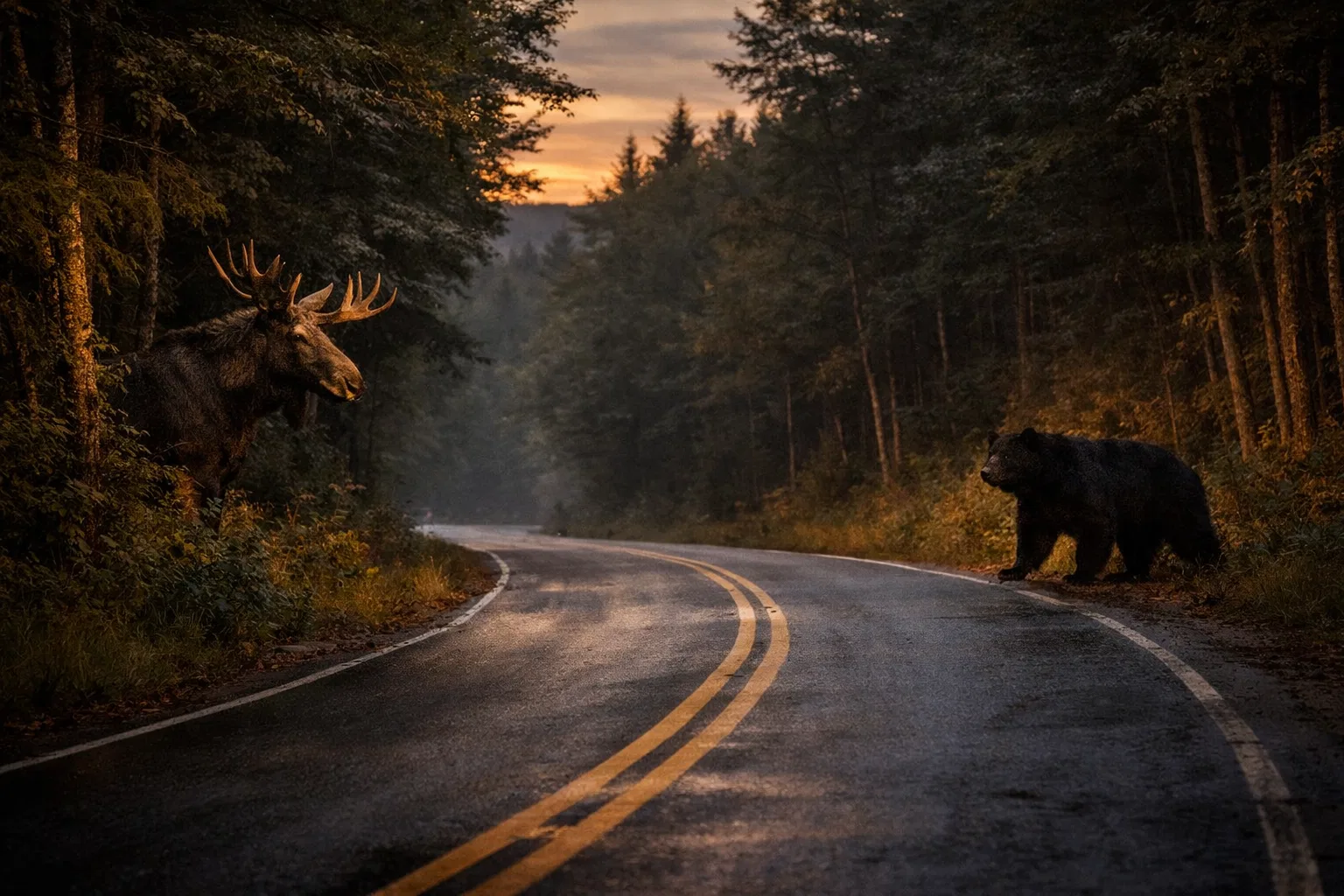
Moose are the obvious starting point. A full-grown moose is not simply “a big deer”; it is a tall, long-legged animal with a heavy body, high shoulders, a long face and a habit of appearing near roads and wet areas. New Hampshire Fish and Game warns drivers to “Brake for Moose” and notes that most moose collisions happen at dawn or dusk, precisely when shape and distance are hardest to judge.[New Hampshire Fish and Game Department]wildlife.nh.govOpen source on nh.gov.
That makes moose especially relevant to tall-creature claims. In northern New Hampshire, a moose partly hidden behind spruce or birch can supply several ingredients of a monster sighting at once: height, a horse-like head, long legs, dark bulk, a sudden crash through brush and a vanishing act into forest. The New Hampshire State Parks folklore piece on the Woods Devil even describes that creature as having a long face “not too far off from a horse or moose”, while the author notes that night driving in the North Country can make trees, reflectors and moose blur into unnerving impressions.[NH State Parks]nhstateparks.orgNH State Parks Mystery in the Great North Woods! What is The Woods Devil?NH State Parks Mystery in the Great North Woods! What is The Woods Devil?
Black bears are another major source of mistaken monster impressions. New Hampshire Fish and Game says bears are found statewide and are densest in central New Hampshire and the White Mountains. Their normal four-legged outline is familiar, but a bear standing up, reaching, turning, or moving through thick cover can look briefly and disturbingly human.[New Hampshire Fish and Game Department]wildlife.nh.govA current NH Bear license is required for all ages. Hunters age 16New Hampshire Fish and Game DepartmentBear Hunting in New HampshireBears are found statewide, with the highest densities in central NH an…
Bear misidentification is especially relevant to Bigfoot-style reports because a bear does not have to walk like a person for long. It only has to be seen upright for a moment, or glimpsed from behind while moving between trunks. A dark bear at dusk can become a broad-shouldered figure; a young bear can become a “small hairy man”; a bear crashing away can become a creature that “knew it had been seen”.
Bobcats explain a different category of New Hampshire mystery beast: the phantom cat. New Hampshire Fish and Game notes that bobcats are commonly confused with Canada lynx, and sighting and roadkill data indicate bobcats now reside in all New Hampshire counties.[New Hampshire Fish and Game Department]wildlife.nh.govBobcat are commonly confused with the Canada lynx given the overlapping historic range of…
A bobcat is not the size of a mountain lion, but it is larger, stronger and stranger-looking than many people expect from a wild cat. Its short tail can be missed in motion; its legs can look long in headlights; and its movement is catlike enough to trigger the thought of something more exotic. That helps explain why mountain lion belief remains persistent in the state even though New Hampshire Fish and Game says it has no physical evidence of current mountain lion presence, despite many reports.[New Hampshire Fish and Game Department]wildlife.nh.govOpen source on nh.gov.
Eastern coyotes occupy the boundary between the familiar and the uncanny. They are not wolves, but in the Northeast they can be larger and more variable-looking than the small western coyote many people have in mind. New Hampshire Fish and Game says coyotes spread across the state from Colebrook to Seabrook between 1972 and 1980, while wildlife-help guidance for New Hampshire describes them as adaptable animals found in almost every habitat type, including urban areas, with adult males in the north-eastern United States typically weighing 40–45 pounds.[New Hampshire Fish and Game Department]wildlife.nh.govOpen source on nh.gov.
That size and adaptability make coyotes good fuel for “wolf”, “devil dog” or “hybrid beast” reports. A winter coyote in thick fur, seen at distance, may look heavier than it is. A mangy coyote may look diseased, unnatural or almost hairless. A coyote moving through suburban edges can also feel out of place even when it is behaving normally.
Fishers are smaller than the legends sometimes make them, but they punch above their weight in local imagination. New Hampshire Fish and Game describes the fisher as a forest carnivore with strong claws, a long bushy tapered tail and males averaging 4–12 pounds, about twice the size of females.[New Hampshire Fish and Game Department]wildlife.nh.govOpen source on nh.gov.
The fisher’s role in monster-making is less about size and more about atmosphere. A dark, low animal moving quickly across a road or stone wall can look like a “black thing” rather than a named species. The animal also carries a loud folklore reputation, with many people linking it to eerie screams even when specific night sounds may have other causes. In a state already rich with woods, old roads and backyard wildlife, that reputation can turn a fleeting mustelid into a miniature monster.
Night Roads, Partial Glimpses and Memory
The most important mechanism behind many New Hampshire monster claims is not lying. It is perception under poor conditions. Research on low-light identification found that increasing distance and reducing light had a dramatic negative effect on eyewitness identification accuracy, with starlight conditions producing severe limits even at short distances. That study involved human identification rather than wildlife, but the basic problem is directly relevant: in dim light, the observer is trying to recognise a moving form with incomplete visual information.[Taylor & Francis Online]tandfonline.comOpen source on tandfonline.com.
This is why roads matter so much. New Hampshire’s wooded highways and notches create short, high-pressure sightings. Headlights catch an animal for a second. The driver is moving. The animal is moving. The background is full of trunks, banks, signs, shadows and reflectors. New Hampshire Fish and Game’s moose-driving advice notes that collisions most often happen at dawn or dusk, but can happen at any time, which underlines how often large wildlife appears in the exact conditions that make clear identification difficult.[New Hampshire Fish and Game Department]wildlife.nh.govOpen source on nh.gov.
Memory then edits the encounter. A witness may honestly remember the most vivid features — height, eyes, speed, a scream, the way the animal “looked at me” — while losing scale, distance and duration. The National Academies’ review of eyewitness identification stresses that accurate identification depends on the limits of sensation, perception and memory, not just sincerity.[National Academies]nationalacademies.orgOpen source on nationalacademies.org.
In monster folklore, retelling adds a further layer. A person may first say, “I saw something huge by the road.” A friend suggests a bear, a moose, a mountain lion or a Woods Devil. The story is then retold with that label attached. Over time, the label can feel like part of the original sighting rather than an interpretation added afterwards.
The Woods Devil as a Case Study in Forest Misreading
The Woods Devil, or Wood Devil, is New Hampshire’s clearest example of how a local monster can grow from forest conditions. In modern retellings it is usually placed in Coös County and the Great North Woods, described as tall, grey, lanky, shaggy and difficult to see because it hides among trees. New Hampshire State Parks’ folklore article frames the creature around northern places such as Dixville Notch, Colebrook, Errol, Pittsburg and Route 3, all of which are real North Country settings rather than invented gothic scenery.[NH State Parks]nhstateparks.orgNH State Parks Mystery in the Great North Woods! What is The Woods Devil?NH State Parks Mystery in the Great North Woods! What is The Woods Devil?
The same article also gives the sceptical reader a built-in explanation: darkness, campfire stories, fearsome-critter traditions and the way the North Country landscape plays tricks on perception. Its author explicitly describes seeing “moose” that turned out to be trees and reflective strips during late-night drives, and suggests that someone in the backcountry could attach the Woods Devil name to something misperceived.[NH State Parks]nhstateparks.orgNH State Parks Mystery in the Great North Woods! What is The Woods Devil?NH State Parks Mystery in the Great North Woods! What is The Woods Devil?
Moose and black bears are the two most useful natural comparisons here. A moose can explain height, a long face, a sudden roadside appearance and a vanishing movement into dark timber. A bear can explain a hairy upright figure, especially if the sighting is brief and partly obscured. Neither explanation accounts for every detail in every retelling, but folklore rarely preserves details with scientific neatness.
The Woods Devil also shows why sceptical explanations do not necessarily kill a legend. In fact, they can make it more locally believable. A monster that might be a misread moose, bear, tree trunk or shadow belongs more deeply to Coös County than a monster with no connection to the actual woods. The story works because it feels as if the forest itself could produce it.
Phantom Cats and the Mountain Lion Problem
New Hampshire’s phantom-cat tradition is not only about misidentifying bobcats. It is about the emotional force of seeing something catlike that seems too big to be ordinary. Mountain lion reports are taken seriously enough to be filed and reviewed, but New Hampshire Fish and Game states that it has no physical evidence of mountain lion presence in the state. NHPR reported in 2024 that dozens of reports are filed each year and that state officials say none has proved the presence of mountain lions.[New Hampshire Fish and Game Department]wildlife.nh.govOpen source on nh.gov.
This creates a classic mystery-beast tension. On one side, witnesses feel certain about what they saw. On the other, a breeding population of large cats should leave evidence: clear photographs, tracks, scat, roadkill, DNA or confirmed kills. New Hampshire has many reported sightings, but not the kind of physical trail that would normally establish a resident population.[New Hampshire Fish and Game Department]wildlife.nh.govOpen source on nh.gov.
Bobcats are the most obvious source of confusion because they are real, recovering and more widespread than many residents may realise. A 2022 “Something Wild” report explained that New Hampshire Fish and Game’s bobcat mortality data showed increasing genetic diversity and a growing population, while noting that modern cameras are also making people more aware of bobcats.[Forest Society]forestsociety.orgsomething wild are there more bobcats nh or just more wildlife camerassomething wild are there more bobcats nh or just more wildlife cameras
The mountain lion question also shows how a misidentification can become more persuasive rather than less. A bobcat seen clearly is just a bobcat. A bobcat seen badly, from a car, stretched by motion and memory, can become “too big for a bobcat”. Once the witness has rejected the ordinary answer, the extraordinary answer feels stronger.
Lake Monsters and Large Fish
Misidentified wildlife is not only a forest issue. New Hampshire’s lake-monster talk also invites ordinary-animal explanations, though the evidence is often thinner and more anecdotal. Dublin Lake, for example, has a local monster legend involving dark water, depth, caverns and frightening underwater encounters. A 2017 Ledger-Transcript article described the legend as a story of a not-yet-classified “sea monster” in the deepest part of Dublin Lake, while noting the lake is around 100 feet deep according to New Hampshire Fish and Game.[Monadnock Ledger-Transcript]ledgertranscript.comMonadnock Ledger-Transcript The search for the Dublin Lake monsterMonadnock Ledger-Transcript The search for the Dublin Lake monster
The Dublin Lake story is not well supported as zoology. It is better read as a local lake legend shaped by depth, limited visibility, diver anxiety and the long tradition of turning deep water into a place where ordinary rules might fail. New Hampshire Fish and Game’s fish pages show that the state has real large or striking fish species, including Atlantic sturgeon records in coastal or estuarine waters, though that does not make sturgeon an automatic explanation for an inland lake monster.[New Hampshire Fish and Game Department]wildlife.nh.govOpen source on nh.gov.
The stronger point is mechanical rather than species-specific. Water makes identification difficult. A fish, floating log, wave pattern, swimming mammal or submerged object can appear larger than it is, especially when seen briefly from the surface. Unlike a road sighting, where the witness may at least see legs or a body outline, lake sightings often consist of humps, wakes, splashes or shadows.
That is why lake monsters tend to survive sceptical explanation so well. A moose beside a road can eventually be reduced to tracks, hair, roadkill or photos. A lake disturbance often leaves nothing behind. The absence of evidence is not proof of a monster, but it does allow the story to keep moving.

How Sceptical Explanations Preserve the Story
It is tempting to treat “misidentified wildlife” as a debunking phrase, but in New Hampshire it is more useful than that. It explains why the stories are plausible as experiences even when they are weak as evidence for unknown animals. The witness may really have seen something. The animal may really have been large, fast, loud or frightening. The mistake lies in the final identification.
This distinction keeps the stories human. A person surprised by a moose at dusk is not inventing the shock. A driver who sees a bobcat cross a road may not have the time, light or experience to judge its size accurately. A hiker who hears a fisher, fox, owl or coyote may remember the sound as “unnatural” because it did not fit any animal they expected to hear.
Sceptical explanations also make the folklore more state-specific. New Hampshire’s monster claims are not floating in an abstract paranormal world. They are tied to the animals and habitats of the Granite State: moose country, bear country, bobcat recovery, coyote expansion, fisher forests, deep ponds and roads that cut through dark timber. The New Hampshire Wildlife Sightings database itself cautions that its species maps represent towns with reports verified through that system since 2002 and that unshaded areas do not imply absence, a reminder that even ordinary wildlife records depend on observation, reporting and verification.[nhwildlifesightings.unh.edu]nhwildlifesightings.unh.eduOpen source on unh.edu.
The best sceptical reading, then, is not “there are no monsters, so nothing happened”. It is “something probably happened, and New Hampshire’s real wildlife gives us several strong reasons why it became a monster story”.
Reading New Hampshire Monster Claims Carefully
A careful reader can enjoy New Hampshire monster lore without treating every claim as literal evidence. The useful question is not just “Was it real?” but “What real thing could have produced this report?”
A few clues matter most:
- Size and posture: Tall, long-faced roadside figures point first towards moose; bulky upright figures point first towards black bear.
- Catlike movement: Reports of large cats should be compared with bobcats before jumping to mountain lions, especially given the lack of confirmed physical evidence for mountain lions in New Hampshire.
- Doglike or wolflike animals: Coyotes are widespread, variable and now deeply established in the state.
- Dark, low, fast animals: Fishers, foxes, raccoons and other mid-sized mammals can look far stranger than expected in headlights.
- Water disturbances: Lake monsters often begin with partial views: humps, wakes, splashes, shadows or fish seen through distorted light.
- Timing: Dawn, dusk and night sightings deserve extra caution because low light sharply reduces recognition accuracy.
- Retelling: The more a report depends on later labels, local legend names or second-hand description, the more careful the reader should be.
This approach does not flatten the folklore. It makes it richer. A Woods Devil story becomes a story about Coös County forests, moose roads, lumber-camp imagination and fear in dark timber. A phantom-cat report becomes a story about bobcat recovery, missing mountain lions and the limits of certainty. A lake monster becomes a story about depth, visibility and how water hides scale.
Why the Ordinary Animal Answer Still Feels Strange
The reason New Hampshire’s wildlife can become monstrous is that real animals are already strange at the edge of vision. A moose is a huge, prehistoric-looking shape when it steps out of wetland brush. A bear can look almost human for a second. A bobcat can seem impossibly exotic in a suburban yard. A coyote’s winter coat can turn a familiar canid into something wolflike. A fisher can cross a stone wall like a piece of moving shadow.
That is the heart of New Hampshire’s misidentified-monster tradition. The state does not need confirmed hidden beasts to produce convincing monster moments. Its forests, mountains, lakes and roadways already contain animals capable of startling people into stories. The sceptical explanation does not remove the chill from the tale; it puts the chill back where it belongs, in the brief, uncertain moment when a real creature is seen badly and the mind has to decide what it was.
eBay marketplace picks
Marketplace Samples
Live-tested eBay searches with available results related to this page.
Endnotes
1.
Source: nhpr.org
Link:https://www.nhpr.org/nh-news/2024-08-07/mountain-lions-in-nh-some-locals-believe-the-big-cats-still-roam-the-granite-state
2.
Source: nhwildlifesightings.unh.edu
Link:https://nhwildlifesightings.unh.edu/WILDLIFE/SpeciesMap
3.
Source: nhpr.org
Title: ask sam why wont new hampshire admit there are mountain lions here
Link:https://www.nhpr.org/environment/2018-11-16/ask-sam-why-wont-new-hampshire-admit-there-are-mountain-lions-here
4.
Source: nhpr.org
Title: think you saw a mountain lion in n h
Link:https://www.nhpr.org/the-exchange/2019-07-05/think-you-saw-a-mountain-lion-in-n-h
5.
Source: nhpr.org
Title: opossum porcupine and fisher some underappreciated n h creatures
Link:https://www.nhpr.org/the-exchange/2019-10-18/opossum-porcupine-and-fisher-some-underappreciated-n-h-creatures
6.
Source: nhpr.org
Title: something wild whats behind the bobcats new hampshire comeback
Link:https://www.nhpr.org/something-wild/2017-02-03/something-wild-whats-behind-the-bobcats-new-hampshire-comeback
7.
Source: nhpr.org
Title: wildlife experts coyotes live across n h but pose few problems
Link:https://www.nhpr.org/the-exchange/2019-03-12/wildlife-experts-coyotes-live-across-n-h-but-pose-few-problems
8.
Source: nhwildlifesightings.unh.edu
Title: about wo.shtml
Link:https://nhwildlifesightings.unh.edu/about_wo.shtml
9.
Source: unh.edu
Title: research finds nh bobcats roam different areas ancestors
Link:https://www.unh.edu/unhtoday/news/release/2019/04/03/unh-research-finds-nh-bobcats-roam-different-areas-ancestors
10.
Source: unh.edu
Title: assessing fisher population dynamics across new hampshire
Link:https://www.unh.edu/inquiryjournal/blog/2024/11/assessing-fisher-population-dynamics-across-new-hampshire
11.
Source: nhgeodata.unh.edu
Link:https://www.nhgeodata.unh.edu/datasets/8889571de44346b689309578df337672_1/about
12.
Source: wildlife.nh.gov
Title: Moose may live 20 years, but average lifespan is 10-12
Link:https://www.wildlife.nh.gov/wildlife-and-habitat/species-occurring-nh/moose
Source snippet
New Hampshire Fish and Game DepartmentMoose | State of New Hampshire Fish and GameCows have been known to kill wolves, grizzlies, black b...
13.
Source: wildlife.nh.gov
Title: A current NH Bear license is required for all ages. Hunters age 16
Link:https://www.wildlife.nh.gov/hunting-nh/bear-hunting-new-hampshire
Source snippet
New Hampshire Fish and Game DepartmentBear Hunting in New HampshireBears are found statewide, with the highest densities in central NH an...
14.
Source: wildlife.nh.gov
Link:https://www.wildlife.nh.gov/wildlife-and-habitat/species-occurring-nh/bobcat
Source snippet
Bobcat are commonly confused with the Canada lynx given the overlapping historic range of...
15.
Source: wildlife.nh.gov
Link:https://www.wildlife.nh.gov/wildlife-and-habitat/species-occurring-nh/eastern-coyote
16.
Source: wildlife.nh.gov
Link:https://www.wildlife.nh.gov/wildlife-and-habitat/species-occurring-nh/fisher
17.
Source: visitwhitemountains.com
Link:https://www.visitwhitemountains.com/things-to-do/outdoors/wildlife/
18.
Source: wildlife.nh.gov
Link:https://www.wildlife.nh.gov/wildlife-and-habitat/moose-new-hampshire/brake-moose
19.
Source: nhstateparks.org
Title: NH State Parks Mystery in the Great North Woods! What is The Woods Devil?
Link:https://www.nhstateparks.org/NHStateParks/media/NHStateParks/PDFs/SCA%20Blog%20docs/mystery-in-the-great-north-woods-what-is-the-woods-devil.pdf
20.
Source: wildlife.nh.gov
Link:https://www.wildlife.nh.gov/wildlife-and-habitat/mountain-lions-new-hampshire
21.
Source: tandfonline.com
Link:https://www.tandfonline.com/doi/full/10.1080/23311908.2019.1632047
22.
Source: nationalacademies.org
Link:https://www.nationalacademies.org/read/18891/chapter/6
23.
Source: forestsociety.org
Title: something wild are there more bobcats nh or just more wildlife cameras
Link:https://www.forestsociety.org/something-wild/something-wild-are-there-more-bobcats-nh-or-just-more-wildlife-cameras
24.
Source: ledgertranscript.com
Title: Monadnock Ledger-Transcript The search for the Dublin Lake monster
Link:https://ledgertranscript.com/2017/07/26/lake-monster-11413244/
25.
Source: wildlife.nh.gov
Link:https://www.wildlife.nh.gov/fishing-new-hampshire/fish-species-nh/atlantic-sturgeon
26.
Source: wildlife.nh.gov
Link:https://www.wildlife.nh.gov/fishing-new-hampshire/fish-species-nh
27.
Source: wildlife.nh.gov
Title: bear assessment
Link:https://www.wildlife.nh.gov/sites/g/files/ehbemt746/files/documents/nh-bear-assessment.pdf
28.
Source: wildlife.nh.gov
Title: moose assessment
Link:https://www.wildlife.nh.gov/sites/g/files/ehbemt746/files/documents/nh-moose-assessment.pdf
29.
Source: wildlife.nh.gov
Title: fg biennialreport
Link:https://www.wildlife.nh.gov/sites/g/files/ehbemt746/files/documents/nhfg-biennialreport.pdf
30.
Source: wildlife.nh.gov
Title: moose season and management
Link:https://www.wildlife.nh.gov/sites/g/files/ehbemt746/files/documents/moose-season-and-management.pdf
31.
Source: wildlife.nh.gov
Title: swap appendix n
Link:https://www.wildlife.nh.gov/sites/g/files/ehbemt746/files/inline-documents/sonh/swap-appendix-n.pdf
32.
Source: wildlife.nh.gov
Title: wildlife frequently asked questions
Link:https://www.wildlife.nh.gov/wildlife-and-habitat/wildlife-frequently-asked-questions
33.
Source: wildlife.nh.gov
Title: public comments
Link:https://www.wildlife.nh.gov/sites/g/files/ehbemt746/files/documents/public-comments.pdf
34.
Source: wildlife.nh.gov
Title: big game management plan
Link:https://www.wildlife.nh.gov/sites/g/files/ehbemt746/files/documents/big-game-management-plan.pdf
35.
Source: wildlife.nh.gov
Title: trails for people wildlife
Link:https://www.wildlife.nh.gov/sites/g/files/ehbemt746/files/inline-documents/sonh/trails-for-people-wildlife.pdf
36.
Source: wildlife.nh.gov
Title: rising temperatures and climate change
Link:https://www.wildlife.nh.gov/wildlife-and-habitat/climate-change-and-wildlife/rising-temperatures-and-climate-change
37.
Source: wildlife.nh.gov
Title: swap appendix i
Link:https://www.wildlife.nh.gov/sites/g/files/ehbemt746/files/inline-documents/sonh/swap-appendix-i.pdf
38.
Source: wildlife.nh.gov
Title: swap species profile mammals
Link:https://www.wildlife.nh.gov/sites/g/files/ehbemt746/files/inline-documents/sonh/swap-species-profile-mammals.pdf
39.
Source: wildlife.nh.gov
Title: comm min 18feb25
Link:https://www.wildlife.nh.gov/sites/g/files/ehbemt746/files/inline-documents/sonh/comm-min-18feb25.pdf
40.
Source: wildlife.nh.gov
Title: swap appendix b
Link:https://www.wildlife.nh.gov/sites/g/files/ehbemt746/files/inline-documents/sonh/swap-appendix-b.pdf
41.
Source: wildlife.nh.gov
Title: wildlines spring 2024
Link:https://www.wildlife.nh.gov/sites/g/files/ehbemt746/files/inline-documents/sonh/wildlines-spring-2024.pdf
42.
Source: wildlife.nh.gov
Title: species occurring nh
Link:https://www.wildlife.nh.gov/wildlife-and-habitat/species-occurring-nh
43.
Source: wildlife.nh.gov
Title: habitat types and species
Link:https://www.wildlife.nh.gov/wildlife-and-habitat/wildlife-habitat-program/habitat-types-and-species
44.
Source: forestsociety.org
Title: what does nhs wildlife action plan do
Link:https://www.forestsociety.org/something-wild/what-does-nhs-wildlife-action-plan-do
45.
Source: cryptidz.fandom.com
Title: Woods Devil
Link:https://cryptidz.fandom.com/wiki/Woods_Devil
46.
Source: cryptidz.fandom.com
Title: Dublin Lake Monster
Link:https://cryptidz.fandom.com/wiki/Dublin_Lake_Monster
47.
Source: frontiersin.org
Link:https://www.frontiersin.org/journals/human-dynamics/articles/10.3389/fhumd.2024.1216121/full
48.
Source: new-hampshire-geodata-portal-1-nhgranit.hub.arcgis.com
Link:https://new-hampshire-geodata-portal-1-nhgranit.hub.arcgis.com/datasets/NHGRANIT%3A%3Anh-wildlife-action-plan-2025-aquatic-habitat-lakes-ponds/about
49.
Source: files.cityofportsmouth.com
Link:https://files.cityofportsmouth.com/police/flyers/coyotes.pdf
50.
Source: ledgertranscript.com
Title: mountain lion 13038507
Link:https://ledgertranscript.com/2017/10/11/mountain-lion-13038507/
Additional References
51.
Source: visitnh.gov
Link:https://www.visitnh.gov/blog/where-to-spot-new-hampshire-s-wildlife
52.
Source: nrc.gov
Link:https://www.nrc.gov/docs/ML0701/ML070190409.pdf
53.
Source: youtube.com
Title: Bear or Bigfoot?! | Strange Evidence | Science Channel
Link:https://www.youtube.com/watch?v=ZuPT2FgEF4w
Source snippet
What's Happening to NH's Moose? | Windows to the Wild...
54.
Source: instagram.com
Link:https://www.instagram.com/reel/DYkySEPCt4W/
55.
Source: researchgate.net
Link:https://www.researchgate.net/publication/385913862_Identifying_signals_of_memory_from_observations_of_animal_movements
56.
Source: fishdatabase.com
Link:https://www.fishdatabase.com/New-Hampshire
57.
Source: researchgate.net
Link:https://www.researchgate.net/publication/9078006_Exposure_duration_Effects_on_eyewitness_accuracy_and_confidence_British_Journal_of_Psychology
58.
Source: gnb.ca
Link:https://www.gnb.ca/en/topic/driving-transportation/driving-safety/highway-wildlife.html
59.
Source: reddit.com
Link:https://www.reddit.com/r/newhampshire/comments/1h3r54v/coos_county_wood_devils/
60.
Source: facebook.com
Link:https://www.facebook.com/groups/uLocalNH/posts/1426946711030629/
Topic Tree