Within Iowa Monsters
Was the Lockridge Monster a Bear?
The Lockridge Monster shows how livestock losses, tracks and fear can turn a possible bear into a cryptid case.
On this page
- The 1975 farmyard reports
- Tracks, turkeys and witness descriptions
- Bear theory versus Bigfoot claims
Page outline Jump by section
Introduction
The Lockridge Monster is best understood as a short, vivid 1975 southeast Iowa mystery-beast case in which farm losses, tracks, dusk sightings and local fear may have turned a plausible wandering animal into a cryptid. The central reports came from around Lockridge in Jefferson County, where a dark, hairy, bear-like creature was linked to partially eaten turkeys and 10-inch tracks. Some retellings fold it into Iowa’s Bigfoot tradition, but the details that make the case memorable also make a simple Bigfoot label awkward: the animal was often described as bear-like, appeared around poultry, and left tracks far smaller than the oversized footprints usually claimed in Sasquatch stories. A black bear does not solve every detail, especially the “monkey face” language used by witnesses, but it remains the most useful sceptical explanation because Iowa has a long history of vanished native bears, occasional wandering bears, and public surprise when large wildlife appears where people no longer expect it.[bfro.net]bfro.netshow report.aspNewspaper article about "The Lockridge Monster."16 Jan 2001 — Lockridge, Iowa (AP) - Skeptics call it "The Lockridge Monster", but…
The 1975 farmyard reports
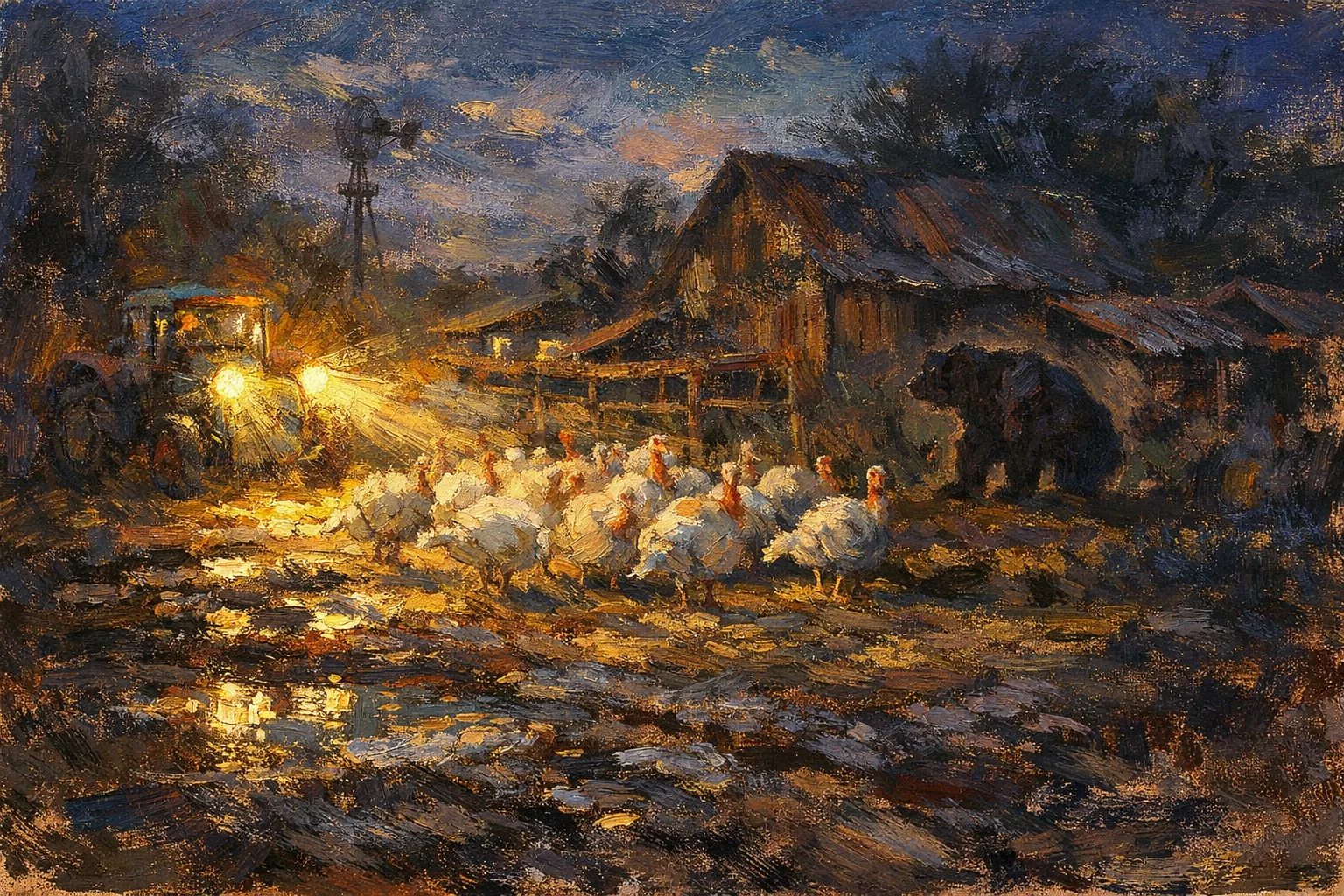
The Lockridge story belongs to a particular moment: autumn 1975, in a turkey-farming community roughly 60 miles south of Iowa City. The Associated Press account, later reproduced by the Bigfoot Field Researchers Organization, described the scare as centred on reports of a “bear-like creature with a monkey face” and said the name “The Lockridge Monster” was already being used by sceptics and locals. The article placed Herb Peiffer’s sighting in the practical setting that matters most for understanding the case: he was driving towards his turkey pens when he saw a dark, four-legged shape in the cornfield in his tractor lights.[BFRO]bfro.netshow report.aspNewspaper article about "The Lockridge Monster."16 Jan 2001 — Lockridge, Iowa (AP) - Skeptics call it "The Lockridge Monster", but…
That setting is important because the story did not begin as a campfire tale about a distant wilderness ape. It began as a farm problem. Something had apparently been getting into or around poultry, and the reports gained force because there were dead birds, tracks and worried residents. Lowell Adkins, identified as a hunter, was reported to have found 10-inch tracks near four partially eaten turkeys. Local fear then filled the gap between “unknown predator” and “monster”: the AP account noted that some parents were keeping children indoors after dark while the mystery remained unresolved.[BFRO]bfro.netshow report.aspNewspaper article about "The Lockridge Monster."16 Jan 2001 — Lockridge, Iowa (AP) - Skeptics call it "The Lockridge Monster", but…
Later cryptid summaries tend to smooth the story into a neat creature profile, but the original elements are messier and more useful. One witness saw a black-haired thing in a cornfield from a moving tractor at low light. Another saw something by an old deserted farmyard just before dark. A hunter found tracks and damaged turkeys. These are exactly the ingredients that make rural monster reports durable: real stakes for farmers, just enough physical trace to keep people talking, and sightings brief enough that no description can settle the question.[BFRO]bfro.netshow report.aspNewspaper article about "The Lockridge Monster."16 Jan 2001 — Lockridge, Iowa (AP) - Skeptics call it "The Lockridge Monster", but…

Tracks, turkeys and witness descriptions
The most concrete reported clue was the track size: about 10 inches. That sounds large in an ordinary farmyard, but it complicates the Bigfoot reading. Little Village’s Iowa cryptid roundup summarised the later argument that Ramona Hibner of the South Mountain Research Group considered the Lockridge prints much smaller than typical Sasquatch claims, and that the turkey-killing behaviour sat awkwardly with the more familiar image of Bigfoot as a shy, forest-dwelling hominid rather than a poultry predator.[Little Village]littlevillagemag.comsightings iowasightings iowa
The turkeys are equally important. In folklore terms, mutilated or half-eaten livestock can become “monster evidence” because it feels more dramatic than a mere glimpse. In wildlife terms, though, poultry is exactly the sort of attractant that can draw known predators into human spaces. The U.S. Department of Agriculture’s black bear damage guide notes that black bears can attack livestock, may leave claw and bite evidence, can drag or partially bury carcasses, and, while they rarely kill several animals at once, “surplus” killing can occur, particularly with poultry, sheep or swine.[APHIS]aphis.usda.govOpen source on usda.gov.
The “monkey face” detail is the hardest part to treat casually. Gloria Olson’s reported description said the animal looked hairy all over and had a monkey-like face; another retelling has her saying she knew it was not a bear. That does not prove an ape-like creature was present, but it does explain why the story escaped ordinary nuisance-wildlife territory. A bear seen poorly, from the front, in failing light can look startlingly unlike the mental picture many people carry of a bear, especially in a county where few residents expected to see one at all.[BFRO]bfro.netshow report.aspNewspaper article about "The Lockridge Monster."16 Jan 2001 — Lockridge, Iowa (AP) - Skeptics call it "The Lockridge Monster", but…
The descriptions also vary in a way that points towards confusion rather than classification. Some versions emphasise four-legged movement; others add standing upright or running “like a man”. Pine Barrens Institute’s profile, a secondary cryptid summary rather than a primary newspaper source, gathers later details such as tracks along stream edges, strange sounds, eaten apples and an unsuccessful attempt to flush out the animal, but also treats the black bear explanation as a serious possibility. This is useful not because it proves those later details, but because it shows how the legend grew: each added feature either makes the animal more bear-like or more cryptid-like, depending on which part of the story a teller wants to stress.[THE PINE BARRENS INSTITUTE]pinebarrensinstitute.comTHE PINE BARRENS INSTITUTECryptid Profile: The Lockridge MonsterTHE PINE BARRENS INSTITUTECryptid Profile: The Lockridge Monster
Bear theory versus Bigfoot claims
The bear theory has three strengths. First, the creature was repeatedly framed as bear-like, even in the AP headline and local descriptions. Second, a 10-inch track is easier to discuss in relation to a large known mammal than as evidence for an enormous unknown ape. Third, the turkey losses fit known bear conflict patterns better than they fit the common Bigfoot image. USDA guidance describes black bears as flat-footed animals with five forward-facing toes and short curved claws, and says black bears can feed on animals when need or opportunity pushes them towards that behaviour.[APHIS]aphis.usda.govOpen source on usda.gov.
The strongest objection is historical: in 1975, a bear in southeast Iowa would have seemed extraordinary. That objection is fair, but not fatal. Iowa’s Department of Natural Resources says black bears were documented in 48 Iowa counties before 1900, mostly in eastern Iowa, but the last historical documentation before modern recolonisation was a bear shot near Spirit Lake in 1876. It also says Iowa has no breeding population of black bears today, and that modern free-ranging bear reports began in the 1990s and have increased as neighbouring populations expanded.[Department of Natural Resources]iowadnr.govOpen source on iowadnr.gov.
That timing means the Lockridge case sits in an awkward gap. A confirmed Iowa bear in 1975 would have been unusual enough to alarm people, but not biologically impossible in a region where bears existed historically and viable populations persisted or recovered in nearby states. The Iowa DNR now identifies Minnesota and Wisconsin as breeding bear states, with southern Missouri also holding a small but expanding population; it also stresses that large mammals can travel long distances and may only pass through Iowa briefly.[Department of Natural Resources]iowadnr.govOpen source on iowadnr.gov.
The Bigfoot claim, by contrast, depends mainly on the face description and the upright or man-like movement reported in some retellings. Those are intriguing details, but they are weak as evidence because the sightings were brief, low-light and emotionally charged. Broader Bigfoot literature has long wrestled with bear confusion, and a 2024 Journal of Zoology paper specifically modelled the relationship between Sasquatch reports and black bear populations, noting the long-standing suggestion that some Bigfoot sightings are misidentified upright bears.[ZSL Publications]zslpublications.onlinelibrary.wiley.comZSL Publications Bigfoot: If it's there, could it be a bear?ZSL Publications Bigfoot: If it's there, could it be a bear?
The fairest reading is not “definitely bear” or “definitely Bigfoot”. It is that the Lockridge Monster is a classic animal-confusion case with enough odd witness language to survive as folklore. The bear hypothesis explains the farm setting, poultry losses, broad body type and transient nature of the scare. The Bigfoot interpretation explains why later cryptid catalogues kept the case alive, but it has to work around the smaller tracks and livestock-predation focus.[It's Something]itsmth.fandom.comIt's Something Lockridge MonsterIt's Something Lockridge Monster

Why Lockridge became an Iowa monster story
The Lockridge Monster matters because it shows how a cryptid can form without needing a long tradition, a lake, a haunted mine or a dramatic hoax. The story needed only a few nights of uncertainty in a rural place where the wrong animal in the wrong field could affect livelihoods and household routines. Once the creature had a name, the name did cultural work: “Lockridge Monster” turned scattered farm reports into a case people could repeat, file, debate and map alongside Iowa’s better-known mystery beasts.[BFRO]bfro.netshow report.aspNewspaper article about "The Lockridge Monster."16 Jan 2001 — Lockridge, Iowa (AP) - Skeptics call it "The Lockridge Monster", but…
Its Iowa character comes from the tension between agricultural normality and ecological surprise. Lockridge was not remote mountain country; it was a small southeast Iowa community. That makes a large, dark, hairy animal more disruptive. Iowa DNR’s current “occasional wildlife visitors” framework helps explain why such stories recur across the state: large mammals once native to Iowa are mostly absent as breeding populations, but wandering animals from neighbouring states can still appear, move quickly and then vanish.[Department of Natural Resources]iowadnr.govOpen source on iowadnr.gov.
That pattern is perfect fuel for folklore. When a bear, cougar-like animal, wolf-like canid or other unexpected creature appears briefly, the lack of local familiarity can make ordinary identification harder. People may know deer, coyotes, raccoons and farm dogs well, yet still be unprepared for a bear-shaped silhouette in headlights. In that moment, the question changes from “what animal was this?” to “what is out there?” The Lockridge case lives in that shift.
What probably happened near Lockridge?
The best answer is cautious: something may well have been killing or scavenging turkeys near Lockridge in 1975, and some residents appear to have seen a large, dark, hairy animal in poor viewing conditions. The available evidence does not establish an unknown primate, and the most grounded explanation is a misidentified known animal, with black bear the leading candidate. That is not because every detail fits perfectly, but because the overall pattern fits better than the alternatives: poultry attraction, bear-like body, tracks, brief sightings, no capture, and no continuing population trail.[bfro.net]bfro.netshow report.aspNewspaper article about "The Lockridge Monster."16 Jan 2001 — Lockridge, Iowa (AP) - Skeptics call it "The Lockridge Monster", but…
A few points keep the case from being closed with complete confidence. The original public accounts do not provide photographs, casts, measurements beyond the reported track length, necropsy-style analysis of the turkeys, hair samples, scat evidence or confirmed wildlife-agency identification. Later versions add colourful details, but many are secondary and difficult to separate from retelling. The lack of a final capture or official identification leaves a gap, and folklore tends to live comfortably inside gaps.
That gap is also why the Lockridge Monster remains a better story than it is a biological mystery. It captures a specific Iowa fear: not a supernatural invader, but a real-seeming animal that should not be there. In a state where bears were historically native, then absent from everyday experience, and now increasingly understood as occasional visitors, the Lockridge Monster reads less like proof of Bigfoot and more like a case study in how wildlife surprise becomes local legend.

eBay marketplace picks
Marketplace Samples
Live-tested eBay searches with available results related to this page.



Endnotes
1.
Source: bfro.net
Title: show report.asp
Link:https://www.bfro.net/GDB/show_report.asp?id=1270
Source snippet
Newspaper article about "The Lockridge Monster."16 Jan 2001 — Lockridge, Iowa (AP) - Skeptics call it "The Lockridge Monster", but...
2.
Source: aphis.usda.gov
Link:https://www.aphis.usda.gov/sites/default/files/black-bear-wdm-tech-series.pdf
3.
Source: pinebarrensinstitute.com
Title: THE PINE BARRENS INSTITUTECryptid Profile: The Lockridge Monster
Link:https://pinebarrensinstitute.com/cryptids/2018/8/19/quick-cryptid-snippet-the-lockridge-monster
4.
Source: bfro.net
Link:https://www.bfro.net/GDB/show_report.asp?ID=1270&PrinterFriendly=True
5.
Source: bear.org
Link:https://bear.org/bear-facts/bear-tracks-and-trails/
6.
Source: littlevillagemag.com
Title: sightings iowa
Link:https://littlevillagemag.com/sightings-iowa/
7.
Source: iowadnr.gov
Link:https://www.iowadnr.gov/media/8731/download?inline=
8.
Source: iowadnr.gov
Link:https://www.iowadnr.gov/programs-services/iowas-wildlife/occasional-wildlife-visitors
9.
Source: zslpublications.onlinelibrary.wiley.com
Title: ZSL Publications Bigfoot: If it’s there, could it be a bear?
Link:https://zslpublications.onlinelibrary.wiley.com/doi/10.1111/jzo.13148
10.
Source: itsmth.fandom.com
Title: It’s Something Lockridge Monster
Link:https://itsmth.fandom.com/wiki/Lockridge_Monster
11.
Source: cryptidz.fandom.com
Title: Lockridge Monster
Link:https://cryptidz.fandom.com/wiki/Lockridge_Monster
12.
Source: cryptid-tidbits.fandom.com
Title: Lockridge Monster
Link:https://cryptid-tidbits.fandom.com/wiki/Lockridge_Monster
13.
Source: paranormal-strange.fandom.com
Title: Lockridge Monster
Link:https://paranormal-strange.fandom.com/wiki/Lockridge_Monster
14.
Source: iowadnr.gov
Title: black bears becoming regular visitors northeast iowa
Link:https://www.iowadnr.gov/news-release/2026-05-12/black-bears-becoming-regular-visitors-northeast-iowa
15.
Source: iowadnr.gov
Title: black bear sightings rise northeast iowa
Link:https://www.iowadnr.gov/news-release/2025-04-29/black-bear-sightings-rise-northeast-iowa
16.
Source: bigfootencounters.com
Link:https://www.bigfootencounters.com/articles/ramona.htm
17.
Source: Wikipedia
Link:https://en.wikipedia.org/wiki/Bigfoot
Additional References
18.
Source: wildernesscollege.com
Link:https://www.wildernesscollege.com/american-black-bear-tracks.html?srsltid=AfmBOopWscKTEaVBRKqd-AJ8PsCJuUEyiEuzYMZuI1fr5X1saLEVR6tY
19.
Source: facebook.com
Link:https://www.facebook.com/kcrgtv9/posts/black-bear-sightings-are-becoming-more-common-in-iowa-and-the-dnr-is-taking-step/1567725924719708/
20.
Source: facebook.com
Link:https://www.facebook.com/Thehuntingnews/posts/black-bears-do-eat-turkeys-but-they-are-opportunistic-predators-not-turkey-speci/1020804550303328/
21.
Source: facebook.com
Link:https://www.facebook.com/iowacrypto/posts/1092091117929827
22.
Source: facebook.com
Link:https://www.facebook.com/groups/271764596196849/posts/27537715729175034/
23.
Source: facebook.com
Link:https://www.facebook.com/iowacrypto/photos/d41d8cd9/604436503361960/
24.
Source: facebook.com
Link:https://www.facebook.com/press.citizen/posts/iowa-has-seen-an-uptick-in-black-bear-sightings-in-recent-years-the-iowa-dnr-is-/1799052764772762/
25.
Source: hangar1publishing.com
Link:https://hangar1publishing.com/blogs/cryptids/iowa-bigfoot-sightings?srsltid=AfmBOoo2dgydamwPMjTPGeu6_vfY0kwLInr4Q1puJYqnHfIrAael9bE6
26.
Source: listennotes.com
Link:https://www.listennotes.com/podcasts/backwoods-bigfoot/iowa-bigfoot-the-[van-meter
27.
Source: reddit.com
Link:https://www.reddit.com/r/bigfoot/comments/10p941q/is_bigfoot_a_black_bear_new_analysis_suggests/
Topic Tree