Within New York Cryptids
How Whitehall Became Bigfoot Country
Whitehall turned a 1970s roadside encounter tradition into one of New York's most distinctive Bigfoot identities.
On this page
- The Abair Road sighting story
- Police linked testimony and later retellings
- Bigfoot sanctuary branding and civic folklore
Page outline Jump by section
Introduction
Whitehall’s Bigfoot story is not simply “New York has a Sasquatch”. It is a local witness legend that hardened into civic identity. The core tale centres on a cluster of alleged sightings around Abair Road in August 1976, where teenagers, police officers and other local witnesses were said to have seen a large, upright, hairy figure near the edge of town. No body, clear photograph or accepted biological evidence has proved such a creature exists, but the Whitehall case became memorable because it attached Bigfoot to named roads, police-linked testimony, newspaper coverage and later public celebration. Today the village treats Sasquatch as a mascot as much as a mystery: Whitehall has Bigfoot statues, a festival, a “Sasquatch Appreciation Day”, and a folklore marker describing it as a Bigfoot sanctuary.[Times Union]timesunion.comTimes Union Searching for Sasquatch in WhitehallTimes Union Searching for Sasquatch in Whitehall
That mix makes Whitehall one of New York’s clearest examples of how a frightening roadside report can become local folklore. The legend belongs to the Adirondack–Lake Champlain borderland, where wooded slopes, farms, watercourses and night driving give the story a plausible stage, even for readers who remain firmly sceptical.
Why Whitehall feels like Bigfoot country
Whitehall sits in Washington County, close to the Vermont border and the southern end of Lake Champlain. It is not remote in the wilderness-romance sense of the Pacific Northwest, but it does sit at a useful folklore threshold: village streets give way quickly to farms, wooded hills, streams, back roads and the wider Adirondack region. That matters because Whitehall Bigfoot is usually told as a forest-edge creature, not a deep-wilderness monster. The reported animal appears near roads, fields, golf courses and water margins, close enough to be encountered by ordinary residents but just far enough from town lights to stay uncertain.
This is one reason the Whitehall story works so well as a New York legend. The state already has a famous lake monster in Champ, tied to Lake Champlain, but Whitehall offers a land-based counterpart: a hairy, upright figure supposedly moving through the same North Country border landscape. Tourism writing about the Adirondacks often presents Whitehall as the best-known Sasquatch location in the region, with the Abair Road incident treated as the spark for modern interest. ADK Taste - The Best of the Adirondacks[adktaste.com]adktaste.comADK TasteADK Taste
The setting also gives sceptics something solid to work with. New York has real large mammals, especially black bears. The Department of Environmental Conservation estimates a minimum of 6,000 to 8,000 black bears in areas open to hunting, with roughly half to three-fifths of them in the Adirondack region; bears are also increasingly found in semi-rural and occasionally urban settings. Adult male black bears average about 300 pounds, can be much heavier, and may briefly appear startlingly upright or human-like in poor light. That does not “solve” every Whitehall report, but it gives the area a credible misidentification candidate for some fleeting night encounters.[Department of Environmental Conservation]dec.ny.govDepartment of Environmental Conservation Black BearDepartment of Environmental Conservation Black Bear
The legend therefore sits in a productive middle ground. It is not supported by mainstream zoological proof, yet it is also not a purely invented town logo with no witness tradition behind it. Whitehall’s Bigfoot identity grew because place, testimony and retelling reinforced one another.

The Abair Road sighting story
The modern Whitehall Bigfoot tradition is usually traced to late August 1976, when three teenagers reportedly saw a strange creature in a field off Abair Road. According to later retellings gathered by regional researcher Paul Bartholomew, the teens reported the sighting to authorities, and sheriff’s deputies and state troopers investigated. Over the following week, at least 10 witnesses were said to have reported a figure roughly eight feet tall, walking upright, with red eyes, a high-pitched sound, and a gorilla-like appearance.[Times Union]timesunion.comTimes Union Searching for Sasquatch in WhitehallTimes Union Searching for Sasquatch in Whitehall
The story mattered because it reached the local press quickly. The Post-Star ran a front-page story in 1976 under the headline “Officers track creature”, and a Newspapers.com archive entry summarises the report as police investigating a “large, unidentified creature” seen in the Town of Whitehall.[newspapers.com]newspapers.comthe post star abair rdthe post star abair rd That early press attention helped fix the incident as more than a private campfire tale. It became a public local event, one that residents could argue over, laugh about, fear, deny or quietly add to with their own memories.
The Abair Road account has the structure of a classic witness legend. It begins with ordinary people in an ordinary place, adds an official response, then expands through repeat reports and social pressure. The details most often repeated are vivid but not testable in a modern scientific sense: glowing or red eyes, great height, upright movement, a scream, and tracks near water or mud. These details are exactly the kind that make a legend memorable. They are also exactly the kind that become harder to verify once decades of retelling, documentaries, interviews and festival culture have layered themselves over the original event.
That does not mean the witnesses lied. It means the Whitehall case is best read as testimony rather than proof. People reported seeing something frightening or unusual. What that “something” was remains unresolved, and the evidence now available to outsiders is mostly documentary, anecdotal and folkloric rather than biological.
Police-linked testimony and why it changed the story
The most distinctive feature of the Whitehall legend is not simply that someone saw a hairy figure. Bigfoot reports exist across the United States. What makes Whitehall stand out is the repeated emphasis on police-linked testimony.
In many retellings, Whitehall police officer Bryan or Brian Gosselin is central to the Abair Road incident. Regional summaries describe him as responding after the teenage witnesses came forward and then seeing an unexplained creature himself. Some accounts say other officers, along with Gosselin’s father Wilfred and brother Paul, also saw something over the following days. ADK Taste - The Best of the Adirondacks[adktaste.com]adktaste.comADK TasteADK Taste The spelling of his first name varies in secondary sources, which is a useful reminder that even well-known folklore cases can become unstable in small details as they circulate.
Police involvement gave the legend a special kind of social force. To believers, an officer’s report suggests a calmer, more observant witness than a panicked passer-by. To sceptics, it still does not establish a new species, but it does make the story harder to dismiss as one person’s private fantasy. That tension is the engine of the Whitehall case: it is credible enough as local testimony to keep being discussed, but not evidentially complete enough to close the question.
The Times Union’s 2018 reporting shows how much the police-linked element shaped later identity. Bartholomew, who grew up in Whitehall and became a long-running investigator of local sightings, recalled seeing the “Officers track creature” headline as a 12-year-old and later collected witness accounts, plaster casts and sighting locations. He told the paper he had visited more than 50 sighting scenes, while also acknowledging that he himself had never seen Bigfoot.[Times Union]timesunion.comTimes Union Searching for Sasquatch in WhitehallTimes Union Searching for Sasquatch in Whitehall
That last point is important. Whitehall’s Bigfoot identity does not rest on a single neat piece of evidence. It rests on accumulation: police-linked stories, local memory, repeated alleged sightings, casts, roadside places, films, books, festivals and the willingness of residents to keep retelling an odd event that might otherwise have faded into a one-week newspaper curiosity.
From ridicule to civic folklore
Early Bigfoot attention was not necessarily flattering. Bartholomew told the Times Union that in 1976 Bigfoot was “a negative” for people involved: witnesses did not want their names used, did not want to talk, and feared ridicule. By 2018, he argued, the town had “come full circle” and was embracing a phenomenon that had once been shunned.[Times Union]timesunion.comTimes Union Searching for Sasquatch in WhitehallTimes Union Searching for Sasquatch in Whitehall
That before-and-after shift is the heart of Whitehall’s mascot story. A frightening or embarrassing claim became, over time, a usable local identity. The village did not need to prove Bigfoot’s existence in order to put Sasquatch on signs, statues or festival posters. It only needed the legend to be recognisable, distinctive and affectionate enough for residents and visitors to enjoy.
Several civic steps mark that transformation. In 2004, Whitehall passed a local law prohibiting the hunting of Bigfoot, a move now described by the William G. Pomeroy Foundation’s folklore marker as making the town a Bigfoot sanctuary. The marker’s inscription says local stories have long told of “giant hairy beasts” that walk upright and leave huge footprints, and adds that “local law protects them”.[William G. Pomeroy Foundation]wgpfoundation.orgWilliam G. Pomeroy Foundation BIGFOOT SANCTUARY | William G. Pomeroy FoundationWilliam G. Pomeroy Foundation BIGFOOT SANCTUARY | William G. Pomeroy Foundation
In 2018, the Village of Whitehall declared Sasquatch its official animal. Times Union reporting says the resolution referred to four prominent Bigfoot statues, the Bigfoot Half-Marathon and a Sasquatch Festival drawing visitors from around the north-eastern United States and Canada. The same resolution declared the last Saturday of September “Sasquatch Appreciation Day”, and the vote was reported as 4–0.[Times Union]timesunion.comTimes Union Whitehall names sasquatch as village's official animalTimes Union Whitehall names sasquatch as village's official animal
The humour is obvious, but it is not meaningless. “It can’t hurt,” one trustee said of the 2018 resolution. That line captures the town’s approach: playful rather than doctrinaire, promotional rather than purely paranormal. Whitehall’s Bigfoot became a civic mascot because it was strange enough to attract attention and local enough to feel owned.

Bigfoot sanctuary branding and the festival economy
Whitehall’s current Bigfoot identity is visible rather than hidden. Visitors encounter statues, signs, festival material and themed businesses. Atlas Obscura describes “Golf-Squatch”, a nearly twelve-foot steel-wire Sasquatch sculpture with a putter, commissioned after a golf-course encounter and now part of a wider scattering of Sasquatch images around Whitehall. The same account notes that Sasquatch became the golf club’s mascot and that Whitehall has embraced the creature as a “town ambassador”.[Atlas Obscura]atlasobscura.comAtlas Obscura Golf-SquatchAtlas Obscura Golf-Squatch
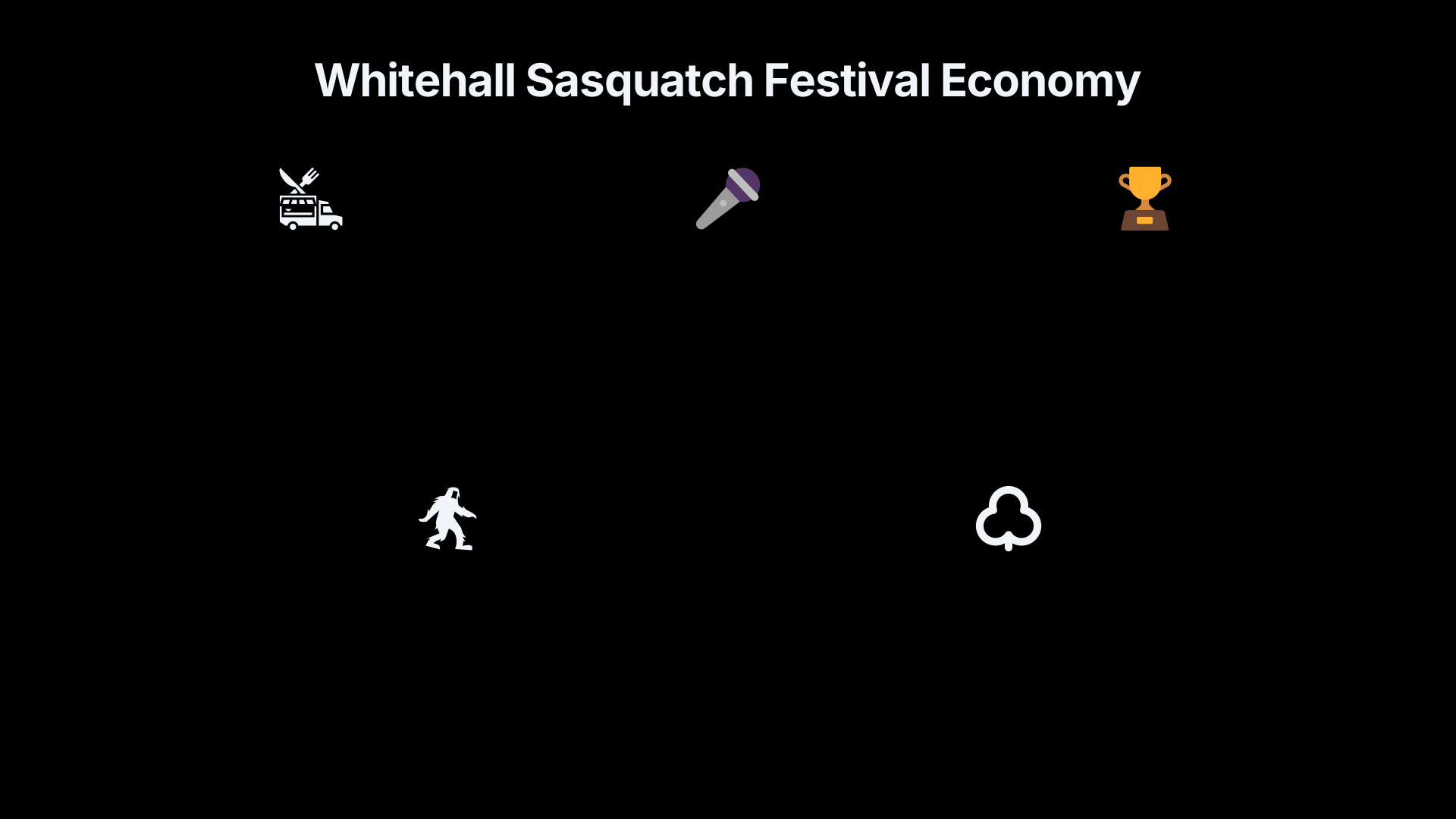
The annual Sasquatch Festival and Calling Contest turns the legend into a public gathering. Washington County tourism material for the 2025 festival advertised gifts, food trucks, family activities, researchers, costume contests and raffles, presenting the event as “all things Sasquatch” rather than a solemn investigation.[Washington County NY]washingtoncounty.funOpen source on washingtoncounty.fun. Adirondack Life reported that the 2021 festival attracted 75 vendors, a dozen Bigfoot experts and authors, and thousands of visitors; festival organiser Chris Spoor framed the point less as proving Sasquatch exists than creating an event where both sceptics and believers could enjoy themselves.[Adirondack Life Magazine]adirondacklife.comAdirondack Life Magazine Whitehall's Sasquatch Festival Is a Big, Hairy DealAdirondack Life Magazine Whitehall's Sasquatch Festival Is a Big, Hairy Deal
That distinction matters. Whitehall’s Bigfoot economy is not just a claim about a creature. It is a local culture built around permission to talk about the weird thing. The festival gives witnesses a stage, researchers a table, children a mascot, vendors a theme and the town a reason for visitors to stop. It turns an uncertain report into a shared seasonal ritual.
The Pomeroy folklore marker formalises this in a different way. Folklore markers do not verify monsters as zoological facts; they recognise stories as part of place identity. In Whitehall’s case, the marker links the town’s modern festival culture with older local stories of upright hairy beasts and the 2004 protective law.[William G. Pomeroy Foundation]wgpfoundation.orgWilliam G. Pomeroy Foundation BIGFOOT SANCTUARY | William G. Pomeroy FoundationWilliam G. Pomeroy Foundation BIGFOOT SANCTUARY | William G. Pomeroy Foundation That is a useful model for reading the legend: not “proved animal”, not “mere joke”, but civic folklore with a paper trail.
What counts as evidence here?
Whitehall’s evidence is strongest as a record of belief, testimony and local memory. It is weaker as biological evidence for an undiscovered primate in New York.
The main evidence categories are:
Witness testimony. The Abair Road story, later police-linked accounts and subsequent reports around Whitehall are the core of the legend. These accounts matter culturally because witnesses described specific places and because some were connected to law enforcement. They do not, by themselves, meet the standard needed to establish a new animal species.
Newspaper and media documentation. The 1976 Post-Star coverage shows that the story was public at the time, not wholly invented decades later. Later reporting by the Times Union documented the town’s transformation from embarrassed sighting location to Bigfoot-themed destination.[newspapers.com]newspapers.comthe post star abair rdthe post star abair rd
Footprint casts and field research. Bartholomew and other enthusiasts have collected casts and investigated sighting scenes. Adirondack Life describes festival crowds waiting to speak with him while he displayed plaster casts of alleged footprints.[Adirondack Life Magazine]adirondacklife.comAdirondack Life Magazine Whitehall's Sasquatch Festival Is a Big, Hairy DealAdirondack Life Magazine Whitehall's Sasquatch Festival Is a Big, Hairy Deal Such casts can be intriguing, but without secure chain of custody, repeatable analysis and independent verification, they remain suggestive artefacts rather than decisive proof.
Civic records and public symbols. The 2004 protective law, 2018 official-animal resolution, statues, festival and folklore marker are excellent evidence for Whitehall’s identity as Bigfoot country. They prove that the legend became locally important. They do not prove that the creature exists.
The sceptical reading is straightforward: poor light, distance, fear, expectation, bears, hoaxes, pranksters, ordinary animals and memory reshaping could explain some or many reports. The believer’s reading is that the number of accounts, the police-linked testimony and the persistence of sightings point to something not yet recognised by science. The evidence available publicly supports the first conclusion more safely than the second: Whitehall has a real Bigfoot tradition, but not confirmed Bigfoot biology.
The changing story around Whitehall
Whitehall Bigfoot changed in stages.
First came the encounter phase: local reports, police response, newspaper attention and embarrassment. In this phase, the story was raw and socially risky. Witnesses could be mocked. The creature was not yet a mascot; it was an unsettling claim attached to real people and a real road.
Next came the investigator phase. Paul Bartholomew and others gathered accounts, revisited scenes and connected Whitehall to wider Bigfoot research. The local story became part of a regional Sasquatch map, stretching across the Adirondacks and into nearby Vermont. Tourism and local media now regularly present Whitehall as the “Bigfoot capital” or a major North Country Sasquatch location. ADK Taste - The Best of the Adirondacks[adktaste.com]adktaste.comADK TasteADK Taste
Then came the civic-folklore phase. The town adopted protective and symbolic measures, festivals grew, statues appeared, and Sasquatch became a friendly public emblem. The 2018 official-animal resolution is especially revealing because it names tourism directly: statues, a half-marathon and a festival all helped make Whitehall a destination for Bigfoot searchers.[Times Union]timesunion.comTimes Union Whitehall names sasquatch as village's official animalTimes Union Whitehall names sasquatch as village's official animal
That final stage does not erase the original witness claims. Instead, it changes how they are used. The Abair Road incident becomes a founding story. Police-linked testimony becomes a credibility anchor. The sanctuary law becomes a civic joke with genuine branding power. The festival becomes the yearly performance of the legend.
This is how many local monster traditions survive. They stop depending entirely on whether every listener believes. Instead, they become a way for a place to say: this strange story happened here, people still talk about it, and now it belongs to us.
Why Whitehall matters in New York cryptid history
Whitehall matters because it gives New York a Bigfoot identity that is local, named and socially traceable. Champ belongs to the long lake-monster tradition of Lake Champlain. The Montauk Monster belongs to carcass-mystery and internet panic. The Cardiff Giant belongs to hoax history. Whitehall Bigfoot belongs to the witness-legend category: a cluster of claimed encounters, strengthened by police-linked testimony, then reworked into town folklore.
It is also a useful corrective to the idea that Bigfoot is only a Pacific Northwest story. Modern Bigfoot popular culture did take much of its shape from western newspaper stories in the late 1950s, but regional variants now exist across the United States. Whitehall’s version is distinct because it has a recognisable New York setting: Adirondack foothills, Lake Champlain country, village politics, roadside sightings and small-town festival culture.
For sceptical readers, Whitehall is a case study in how extraordinary claims grow without extraordinary proof. For folklore readers, it shows how a community can turn ridicule into identity. For road-trip mystery fans, it offers something rare: a cryptid place where the legend is visible in the landscape, from Abair Road retellings to Skenesborough Park events and Sasquatch statues.
The most balanced conclusion is also the most interesting one. Whitehall has not proved that a giant unknown primate lives in New York. It has proved that a town can adopt a mystery, protect it with a wink, and make it part of its public face. That is why Whitehall remains Bigfoot country: not because the case is closed, but because the story is still alive.
Amazon book picks
Further Reading
Books and field guides related to How Whitehall Became Bigfoot Country. Use these as the next step if you want deeper reading beyond the article.
Sasquatch: Legend Meets Science
Examines witness reports and physical-claim arguments.
eBay marketplace picks
Marketplace Samples
Live-tested eBay searches with available results related to this page.


Endnotes
1.
Source: adktaste.com
Title: ADK Taste
Link:https://www.adktaste.com/blog/sasquatch-in-the-adirondacks
2.
Source: newspapers.com
Title: the post star abair rd
Link:https://www.newspapers.com/article/the-post-star-abair-rd/18069108/
3.
Source: washingtoncounty.fun
Link:https://washingtoncounty.fun/sasquatch-festival/
4.
Source: adirondack.net
Link:https://www.adirondack.net/wildlife/black-bears/
5.
Source: timesunion.com
Title: Times Union Searching for Sasquatch in Whitehall
Link:https://www.timesunion.com/news/article/Searching-for-Sasquatch-in-Whitehall-13264456.php
6.
Source: timesunion.com
Title: Times Union Whitehall names sasquatch as village’s official animal
Link:https://www.timesunion.com/news/article/Whitehall-names-sasquatch-as-village-s-official-13050743.php
7.
Source: wgpfoundation.org
Title: William G. Pomeroy Foundation BIGFOOT SANCTUARY | William G. Pomeroy Foundation
Link:https://www.wgpfoundation.org/historic-markers/bigfoot-sanctuary/
8.
Source: dec.ny.gov
Title: Department of Environmental Conservation Black Bear
Link:https://dec.ny.gov/nature/animals-fish-plants/black-bear
9.
Source: atlasobscura.com
Title: Atlas Obscura Golf-Squatch
Link:https://www.atlasobscura.com/places/golf-squatch-whitehall-new-york
10.
Source: adirondacklife.com
Title: Adirondack Life Magazine Whitehall’s Sasquatch Festival Is a Big, Hairy Deal
Link:https://www.adirondacklife.com/2022/09/23/whitehalls-sasquatch-festival-is-a-big-hairy-deal/
11.
Source: dec.ny.gov
Title: dec announces record breaking 2025 bear harvest estimates
Link:https://dec.ny.gov/news/press-releases/2026/3/dec-announces-record-breaking-2025-bear-harvest-estimates
12.
Source: dec.ny.gov
Link:https://dec.ny.gov/sites/default/files/2025-03/bbrpt2024.pdf
13.
Source: adktaste.com
Title: whitehall sasquatch festival adirondacks
Link:https://www.adktaste.com/adirondack-events/whitehall-sasquatch-festival-adirondacks
14.
Source: timesunion.com
Title: new york bear hunting season 2025 tallies 22153600
Link:https://www.timesunion.com/state/article/new-york-bear-hunting-season-2025-tallies-22153600.php
15.
Source: wral.com
Link:https://www.wral.com/archive/17771295/
16.
Source: Wikipedia
Link:https://en.wikipedia.org/wiki/Bigfoot
Additional References
17.
Source: youtube.com
Title: Using the Police to Catch Bigfoot! | Finding Bigfoot | Animal Planet
Link:https://www.youtube.com/watch?v=WEMy2WWezLk
Source snippet
"I Was TERRIFIED!" 800 Pound Bigfoot Found in New York (S2) | MonsterQuest...
18.
Source: youtube.com
Title: “I Was TERRIFIED!” 800 Pound Bigfoot Found in New York (S2) | Monster Quest
Link:https://www.youtube.com/watch?v=1ER4MLqp8yw
Source snippet
Sasquatch festival looks to make believers out of skeptics...
19.
Source: youtube.com
Title: Squatch Stories: Beast of Whitehall Witnesses
Link:https://www.youtube.com/watch?v=J4kSnx1BoyU
Source snippet
BIGFOOT DocuSeries | MAN APE AMONG US | The Beast of Whitehall feat. Brian Gosselin...
20.
Source: youtube.com
Title: Sasquatch festival looks to make believers out of skeptics
Link:https://www.youtube.com/watch?v=9QXE40zD-oM
Source snippet
Squatch Stories: Beast of Whitehall Witnesses...
21.
Source: facebook.com
Link:https://www.facebook.com/smltownmonsters/posts/appalachian-bigfoot-files-is-back-again-this-episode-focuses-on-the-adirondack-r/1089598383169777/
22.
Source: catskillmountaineer.com
Link:https://www.catskillmountaineer.com/pdf/bears-DEC.pdf
23.
Source: tripadvisor.com
Link:https://www.tripadvisor.com/Attraction_Review-g48885-d34409532-Reviews-Bigfoot_Statue-Whitehall_New_York.html
24.
Source: amazon.com
Link:https://www.amazon.com/Bigfoot-Whitehall-Hometown-Became-Cultural/dp/047378162X?tag=searcht-20
25.
Source: facebook.com
Link:https://www.facebook.com/groups/402724958101648/posts/1292818089092326/
26.
Source: instagram.com
Link:https://www.instagram.com/p/DN3CbWnYqv0/
Topic Tree