Within Iowa Monsters
When Real Wildlife Feeds Monster Stories
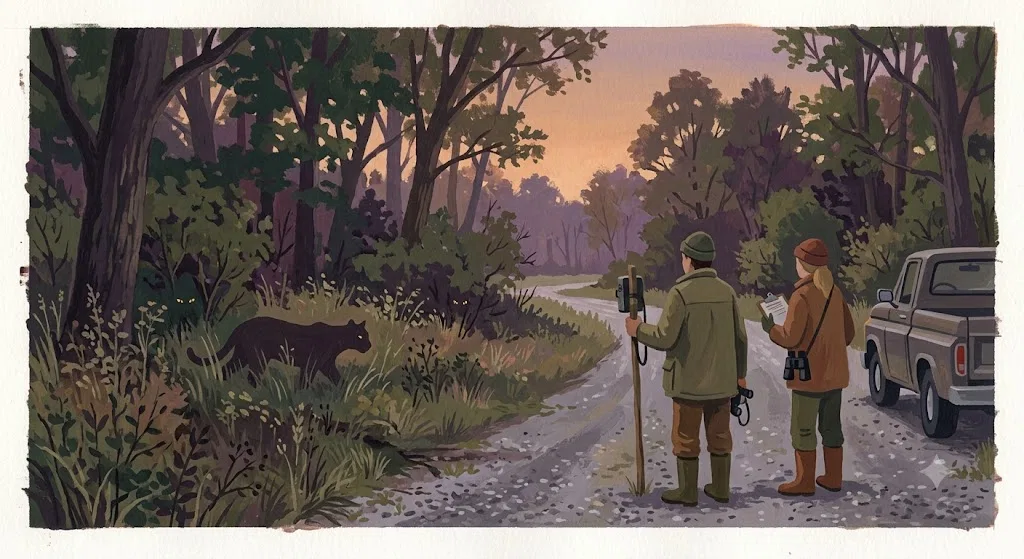
Iowa's monster stories often grow from real surprises: cougars, bears and other animals appearing where people do not expect them.
On this page
- Occasional large animal visitors
- Why sightings become bigger in retelling
- Rivers, roads and edge habitats
Page outline Jump by section
Introduction
Iowa’s “mystery beast” stories are often most convincing when they begin with something real: a large animal where people do not expect one. The state has no established breeding populations of mountain lions, black bears, moose, elk, wolves or fishers in the everyday sense familiar from northern or western states, but it does have occasional visitors. A young cougar crossing from Nebraska, a black bear nosing near a Mississippi River campground, an elk on a trail camera, or a dark shape moving along a timbered creek can quickly become local rumour before anyone has a clear photograph.
That is why Iowa’s monster folklore works best as a borderland between wildlife biology and storytelling. Some reports are misidentified dogs, bobcats, coyotes, deer or shadows. Some are genuine wanderers. Some, like the 1975 Lockridge Monster, sit in the middle: strange enough to become folklore, but shaped by the same rural conditions that make real animal surprises possible.
Occasional large-animal visitors
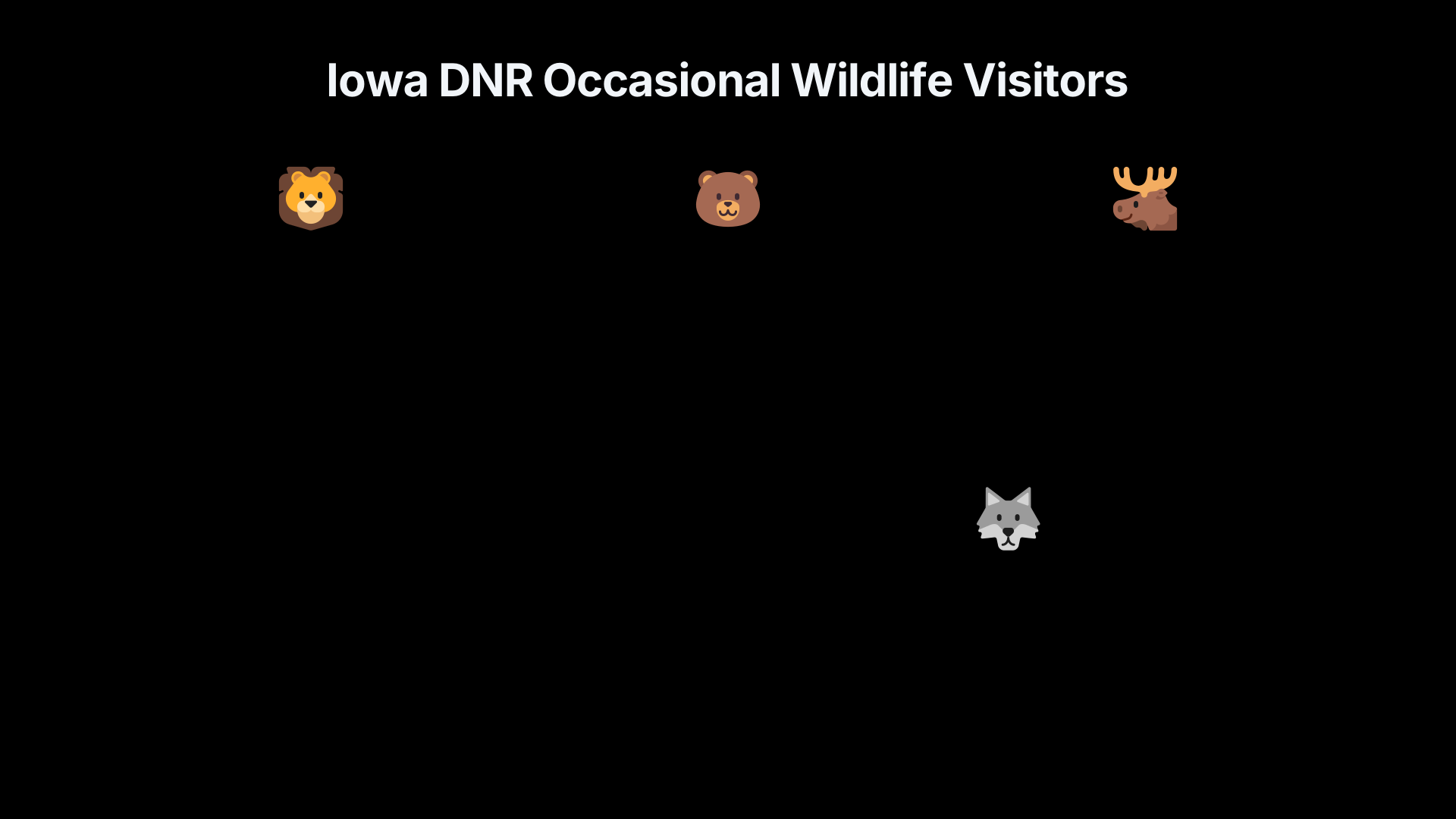
The Iowa Department of Natural Resources treats several dramatic animals as “occasional wildlife visitors” rather than as ordinary resident wildlife. Its list includes moose, mountain lions, wolves, elk, fishers and black bears, all of which have different routes into Iowa and different chances of being misread by witnesses. The important point for monster stories is not that these animals prove any cryptid claim. It is that they keep reminding Iowans that the state’s wildlife map is more porous than it appears.[Department of Natural Resources]iowadnr.govDepartment of Natural ResourcesOccasional Wildlife VisitorsLearn more about Iowa's occasional wildlife visitors… Wolves are a protecte…
Mountain lions are the clearest example. Iowa DNR explains that small breeding populations exist in South Dakota and Nebraska, and that young males pushed out by older males sometimes make long treks in search of territory. Iowa may offer deer and cover, but the agency says it lacks the large stretches of wild country and female mates needed for a self-sustaining breeding population. DNR also says it has not stocked mountain lions and has no plan to do so, which matters because “the state released cougars to control deer” is one of the rumours that often follows big-cat reports.[Department of Natural Resources]iowadnr.govDepartment of Natural ResourcesOccasional Wildlife VisitorsLearn more about Iowa's occasional wildlife visitors… Wolves are a protecte…
Recent evidence has made the occasional-cougar story less theoretical. In August 2025, Iowa DNR confirmed trail-camera images of a collared mountain lion in northwest Iowa. The animal was a subadult male, less than two years old, originally collared for a Nebraska Game, Fish & Parks research project, and its movement into Iowa gave biologists a documented example of long-distance dispersal rather than a vague “big cat” tale.[Department of Natural Resources]iowadnr.govOpen source on iowadnr.gov.
Black bears are beginning to feel less like one-off surprises, especially in the northeast. In 2023, Iowa DNR said bear visits to northeast Iowa had become an annual spring occurrence since 2014, usually involving animals coming down from Minnesota and Wisconsin ahead of the breeding season. By 2025, the agency said Iowa had moved from occasional visiting bears to more frequent visitors and even two to four bears moving in and overwintering, while still stressing that cubs and a breeding population had not been documented.[Department of Natural Resources]iowadnr.govmidwest black bear population may start calling parts iowa home down roadmidwest black bear population may start calling parts iowa home down road
That change is visible in management, not just in anecdotes. In May 2026, Iowa DNR announced bear-proof rubbish bins at Pikes Peak State Park, explaining that the park’s position on the Upper Mississippi River near Wisconsin and Minnesota puts it within reach of young male black bears dispersing on their own. The same release said Iowa currently has no black bear population, but it has had one bear overwintering in Dubuque County for several years and may have to deal with more bears over the next decade.[Department of Natural Resources]iowadnr.govblack bears becoming regular visitors northeast iowablack bears becoming regular visitors northeast iowa
Other visitors create a different kind of “monster” moment because their bodies are so unexpected in Iowa landscapes. Moose, DNR says, sometimes wander in from northern Minnesota, usually young bulls, and stand out in harvested crop fields because they are less secretive than cougars, wolves or bears. Elk were once native to Iowa, disappeared after settlement, and now turn up most often in western Iowa, especially near the Missouri River corridor, with young bulls wandering during the autumn breeding season.[Department of Natural Resources]iowadnr.govDepartment of Natural ResourcesOccasional Wildlife VisitorsLearn more about Iowa's occasional wildlife visitors… Wolves are a protecte…
Fishers are smaller, but they show how “impossible animal” stories can begin even without a giant silhouette. Fishers are members of the weasel family, dark woodland carnivores shaped rather like a large mink or smaller otter. Iowa DNR says they were native to Iowa but extirpated by habitat loss and unregulated harvest, and recent northeast Iowa records probably involve natural dispersal from southeast Minnesota. In 2026, DNR biologist Vince Evelsizer told Radio Iowa that two to five confirmed sightings or reports in northeast Iowa were notable precisely because the incursion remained small.[Department of Natural Resources]iowadnr.govDepartment of Natural ResourcesOccasional Wildlife VisitorsLearn more about Iowa's occasional wildlife visitors… Wolves are a protecte…
Why sightings grow in the telling
A genuine animal does not have to be mythical to become a monster story. The process often starts with a poor view: headlights across a ditch, a trail camera at night, a shape crossing a field edge, or eyeshine in timber. The first witness may say “I don’t know what I saw”; the second retelling may become “someone saw a huge cat”; by the time the story reaches social media, the animal may have acquired extra size, speed, menace and intention.
Iowa DNR’s mountain lion identification guide is useful because it names the ordinary mistakes. Yellow Labradors, German shepherds, bobcats, feral house cats and deer are often mistaken for mountain lions, especially at night, in bad light, poor weather or at long distance. The guide also gives a simple test: a mountain lion has a long, heavy tail, while a bobcat has a short “bobbed” tail; an adult male cougar may be seven to nine feet long, while a bobcat is around three feet.[Department of Natural Resources]iowadnr.govDepartment of Natural Resources Mountain LionsDepartment of Natural Resources Mountain Lions
That identification problem feeds Iowa’s phantom-cat tradition. A real cougar can pass through the state, so witnesses are not automatically absurd for wondering about one. But most reported sightings are never confirmed, and DNR maps only confirmed or highly probable reports where there is stronger evidence such as roadkill, a carcass, verified photographs, tracks, DNA or a reliable field investigation. The gap between “many people report big cats” and “few reports are confirmed” is exactly where modern monster stories live.[Department of Natural Resources]iowadnr.govOpen source on iowadnr.gov.
Black bears produce a different kind of exaggeration. They are more distinctive than cougars, and DNR notes that bear sightings are usually more reliable because bears are visually obvious, less likely to flee immediately, and leave tracks that are not easily confused with those of other animals. Yet a single bear can still generate many reports as it moves, especially if sightings are shared rapidly online. A bear that is simply passing through can feel, to a local community, like a lurking creature that has “moved into” the neighbourhood.[Department of Natural Resources]iowadnr.govOpen source on iowadnr.gov.
The same amplification happens with elk. Iowa DNR has said elk visits are now shared through social media “at the speed of downloads”, and that a very small number of individual animals may produce many reports as they cover long distances and appear on different trail cameras. That is a perfect modern mystery-beast mechanism: one animal, many cameras, many posts, and a public trying to decide whether it is seeing an escaped farm animal, a wild wanderer, or something stranger.[Department of Natural Resources]iowadnr.govelk appearing trail cameras central and western iowaelk appearing trail cameras central and western iowa
The Lockridge Monster shows the folklore version of the pattern
The Lockridge Monster is one of Iowa’s best examples of a rural wildlife scare becoming a named creature. The story comes from southeast Iowa in 1975, when reports near Lockridge described a dark, bear-like animal with an ape-like or “monkey” face around turkey farms and cornfields. In the commonly repeated version, hunter Lowell Adkins found ten-inch tracks near partially eaten turkeys, while residents including Gloria Olson and Herb Peiffer reported seeing the animal in farm settings after dark.[Little Village]littlevillagemag.comLittle Village Sightings: IowaLittle Village Sightings: Iowa
What makes the case valuable for this page is not that it proves an unknown animal. It shows how the ingredients of a monster flap come together. There was livestock loss, night-time movement, an animal seen in artificial light, tracks that could be argued over, local reluctance to speak for fear of ridicule, and then newspaper language that gave the whole event a sharper identity. Once a “bear-like creature with a monkey face” entered circulation, the story no longer behaved like a routine wildlife report. It became a local beast.
The possible explanations are ordinary but not tidy. A black bear would fit the “bear-like” part and the turkey damage better than a giant ape would, but a bear in that part of Iowa would itself have seemed extraordinary to many residents at the time. A large dog, escaped exotic, misread livestock predator, hoax, or mixed retelling could explain parts of the account. The point is that the Lockridge Monster sits in the same psychological space as Iowa’s confirmed wanderers: the state is not expected to contain such an animal, so the sighting becomes memorable before the evidence can catch up.
The story also shows why rural monster reports can become protective as well as playful. The old Associated Press account preserved by the Bigfoot Field Researchers Organization includes a local warning that if someone were playing a joke, they could get shot, and notes that some parents were keeping children indoors after sundown. That is folklore with consequences: a rumour shaped by real fears about livestock, children, firearms and the unknown animal at the edge of the farmyard.[BFRO]bfro.netshow report.aspshow report.asp

Rivers, roads and edge habitats
Iowa may look open on a road atlas, but its animal surprises often follow the parts of the landscape that provide cover and movement: river bottoms, wooded corridors, bluffs, crop edges, pasture margins and roadsides. Iowa DNR’s Wildlife Action Plan describes alluvial plains as floodplain corridors created by rivers and streams, largest along the Missouri and Mississippi but present along streams across the state. Those corridors matter because they are natural travel lanes through otherwise heavily farmed country.[Department of Natural Resources]iowadnr.govOpen source on iowadnr.gov.
The forest pattern reinforces that point. A 2025 USDA Forest Service snapshot estimated Iowa’s forest land at about 2.9 million acres, roughly eight per cent of sampled land area, while older Forest Service analysis described Iowa forests as mostly woodlots or riparian corridors after settlement and agriculture transformed the landscape. For a wandering animal, the state is not one continuous wilderness; it is a network of cover, breaks, river timber and private land stitched through cropland.[Department of Natural Resources]iowadnr.govOpen source on iowadnr.gov.
That structure helps explain why mystery-beast reports often happen at “edges”. A driver sees something leaving a ditch. A farmer glimpses movement at the margin of a field. A trail camera catches a partial body in timber. A camper hears or smells something near rubbish or food. Edge habitats are good for real animals because they offer food and cover, and they are good for folklore because they give witnesses just enough information to be startled and not enough to be certain.
The Mississippi River is especially important for occasional visitors from the north and east. Iowa DNR notes that wolves from Minnesota and Wisconsin may use the Mississippi River and tributaries as natural travel corridors, and that wolves and coyotes are secretive animals easily confused with each other. The same general corridor logic helps make sense of northeast Iowa bear reports and fisher records, where nearby Minnesota and Wisconsin populations provide likely sources for dispersing animals.[Department of Natural Resources]iowadnr.govDepartment of Natural ResourcesOccasional Wildlife VisitorsLearn more about Iowa's occasional wildlife visitors… Wolves are a protecte…
Roads add the final piece. They create sightings because people encounter wildlife from vehicles, often at speed and in poor light. They also create evidence when animals are hit. A road-killed cougar, wolf or bear can turn years of local “I swear I saw one” stories into a confirmed record. But roads also distort perception: a three-second view from a car is exactly the kind of encounter that makes animals look larger, darker, faster or stranger than they are.
How to read an Iowa mystery-beast report
The most useful question is not “was it definitely a monster?” but “what kind of report is this?” Iowa’s occasional wildlife visitors give readers a practical way to sort claims without draining the strangeness from them.
A strong report usually has at least one of these features:
- Physical evidence: clear photographs, trail-camera sequences, tracks with scale, scat, hair, DNA, a carcass, roadkill or expert field confirmation.
- A plausible route: a sighting in northeast Iowa for a bear or fisher, northwest or western Iowa for an animal dispersing from Nebraska or South Dakota, or a river corridor that fits known movement patterns.
- A useful description: tail length, body proportions, gait, size compared with a known object, and whether the animal was seen in daylight or poor light.
- Multiple independent observations: separate reports that track a moving animal, rather than repeated shares of the same unclear image.
- A non-sensational witness account: uncertainty can be a strength. “I saw a large tan animal with a long tail” is often more useful than “I saw a monster.”
A weak report is not worthless, but it should be read differently. A dark blur, a single night-time glimpse, a story repeated without date or place, or a claim that grows more elaborate with each retelling belongs closer to folklore than to wildlife evidence. That does not make it uninteresting. It means the value may lie in what the story reveals about local fears, landscape, memory and rumour.

What these visitors change about Iowa monster folklore
Occasional wildlife visitors make Iowa’s monster stories harder to dismiss and easier to misunderstand. They prove that surprising animals really do cross the state. They do not prove that every big cat, bear-like shape or hairy field creature is an unknown species. The honest middle ground is more interesting: Iowa’s monster lore is partly built from real ecological movement, then enlarged by darkness, distance, social media, old newspaper phrasing and the human habit of making a strange encounter into a story.
This is why a page about Iowa cryptids needs room for ordinary wildlife. A confirmed mountain lion on a trail camera can do more to explain modern “phantom cat” rumours than a dozen dramatic legends. Bear-proof bins at Pikes Peak State Park say more about changing expectations than a campfire tale does. A few fishers in northeast Iowa show how an animal can be both native in a historical sense and startlingly unfamiliar to modern residents.
The result is a living mechanism behind the folklore. Iowa’s mystery beasts are not only creatures people imagine; they are also the names people give to brief encounters before certainty arrives. Sometimes the answer is a bobcat, dog, coyote, deer or shadow. Sometimes it is a real wandering cougar, bear, elk, moose, wolf or fisher. And sometimes, as with the Lockridge Monster, the evidence remains thin while the story survives because it captures a very Iowan kind of unease: something large and out of place moving at the edge of the field.
Amazon book picks
Further Reading
Books and field guides related to When Real Wildlife Feeds Monster Stories. Use these as the next step if you want deeper reading beyond the article.
The United States of Cryptids
Provides comparative examples of mystery-animal stories.
eBay marketplace picks
Marketplace Samples
Live-tested eBay searches with available results related to this page.




Endnotes
1.
Source: bfro.net
Title: show report.asp
Link:https://www.bfro.net/GDB/show_report.asp?id=1270
2.
Source: research.fs.usda.gov
Link:https://research.fs.usda.gov/download/treesearch/19028.pdf
3.
Source: iowa.gov
Link:https://www.iowa.gov/
4.
Source: wildlife.org
Title: elk spotted in eastern iowa is a rare sight
Link:https://wildlife.org/elk-spotted-in-eastern-iowa-is-a-rare-sight/
5.
Source: iowadnr.gov
Link:https://www.iowadnr.gov/programs-services/iowas-wildlife/occasional-wildlife-visitors
Source snippet
Department of Natural ResourcesOccasional Wildlife VisitorsLearn more about Iowa's occasional wildlife visitors... Wolves are a protecte...
6.
Source: iowadnr.gov
Link:https://www.iowadnr.gov/media/8739/download?inline=
Source snippet
Page 2. has not “stocked” or introduced mountain lions into the state nor is there any consideration of doing so. There are very few repo...
7.
Source: iowadnr.gov
Link:https://www.iowadnr.gov/news-release/2025-08-19/collard-mountain-lion-appears-trail-camera-northwest-iowa
8.
Source: iowadnr.gov
Title: midwest black bear population may start calling parts iowa home down road
Link:https://www.iowadnr.gov/news-release/2023-05-09/midwest-black-bear-population-may-start-calling-parts-iowa-home-down-road
9.
Source: iowadnr.gov
Title: black bear sightings rise northeast iowa
Link:https://www.iowadnr.gov/news-release/2025-04-29/black-bear-sightings-rise-northeast-iowa
10.
Source: iowadnr.gov
Title: black bears becoming regular visitors northeast iowa
Link:https://www.iowadnr.gov/news-release/2026-05-12/black-bears-becoming-regular-visitors-northeast-iowa
11.
Source: iowadnr.gov
Title: Department of Natural Resources Mountain Lions
Link:https://www.iowadnr.gov/media/8738/download?inline=
12.
Source: iowadnr.gov
Title: cool things you should know about bobcats iowa
Link:https://www.iowadnr.gov/news-release/2015-10-21/cool-things-you-should-know-about-bobcats-iowa
13.
Source: iowadnr.gov
Link:https://www.iowadnr.gov/media/1733/download?inline=
14.
Source: iowadnr.gov
Title: elk appearing trail cameras central and western iowa
Link:https://www.iowadnr.gov/news-release/2023-01-10/elk-appearing-trail-cameras-central-and-western-iowa
15.
Source: littlevillagemag.com
Title: Little Village Sightings: Iowa
Link:https://littlevillagemag.com/sightings-iowa/
16.
Source: iowadnr.gov
Link:https://www.iowadnr.gov/programs-services/iowas-wildlife/wildlife-action-plan
17.
Source: iowadnr.gov
Link:https://www.iowadnr.gov/media/8860/download?inline=
18.
Source: iowadnr.gov
Link:https://www.iowadnr.gov/media/8740/download?inline=
19.
Source: itsmth.fandom.com
Title: Lockridge Monster
Link:https://itsmth.fandom.com/wiki/Lockridge_Monster
20.
Source: cryptidz.fandom.com
Title: Lockridge Monster
Link:https://cryptidz.fandom.com/wiki/Lockridge_Monster
21.
Source: iowadnr.gov
Link:https://www.iowadnr.gov/topics/iowas-wildlife
22.
Source: iowadnr.gov
Title: hunting regulations laws
Link:https://www.iowadnr.gov/things-do/hunting-trapping/hunting-regulations-laws
23.
Source: iowadnr.gov
Title: state forests
Link:https://www.iowadnr.gov/places-go/state-forests
24.
Source: iowadnr.gov
Title: Iowa Wildlife Action Plan
Link:https://www.iowadnr.gov/media/8995/download?inline=
25.
Source: iowadnr.gov
Title: River Restoration Toolbox Practice Guide 3
Link:https://www.iowadnr.gov/media/7070/download?inline=
26.
Source: iowadnr.gov
Link:https://www.iowadnr.gov/media/589/download?inline=
27.
Source: Wikipedia
Link:https://en.wikipedia.org/wiki/Iowa
28.
Source: wildlifeillinois.org
Title: mountain lion
Link:https://wildlifeillinois.org/identify-wildlife/mountain-lion/
Additional References
29.
Source: youtube.com
Title: Iowa DNR expecting more black bears migrating from Minnesota and Wisconsin
Link:https://www.youtube.com/watch?v=BYflboWhyiU
Source snippet
Black bears becoming regular visitors in northeast Iowa...
30.
Source: youtube.com
Title: Iowa DNR confirms mountain lion video taken in Des Moines
Link:https://www.youtube.com/watch?v=NS0VW6byEHM
Source snippet
Iowa DNR expecting more black bears migrating from Minnesota and Wisconsin...
31.
Source: youtube.com
Title: Iowa black bear sightings rising as animals reclaim native range
Link:https://www.youtube.com/watch?v=YIZyAow-zeU
Source snippet
Iowa DNR confirms mountain lion video taken in Des Moines...
32.
Source: youtube.com
Title: Black bears becoming regular visitors in northeast Iowa
Link:https://www.youtube.com/watch?v=zQzvUizvnYA
Source snippet
Iowa DNR confirms mountain lion sighting in Ankeny...
33.
Source: instagram.com
Link:https://www.instagram.com/p/DNiuJ4vymrc/
34.
Source: facebook.com
Link:https://www.facebook.com/ottumwaradio/posts/bears-and-mountain-lions-are-still-roaming-around-iowa/1241120774699938/
35.
Source: facebook.com
Link:https://www.facebook.com/kcrgtv9/posts/black-bear-sightings-are-becoming-more-common-in-iowa-and-the-dnr-is-taking-step/1567725924719708/
36.
Source: instagram.com
Link:https://www.instagram.com/reel/DaB3fdZDM4n/
37.
Source: facebook.com
Link:https://www.facebook.com/trophybucksofiowa/posts/check-out-this-mountain-lion-captured-on-trail-this-weekend-in-nw-iowa-it-appear/1113633800868297/
38.
Source: facebook.com
Link:https://www.facebook.com/trophybucksofiowa/videos/check-out-this-mountain-lion-captured-on-trail-this-weekend-in-nw-iowa-it-appear/781010941111396/
Topic Tree