Within Rhode Island Monsters
Is Big Rhodey Rhode Island's Bigfoot?
Rhode Island's Bigfoot story is small but rooted in wooded roads, swamp margins, and scattered rural sighting claims.
On this page
- Where sightings cluster
- What witnesses claimed
- Bears, shadows and folklore
Page outline Jump by section
Introduction
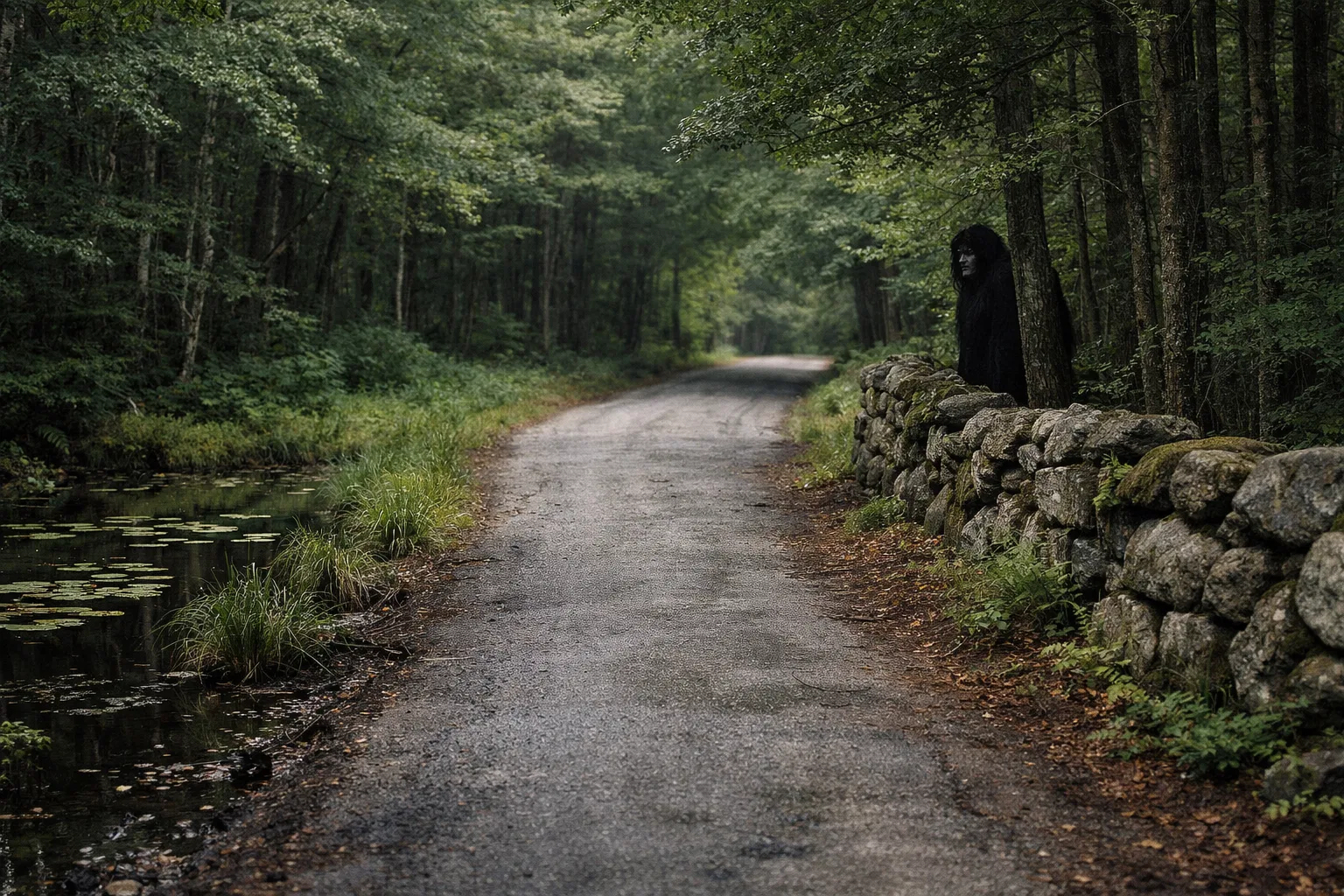
Big Rhodey is Rhode Island’s local Bigfoot: a white, grey or pale ape-like figure said to appear on wooded roads, swamp edges and rural trails in the western and southern parts of the state. The evidence is thin, but the pattern is distinctive. Rhode Island’s best-known reports cluster around Providence County and Washington County, especially Black Hut Management Area near Glendale, Route 6 near Foster, and the Great Swamp area of South Kingstown. The story matters because it shows how even America’s smallest state can produce a Bigfoot tradition when the right ingredients are present: dark roads, old woodland, swamp margins, state management areas, neighbouring bear country and a few memorable witness claims. The strongest way to read Big Rhodey is not as a proven animal, but as a compact Rhode Island version of the wider New England Sasquatch tradition, shaped by real terrain and uncertain sightings.[bfro.net]bfro.netstate listing.aspstate listing.asp
Where sightings cluster
The most useful map of Big Rhodey is not statewide. It is a borderlands map. The reports that keep the legend alive sit mainly in two belts: the north-western woods of Providence County and the southern swamp-and-forest country of Washington County. The Bigfoot Field Researchers Organization’s Rhode Island listing shows only a small set of reports, with Providence County represented by Black Hut and Foster claims, and Washington County represented by Great Swamp, Charlestown and Wakefield-area accounts.[BFRO]bfro.netshow county reports.aspshow county reports.asp
That distribution makes local sense. North-western Rhode Island is where the state begins to feel less coastal and more like inland New England. Black Hut Management Area lies in Burrillville, around Spring Lake Road, a few miles south of the Massachusetts border and roughly halfway between Woonsocket and the Connecticut line. Recent Rhode Island Department of Environmental Management material describes Black Hut as a 1,684-acre management area, expanded in 2025 with a 151-acre forestland acquisition that strengthens its boundary.[RIDEM]dem.ri.gov151 acres forestland conserved burrillville151 acres forestland conserved burrillville
The southern cluster has a different flavour. Great Swamp Management Area in South Kingstown is repeatedly important to Rhode Island’s Bigfoot lore because it feels like the sort of place where visibility breaks down. Tourism and birding sources describe it as a 3,349-acre landscape of forested freshwater wetlands, red maple and cedar swamp, fields, mixed forest, marsh, brush and ponds. That does not prove anything extraordinary is there. It does explain why the site works so well as a stage for a mystery-beast report: a witness can be close to roads and houses while still looking into dense, wet, confusing cover.[visitrhodeisland.com]visitrhodeisland.comOpen source on visitrhodeisland.com.
The “borderlands” idea is important because Big Rhodey is not usually imagined in downtown Providence, Newport mansions or beach-boardwalk Rhode Island. The creature belongs to places where Rhode Island touches the wider wooded region: Foster and Burrillville towards Connecticut and Massachusetts, South Kingstown and Charlestown around swampy South County, and the half-rural roads between settlement and cover. That is why the legend feels local even though Bigfoot itself is a national figure.
What witnesses claimed
The oldest Rhode Island reports in the BFRO database are not polished monster tales. They read like brief, startling encounters: a cyclist, a car at night, a mountain biker, a hiker noticing odd wood damage. The details vary, but several claims share a striking feature: the alleged figure is described as white, grey or pale rather than the dark brown or black shape many people expect from Bigfoot stories.[BFRO]bfro.netshow report.aspshow report.asp
A 1974 Washington County report describes a University of Rhode Island student riding a ten-speed bicycle near Perry Avenue at about 10 pm. The witness said a “white” gorilla-like figure moved towards him, stopped in the road, swayed, and cleared a stone wall before disappearing. The report also includes second-hand references to other alleged “white” sightings in the wider area, but those extra claims are weaker because they are not direct, documented observations by the same witness.[BFRO]bfro.netshow report.aspshow report.asp
A 1978 Charlestown-area report, preserved in later retellings of the BFRO case, again describes a pale figure. The account places a mother and son on a road during rain, their headlights catching what looked to them like a large yellow-white ape near a broken tree or stump. The sighting is vivid because it includes ordinary roadside conditions — rain, headlights, a turn in the road and a very short viewing distance — but those same conditions also limit certainty. A brief illuminated view in bad weather can make shape, colour and size hard to judge.[BFRO]bfro.netOpen source on bfro.net.
The 1998 Black Hut Management Area report is one of the best-known Big Rhodey claims because it was a daylight encounter, not a distant night sound. The witness, a mountain biker training in the Glendale area, reported seeing a white or grey upright figure moving through the woods. BFRO classifies it as a “Class A” report, its category for a clear visual encounter, although that classification is internal to the organisation and should not be confused with independent scientific verification.[BFRO]bfro.netshow report.aspshow report.asp
The 2006 Great Swamp report is weaker as evidence because it was not a sighting at all. A hiker went into the area after reading earlier reports and described a snapped tree and a stick formation. This kind of claim is common in Bigfoot culture, where broken branches and arranged wood are sometimes interpreted as signs of activity. In ordinary evidence terms, however, broken trees can result from weather, rot, human activity, deer rubs, trail work or other natural causes. It is part of the folklore record, but it is not strong proof of a hidden animal.[BFRO]bfro.netshow report.aspshow report.asp
The 2010 Foster report brings the story back to the road. A motorist claimed to see a bipedal figure cross Route 6 early in the morning near Foster, apparently moving quickly and clearing a guardrail. The appeal of this report is obvious: road crossings are among the most familiar Bigfoot story types, because they place the witness in a car, the figure in the headlights or road edge, and the encounter over within seconds. The weakness is equally obvious: a short early-morning look at a moving figure leaves little room for checking scale, anatomy or identity.[BFRO]bfro.netshow report.aspshow report.asp
Why Big Rhodey became a Rhode Island story
The name “Big Rhodey” appears to have gained broader public attention through local paranormal and Bigfoot circles rather than through a long nineteenth-century newspaper tradition. A 2011 Patch article helped carry the label to general readers, quoting Carl Johnson of Beyond the Veil Paranormal Research and the Big Rhodey Research Project and framing the creature as something glimpsed in Rhode Island’s more remote places. Johnson compared such fleeting sightings with the way people sometimes catch only brief views of bears.[Patch]patch.comCould Bigfoot Be Roaming Rhode Island?Could Bigfoot Be Roaming Rhode Island?
That comparison is revealing. Big Rhodey is not famous because Rhode Island has hundreds of reports. It is famous, within a small niche, because the state seems like an unlikely Bigfoot setting. A Sasquatch in the Pacific Northwest fits popular expectations; a Sasquatch in the smallest state in the US feels odd enough to be memorable. The label turns scattered claims into a local character, giving Rhode Island a monster that belongs to its own map rather than merely borrowing “Bigfoot” from elsewhere.
Television also helped. Animal Planet’s Finding Bigfoot featured a Rhode Island episode under the “Big Rhodey” label, investigating a roadside sighting in the state. That kind of programme does not settle the evidence, and local commentary at the time was openly sceptical about the show’s methods and tone. Still, television gave the story an afterlife: Big Rhodey became easier to search for, repeat and package as part of Rhode Island’s strange-local-history shelf.[Animal Planet]animalplanet.comAnimal Planet Finding BigfootAnimal Planet Finding Bigfoot
The result is a modern folk creature rather than a deep, continuous tradition. Big Rhodey is built from a small number of witness reports, Bigfoot database entries, local investigators, paranormal media and the state’s own geography. That does not make the story worthless. It makes it a useful example of how cryptid traditions form: a place gets a handful of claims, someone gives the creature a name, media repeats the name, and the landscape begins to feel retroactively haunted by it.

Bears, shadows and folklore
The most grounded explanation for some Big Rhodey sightings is not that witnesses are lying. It is that Rhode Island contains enough real wildlife, awkward light and wooded cover to make honest mistakes possible. The Rhode Island Department of Environmental Management notes that most bears seen in the state in recent years have been transient young males, likely from Massachusetts or Connecticut. It also says Rhode Island has suitable conditions for a resident black bear population, especially as bear numbers increase in surrounding states.[RIDEM]dem.ri.govOpen source on ri.gov.
Confirmed bear sightings have occurred in exactly the kinds of places that matter for Big Rhodey interpretation. In 2013, Rhode Island officials reported confirmed black bear sightings in northern towns including Burrillville, Foster, Glocester and Scituate, and in southern towns including Exeter, West Greenwich, Richmond and Hopkinton. Those towns sit near the same broad inland and South County zones that make up the state’s Bigfoot borderlands.[Rhode Island Government]ri.govOpen source on ri.gov.
Bears are not a perfect explanation for every report. A black bear on all fours does not look like a tall white ape, and Rhode Island bear numbers are low. But bears can stand briefly, move through headlights, appear larger than expected, and vanish quickly into cover. Young dispersing bears also fit the “passing through” pattern better than a breeding population of large unknown primates would. That matters because a plausible ordinary animal does not need to explain every dramatic detail; it only needs to show that the landscape can produce surprising large-animal encounters without invoking an undiscovered species.[ecoRI News]ecori.orgeco RI News Despite Perceptions, Black Bear Numbers Remain Loweco RI News Despite Perceptions, Black Bear Numbers Remain Low
Other explanations are more mundane but just as important. A pale deer glimpsed through rain, a person in light clothing, a large dog, a hunter, a decaying tree stump, a broken branch arrangement, or a brief view through windscreen glare can all become stranger in memory. Night driving is especially treacherous for identification because headlights flatten depth and exaggerate contrast. Swamps add another layer: water, brush, shadow and fallen timber create shapes that look purposeful for a moment and meaningless a second later.
The folklore explanation is not a dismissal. It is a different kind of truth. Big Rhodey turns Rhode Island’s quiet rural edges into story places. A stone wall becomes the obstacle a creature cleared. A swamp trail becomes a possible route. A road crossing becomes an encounter. Whether or not a witness saw an unknown animal, the story records how ordinary landscapes can feel briefly uncanny.
How strong is the evidence?
As evidence for a real, unknown primate, Big Rhodey is weak. The public record is small, the reports are scattered across decades, and the best-known cases depend on eyewitness memory rather than photographs, tracks, DNA, carcasses or repeatable observation. The BFRO database is useful because it preserves claims in a searchable form, but it is an advocacy-oriented Bigfoot archive, not a neutral wildlife agency or peer-reviewed scientific body.[BFRO]bfro.netOpen source on bfro.net.
The strongest Big Rhodey cases are the direct visual accounts: the 1974 bicycle encounter, the 1978 roadside sighting, the 1998 Black Hut mountain-biker report and the 2010 Foster road-crossing claim. They are stronger than the 2006 stick-formation report because they involve witnesses describing an animal-like figure. They are still limited because none produced physical evidence that can be independently tested.[BFRO]bfro.netshow report.aspshow report.asp
The pale-colour pattern is interesting but not conclusive. Repeated descriptions of a white, grey or yellow-white figure give Rhode Island’s reports a recognisable local texture. Yet colour is one of the easiest features to distort under headlights, rain, dusk, distance, dirty fur, pale clothing, or the witness’s later attempt to make sense of something seen too quickly. A distinctive motif can be a clue, but it can also be the part of a legend that makes later stories easier to remember and retell.
The state’s small size also cuts both ways. On one hand, sceptics can reasonably ask how a population of large apes could persist in Rhode Island without leaving clearer evidence, especially in an era of trail cameras, smartphones, hunters, hikers and wildlife monitoring. On the other hand, Rhode Island’s smallness is exactly what makes the legend appealing: the idea that something huge could slip through a pocket of woods between familiar roads is more intimate than a monster hidden in a remote mountain range.
What Big Rhodey adds to Rhode Island folklore
Big Rhodey is not Rhode Island’s best-evidenced creature story, but it may be its most geographically revealing land monster. It points readers away from the postcard Ocean State and towards Burrillville, Foster, Glocester, Exeter, South Kingstown and Charlestown: places where old roads, reservoirs, management areas and swamp margins make the state feel larger than it looks on a map.[eregulations.com]eregulations.come Regulations State Land Spotlight: Black Hut WMAe Regulations State Land Spotlight: Black Hut WMA
The legend also sits neatly beside neighbouring New England traditions. Rhode Island’s Bigfoot borderlands are porous. A bear, a rumour, a hunter’s story or a Sasquatch motif can cross from Connecticut or Massachusetts more easily than the state line suggests. That is why Big Rhodey feels less like an isolated species claim and more like a local dialect of a regional story: New England woods, but scaled down to Rhode Island’s roads and swamps.
For readers sorting folklore from evidence, the fairest conclusion is simple. Big Rhodey is a named Rhode Island Bigfoot tradition supported by a few memorable witness claims and a lot of suggestive landscape, not by hard biological evidence. Its best value is as a strange, place-specific lens on the state’s western and southern wild edges: the places where a bear can still surprise residents, a swamp can still hide a trail from view, and a half-seen figure can become Rhode Island’s own Sasquatch.
Amazon book picks
Further Reading
Books and field guides related to Is Big Rhodey Rhode Island's Bigfoot?. Use these as the next step if you want deeper reading beyond the article.
eBay marketplace picks
Marketplace Samples
Live-tested eBay searches with available results related to this page.

Endnotes
1.
Source: bfro.net
Title: state listing.asp
Link:https://www.bfro.net/GDB/state_listing.asp?state=ri
2.
Source: dem.ri.gov
Link:https://dem.ri.gov/sites/g/files/xkgbur861/files/programs/bnatres/fishwild/pdf/blackbear.pdf
3.
Source: bfro.net
Title: show county reports.asp
Link:https://www.bfro.net/GDB/show_county_reports.asp?county=Providence&state=RI
4.
Source: bfro.net
Link:https://www.bfro.net/GDB/show_county_reports.asp?county=Washington&state=ri
5.
Source: eregulations.com
Title: e Regulations State Land Spotlight: Black Hut WMA
Link:https://www.eregulations.com/rhodeisland/hunting/state-land-spotlight-black-hut-wma
6.
Source: bfro.net
Title: show report.asp
Link:https://www.bfro.net/gdb/show_report.asp?id=6496
7.
Source: bfro.net
Title: show report.asp
Link:https://www.bfro.net/GDB/show_report.asp?id=15923
8.
Source: bfro.net
Link:https://www.bfro.net/gdb/
9.
Source: bfro.net
Title: show report.asp
Link:https://www.bfro.net/gdb/show_report.asp?id=16746
10.
Source: bfro.net
Title: show report.asp
Link:https://www.bfro.net/GDB/show_report.asp?id=30906
11.
Source: patch.com
Title: Could Bigfoot Be Roaming Rhode Island?
Link:https://patch.com/rhode-island/northkingstown/could-bigfoot-be-roaming-rhode-island
12.
Source: patch.com
Title: Not Finding Bigfoot In Rhode Island!
Link:https://patch.com/rhode-island/eastgreenwich/bp–not-finding-bigfoot-in-rhode-island
13.
Source: ecori.org
Title: eco RI News Despite Perceptions, Black Bear Numbers Remain Low
Link:https://ecori.org/2021-5-11-despite-perceptions-bear-numbers-in-rhode-island-remain-low/
14.
Source: ecori.org
Title: rhode islands great swamp its not just for ogres
Link:https://ecori.org/rhode-islands-great-swamp-its-not-just-for-ogres/
15.
Source: bfro.net
Title: All Reports KMZ.aspx
Link:https://www.bfro.net/app/AllReportsKMZ.aspx
16.
Source: ri.gov
Link:https://www.ri.gov/press/view/19726
17.
Source: dem.ri.gov
Title: 151 acres forestland conserved burrillville
Link:https://dem.ri.gov/press-releases/151-acres-forestland-conserved-burrillville
18.
Source: visitrhodeisland.com
Link:https://www.visitrhodeisland.com/listing/great-swamp-management-area/8615/
19.
Source: birdobserver.org
Title: a guide to birding great swamp management area south kingstown rhode island
Link:https://www.birdobserver.org/Issues/2021/October-2021/a-guide-to-birding-great-swamp-management-area-south-kingstown-rhode-island
20.
Source: ribird.org
Title: Great Swamp Management Area
Link:https://ribird.org/locations/4
21.
Source: animalplanet.com
Title: Animal Planet Finding Bigfoot
Link:https://www.animalplanet.com/video/finding-bigfoot-animal-planet/big-rhodey
22.
Source: dem.ri.gov
Link:https://dem.ri.gov/sites/g/files/xkgbur861/files/programs/bnatres/fishwild/pdf/black-bear-response.pdf
23.
Source: visitrhodeisland.com
Title: black hut management area
Link:https://www.visitrhodeisland.com/listing/black-hut-management-area/8611/
24.
Source: preservation.ri.gov
Link:https://preservation.ri.gov/sites/g/files/xkgbur406/files/pdfs_zips_downloads/survey_pdfs/charlestown.pdf
25.
Source: dem.ri.gov
Title: pheasant map Black Hut Hunter 2021
Link:https://dem.ri.gov/sites/g/files/xkgbur861/files/2022-08/pheasant-map-Black_Hut_Hunter_2021.pdf
26.
Source: nrinow.news
Link:https://www.nrinow.news/2025/04/03/ridem-finalizes-purchase-of-sweets-hill-151-acres-added-to-black-hut-management-area/
27.
Source: rifamiliesinnature.org
Title: Great Swamp Management Area
Link:https://www.rifamiliesinnature.org/great-swamp-management-area/
28.
Source: route6tour.com
Title: Rhode Island
Link:https://route6tour.com/Route6rhodeisland.htm
29.
Source: singletracks.com
Title: Black Hut Management Area
Link:https://www.singletracks.com/bike-trails/black-hut-management-area/
Additional References
30.
Source: facebook.com
Link:https://www.facebook.com/krista.perry.634236/posts/2-ex-rhode-islanders-and-my-missourian-man-in-a-bigfoot-worldit-was-great-to-see/122193212558435467/
31.
Source: facebook.com
Link:https://www.facebook.com/WGME13/posts/an-intoxicated-man-who-was-wearing-a-bigfoot-costume-scared-a-group-of-trick-or-/721072080048087/
32.
Source: reddit.com
Link:https://www.reddit.com/r/bigfoot/comments/1ren7g3/bigfoot_sightings_in_rhode_island_providence_and/
33.
Source: facebook.com
Link:https://www.facebook.com/groups/BFRO.group/posts/10157044270025169/
34.
Source: homes.com
Link:https://www.homes.com/local-guide/foster-ri/
35.
Source: facebook.com
Link:https://www.facebook.com/groups/177905516269509/posts/1726706264722752/
36.
Source: youngforest.org
Link:https://youngforest.org/project/great-swamp-wildlife-management-area-rhode-island
37.
Source: internationalparks.org
Link:https://www.internationalparks.org/united-states/Great%20Swamp
38.
Source: reddit.com
Link:https://www.reddit.com/r/RhodeIsland/comments/1uebeqy/has_anyone_hiked_black_hut_management_area/
39.
Source: reddit.com
Link:https://www.reddit.com/r/RhodeIsland/comments/198x0ah/hopping_on_the_cryptid_post_for_a_second/
Topic Tree