Within Minnesota Monsters
Why Bigfoot Belongs In Minnesota's Northwoods
Minnesota's Sasquatch reports cluster around forests, logging roads and cabin country where wildlife encounters can become strange testimony.
On this page
- Where Minnesota Bigfoot reports cluster
- Common sighting patterns and witness claims
- Bears, wolves and the limits of evidence
Page outline Jump by section
Introduction
Minnesota’s Northwoods make Bigfoot feel at home, at least as a story. The state’s modern Sasquatch reports are not spread evenly across suburbia and prairie; they gather most naturally around forest roads, hunting land, lakeside cabins, campgrounds and the big woods of the north. The strongest evidence is not physical proof, but a pattern of testimony: road crossings, tall dark figures, night sounds, possible tracks and repeated claims from counties such as St. Louis, Itasca, Beltrami, Cass and Pine. The Bigfoot Field Researchers Organization lists 80 Minnesota reports, with particularly high totals in St. Louis County and Itasca County, and recent entries from Pine and Cass counties.[BFRO]bfro.netReports for MinnesotaReports for Minnesota…
That makes Minnesota Bigfoot useful to read as a regional mystery tradition rather than a confirmed animal. The Northwoods provide the right mood, the right cover and plenty of known wildlife that can confuse a witness. Black bears, wolves, deer, moose country, swampy ground, poor light and excited memory all matter. The result is a legend that belongs to Minnesota not because it has been proved, but because the state’s northern landscape gives Bigfoot reports a believable stage.
Where Minnesota Bigfoot Reports Cluster
The clearest public dataset for Minnesota Bigfoot claims is the BFRO’s state listing. It is not a scientific census, and it depends on submitted reports, investigator judgement and uneven public awareness. Even so, it gives a useful map of where the story is most active. St. Louis County has the largest number in the database, with 21 listings, while Itasca County has 12 and Beltrami County has 9. Cass, Pine, Carlton, Lake and several other northern or forested counties also appear.[BFRO]bfro.netReports for MinnesotaReports for Minnesota…
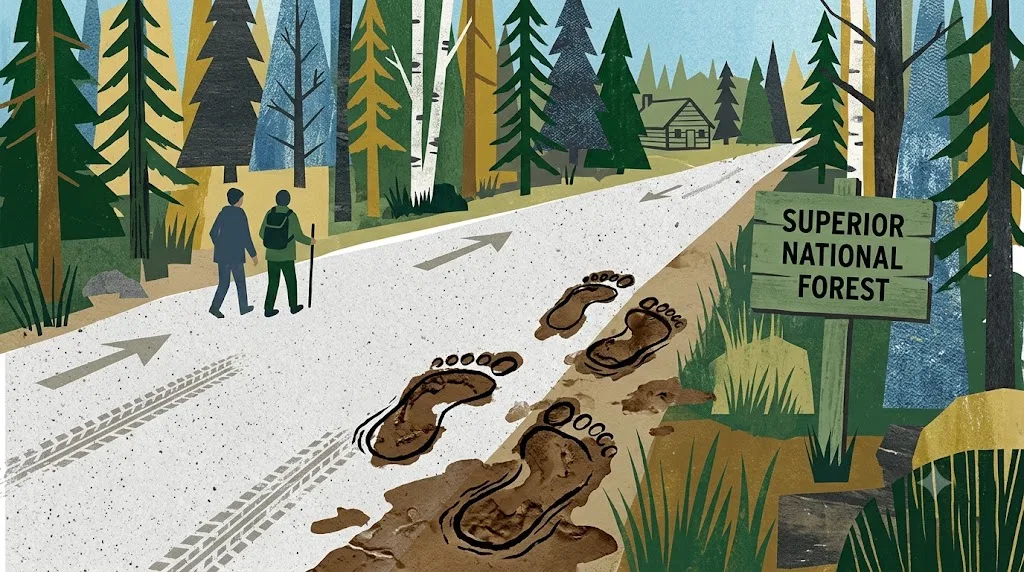
That geography matters. St. Louis County includes the Ely, Virginia, Hibbing, Babbitt and Superior National Forest world: long roads, hunting areas, lakes, bogs and stretches of dark timber. BFRO’s St. Louis County page includes reported road crossings, hunter sightings, campsite incidents, strange howls and Boundary Waters-adjacent memories from the 1970s through 2020.[BFRO]bfro.netSt. Louis County, Minnesota – Reports & ArticlesSt. Louis County, Minnesota – Reports & Articles Itasca County shows a similar pattern, with reports around Grand Rapids, Bigfork, Ball Club, Goodland, Bovey, Calumet and the Lost Forty Scientific and Natural Area.[BFRO]bfro.netItasca County, Minnesota – Reports & ArticlesItasca County, Minnesota – Reports & Articles
These are not random monster-movie settings. The Superior National Forest is a three-million-acre forest at the southern edge of Minnesota’s boreal ecosystem, with thousands of lakes, rocky landscapes and the one-million-acre Boundary Waters Canoe Area Wilderness inside its boundaries.[US Forest Service]fs.usda.govUS Forest Service Home | Superior National Forest | Forest ServiceUS Forest Service Home | Superior National Forest | Forest Service Chippewa National Forest, another recurring part of Minnesota’s Bigfoot geography, is wildlife-rich and lake-heavy; the Forest Service notes more than 250 wildlife species there.[US Forest Service]fs.usda.govUS Forest Service Animals and PlantsUS Forest Service Animals and Plants A person driving home at dusk, scouting deer sign, fishing late, walking to an outhouse or hearing a call across water is already in a setting where distance, darkness and expectation can do a lot of work.
The cluster around Remer in Cass County has become the state’s most visible Bigfoot brand. Remer calls itself the “Home of Bigfoot”, a tourism identity tied to reported local sightings, the Chippewa National Forest setting and a reputed 2009 trail-camera image that helped push the town into Bigfoot culture.[homeofbigfoot.com]homeofbigfoot.comOpen source on homeofbigfoot.com. By 2025, the Minnesota Star Tribune was describing Bigfoot Days as a festival drawing thousands of believers and curiosity-seekers to a town of about 400 people.[Star Tribune]startribune.comOpen source on startribune.com.

Why Remer Became Minnesota’s Bigfoot Capital
Remer is important because it shows how a sighting tradition becomes a public identity. The town did not invent Minnesota Bigfoot reports from nothing; northern Minnesota claims pre-date the festival culture. But Remer turned the idea into something visible, friendly and repeatable: signs, silhouettes, burgers, storytelling events, calling contests and guided curiosity. CBS Minnesota reported in 2024 that the town’s Bigfoot identity was strengthened by a 2009 trail-camera image near Remer and by local organiser Cheryle Ruyak’s decision to trademark the “Home of Bigfoot” identity.[CBS News]cbsnews.comremer minnesota home of bigfoot finding minnesotaremer minnesota home of bigfoot finding minnesota
The important word there is “identity”. A town can embrace Bigfoot without proving Bigfoot. Remer’s annual Bigfoot Days functions partly as folklore theatre, partly as small-town tourism and partly as a gathering place for people who say they have seen or heard something they cannot explain. The Star Tribune’s 2025 account describes children’s Bigfoot-calling contests, storytelling sessions, themed businesses and the presence of the Minnesota Bigfoot Research Team, while also including a tellingly cautious child’s comment about a possible sighting: “it could have been a shadow.”[Star Tribune]startribune.comOpen source on startribune.com.
That mixture is very Minnesota Northwoods: playful, local, outdoorsy and not always solemnly paranormal. Bigfoot gives Remer a story that visitors can photograph and locals can sell, but it also gives witnesses a less embarrassing place to speak. In many cryptid traditions, the festival arrives after the legend; in Remer, the festival has helped keep the legend alive by turning scattered accounts into a shared public ritual.
There is a feedback loop here. More Bigfoot branding brings more Bigfoot-interested visitors. More visitors bring more night walks, story swaps, campfire interpretations and submitted reports. That does not mean the sightings are false, but it does mean the dataset is shaped by culture as well as by landscape. A quiet hunter who saw something odd in 1978 and a modern festivalgoer primed for a Sasquatch encounter are both part of the record, but they are not observing from the same mental starting point.
Common Sighting Patterns And Witness Claims
Minnesota’s reported Bigfoot encounters fit the wider North American Sasquatch pattern, but the local texture is strongly northern: roads through woods, deer-hunting setups, lake cabins, campgrounds and remote recreation areas. The BFRO’s Minnesota listing separates reports into classes, with “Class A” generally used for clearer alleged sightings and “Class B” for sounds, tracks or less direct evidence. Recent Minnesota entries include a 2024 Pine County expedition report, a 2023 Cass County multi-witness daylight sighting near Sixmile Lake on the Leech Lake Reservation, and a 2022 Carlton County report of sounds in Jay Cooke State Park.[BFRO]bfro.netReports for MinnesotaReports for Minnesota…
The repeated motifs are easy to recognise:
Road crossings. Several northern Minnesota reports describe a large upright figure seen briefly by a motorist. This is one of the most common Bigfoot report types because the encounter is sudden, the observer is moving, and the figure is often visible for only a few seconds. St. Louis County listings include claimed road or roadside sightings near Ely, Cook, Mountain Iron, Babbitt and Virginia.[BFRO]bfro.netSt. Louis County, Minnesota – Reports & ArticlesSt. Louis County, Minnesota – Reports & Articles
Hunting encounters. Hunters appear often because they spend quiet time in cover, at dawn or dusk, looking for movement. Itasca County reports include a grouse hunter’s alleged 1999 encounter southwest of Grand Rapids, deer-hunting track claims near Goodland and an older hunting memory near Nashwauk.[BFRO]bfro.netItasca County, Minnesota – Reports & ArticlesItasca County, Minnesota – Reports & Articles These stories can feel compelling because hunters are often treated as careful wildlife observers, but hunting situations also involve distance, adrenaline, partial views and camouflage.
Cabin and campsite incidents. Cabins create a classic Northwoods Bigfoot setting: people are close to the forest, but still protected enough to listen, watch and worry. The St. Louis County list includes reports at or near Lake Jeanette, Gnesen, Boundary Waters country and family cabin settings.[BFRO]bfro.netSt. Louis County, Minnesota – Reports & ArticlesSt. Louis County, Minnesota – Reports & Articles The claimed events include howls, movement, possible visitors and glimpses near buildings.
Sounds and tracks. Screams, knocks, whoops and large footprints are among the most flexible evidence types. They are intriguing because they can feel personal and immediate, but they are also hard to verify after the fact. Itasca County’s page includes reports of screams on Moose Lake, possible tracks near Bigfork and Goodland, and howls near the north-east corner of Chippewa National Forest.[BFRO]bfro.netItasca County, Minnesota – Reports & ArticlesItasca County, Minnesota – Reports & Articles
The weakness across these patterns is not that witnesses must be lying. It is that the reports are usually brief, unrepeatable and filtered through memory. A large dark shape at dusk can be emotionally powerful without being biologically decisive. A huge footprint can be suggestive without proving what made it. A scream in the woods can be unforgettable and still come from a known animal, a person, or a sound warped by distance and terrain.
The Pine County Expedition Shows The Evidence Problem
The 2024 Pine County BFRO expedition is a good example of why Minnesota Bigfoot evidence remains interesting but not conclusive. The report describes a May 2024 organised trip with 18 participants in a heavily forested area with swamps and rivers. According to the account, nearly all participants either heard or saw activity interpreted as Bigfoot-related, and the public version redacted detailed maps and location information.[BFRO]bfro.netshow report.aspshow report.asp
For believers, that kind of group report is stronger than a lone roadside glimpse. It includes multiple people, field notes, a planned return to an allegedly active area and an organisation familiar with Bigfoot claims. It also sits in suitable habitat, at least in the loose sense that the area is wooded, wet and capable of hiding large animals.[BFRO]bfro.netshow report.aspshow report.asp
For sceptics, the same report raises different questions. An organised Bigfoot expedition is not a blind survey. Participants arrive expecting unusual activity, using a framework in which sounds, eye shine or “eye glow”, knocks, movement and distant figures may be interpreted as Sasquatch signs. The location is redacted, making independent checking difficult. The report may document sincere experiences, but sincerity is not the same as a testable specimen, clear DNA, a body, or repeated independent photographic evidence.
This is the central Minnesota Bigfoot tension. The Northwoods can generate strong testimony because people genuinely do encounter things there: bears, wolves, deer, coyotes, owls, moose, bobcats, fishers, shadows, falling branches, echoing calls and other humans. But the stronger the claimed animal, the stronger the evidence needs to be. So far, Minnesota’s public Bigfoot material remains a pattern of anecdote rather than a confirmed wildlife record.
Bears, Wolves And The Limits Of Evidence
Black bears are the most important natural comparison for Minnesota Bigfoot reports. The Minnesota DNR says black bears live in forests, swamps and dense cover, venture into clearings to feed, and are found mainly in the northern third of the state.[Minnesota DNR]dnr.state.mn.usOpen source on mn.us. That overlaps strongly with the state’s Bigfoot report geography. A bear on hind legs, a bear partly hidden by brush, or a bear seen briefly from a road can produce a surprisingly human-like impression, especially when the witness is startled.
This is not just a lazy sceptical answer. A 2024 Journal of Zoology analysis by data scientist Floe Foxon modelled Sasquatch sightings against black bear populations across the United States and Canada while adjusting for human population and forest area. The study found a statistically significant association: as bear populations increased, Sasquatch sightings were expected to increase, with an average of about 5,000 bears per Sasquatch sighting in 2006. The paper’s cautious conclusion was that many supposed Sasquatch are probably misidentified known animals.[ResearchGate]researchgate.netResearch Gate(PDF) Bigfoot: If it's there, could it be a bear?Research Gate(PDF) Bigfoot: If it's there, could it be a bear?
Wolves add another layer, especially for sound reports. Minnesota is one of the few lower-48 states with a large wolf population. The International Wolf Center, summarising Minnesota DNR data, gives a 2022–23 midwinter estimate of 2,919 wolves, mostly in the north-eastern part of the state.[Wolf Center]wolf.orgCenter Minnesota | International Wolf CenterCenter Minnesota | International Wolf Center A wolf howl is not usually mistaken for a bipedal ape by an experienced listener, but long-distance calls, multiple animals, echoes across lakes and night-time fear can make familiar wildlife sound strange.
Cougars show why scepticism should not become smug dismissal of every odd animal report. The Minnesota DNR has long treated cougars as rare but verifiable, noting confirmed records from trail cameras, dead animals and other signs.[Minnesota DNR]dnr.state.mn.usOpen source on mn.us. In 2026, the DNR reported trail-camera footage of a female cougar with three large kittens near Voyageurs National Park, the first documentation of cougar reproduction in Minnesota in more than a century.[Minnesota DNR]dnr.state.mn.usevidence reproducing cougar population minnesotaevidence reproducing cougar population minnesota That does not help prove Bigfoot. It does show the right standard: when a large rare animal is truly present, modern trail cameras, carcasses, tracks, scat, DNA and repeated documentation can begin to move it from rumour into wildlife biology.
Bigfoot has not crossed that line. Live Science’s general review of the subject puts the mainstream position plainly: Bigfoot is described as an ape-like creature some people believe inhabits North America, but there is no hard evidence that it exists.[Live Science]livescience.comOpen source on livescience.com. Genetic testing has also failed to rescue the claim. A 2014 Proceedings of the Royal Society B study examined hair samples attributed to anomalous primates, including Bigfoot and yeti claims, and found matches to known animals rather than an unknown North American ape.[PMC]pmc.ncbi.nlm.nih.govOpen source on nih.gov.
Why The Northwoods Keep Producing Bigfoot Stories
The most interesting question is not simply “Is Bigfoot real?” In Minnesota, the better question is why the reports feel so locally plausible. The Northwoods are a contact zone between ordinary recreation and genuinely wild sensation. People go there to fish, hunt, camp, snowmobile, hike and get away from towns. They also go there expecting the forest to feel different. That expectation does not make a witness dishonest; it changes what an ambiguous moment can become.
A few ingredients recur again and again:
Edges of visibility. Many reports happen at dusk, night, dawn, in headlights, across water, through trees or at the edge of a road. These are exactly the conditions where size, posture and distance are hardest to judge.
Large known animals. Minnesota’s northern forests really do contain bears, wolves, moose in parts of the north, deer and other wildlife capable of making startling sounds or movements. Bigfoot stories borrow credibility from that real wildness.
Cabin-country storytelling. A strange sound at home may be a nuisance. The same sound at a remote cabin becomes a story. Once told around a fire, at a bar, at a festival or in an online database, it joins a larger pattern.
Tourism and permission. Remer’s Bigfoot identity gives people permission to tell stories that might otherwise be kept quiet. That can surface genuine local testimony, but it can also increase expectation and playful exaggeration.
The forest as symbol. Bigfoot often stands for the idea that something still escapes roads, maps, phones and official knowledge. Minnesota’s Northwoods, with their bogs, lakes and deep public lands, are one of the state’s best places to imagine that possibility.
That symbolic role is why the legend survives thin evidence. A confirmed animal needs bones, bodies, DNA and clear images. A folklore figure needs repeated telling, believable settings and enough uncertainty to stay alive. Minnesota Bigfoot has the latter in abundance.
How To Read Minnesota Bigfoot Reports Fairly
A fair reading of Minnesota Bigfoot reports should avoid two easy mistakes. The first is credulity: treating every dark figure, howl or track as evidence of an undiscovered primate. The second is contempt: assuming every witness is foolish or lying. The better approach is to sort the claim by evidence type.
A close daylight sighting by multiple witnesses is more interesting than a distant night sound. A trackway photographed with scale, location, substrate detail and follow-up is more useful than a single print. A trail-camera image with metadata and independent review is stronger than a cropped viral picture. A biological sample tested by a reputable lab would matter far more than a story about hair found on bark.
Minnesota’s public record contains many claims that are culturally valuable and a few that are genuinely intriguing as witness testimony. But it does not yet contain the kind of physical evidence that would force wildlife agencies, mammalogists or conservation biologists to recognise a large unknown primate in the state. That is why the bear comparison remains so powerful. It does not explain every report neatly, but it explains why Bigfoot sightings would concentrate where Minnesota already has large, dark, sometimes bipedal-looking mammals in dense cover.
The Northwoods legend is strongest when read in that middle space. It is not proof of Sasquatch. It is not nothing. It is a living Minnesota creature tradition shaped by forests, roads, cabins, hunting culture, local pride, modern databases and the enduring human habit of turning a frightening glimpse into a story worth repeating.
eBay marketplace picks
Marketplace Samples
Live-tested eBay searches with available results related to this page.



Endnotes
1.
Source: bfro.net
Title: Reports for Minnesota
Link:https://www.bfro.net/GDB/state_listing.asp?state=MN
Source snippet
Reports for Minnesota...
2.
Source: bfro.net
Title: St. Louis County, Minnesota – Reports & Articles
Link:https://www.bfro.net/GDB/show_county_reports.asp?county=St.+Louis&state=mn
3.
Source: bfro.net
Title: Itasca County, Minnesota – Reports & Articles
Link:https://www.bfro.net/GDB/show_county_reports.asp?county=Itasca&state=mn
4.
Source: homeofbigfoot.com
Link:https://www.homeofbigfoot.com/
5.
Source: bfro.net
Title: show report.asp
Link:https://www.bfro.net/GDB/show_report.asp?id=77435
6.
Source: dnr.state.mn.us
Link:https://www.dnr.state.mn.us/mammals/blackbear.html
7.
Source: researchgate.net
Title: Research Gate(PDF) Bigfoot: If it’s there, could it be a bear?
Link:https://www.researchgate.net/publication/377389781_Bigfoot_If_it%27s_there_could_it_be_a_bear
8.
Source: wolf.org
Title: Center Minnesota | International Wolf Center
Link:https://wolf.org/wow/united-states/minnesota/
9.
Source: dnr.state.mn.us
Link:https://www.dnr.state.mn.us/mammals/cougar/index.html
10.
Source: dnr.state.mn.us
Title: evidence reproducing cougar population minnesota
Link:https://www.dnr.state.mn.us/news/2026/04/30/evidence-reproducing-cougar-population-minnesota
11.
Source: pmc.ncbi.nlm.nih.gov
Link:https://pmc.ncbi.nlm.nih.gov/articles/PMC4100498/
12.
Source: wolf.report
Link:https://wolf.report/news/wolves-are-everywhere-what-1-000-community-reports-tell-us-about-minnesotas-wolf-population
13.
Source: time.com
Title: bigfoot dna bear animal
Link:https://time.com/2949457/bigfoot-dna-bear-animal/
14.
Source: fs.usda.gov
Title: US Forest Service Home | Superior National Forest | Forest Service
Link:https://www.fs.usda.gov/r09/superior
15.
Source: fs.usda.gov
Title: US Forest Service Animals and Plants
Link:https://www.fs.usda.gov/r09/chippewa/animals-plants
16.
Source: cbsnews.com
Title: remer minnesota home of bigfoot finding minnesota
Link:https://www.cbsnews.com/minnesota/news/remer-minnesota-home-of-bigfoot-finding-minnesota/
17.
Source: startribune.com
Link:https://www.startribune.com/remer-the-home-of-bigfoot-draws-thousands-of-believers-and-curiosity-seekers-to-festival/601394322
18.
Source: livescience.com
Link:https://www.livescience.com/24598-bigfoot.html
19.
Source: Wikipedia
Title: Boundary Waters Canoe Area Wilderness
Link:https://en.wikipedia.org/wiki/Boundary_Waters_Canoe_Area_Wilderness
20.
Source: Wikipedia
Link:https://en.wikipedia.org/wiki/Bigfoot
21.
Source: dnr.state.mn.us
Link:https://www.dnr.state.mn.us/bear/index.html
22.
Source: dnr.state.mn.us
Link:https://www.dnr.state.mn.us/gohunting/bear-hunting.html
23.
Source: dnr.state.mn.us
Link:https://www.dnr.state.mn.us/wolves/index.html
24.
Source: dnr.state.mn.us
Link:https://www.dnr.state.mn.us/state_forests/index.html
25.
Source: dnr.state.mn.us
Link:https://www.dnr.state.mn.us/state_parks/park.html?id=spk00181
26.
Source: dnr.state.mn.us
Link:https://www.dnr.state.mn.us/
27.
Source: fs.usda.gov
Link:https://www.fs.usda.gov/r09/chippewa/animals-plants/animals
28.
Source: fs.usda.gov
Title: boundary waters canoe area wilderness
Link:https://www.fs.usda.gov/r09/superior/recreation/boundary-waters-canoe-area-wilderness
29.
Source: livescience.com
Title: bigfoot sasquatch nope its probably just a black bear unless you live in florida
Link:https://www.livescience.com/animals/bears/bigfoot-sasquatch-nope-its-probably-just-a-black-bear-unless-you-live-in-florida
30.
Source: livescience.com
Title: 348 voice reason reality bigfoot
Link:https://www.livescience.com/348-voice-reason-reality-bigfoot.html
31.
Source: theoutdoorsapp.com
Title: chippewa national forest
Link:https://theoutdoorsapp.com/parks/chippewa-national-forest
32.
Source: med.umn.edu
Link:https://med.umn.edu/vhlab/research/bears/live
33.
Source: mnhs.org
Link:https://www.mnhs.org/mnopedia/search/index/place/superior-national-forest
Additional References
34.
Source: youtube.com
Title: From Legends to Lore: Minnesota’s Deep Connection to Bigfoot
Link:https://www.youtube.com/watch?v=zsRcRHkRAkk
Source snippet
Video Evidence Clearly Shows A Sasquatch Footprint | Finding Bigfoot...
35.
Source: youtube.com
Title: Video Evidence Clearly Shows A Sasquatch Footprint | Finding Bigfoot
Link:https://www.youtube.com/watch?v=Qg5Oyp-4yp8
Source snippet
This small Minnesota town is home to Bigfoot...
36.
Source: instagram.com
Link:https://www.instagram.com/p/DNOMzKnzh39/
37.
Source: ebsco.com
Link:https://www.ebsco.com/research-starters/social-sciences-and-humanities/bigfoot-cryptozoology
38.
Source: reddit.com
Link:https://www.reddit.com/r/Cryptozoology/comments/19di7nu/bigfoot_and_black_bears_a_correlational_analysis/
39.
Source: pbs.org
Link:https://www.pbs.org/video/bigfoot-in-minnesota-pho46u/
40.
Source: facebook.com
Link:https://www.facebook.com/groups/1691426524521341/posts/3905988383065133/
41.
Source: americanrivers.org
Link:https://www.americanrivers.org/river/boundary-waters-canoe-area-wilderness/
42.
Source: tgigroup.org
Link:https://tgigroup.org/chippewa-national-forest-2/
43.
Source: mspmag.com
Link:https://mspmag.com/arts-and-culture/cougar-family-spotted-mn-first-time-modern-history/
Topic Tree