Within Maryland Monsters
Why Did the Goatman Haunt Maryland's Back Roads?
The Goatman legend spread through Prince George's County roads, newspaper stories, teenage dares and ever-changing origin tales.
On this page
- Tucker Road, Fletchertown Road and Crybaby Bridge
- The 1971 reports and Ginger the puppy
- Teenage dares, newspapers and changing origins
Page outline Jump by section
Introduction
Maryland’s Goatman is not mainly a wilderness monster story. It is a road story: a half-human, half-goat figure said to lurk around Prince George’s County back roads, frighten parked couples, chase cars, attack pets and appear near bridges, woods and old lover’s lanes. The legend’s most important places are Tucker Road, Fletchertown Road and the Lottsford Road/Crybaby Bridge cluster. Its modern fame came together quickly in 1971, when a University of Maryland folklore project, Prince George’s County newspaper stories, the death of a dog named Ginger and teenage “Goatman hunts” fed one another. Folklorist David Puglia argues that the Goatman became a Maryland legend through a mix of oral tradition, sensational local journalism, people acting out the story, and teenage legend-tripping rather than through one clean eyewitness case.[IUScholarWorks]scholarworks.iu.eduScholar Works Getting Maryland's Goat: Diffusion and Canonization of PrinceRoad.” He collected eight Goatman legends for his project—seven of a single type. Eighteen-year-old…Read more…
That is why the Goatman still feels so local. He belongs to the kind of road where older teenagers dared each other to park, drive slowly, flash headlights, listen for noises, or run into the woods because someone had heard that someone else had seen him there. The creature is less convincing as evidence for an unknown animal than as a study in how a place becomes haunted by repetition.
Why the Goatman belongs to Prince George’s County roads
The classic Maryland Goatman is usually described as a bipedal, hairy, goat-like humanoid: sometimes a man with goat features, sometimes a goat-headed figure with a human body, sometimes closer to a shaggy Bigfoot-like creature. In later popular versions he may carry an axe, attack cars, kill dogs or terrorise couples on secluded roads. The setting matters as much as the anatomy. The Goatman is not usually imagined in a remote mountain cave or deep swamp; he appears at the edge of suburbs, along wooded roads, near bridges, railway lines and places where young people could plausibly be out after dark.[Washingtonian]washingtonian.comThe Goatman–Or His Story, at Least–Still Haunts PrinceThe first media mention of the Goatman came on October 27, 1971, in the Bowie-based Prince George's…Read more…
Prince George’s County was ideal ground for that kind of legend. In the late twentieth century, parts of the county still had rural-feeling lanes and wooded pockets close to fast-growing suburbs and the Washington, D.C. metropolitan area. A dark road could feel isolated without being truly far away. That made the Goatman useful as a warning, a dare, a joke and a local identity marker all at once: “everyone” had heard of him, but everyone had heard a slightly different version.
The legend’s power also comes from its flexible geography. A story told on one road could be moved to another road with the same ingredients: trees, a bridge, a sharp bend, an abandoned-looking structure, a local death rumour, a place where couples parked, or a stretch where teenagers already went to frighten one another. Puglia identifies the main Goatman triangle as Tucker Road in Clinton, Fletchertown Road in Bowie and Lottsford Road in Mitchellville, with the legend shifting between these places as it spread.[IUScholarWorks]scholarworks.iu.eduScholar Works Getting Maryland's Goat: Diffusion and Canonization of PrinceRoad.” He collected eight Goatman legends for his project—seven of a single type. Eighteen-year-old…Read more…
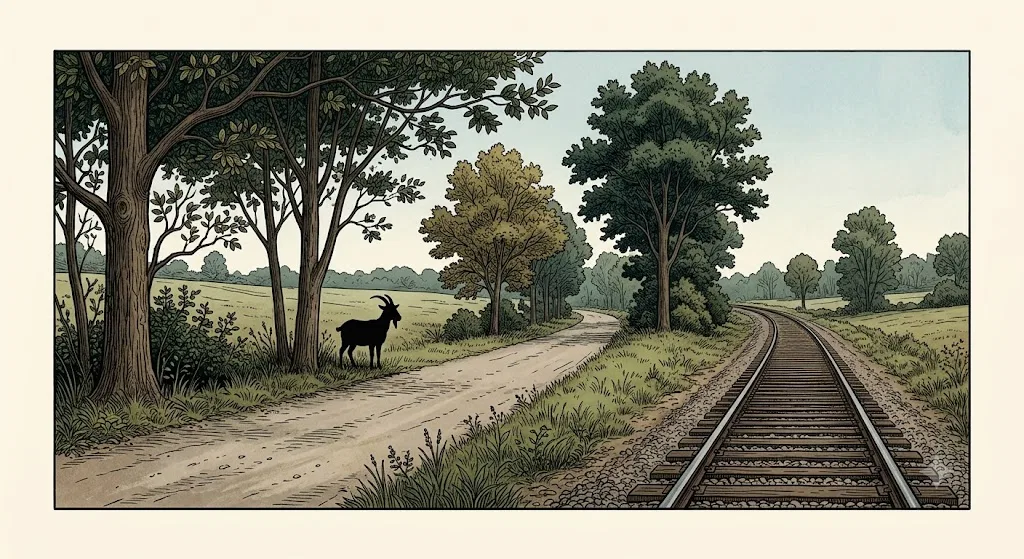
Tucker Road, Fletchertown Road and Crybaby Bridge
Tucker Road is important because it appears in the early archive material. In May 1971, University of Maryland student George Lizama submitted a folklore project called “The Goatman of Tucker Road”. According to Puglia’s study, Lizama collected eight Goatman legends, most of them sharing a recognisable pattern: an old hermit or goat-herder figure near a narrow, tree-lined road and a one-lane bridge, associated with full moons, glowing eyes, thrown bricks or rocks, and cars damaged or driven off the road.[IUScholarWorks]scholarworks.iu.eduScholar Works Getting Maryland's Goat: Diffusion and Canonization of PrinceRoad.” He collected eight Goatman legends for his project—seven of a single type. Eighteen-year-old…Read more…
That Tucker Road version feels different from the later horror-creature image. It is closer to a local road-ogre: a frightening figure tied to a specific bridge, a bad bend and teenage driving culture. The Goatman guards territory, punishes intruders and gives a dangerous road a face. The old-hermit detail also matters because it keeps the story close to ordinary human fears. Some versions do not require a laboratory monster at all; they need only a reclusive man, a dark road and teenagers willing to embroider the tale.
Fletchertown Road then became the legend’s public stage. The first known media mention came in the Bowie-based Prince George’s County News on 27 October 1971, when reporter Karen Hosler wrote about local folklore from the University of Maryland archives and placed Goatman material around the Fletchertown Road woods. Two weeks later, her follow-up story connected the legend to the death of the Edwards family’s puppy, Ginger, found decapitated near Fletchertown Road.[Washingtonian]washingtonian.comThe Goatman–Or His Story, at Least–Still Haunts PrinceThe first media mention of the Goatman came on October 27, 1971, in the Bowie-based Prince George's…Read more…
Lottsford Road and Crybaby Bridge added another layer. Puglia describes Lottsford as the third point in the Goatman’s local geography, noting that it was also a dark, wooded road with its own frightening reputation. Later folklore archive files included “The Goatman and Crybaby Bridge: Local Legends of Lottsford Road”, while local memory and journalism continued to connect Goatman hunts with Fletchertown Road and nearby Crybaby Bridge.[IUScholarWorks]scholarworks.iu.eduScholar Works Getting Maryland's Goat: Diffusion and Canonization of PrinceRoad.” He collected eight Goatman legends for his project—seven of a single type. Eighteen-year-old…Read more…
Crybaby Bridge stories are not unique to Maryland. Across the United States, “crybaby bridge” legends often involve a bridge where a baby is said to have died and where visitors claim to hear crying. In Maryland, these bridge legends overlapped with Goatman material, especially around Lottsford Road, Governor’s Bridge Road and other disputed local sites. That overlap shows how roadside folklore often works: one spooky place can collect several legends until the bridge is not only haunted, but also part of the Goatman’s route.[Wikipedia]WikipediaCrybaby BridgeCrybaby Bridge
The 1971 reports and Ginger the puppy
The 1971 Ginger incident is the moment that turned a local road legend into a wider Maryland story. The outline is grim but simple: April Edwards and others reported strange noises and a large, hairy, upright creature near the family’s home; the puppy Ginger disappeared; and the dog was later found dead and decapitated near Fletchertown Road and the railway. Hosler’s Prince George’s County News follow-up framed the case in relation to Goatman rumours, and the Washington Post then brought the legend to a broader audience with Ivan Goldman’s 30 November 1971 article, “A Legendary Figure Haunts Remote Pr. George’s Woods.”[Washingtonian]washingtonian.comThe Goatman–Or His Story, at Least–Still Haunts PrinceThe first media mention of the Goatman came on October 27, 1971, in the Bowie-based Prince George's…Read more…
For believers, Ginger became the horrible “proof” that the Goatman was not just a story. For sceptics, the case shows how a frightening but ambiguous animal death can attach itself to a legend already circulating nearby. The key point is not that the dog’s death proved a monster existed. It is that the death gave the legend a concrete, emotionally charged anchor: a named pet, a named family, a named road and newspaper coverage close enough to Halloween to make the story spread.
Puglia’s reconstruction is especially useful because it does not treat the newspapers as passive recorders of a fixed tradition. He argues that the archive, the newspaper stories and public behaviour interacted. Lizama’s student collection preserved a Tucker Road legend; Hosler’s first article helped move Goatman attention towards Bowie and Fletchertown Road; Ginger’s death seemed to give the story evidence; and the follow-up coverage encouraged more talk, trips and reports.[IUScholarWorks]scholarworks.iu.eduScholar Works Getting Maryland's Goat: Diffusion and Canonization of PrinceRoad.” He collected eight Goatman legends for his project—seven of a single type. Eighteen-year-old…Read more…
That chain also explains why the Goatman story became hard to pin down. Once newspapers gave the legend visibility, future tellers could truthfully say they had “seen it in the paper”, even when the details they repeated came from local gossip, teenage dares or later embellishment. The story became self-reinforcing: the more people went looking, the more noises, shadows, pranks and sightings could be folded back into the legend.
Teenage dares made the monster visible
Legend-tripping means visiting a place linked to a legend in order to test it, perform it, or feel its fear first-hand. For the Goatman, that often meant teenagers driving to Fletchertown Road, Lottsford Road or a bridge at night, parking, drinking, daring one another to get out, or claiming to hear squeals and movement in the woods. Puglia describes Goatman legend-tripping as a mainstay of Prince George’s County teenage life in the 1970s, while later local accounts remember “Goatman hunting” as something teenagers did for excitement.[IUScholarWorks]scholarworks.iu.eduScholar Works Getting Maryland's Goat: Diffusion and Canonization of PrinceRoad.” He collected eight Goatman legends for his project—seven of a single type. Eighteen-year-old…Read more…
This matters because Goatman stories were not only told; they were enacted. A group of teenagers who drove to the road because of the legend might become part of the next version of the legend. If a branch cracked, a deer bolted, a prankster shouted, a car backfired or someone threw a rock, the trip could be retold as a near encounter. Even a failed hunt helped the story: the road had been scary enough to visit, which confirmed that it was a Goatman place.
The teenage element also pushed the legend towards lover’s lane material. Folklorists have long noted American legends in which secluded couples are threatened by a hook-handed killer, a madman, a hanging corpse or an unknown attacker. In Prince George’s County, the Goatman could step into that role. He became the thing that punished privacy, trespass and adolescent bravery: the monster outside the car window, the noise in the woods, the shape near the bridge.
The result was a creature built for repetition. A Snallygaster newspaper hoax might be read at breakfast; a Chessie sighting might depend on being near the Chesapeake Bay at the right moment; but the Goatman could be summoned socially. Tell the story, drive the road, scare your friends, return with a better story. That cycle is one reason the Goatman became Maryland’s best-known roadside monster.

Newspapers changed the origin story
Early Goatman material did not have a single official origin. Some versions made him an old hermit. Others made him a goat herder who became goat-like after losing his animals. Later versions tied him to a failed experiment at the Beltsville Agricultural Research Center, where a scientist supposedly crossed human and goat DNA or otherwise transformed into a monster. WTOP’s 2018 Halloween feature summarised the Beltsville version but flagged the piece as tongue-in-cheek folklore rather than hard evidence.[WTOP News]wtop.comNews Local Legends: The Goat Man of MdWTOP NewsLocal Legends: The Goat Man of Md. - WTOP News31 Oct 2018 — WTOP's Jason Fraley explores the local legend of the Goat Man of Mar…
The laboratory origin is memorable because it modernises the monster. A hermit on a bridge belongs to rural road folklore; a failed experiment belongs to twentieth-century anxieties about science, institutions and hidden mistakes. Beltsville also gave the legend a real place name with official weight. That does not make the story more credible, but it does make it easier to retell.
The Beltsville rumour has been publicly denied. Modern Farmer reported in 2013 that the United States Department of Agriculture’s research centre rejected the Goatman origin story, with a spokesperson joking about the absurdity of a creature from decades earlier still being active.[All That's Interesting]allthatsinteresting.comAll That's Interesting What Is The Goatman, The Legendary Half-Man, Half-Goat?All That's Interesting What Is The Goatman, The Legendary Half-Man, Half-Goat?
The important pattern is mutation, not laboratory mutation but folklore mutation. The Goatman changed because different tellers needed different versions. A scary old man works for a bridge dare. A dog-killing beast works for the Ginger story. A horned axe-carrier works for horror imagery. A failed science experiment works for a modern cryptid page, Halloween segment or campfire retelling. None of these versions has to erase the others.
What evidence is there for the Goatman?
The evidence for the Goatman is strong as folklore and weak as zoology. There are archive references, local newspaper reports, named roads, named witnesses, remembered teenage trips and decades of retellings. Those sources show that people in Prince George’s County talked about the Goatman, went looking for him, blamed events on him and passed the story into Maryland popular culture. They do not show that a goat-human creature existed.[IUScholarWorks]scholarworks.iu.eduOpen source on iu.edu.
The strongest historical evidence concerns the legend’s spread. We can trace a 1971 student folklore project, local newspaper coverage in October and November 1971, the Ginger incident, wider Washington Post attention and later teenage recollections. That is a solid record of legend formation. It is not the same as a body, a clear photograph, biological material or a reliable chain of physical evidence.
The Maryland Department of Natural Resources treats Goatman as one of the state’s cryptid traditions and offers ordinary possibilities for some reports: an injured deer, a piebald deer, an animal with mange or another skin condition, or simply a person behaving strangely. That official wildlife framing is useful because it keeps the two questions separate. “Why did people report something?” is not the same as “Was there a hidden goat-man species?”[Maryland News]news.maryland.govs cryptids and the wildlife that may have inspired thems cryptids and the wildlife that may have inspired them
Some sightings may have involved misidentified animals at night. Deer can stand, stumble, rear or move oddly when injured; mange can make animals look patchy, distorted or unrecognisable; darkness and fear can exaggerate size and shape. Other episodes may have involved pranks, trespassing, drunken dares or people interpreting ordinary noises through a story they already expected to encounter. None of that makes the legend worthless. It explains why this kind of legend thrives.

Why the roads mattered more than the monster
The Goatman’s staying power comes from place. Fletchertown Road, Tucker Road, Lottsford Road and Crybaby Bridge gave the story a map. A monster said to live “somewhere in Maryland” is vague; a monster said to wait on a narrow road where your older brother might actually drive you is immediate. That is why local people who grew up around Bowie, Greenbelt, Clinton or Mitchellville often remember not just the creature, but the social ritual around it.[Washingtonian]washingtonian.comThe Goatman–Or His Story, at Least–Still Haunts PrinceThe first media mention of the Goatman came on October 27, 1971, in the Bowie-based Prince George's…Read more…
The roads also made the legend adaptable to suburban change. As Prince George’s County developed, some older rural-feeling spaces changed, bridges were replaced, roads were widened and once-secluded spots became less mysterious. Strange Magazine’s Crybaby Bridge discussion notes that the Lottsford Road bridge over Western Branch was destroyed and replaced, and that the road itself was reconstructed and widened.[strangemag.com]strangemag.comOpen source on strangemag.com.
That kind of change can weaken a legend’s original stage, but it can also make the story more nostalgic. The Goatman becomes a memory of a county that felt darker, emptier and more rural to the teenagers who drove those roads in the 1970s and 1980s. The monster preserves the atmosphere of places that may no longer look as frightening in daylight or on a modern map.
This is also why Goatman stories resist neat debunking. Proving that there is no goat-man under a specific bridge does not erase the teenage memory of going there, hearing something in the woods and racing back to the car. Folklore is not only a claim about the outside world. It is also a record of how a community used fear, humour and place to make ordinary roads feel charged.
How later accounts reshaped Goatman
The older road versions of the Goatman were relatively local and physical: a hermit, a bridge, bricks, rocks, a shack, a dark lane, a damaged car. The 1971 newspaper moment made the legend public and attached it to Ginger’s death. The teenage legend-tripping era turned it into a repeatable ritual. Later books, websites, Halloween pieces and cryptid pages made the Goatman more visual: horns, hooves, axe, glowing eyes and a more standard monster shape.[IUScholarWorks]scholarworks.iu.eduScholar Works Getting Maryland's Goat: Diffusion and Canonization of PrinceRoad.” He collected eight Goatman legends for his project—seven of a single type. Eighteen-year-old…Read more…
That change has a cost. The more the Goatman becomes a generic internet cryptid, the easier it is to lose what made the Maryland version distinctive. He is not just “a goat monster”. He is a Prince George’s County roadside legend shaped by specific roads, local newspapers, archive collecting, a pet’s death, high-school dares, and the strange power of suburban edges.
The best way to read the Goatman, then, is not to ask only whether he is “real”. A better question is why so many people knew where he was supposed to be. The answer lies in the roads themselves. Tucker Road gave the legend an early bridge-and-hermit pattern. Fletchertown Road gave it a newspaper-era shock. Lottsford Road and Crybaby Bridge gave it a wider teenage circuit. Together, they turned the Goatman into Maryland’s most durable back-road monster.
Amazon book picks
Further Reading
Books and field guides related to Why Did the Goatman Haunt Maryland's Back Roads?. Use these as the next step if you want deeper reading beyond the article.
Encyclopedia of Urban Legends
Useful for understanding Goatman as a modern legend tradition.

eBay marketplace picks
Marketplace Samples
Live-tested eBay searches with available results related to this page.


Endnotes
1.
Source: washingtonian.com
Title: The Goatman–Or His Story, at Least–Still Haunts Prince
Link:https://washingtonian.com/2015/10/30/the-goatman-or-his-story-at-least-still-haunts-prince-georges-county/
Source snippet
The first media mention of the Goatman came on October 27, 1971, in the Bowie-based Prince George's...Read more...
Published: October 27, 1971
2.
Source: wtop.com
Title: News Local Legends: The Goat Man of Md
Link:https://wtop.com/halloween-news/2018/10/local-legends-the-goat-man-of-md/
Source snippet
WTOP NewsLocal Legends: The Goat Man of Md. - WTOP News31 Oct 2018 — WTOP's Jason Fraley explores the local legend of the Goat Man of Mar...
3.
Source: Wikipedia
Title: Crybaby Bridge
Link:https://en.wikipedia.org/wiki/Crybaby_Bridge
4.
Source: strangemag.com
Link:https://www.strangemag.com/strangemag/strange21/crybabybridge21.html
5.
Source: news.maryland.gov
Title: s cryptids and the wildlife that may have inspired them
Link:https://news.maryland.gov/dnr/2024/10/04/marylands-cryptids-and-the-wildlife-that-may-have-inspired-them/
6.
Source: Wikipedia
Title: Goatman (urban legend)
Link:https://en.wikipedia.org/wiki/Goatman_%28urban_legend%29
7.
Source: folklore.ee
Link:https://folklore.ee/FOAFtale/ftn78.pdf
8.
Source: scholarworks.iu.edu
Title: Scholar Works Getting Maryland’s Goat: Diffusion and Canonization of Prince
Link:https://scholarworks.iu.edu/journals/index.php/cl/article/download/35074/38274/90965
Source snippet
Road.” He collected eight Goatman legends for his project—seven of a single type. Eighteen-year-old...Read more...
9.
Source: scholarworks.iu.edu
Link:https://scholarworks.iu.edu/journals/index.php/cl/article/view/35074
10.
Source: allthatsinteresting.com
Title: All That’s Interesting What Is The Goatman, The Legendary Half-Man, Half-Goat?
Link:https://allthatsinteresting.com/goatman
11.
Source: cryptidz.fandom.com
Title: Maryland Goatman
Link:https://cryptidz.fandom.com/wiki/Maryland_Goatman
12.
Source: scholarworks.iu.edu
Title: acm sig proceedings
Link:https://scholarworks.iu.edu/journals/index.php/cl/citationstylelanguage/get/acm-sig-proceedings?publicationId=32537&submissionId=35074
13.
Source: scholarworks.iu.edu
Title: harvard cite them right
Link:https://scholarworks.iu.edu/journals/index.php/cl/citationstylelanguage/get/harvard-cite-them-right?publicationId=32537&submissionId=35074
14.
Source: scholarworks.iu.edu
Title: modern language association
Link:https://scholarworks.iu.edu/journals/index.php/cl/citationstylelanguage/get/modern-language-association?publicationId=32537&submissionId=35074
15.
Source: scholarworks.iu.edu
Link:https://scholarworks.iu.edu/journals/index.php/cl/citationstylelanguage/get/ieee?publicationId=32537&submissionId=35074
16.
Source: brickthology.com
Link:https://brickthology.com/2021/06/27/goatman/
17.
Source: brickthology.com
Link:https://brickthology.com/tag/goatman/
18.
Source: cryptidempire.com
Link:https://cryptidempire.com/cryptids/maryland-goatman
Additional References
19.
Source: youtube.com
Title: The Goatman of Maryland: The Urban Legend That Won’t Die
Link:https://www.youtube.com/watch?v=sRuv4RNWzK4
Source snippet
Our 2000 documentary about the GOATMAN might have actually found him...
20.
Source: youtube.com
Link:https://www.youtube.com/watch?v=Ia6kO0gnY3Q
Source snippet
The Goat Man (Mysterious Legends & Creatures #1)...
21.
Source: youtube.com
Title: The Goat Man (Mysterious Legends & Creatures #1)
Link:https://www.youtube.com/watch?v=etTq-UIq2e4
Source snippet
CRYPTID: THE GOATMAN Movie Trailer | Documentary, History, Mystery...
22.
Source: reddit.com
Link:https://www.reddit.com/r/baltimore/comments/1flgg8r/baltimore_spooky_spots/
23.
Source: facebook.com
Link:https://www.facebook.com/groups/1555037394799189/posts/3224795187823393/
24.
Source: reddit.com
Link:https://www.reddit.com/r/PrinceGeorgesCountyMD/comments/1fsxid7/did_anyone_else_grow_scared_to_death_of_lottsford/
25.
Source: facebook.com
Link:https://www.facebook.com/groups/MyAroostook/posts/1329084997486486/
26.
Source: instagram.com
Link:https://www.instagram.com/p/CG49affAyMW/
27.
Source: facebook.com
Link:https://www.facebook.com/groups/804588512942919/posts/25468711582770603/
28.
Source: facebook.com
Link:https://www.facebook.com/HISTORY/posts/in-lake-worth-texas-a-wave-of-terrifying-encounters-with-a-massive-seven-foot-ta/1432783898414582/
Topic Tree