Within Connecticut Cryptids
Which Real Animals Feed Connecticut Monster Stories?
Bobcats, bears, coyotes, fishers, and rare wanderers help explain why Connecticut monster reports can feel plausible.
On this page
- Known predators and common misidentifications
- The Milford mountain lion problem
- Why forests, suburbs, and reservoirs matter
Page outline Jump by section
Introduction
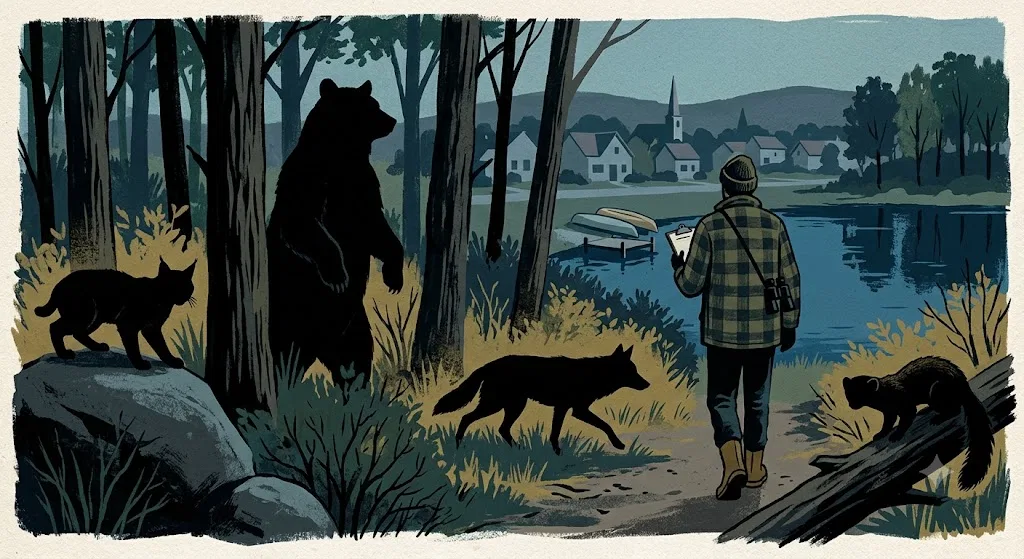
Connecticut monster sightings often sound more believable than they first appear because the state really does have a lively cast of hard-to-see predators. Bobcats, black bears, coyotes, fishers, foxes and occasional wanderers give local legends a practical foundation: a scream in the woods, a large shape at the edge of a road, a pet attack, tracks in snow, or a brief cat-like silhouette can quickly become a “panther”, “wild man”, “Glawackus”, or Bigfoot-adjacent report. That does not mean Connecticut’s cryptids are confirmed animals. It means many stories grow in the overlap between real wildlife, changing animal ranges, suburban encounters, and the human habit of filling in details when visibility is poor.
The key is not to ask whether every strange report is “just a bear” or “just a bobcat”. The better question is which real animals make a particular sighting feel plausible, and where the explanation breaks down. Connecticut’s forests have regrown dramatically, bears and bobcats are reported widely, coyotes are now common statewide, and the famous Milford mountain lion proved that very rare wildlife surprises can happen — while also showing how much evidence a genuine large predator tends to leave behind.[ct.gov]portal.ct.govBobcats in ConnecticutBobcats in Connecticut
The real animals that make monster reports feel possible
Connecticut is small, but its wildlife does not behave as if it has read the state map. Animals move along wooded ridges, river valleys, reservoirs, back gardens, road verges, golf courses, farms and suburban greenbelts. For a witness who gets only a few seconds of viewing time, especially at dawn, dusk, or night, a normal animal can become unusually large, hybrid-looking, or strangely human-shaped.
Bobcats are the most important “phantom cat” ingredient. Connecticut’s bobcat population was once in serious trouble, but it recovered after legal protection and improved forest habitat. DEEP notes that the state was only about 25% forested by 1825, while today nearly 60% is forested; bobcats are now regularly observed around the state. They are also monitored through public sightings and road-kill records, with DEEP collecting 20 to 30 vehicle-killed bobcats annually for examination.[CT.gov]portal.ct.govBobcats in ConnecticutBobcats in Connecticut
That matters for monster lore because a bobcat is recognisably feline, but not familiar in the way a house cat is. It has a muscular body, tufted ears, a short tail, a low stalking gait and a habit of appearing briefly along brushy edges. Under poor light, a bobcat glimpsed crossing a road can be mentally enlarged into a cougar. In a story already primed by talk of “panthers”, it can become evidence for a hidden big cat population.
Black bears supply a different kind of misidentification. Connecticut has a healthy and increasing bear population, with the resident population estimated at around 1,200 including juveniles. DEEP says the highest concentration is in the north-west, but the population is expanding into suitable habitat elsewhere; in 2023, bears were reported from 165 of the state’s 169 towns and cities.[CT.gov]portal.ct.govBlack BearBlack Bear
Bears can look uncannily unlike themselves in the right moment. A young bear standing upright, a bear crossing a road at speed, or a dark animal seen through trees can feed “wild man” or Bigfoot-like impressions. The animal is real, large, intelligent and increasingly seen near homes, which gives an eyewitness the feeling that something out of place has stepped into ordinary life.
Coyotes explain many “something was stalking the neighbourhood” reports. They were not originally found in Connecticut, but expanded eastward and were first reported in the state in the mid-1950s. DEEP now describes coyotes as part of Connecticut’s ecosystem and common throughout the state, including developed places such as wooded suburbs, parks, beach fronts and office parks.[CT.gov]portal.ct.govOpen source on ct.gov.
The eastern coyote can appear larger and bolder than people expect. It may travel alone or in pairs, move through residential areas, and become more noticeable around pup-rearing season. In folklore terms, coyotes are not only possible visual culprits; their calls and yips also add the soundtrack that makes a night-time story feel stranger than the animal behind it.
Fishers are a classic example of a real animal wrapped in exaggeration. The fisher is a large member of the weasel family, often called a “fisher cat” even though it is not a cat, and DEEP describes it as alert, secretive and primarily associated with forest cover. Its long body, dark fur, low movement and unfamiliar profile can look odd to someone who has never seen one before.[CT.gov]portal.ct.govOpen source on ct.gov.
The twist is that the most famous “fisher scream” explanation is often wrong. DEEP specifically warns that many reports of fisher calls sounding like a person crying are probably red foxes, because fishers are not very vocal. Red foxes, by contrast, make barks, screeches, yells and long howls; DEEP says a common report involves a raspy scream or bark repeated every few seconds.[CT.gov]portal.ct.govReport a Wildlife SightingReport a Wildlife Sighting
That one correction says a lot about Connecticut monster stories. Sometimes the sceptical explanation is not “the witness invented it”. It is that a real animal was present, but the animal named in the retelling is still the wrong one.
Known predators and common misidentifications
The most useful way to read Connecticut creature reports is to separate the sensory clue from the legend attached to it. A person may accurately remember a scream, a dark shape, a killed chicken, a huge track, or a cat-like movement. The jump from that clue to “monster” is where ordinary wildlife often enters.
A few patterns recur:
- Large dark shape near woods: often bear, deer, or shadow-distorted domestic animal; in Bigfoot-style reports, a bear upright on hind legs is especially important.
- Cat-like animal bigger than expected: often bobcat, sometimes large domestic cat, dog, coyote at a distance, or a rare confirmed wanderer only if strong evidence follows.
- Night scream: often red fox, sometimes coyote, owl, domestic animal, or other wildlife; the “fisher scream” label is popular but often misleading.
- Pet or livestock attack: can involve coyote, bobcat, fisher, fox, dog, raccoon or bear, depending on prey type, tracks, wounds and setting.
- Strange tracks in snow or mud: can be distorted by melting, overlap, stride pattern, or partial prints; DEEP’s fisher information notes that fisher tracks can vary depending on substrate conditions.[CT.gov]portal.ct.govOpen source on ct.gov.
This does not mean every historic report can be solved neatly. Many old Connecticut stories were filtered through newspaper humour, second-hand testimony and local rumour before anyone could examine tracks or remains. The Glastonbury Glawackus is the best example: the 1939 reports involved cries, pet and livestock attacks, hunting parties and uncertain descriptions, while later retellings turned the creature into a hybrid of cat, bear, lion and local joke. Contemporary and later accounts included speculation about a mountain lion or large bobcat, but the animal was never definitively identified.[damnedct.com]damnedct.comOpen source on damnedct.com.
The Glawackus matters here because it sits exactly where wildlife and legend meet. If pets or farm animals really were attacked, a real predator may have been involved. If descriptions multiplied and changed, folklore and publicity were also involved. A bobcat, coyote, fisher, escaped animal, domestic dog, hoax, or a mixture of separate incidents could all have contributed. The story’s power comes from the fact that none of those explanations fully kills the atmosphere of the original winter scare.
The Milford mountain lion problem
No Connecticut animal complicates sceptical explanations more than the mountain lion killed in Milford in June 2011. For years, state wildlife agencies in the eastern United States have had to handle public reports of cougars where no established breeding population is known. Then a real cougar appeared in Connecticut, was struck by a vehicle on the Wilbur Cross Parkway, and genetic testing linked it to the Black Hills region of South Dakota. DEEP’s reported results said the animal’s movements had been tracked through Minnesota and Wisconsin and that it had travelled more than 1,500 miles, one of the longest recorded movements for a land mammal.[CT Insider]ctinsider.comConnecticut Mountain Lion Originated in South 16888952Connecticut Mountain Lion Originated in South 16888952
For believers in Connecticut “panthers”, the Milford animal is irresistible: a large wild cat really did reach the state. But for sceptics, it is just as important for the opposite reason. It did not prove a hidden local population. It proved that when a mountain lion is genuinely present, it can leave a chain of evidence: sightings, physical traces, genetic testing, road collision records and inter-state tracking. A DEEP wildlife biologist later pointed out that the 2011 animal was documented repeatedly along its route, and argued that an established population in a densely populated, camera-filled state such as Connecticut would be detected fairly quickly.[New Hampshire Public Radio]nhpr.orgwildlife biologist breaks down mountain lion sightings in ctwildlife biologist breaks down mountain lion sightings in ct
That creates the “Milford problem” for modern monster reports. The case makes rare wanderers plausible in principle, but it raises the evidence standard for claims of resident big cats. A single fleeting sighting, however sincere, is weaker after Milford, not stronger, because Milford showed what confirmation looks like.
There is also a psychological effect. Once people know a cougar reached Connecticut, every large tan animal, long-tailed silhouette, or bobcat seen too quickly can be upgraded in memory. The 2011 case becomes a permission slip for possibility. It is a good reminder that a true anomaly can make later misidentifications more likely, not less.

Why forests, suburbs and reservoirs matter
Connecticut’s monster geography is not wilderness in the western American sense. It is a patchwork: regrown woods, old farms, traprock ridges, reservoirs, wetlands, suburban streets, commuter roads and protected parcels pressed against dense human settlement. That is exactly the kind of landscape where wildlife encounters are frequent enough to seed stories, but brief and ambiguous enough to leave room for imagination.
Forest recovery is central. Bobcats benefited from improved habitat and legal protection, while fishers are associated with forested cover and have become the subject of monitoring and research. Bears also use suitable habitat but are now common enough near residential areas that DEEP emphasises human-associated foods such as birdseed, rubbish, pet food and grills as drivers of conflict.[CT.gov]portal.ct.govBobcats in ConnecticutBobcats in Connecticut
Suburbs add the surprise. A bear in a deep forest is wildlife; a bear near a driveway becomes a story. A coyote on a ridge is expected; a coyote in an office park feels uncanny. A bobcat in a swamp is natural; a bobcat slipping between garden hedges seems like a secret predator living beside the school run. DEEP explicitly notes that coyotes thrive in human-disturbed environments and that bears are increasingly reported even in heavily populated residential areas.[CT.gov]portal.ct.govOpen source on ct.gov.
Reservoirs and wooded water corridors add another layer. They create long, quieter strips of habitat through otherwise settled country, and they shape the way sightings are narrated. A creature glimpsed near a reservoir or wooded public trail seems less like a random animal and more like it belongs to a hidden pocket of the state. That is why Connecticut’s creature stories so often feel local rather than vast: the monster is not imagined as ruling an untouched wilderness, but as slipping through the green seams behind ordinary towns.

How wildlife turns into a monster story
Most Connecticut monster reports do not begin with a complete legend. They begin with a mismatch between expectation and perception. The witness expects deer, raccoons, squirrels, maybe a fox. Instead, they see something larger, darker, louder, faster, more upright, more cat-like, or more confident near people than expected. The brain tries to sort the clue quickly, and local lore supplies the nearest dramatic label.
Several mechanisms do the work:
Distance changes scale. A bobcat at the far edge of a field can be hard to size without a reference point. A coyote with winter fur can look heavier than expected. A bear cub can look like a different species entirely if the mother is not visible.
Low light removes detail. Dawn, dusk and headlights flatten colour and hide tails, ears and markings. Many animals active at those times are also the ones most likely to be involved in mystery sightings.
Sound detaches from source. A fox scream from a wooded patch can sound human, feline, or impossible when the animal is invisible. If neighbours already speak of fishers or “something in the woods”, the sound is easily folded into that explanation. DEEP’s correction about foxes and fishers is valuable because it shows how a widely repeated wildlife “fact” can itself become folklore.[CT.gov]portal.ct.govReport a Wildlife SightingReport a Wildlife Sighting
Real range changes make old assumptions unreliable. Coyotes were not always part of Connecticut life; now they are common. Bears have recolonised and expanded. Bobcats recovered from severe decline. When people say “we never used to see those here”, they may be remembering accurately — but the explanation can be ecological change rather than cryptid mystery.[CT.gov]portal.ct.govOpen source on ct.gov.
The rare true case keeps the door open. The Milford mountain lion means Connecticut cannot honestly say, “That could never happen.” It can say something more precise: a wandering large cat can occur, but an established hidden population would need much stronger evidence than ordinary sighting stories.[CT Insider]ctinsider.comConnecticut Mountain Lion Originated in South 16888952Connecticut Mountain Lion Originated in South 16888952
Reading Connecticut sightings without spoiling the fun
A good sceptical reading of Connecticut monster lore does not require mocking witnesses or flattening every story into “people saw a dog”. The more interesting approach is to keep two ideas together: Connecticut’s creature legends are culturally real, and many of their raw ingredients are biologically real.
For a reader, the practical test is evidence quality. A report becomes more persuasive when it includes clear photographs, video, tracks with scale, hair or scat suitable for testing, multiple independent witnesses, expert review, or a pattern that matches known animal behaviour. It becomes weaker when the claim depends on size estimates in poor light, dramatic second-hand retellings, no physical trace, or descriptions that change as the story spreads.
This is why the state’s wildlife records are so useful for cryptid reading. DEEP asks the public to report black bears, bobcats, moose, fishers and other species, and those reports help track distribution and abundance. That official habit of collecting sightings shows that unusual animal reports are not automatically foolish. It also shows the difference between a monitored species and a monster claim: wildlife records improve when reports can be checked, mapped and compared.[CT.gov]portal.ct.govReport a Wildlife SightingReport a Wildlife Sighting
Connecticut’s best creature stories survive because they sit in the gap between what is known and what is glimpsed. A bear can look like a wild man. A bobcat can become a panther. A fox can give the night a human scream. A coyote can make a suburb feel suddenly less tame. The monster is usually not a new species hiding in the hills; it is the moment when a real animal, a half-seen landscape and a local story meet before anyone has quite worked out what they saw.
Amazon book picks
Further Reading
Books and field guides related to Which Real Animals Feed Connecticut Monster Stories?. Use these as the next step if you want deeper reading beyond the article.
Mammals of North America
Covers the real mammals most often mistaken for monsters in the Northeast.
Peterson Field Guide To Mammals Of North America
Helps identify bears, bobcats, coyotes and other animals behind sightings.
Mysterious America
Provides the folklore side of reports that may originate in wildlife encounters.
eBay marketplace picks
Marketplace Samples
Live-tested eBay searches with available results related to this page.


Endnotes
1.
Source: damnedct.com
Link:https://www.damnedct.com/the-glawackus-glastonbury/
2.
Source: damnedct.com
Title: mountain lions
Link:https://www.damnedct.com/mountain-lions/
3.
Source: damnedct.com
Title: beware the fisher
Link:https://www.damnedct.com/beware-the-fisher/
4.
Source: patch.com
Title: mountain lion sighting reported milford
Link:https://patch.com/connecticut/milford/mountain-lion-sighting-reported-milford
5.
Source: patch.com
Title: connecticut mountain lion traveled from south dakota
Link:https://patch.com/connecticut/greenwich/connecticut-mountain-lion-traveled-from-south-dakota
6.
Source: patch.com
Title: bobcat sets quite habitat vernon near animal control
Link:https://patch.com/connecticut/vernon/bobcat-sets-quite-habitat-vernon-near-animal-control
7.
Source: patch.com
Title: bobcat making rounds vernon neighborhood
Link:https://patch.com/connecticut/vernon/bobcat-making-rounds-vernon-neighborhood
8.
Source: portal.ct.gov
Title: Bobcats in Connecticut
Link:https://portal.ct.gov/DEEP/Wildlife/Learn-About-Wildlife/Bobcats-in-Connecticut
9.
Source: portal.ct.gov
Title: frequently asked questions about black bears
Link:https://portal.ct.gov/deep/wildlife/bears/frequently-asked-questions-about-black-bears
10.
Source: portal.ct.gov
Link:https://portal.ct.gov/DEEP/Wildlife/Fact-Sheets/Coyote
11.
Source: ctinsider.com
Title: Connecticut Mountain Lion Originated in South 16888952
Link:https://www.ctinsider.com/news/article/Connecticut-Mountain-Lion-Originated-in-South-16888952.php
12.
Source: portal.ct.gov
Link:https://portal.ct.gov/DEEP/Wildlife/Fact-Sheets/Bobcat
13.
Source: portal.ct.gov
Title: Black Bear
Link:https://portal.ct.gov/DEEP/Wildlife/Fact-Sheets/Black-Bear
14.
Source: portal.ct.gov
Title: Living with Coyotes
Link:https://portal.ct.gov/DEEP/Wildlife/Nuisance-Wildlife/Living-with-Coyotes
15.
Source: portal.ct.gov
Link:https://portal.ct.gov/DEEP/Wildlife/Fact-Sheets/Fisher
16.
Source: portal.ct.gov
Title: Report a Wildlife Sighting
Link:https://portal.ct.gov/DEEP/Wildlife/Report-a-Wildlife-Sighting
17.
Source: portal.ct.gov
Title: Red Fox
Link:https://portal.ct.gov/DEEP/Wildlife/Fact-Sheets/Red-Fox
18.
Source: nhpr.org
Title: wildlife biologist breaks down mountain lion sightings in ct
Link:https://www.nhpr.org/2022-08-25/wildlife-biologist-breaks-down-mountain-lion-sightings-in-ct
19.
Source: portal.ct.gov
Title: the basics of living with black bears
Link:https://portal.ct.gov/deep/wildlife/bears/the-basics-of-living-with-black-bears
20.
Source: portal.ct.gov
Link:https://portal.ct.gov/-/media/DEEP/wildlife/pdf_files/outreach/fact_sheets/coyotepdf.pdf
21.
Source: portal.ct.gov
Title: bnr historical timeline
Link:https://portal.ct.gov/deep/wildlife/bnr-150th-anniversary/bnr-historical-timeline?archived=true
22.
Source: portal.ct.gov
Title: wildlife fact sheets
Link:https://portal.ct.gov/deep/wildlife/learn-about-wildlife/wildlife-fact-sheets
23.
Source: portal.ct.gov
Title: Large Mammals in Distress
Link:https://portal.ct.gov/DEEP/Wildlife/Rehabilitator/Large-Mammals-in-Distress
24.
Source: portal.ct.gov
Link:https://portal.ct.gov/-/media/deep/wildlife/pdf_files/outreach/connecticut_wildlife_magazine/cwnd17pdf.pdf
25.
Source: portal.ct.gov
Title: community science volunteer opportunities ct wildlife division
Link:https://portal.ct.gov/deep/wildlife/community-science-volunteer-opportunities-ct-wildlife-division
26.
Source: portal.ct.gov
Title: Fact Sheets
Link:https://portal.ct.gov/DEEP/Wildlife/Fact-Sheets
27.
Source: portal.ct.gov
Link:https://portal.ct.gov/deep/wildlife?page=17
28.
Source: Wikipedia
Link:https://en.wikipedia.org/wiki/Connecticut
29.
Source: Wikipedia
Link:https://en.wikipedia.org/wiki/Glawackus
30.
Source: ctinsider.com
Title: DEEP Mountain lion killed in Milford originated 11871821
Link:https://www.ctinsider.com/news/article/DEEP-Mountain-lion-killed-in-Milford-originated-11871821.php
31.
Source: ctinsider.com
Title: DEEP Mountain lion killed in Connecticut 16849367
Link:https://www.ctinsider.com/news/article/DEEP-Mountain-lion-killed-in-Connecticut-16849367.php
32.
Source: ctinsider.com
Title: bobcat sightings rise connecticut wildlife 20253118
Link:https://www.ctinsider.com/news/article/bobcat-sightings-rise-connecticut-wildlife-20253118.php
33.
Source: ctinsider.com
Title: ct deep fisher tracking gps decline 18964544
Link:https://www.ctinsider.com/connecticut/article/ct-deep-fisher-tracking-gps-decline-18964544.php
34.
Source: cryptidz.fandom.com
Link:https://cryptidz.fandom.com/wiki/Glawackus
35.
Source: beastsoflegend.com
Link:https://beastsoflegend.com/bestiary/fearsome-critters/glawackus/
Additional References
36.
Source: youtube.com
Link:https://www.youtube.com/watch?v=icTIeZFCw3Y
Source snippet
2 CT wildlife in suburbs becoming common...
37.
Source: mass.gov
Link:https://www.mass.gov/info-details/are-there-mountain-lions-in-massachusetts
38.
Source: facebook.com
Link:https://www.facebook.com/UConn/posts/a-new-study-aims-to-gain-more-knowledge-about-the-fisher-a-mysterious-and-nimble/1333028578868567/
39.
Source: facebook.com
Link:https://www.facebook.com/FOX61News/posts/across-connecticut-residents-in-wooded-areas-are-reporting-more-coyote-sightings/1452668309783975/
40.
Source: facebook.com
Link:https://www.facebook.com/CTFishAndWildlife/videos/deep-fisher-release/1501186623922951/
41.
Source: facebook.com
Link:https://www.facebook.com/groups/327737230073/posts/10173501543865074/
42.
Source: facebook.com
Link:https://www.facebook.com/repam/posts/bear-sightings-were-reported-in-almost-all-of-connecticuts-169-municipalities-in/1474383114692118/
43.
Source: mcleancare.org
Link:https://mcleancare.org/wp-content/uploads/2021/03/Black-Bear-Fact-Sheet-Connecticut-DEEP-1.pdf
44.
Source: facebook.com
Link:https://www.facebook.com/CTFishAndWildlife/posts/connecticut-is-home-to-approximately-1840-known-wildlife-species-the-wildlife-di/1410284177805962/
45.
Source: facebook.com
Link:https://www.facebook.com/CTFishAndWildlife/posts/ah-the-pungent-odor-of-weasel-love-pardon-the-feet-pics-but-we-think-youll-find-/1423509873150059/
Topic Tree