Within Arkansas Monsters
Arkansas' Forgotten Cave Monster Tall Tale
The gowrow shows how Arkansas monster lore grew from frontier humour, cave-country storytelling and newspaper sensation.
On this page
- Searcy County and cave country settings
- Frontier humour and newspaper monster stories
- How the gowrow differs from modern cryptids
Page outline Jump by section
Introduction
The gowrow is Arkansas’s forgotten cave monster: a twenty-foot, tusked, green-scaled beast said to have come out of the Ozark hills, raided livestock, roared its own name and died in a rifle fight near Blanco in Searcy County. The story matters less as evidence for an unknown animal than as a perfect Arkansas monster tale — part cave-country atmosphere, part frontier humour, part newspaper sensation. Its main source is an 1897 Arkansas Gazette article, later treated by folklorist Vance Randolph as part of the Ozarks’ tradition of extravagant tall tales rather than a reliable eyewitness record.[Encyclopedia of Arkansas]encyclopediaofarkansas.netEncyclopedia of Arkansas GowrowEncyclopedia of Arkansas Gowrow
That makes the gowrow different from Arkansas’s better-known modern cryptids. The Fouke Monster and White River Monster are built around repeated twentieth-century sighting traditions; the gowrow is older, stranger and more knowingly comic. It belongs to a world of caves, rock ledges, travelling salesmen, rural newspapers, showman tricks and stories told with a wink.
The Searcy County monster that came from cave country
The classic gowrow story is set around Blanco in Calf Creek Township, Searcy County, in the Ozarks of north-central Arkansas. According to the Encyclopedia of Arkansas, Little Rock businessman William Miller claimed he had been travelling in the Ozarks when he heard that a “horrible monster” was killing cattle, horses, hogs, dogs and cats in the neighbourhood. The creature’s name supposedly came from the awful sound it made during its night-time raids.[Encyclopedia of Arkansas]encyclopediaofarkansas.netEncyclopedia of Arkansas GowrowEncyclopedia of Arkansas Gowrow
The landscape is important. The gowrow was not imagined as a creature of city alleys or open prairie; it was a cave-and-hollow beast. Miller’s posse allegedly tracked it to a lair described as a cave littered with animal bones and even human remains. In the tale, the creature then emerged from a nearby lake, shook the ground, attacked the hunters, uprooted trees and was finally killed by repeated rifle volleys. The newspaper illustration preserved by the Encyclopedia of Arkansas shows the monster as a lizard-dragon hybrid with tusks, spikes, oversized claws, webbed feet and a long bladed tail.[Encyclopedia of Arkansas]encyclopediaofarkansas.netEncyclopedia of Arkansas GowrowEncyclopedia of Arkansas Gowrow
This was a clever setting for a monster story because northern Arkansas really is cave country. The Encyclopedia of Arkansas notes that the Ozark Plateaus of northern Arkansas contain thousands of caves and hundreds of springs, with limestone and dolostone bedrock producing the classic karst landscape of caves, sinkholes, disappearing streams and dry valleys. The Boone Formation alone contains more than half of the caves in the state.[Encyclopedia of Arkansas]encyclopediaofarkansas.netEncyclopedia of Arkansas Karst TopographyEncyclopedia of Arkansas Karst Topography The National Park Service makes the same broad point for the Buffalo River drainage, where karst systems are associated with limestone of the Boone Formation and larger cave systems cluster near geological contacts.[National Park Service]nps.govNational Park Service Cave / Karst SystemsNational Park Service Cave / Karst Systems
That geology does not make a gowrow plausible as a hidden animal. It does explain why the story felt locally well placed. A cave opening, a bluff shelter, a deep fissure or a spring-fed hollow gives a storyteller somewhere for the monster to vanish. In a region where real caves can be dangerous, dark and hard to map, a cave monster needs less explanation than it would on flat, open ground.

How the 1897 newspaper story built the beast
The gowrow’s best-documented appearance came on 31 January 1897, when the Arkansas Gazette ran “The Green Gowrow, Killed in Searcy County”. The article was apparently written by Elbert Smithee, with an illustration by Elmer Burrus allegedly based on a photograph supplied by William Miller. The surviving page image is striking because it presents the beast with the visual confidence of a newspaper “find”: tusks, claws, spines, scales and a caption implying photographic authority.[Encyclopedia of Arkansas]encyclopediaofarkansas.netEncyclopedia of Arkansas GowrowEncyclopedia of Arkansas Gowrow
The account reads like a frontier adventure compressed into newspaper form. Miller hears rumours, investigates, finds a frightened community, organises a posse, discovers monstrous tracks, enters a cave, sees bones, waits in ambush, hears the beast approaching from water, then helps kill it. After the battle, the body is supposedly examined and identified as a twenty-foot creature with tusks, webbed clawed feet, horns along the back and a long tail ending in a blade-like weapon. Miller then claims the remains were sent to the Smithsonian Institution, where they conveniently never arrived.[Encyclopedia of Arkansas]encyclopediaofarkansas.netEncyclopedia of Arkansas GowrowEncyclopedia of Arkansas Gowrow
That last detail is one of the clearest warning signs. A vanished body is a familiar device in monster stories: it gives the tale a scientific destination while removing the need for physical proof. The Encyclopedia of Arkansas records that Fred W. Allsopp, editor of the Gazette at the time, later dismissed the account as “a great fake, probably without foundation in fact”.[Encyclopedia of Arkansas]encyclopediaofarkansas.netEncyclopedia of Arkansas GowrowEncyclopedia of Arkansas Gowrow
The article also shows how newspaper monster stories could work as entertainment. It offered readers a named place, named people, dramatic violence, a pseudo-scientific specimen description and the tease of a museum shipment. It was not simply “someone saw something”. It was a complete set-piece: a rural panic, a hunt, a monster corpse and a missing proof trail.
Frontier humour, not just monster belief
The gowrow belongs to the Ozark “tall tale” tradition: stories told as if true, but inflated so boldly that the exaggeration becomes the pleasure. Folklorist Vance Randolph placed the gowrow in the “Fabulous Monsters” section of We Always Lie to Strangers: Tall Tales from the Ozarks, a 1951 collection that gathered Ozark yarns, comic exaggerations and local wonder stories. The book’s table of contents itself makes the category clear: the gowrow sits alongside steep hills, razorbacks, hunting yarns, giant vegetables, strange weather and other boastful backwoods inventions.[dokumen.pub]dokumen.pubWe Always Lie to Strangers. Tall Tales from the Ozarks9780231899444 - DOKUMEN.PUB…
Randolph’s discussion is useful because it shows the gowrow was remembered as more than one newspaper hoax. He wrote that stories of the creature were associated with rural Arkansas in the 1880s and that the beast was generally imagined as a lizard-like animal about twenty feet long, tusked, carnivorous and fond of caverns or rock ledges. Some versions turned it from a single slain monster into a species, hatching from soft-shelled eggs “as big as beer kegs” and perhaps carrying young in a pouch.[dokumen.pub]dokumen.pubWe Always Lie to Strangers. Tall Tales from the Ozarks9780231899444 - DOKUMEN.PUB…
The key point is not that Randolph proved the creature existed. He did the opposite of what a modern cryptid database often does: he put the gowrow inside a recognised culture of comic exaggeration. The Encyclopedia of Arkansas explicitly says creatures like the gowrow “abound in the folklore of exaggeration” associated with the frontier and that Randolph treated this material as tall tales or “lies”, using the storytellers’ own playful term.[Encyclopedia of Arkansas]encyclopediaofarkansas.netEncyclopedia of Arkansas GowrowEncyclopedia of Arkansas Gowrow
That changes how the reader should approach the beast. A gowrow tale was not necessarily a failed zoological report. It could be a performance: a way to entertain strangers, test credulity, dramatise the wildness of the hills or turn local geography into a shared joke. In that sense, the gowrow is closer to the “fearsome critters” of lumber-camp and frontier humour than to a modern Bigfoot claim.
Devil’s Hole and the cave-monster afterlife
The gowrow did not remain fixed in Searcy County. Randolph also recorded a story connected with Devil’s Hole in Boone County, Arkansas. In that version, a deep fissure near the Self post office, on land owned by E. J. Rhodes, becomes the setting for a subterranean encounter. Rhodes allegedly descended by rope to a ledge about 200 feet below the surface but could go no farther; later, men lowered a flatiron into the hole and heard hissing when it struck the ledge. When the line came back up, the iron was bent or the rope was cut, which some in the story attributed to a gowrow.[dokumen.pub]dokumen.pubWe Always Lie to Strangers. Tall Tales from the Ozarks9780231899444 - DOKUMEN.PUB…
The Devil’s Hole tale is especially revealing because it barely needs a visible monster. The evidence is sound, darkness, depth, a damaged object and frightened interpretation. That makes it a cleaner cave legend than the 1897 newspaper adventure. There is no corpse, no heroic battle and no missing Smithsonian shipment; there is only a dangerous hole and the suggestion that something below does not want to be disturbed.[dokumen.pub]dokumen.pubWe Always Lie to Strangers. Tall Tales from the Ozarks9780231899444 - DOKUMEN.PUB…
This is where Ozark cave monsters become less like animal reports and more like place-lore. A deep fissure invites speculation. A rope cut in darkness can become teeth. A hiss can become a reptile. A ledge two hundred feet down becomes a threshold between the known farm landscape and the imagined underworld. In a region full of real karst features, such stories could attach themselves naturally to named holes, caves and rock shelters.
The Mena story from Polk County pushes the legend even further towards comic showmanship. Randolph recorded a tale of a man who claimed to have captured a gowrow by feeding it so many dried apples that it swelled up and could not get back into its burrow. He then charged spectators twenty-five cents to see it, only to burst out in torn clothes and announce that the monster had escaped, sending the audience running without ever showing a beast.[Encyclopedia of Arkansas]encyclopediaofarkansas.netEncyclopedia of Arkansas GowrowEncyclopedia of Arkansas Gowrow
That story is almost a key to the whole tradition. The point is not the hidden animal behind the curtain; the point is the performance, the panic and the successful extraction of a coin from an audience that half wanted to be fooled.
What kind of creature was the gowrow supposed to be?
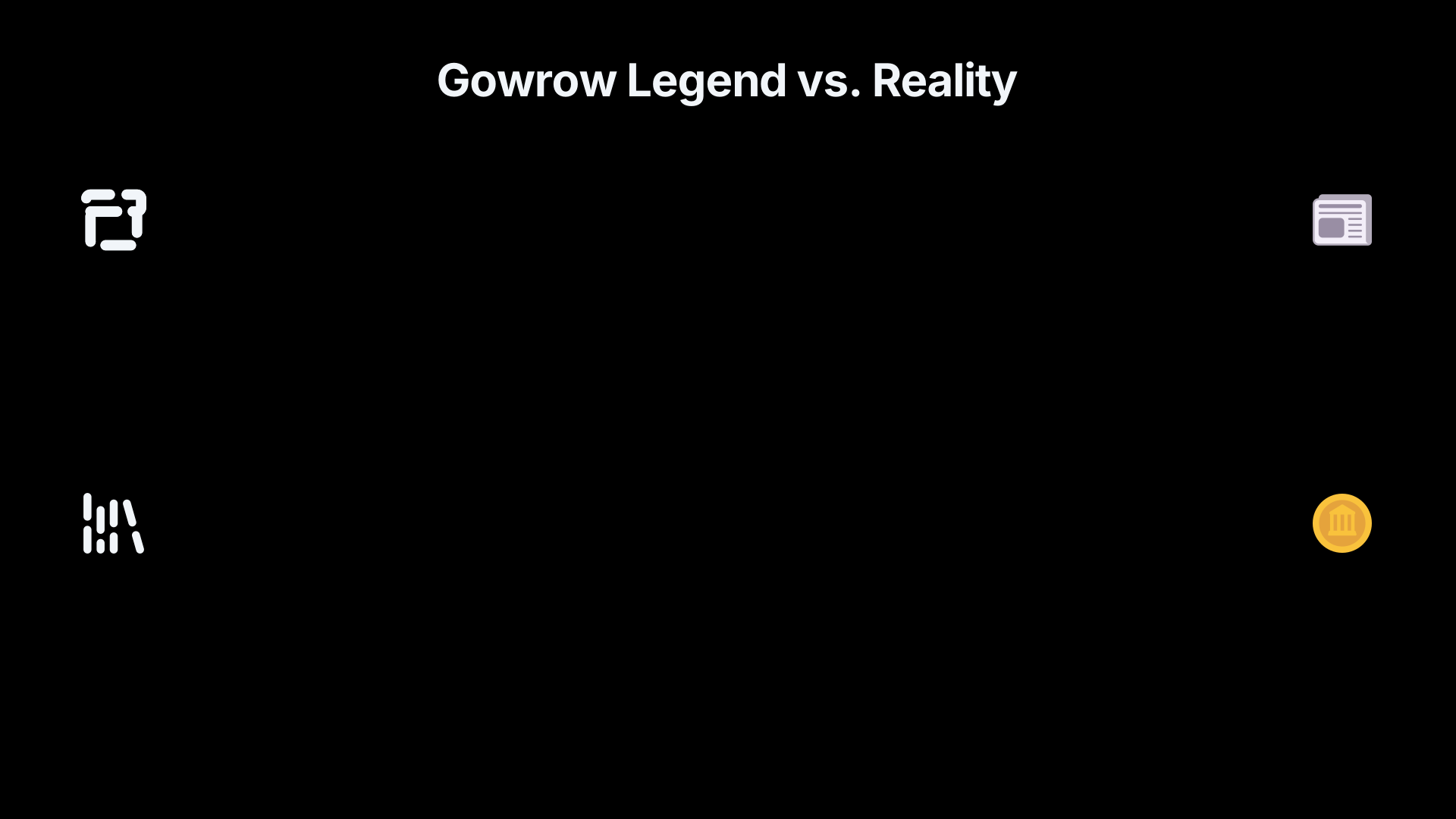
Descriptions vary, but the core gowrow image is fairly consistent: a large reptilian or dragon-like animal, around twenty feet long, with tusks, claws, webbed feet, a spined or horned back, green scales and a tail that could cut like a blade. The 1897 newspaper art leans heavily into this impossible mixture, making the creature look less like any known Arkansas animal and more like a assembled monster from several frightening parts.[bloximages.chicago2.vip.townnews.com]bloximages.chicago2.vip.townnews.comOpen source on townnews.com.
The ingredients are telling:
- Tusks give it a boar-like or prehistoric look.
- Webbed feet connect it to water, caves and lake emergence.
- Green scales make it reptilian.
- Back spines and a bladed tail push it towards dragon or dinosaur imagery.
- A roar that sounds like its name turns the creature into a campfire mnemonic: hear “gowrow”, say “gowrow”, remember “gowrow”.
The animal also behaves like several predators at once. It raids farms like a wolf or big cat, emerges from water like an alligator or river monster, lives in caves like a dragon, and fights hunters like a frontier bear. That patchwork quality weakens it as zoology but strengthens it as folklore. It can do whatever the story needs.
Some later popular accounts have tried to suggest possible misidentified animals, such as feral hogs, alligators or other large wildlife. Those explanations can account for fragments — tusks, night raids, water, fear — but not for the full twenty-foot, web-footed, spike-backed beast. The more cautious reading is that the gowrow is not a distorted report of one real animal; it is a tall-tale creature assembled from frontier anxieties, comic exaggeration and cave-country imagination.
How the gowrow differs from modern Arkansas cryptids
The gowrow often appears today on lists of Arkansas cryptids, but it does not work like the Fouke Monster or the White River Monster. Its evidence base is older, thinner and more literary. The main documented case is a sensational newspaper story later dismissed by the newspaper’s own editor; the later folklore material comes through Randolph’s collection of tall tales, not through a chain of fresh witness reports, photographs, tracks or official investigations.[Encyclopedia of Arkansas]encyclopediaofarkansas.netEncyclopedia of Arkansas GowrowEncyclopedia of Arkansas Gowrow
A useful way to separate the gowrow from modern cryptid traditions is to ask what kind of claim is being made:
QuestionGowrow traditionModern cryptid patternMain settingOzark caves, hollows, fissures and rural showman spacesRoads, rivers, swamps, lakes, farms, cabinsMain source typeNewspaper tall tale and folklore collectionRepeated eyewitness claims, local media, tourism, films or databasesBest readingFrontier humour and cave-country monster loreUnproven sighting tradition with possible misidentificationsPhysical evidenceVanished carcass, illustration, damaged ropes in storyTracks, photos, casts, reports, but often disputedToneExaggerated, comic, performativeOften presented more earnestly
This does not make the gowrow unimportant. It makes it important in a different way. It shows that Arkansas monster lore did not begin with modern cryptozoology. Before “cryptid” became a common label, Arkansas already had creatures that moved between newspaper entertainment, local jokes, cave fear and regional identity.
The gowrow also helps explain why Arkansas is such fertile monster ground. The state’s creature legends often attach to habitats that already feel ambiguous: swamp bottoms for hairy monsters, muddy rivers for serpentine beasts, wooded hills for howling animals, and karst caves for reptilian horrors. The gowrow is the cave-country version of that pattern.
Why the legend survived without good evidence
The gowrow survives because it is memorable, not because it is well evidenced. The name is strange. The drawing is vivid. The alleged monster is absurdly overdesigned. The body disappears. The editor calls it fake. Randolph then rescues it as folklore. Each stage adds another reason to retell it.
Its survival also reflects the pleasure of regional exaggeration. Arkansas and the wider Ozarks have long been represented in outside writing through rough roads, remote settlements, oversized animals, hard country and comic backwoods speech. Randolph’s collection shows how local storytellers could use those stereotypes actively, turning them into jokes, boasts and impossible beasts rather than simply being trapped by them.[dokumen.pub]dokumen.pubWe Always Lie to Strangers. Tall Tales from the Ozarks9780231899444 - DOKUMEN.PUB…
For a modern reader, the safest conclusion is that the gowrow is not a credible hidden species. There is no surviving specimen, no reliable biological trail, and no reason to accept a twenty-foot tusked cave reptile in nineteenth-century Arkansas on the basis of a sensational article and tall-tale afterlife. But as folklore, the story is rich. It tells us how a cave landscape becomes a monster landscape, how newspapers could manufacture wonder, and how Ozark humour made room for stories that were funniest when told almost straight.
The gowrow is therefore best remembered as Arkansas’s cave monster tall tale: not proof of a dragon in the Ozarks, but a sharp-clawed reminder that some monsters are built to be doubted, enjoyed and passed on.
Amazon book picks
Further Reading
Books and field guides related to Arkansas' Forgotten Cave Monster Tall Tale. Use these as the next step if you want deeper reading beyond the article.
The United States of Cryptids
Includes Arkansas legends alongside other regional cryptids.
Pissing in the Snow and Other Ozark Folktales
Captures the tall-tale tradition that produced monster stories like the gowrow.
Mysterious America
Helps readers compare the gowrow with other American monster traditions.
eBay marketplace picks
Marketplace Samples
Live-tested eBay searches with available results related to this page.


Endnotes
1.
Source: bloximages.chicago2.vip.townnews.com
Link:https://bloximages.chicago2.vip.townnews.com/lakeexpo.com/content/tncms/assets/v3/editorial/1/6f/16fbca16-b101-11ef-99b1-931dd5c23da0/674e3bd30bf24.pdf.pdf
2.
Source: dokumen.pub
Title: We Always Lie to Strangers. Tall Tales from the Ozarks
Link:https://dokumen.pub/we-always-lie-to-strangers-tall-tales-from-the-ozarks-9780231899444.html
Source snippet
9780231899444 - DOKUMEN.PUB...
3.
Source: newspapers.com
Link:https://www.newspapers.com/article/134385431/the-green-gowrow-original-report/
4.
Source: newspapers.com
Link:https://www.newspapers.com/newspage/132773418/
5.
Source: geology.arkansas.gov
Title: EWS 07
Link:https://geology.arkansas.gov/docs/pdf/publication/educational-workshops/EWS-07.pdf
6.
Source: dokumen.pub
Link:https://dokumen.pub/arkansas-in-ink-gunslingers-ghosts-and-other-graphic-tales-9781935106746-9781935106739.html
7.
Source: youtube.com
Link:https://www.youtube.com/watch?v=0EuW91z1nJc
Source snippet
The Gowrow...
8.
Source: youtube.com
Title: The Gowrow
Link:https://www.youtube.com/watch?v=-UCW4_9ko7I
Source snippet
Haunted Legends of Arkansas: Monsters, Murder and Mystery...
9.
Source: encyclopediaofarkansas.net
Title: Encyclopedia of Arkansas Gowrow
Link:https://encyclopediaofarkansas.net/entries/gowrow-5669/
10.
Source: encyclopediaofarkansas.net
Title: Encyclopedia of Arkansas Karst Topography
Link:https://encyclopediaofarkansas.net/entries/karst-topography-5969/
11.
Source: nps.gov
Title: National Park Service Cave / Karst Systems
Link:https://www.nps.gov/buff/learn/nature/cave.htm
12.
Source: ualrpublicradio.org
Title: encyclopedia of arkansas minute gowrow
Link:https://www.ualrpublicradio.org/2019-10-14/encyclopedia-of-arkansas-minute-gowrow
13.
Source: encyclopediaofarkansas.net
Link:https://encyclopediaofarkansas.net/media/gowrow-article-14157/
14.
Source: encyclopediaofarkansas.net
Title: searcy county 806
Link:https://encyclopediaofarkansas.net/entries/searcy-county-806/
15.
Source: encyclopediaofarkansas.net
Link:https://encyclopediaofarkansas.net/county/searcy/
16.
Source: itsmth.fandom.com
Link:https://itsmth.fandom.com/wiki/Gowrow
17.
Source: facebook.com
Link:https://www.facebook.com/arkansasheritage/photos/have-you-heard-of-the-gowrow-a-monster-of-arkansas-folklore-the-gowrow-was-said-/2070761946279696/
18.
Source: nps.gov
Title: Caves and Karst
Link:https://www.nps.gov/ozar/learn/nature/caves.htm
19.
Source: nps.gov
Title: Buffalo Caves and Karst
Link:https://www.nps.gov/teachers/classrooms/buffalo-caves-and-karst.htm
20.
Source: npgallery.nps.gov
Title: 64500030 text
Link:https://npgallery.nps.gov/NRHP/GetAsset/NRHP/64500030_text
21.
Source: nature.org
Link:https://www.nature.org/en-us/get-involved/how-to-help/places-we-protect/ozark-karst-program/
22.
Source: ualrpublicradio.org
Title: encyclopedia of arkansas minute snowball arkansas
Link:https://www.ualrpublicradio.org/2021-04-30/encyclopedia-of-arkansas-minute-snowball-arkansas
23.
Source: books.google.com
Title: We Always Lie to Strangers
Link:https://books.google.com/books/about/We_Always_Lie_to_Strangers.html?id=jqvYAAAAMAAJ
24.
Source: archeology.uark.edu
Title: calf creek
Link:https://archeology.uark.edu/ozarkbluffshelters/tag/calf-creek/
25.
Source: youtube.com
Title: The Gowrow
Link:https://www.youtube.com/watch?v=mPWMRfPzH3E
26.
Source: findingaids.loc.gov
Link:https://findingaids.loc.gov/agents/people/75345
27.
Source: thepioneerpostbhs.wordpress.com
Title: the gowrow
Link:https://thepioneerpostbhs.wordpress.com/2025/03/20/the-gowrow/
28.
Source: cals.org
Link:https://cals.org/research-tools/encyclopedia-of-arkansas/
29.
Source: onsc.us
Link:https://www.onsc.us/geology
30.
Source: arkansas-streets.openalfa.com
Title: searcy county
Link:https://arkansas-streets.openalfa.com/searcy-county
Additional References
31.
Source: recreation.gov
Link:https://www.recreation.gov/ticket/facility/233266
32.
Source: usgs.gov
Link:https://www.usgs.gov/data/sinkholes-and-springs-ozark-physiographic-province-northern-arkansas-topographic-maps
33.
Source: facebook.com
Link:https://www.facebook.com/kengerhard/posts/my-next-online-cryptozoology-class-will-be-ozark-cryptids-which-will-be-held-nex/10161782892856599/
34.
Source: instagram.com
Link:https://www.instagram.com/p/C9AdnGEt7lY/
35.
Source: vocal.media
Link:https://vocal.media/horror/a-quick-history-of-the-gowrow
36.
Source: facebook.com
Link:https://www.facebook.com/SearcyCountyArkansasChamberOfCommerce/posts/a-searcy-county-legend-the-gowrow/2063120987058275/
37.
Source: instagram.com
Link:https://www.instagram.com/reel/DABYJMGu9YA/
38.
Source: reddit.com
Link:https://www.reddit.com/r/Arkansas/comments/1lzksgf/arkansas_folklore_map/
39.
Source: unidescription.org
Link:https://unidescription.org/account/project/export/698
40.
Source: bullshoalscaverns.com
Link:https://bullshoalscaverns.com/
Topic Tree