Within Illinois Cryptids
Was the Piasa Bird Ever a Bird?
The Piasa story begins with Indigenous cliff art, then changes through French records, settler legend and Alton civic identity.
On this page
- Marquette's early description
- John Russell's man eating legend
- Alton's modern mural and memory
Page outline Jump by section
Introduction
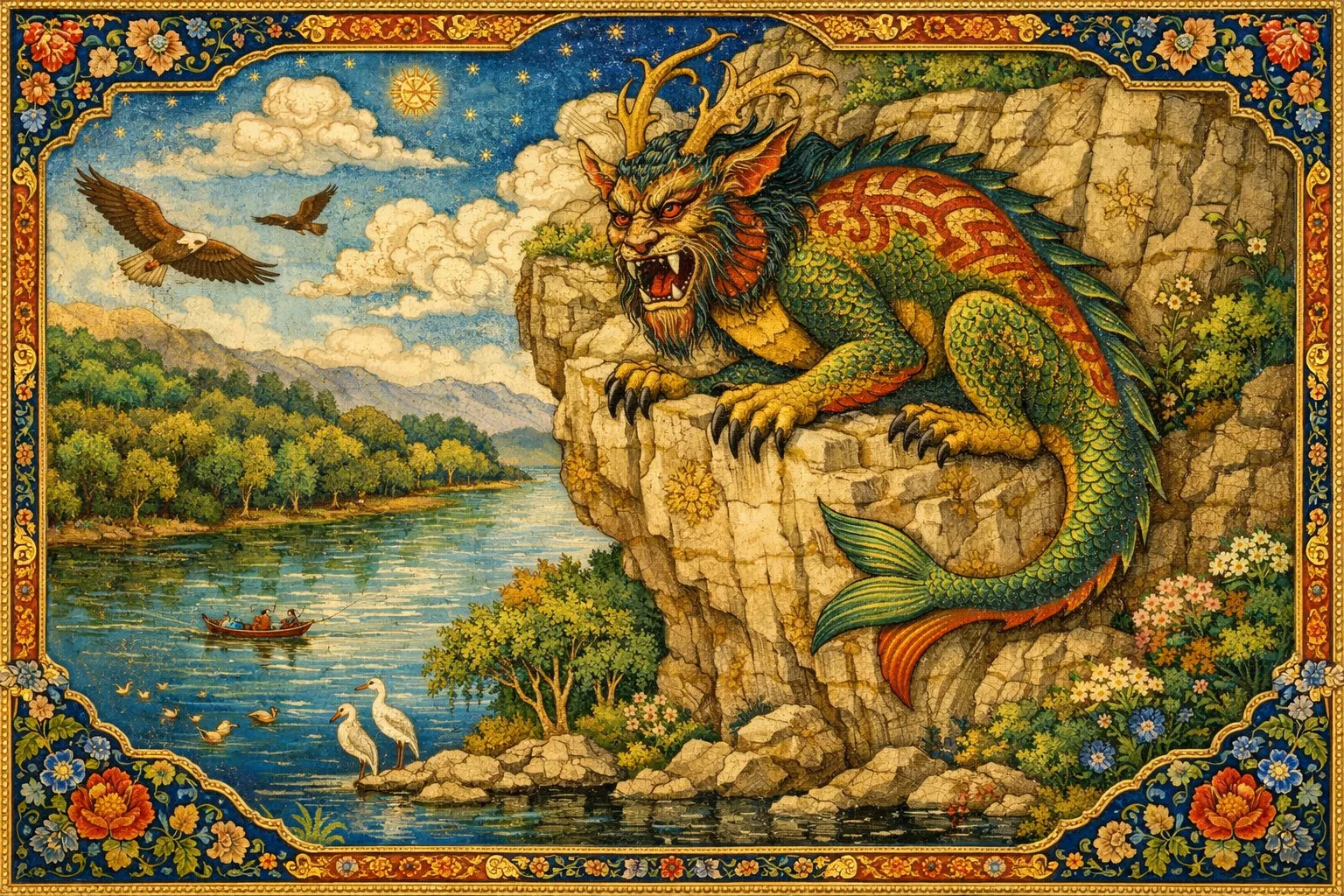
The Piasa Bird is usually introduced as a gigantic man-eating bird painted on the Mississippi bluffs at Alton, Illinois. The older evidence points to something stranger and more interesting: not a simple bird, and not a modern cryptid sighting, but an Indigenous rock-art image that French explorers recorded in 1673 and that later writers, artists and tourism promoters reshaped into Illinois’s most famous monster emblem. The familiar winged beast with antlers, claws and a taste for human victims is largely a nineteenth-century retelling, especially associated with John Russell’s “Bird That Devours Men” story. The earlier record describes two painted “monsters” with deer-like horns, red eyes, a human-like face, scales and a long fish-tail, but no clear wings.[illinois.edu]mythicmississippi.illinois.eduMythic Mississippi Piasa Bird | Mythic Mississippi ProjectMythic MississippiPiasa Bird | Mythic Mississippi Project - University of Illinois at Urbana-Champaign…
That difference matters because the Piasa sits at the crossing point between rock art, Indigenous cosmology, settler folklore and civic branding. For Illinois monster lore, it is not just “the old dragon on the cliff”. It is a case study in how a real image can survive as memory after the original stone is gone, while the story attached to it keeps changing.
Marquette’s early description
The historical starting point is the 1673 Mississippi journey of Jacques Marquette and Louis Jolliet. Near present-day Alton, Marquette recorded seeing two painted figures on a high limestone bluff. Modern summaries often call this the first European description of the Piasa, but Marquette’s account is not the same as the modern Piasa Bird legend. He described two painted monsters, not one bird, and his details are a composite of land, water and human features: calf-sized bodies, deer-like horns, red eyes, a tiger-like beard, a partly human face, scales, and a tail that wound around the body and ended like a fish’s tail.[RiverBender.com]riverbender.comRiver Bender.com100 Years Ago: Piasa Bird Painting Dedicated | River Bender.comRiver Bender.com100 Years Ago: Piasa Bird Painting Dedicated | River Bender.com
The University of Illinois’s Mythic Mississippi Project stresses a hard limit on what can be known with confidence: the first written description and two seventeenth-century French drawings are the core early evidence. The people who made the image left no written explanation of their own, so later interpretation has to come from archaeology, ethnohistory, comparative iconography and the location of the painting itself.[Mythic Mississippi]mythicmississippi.illinois.eduMythic Mississippi Piasa Bird | Mythic Mississippi ProjectMythic MississippiPiasa Bird | Mythic Mississippi Project - University of Illinois at Urbana-Champaign…
The location was not a decorative accident. The original image stood near the confluence zone of the Mississippi and Illinois rivers, an area associated with rapids, strong currents and danger. Dr Mark J. Wagner, whose interpretation is summarised by the Mythic Mississippi Project, connects this setting with Indigenous ideas about powerful beings linked to water, caves, springs and risky river passages. In that reading, the Piasa was not “evil” in the later monster-movie sense. It was dangerous because it carried spiritual power.[Mythic Mississippi]mythicmississippi.illinois.eduMythic Mississippi Piasa Bird | Mythic Mississippi ProjectMythic MississippiPiasa Bird | Mythic Mississippi Project - University of Illinois at Urbana-Champaign…
The physical art is also important. The original image was Indigenous and predated European arrival. The Mythic Mississippi Project states that quarrying destroyed the original bluff image in the nineteenth century, so no modern visitor is looking at the seventeenth-century painting itself. The present cliff figure at Alton is a memorialised and repainted successor, not a preserved original.[Mythic Mississippi]mythicmississippi.illinois.eduMythic Mississippi Piasa Bird | Mythic Mississippi ProjectMythic MississippiPiasa Bird | Mythic Mississippi Project - University of Illinois at Urbana-Champaign…

Was the Piasa ever a bird?
The most useful answer is: not at first, at least not in the way the modern name suggests. Marquette’s description is closer to a composite spirit being than a natural bird. The long fish-like tail points towards water or the underworld; the antlers and panther-like body point towards land; later winged versions pull the creature into the sky. That layered form fits the interpretation that the Piasa combined elements from multiple worlds in an Indigenous cosmos, rather than representing a zoological animal.[Mythic Mississippi]mythicmississippi.illinois.eduMythic Mississippi Piasa Bird | Mythic Mississippi ProjectMythic MississippiPiasa Bird | Mythic Mississippi Project - University of Illinois at Urbana-Champaign…
The Illinois State Museum’s educational material identifies the rock paintings seen by Marquette as depictions of the Piasa, a supernatural creature associated with the Lower World. That does not mean every later claim about the Piasa is Indigenous tradition. It means the early rock art likely belonged to a symbolic world in which powerful beings could be composite, dangerous and tied to particular landscapes.[Illinois State Museum]museum.state.il.usOpen source on il.us.
This is where the Piasa becomes especially relevant to cryptid history. Many American monster stories begin with alleged sightings: someone sees a hairy figure, a lake creature or a winged shape. The Piasa is different. Its earliest evidence is not a witness report of a living animal but a record of rock art. Later writers treated the painted being as if it were the record of an actual monster, but the strongest evidence points first to a sacred or symbolic image. The “bird” label is therefore part of the legend’s later life, not a secure description of the original figure.
That also explains why the modern mural can look more like a dragon, chimera or heraldic monster than Marquette’s description. The Piasa that drivers see from the Great River Road is the product of centuries of reimagining. It is based on memory, copies, artistic reconstructions and local tradition, not on a surviving original surface.
John Russell’s man-eating legend
The story most people remember comes from John Russell, a former professor connected with Shurtleff College in Upper Alton. In 1836, Russell published a version that called the creature the Piasa Bird and explained the name as meaning “the bird which devours men”. In his tale, the creature lived in the cliffs, carried off people, destroyed villages and was finally killed when Chief Ouatoga used himself as bait while hidden warriors fired poisoned arrows.[Illinois State Museum]museum.state.il.uslinois State Museum8. THE PIASA BIRDlinois State Museum8. THE PIASA BIRD…
It is a vivid story, which is why it survived. It gives the painting a plot: terror, sacrifice, battle and commemoration. It also turns an ambiguous Indigenous image into a frontier legend that nineteenth-century readers could easily understand. A monster threatens a community; a heroic leader defeats it; the image on the cliff becomes a trophy or memorial. That is good storytelling, but it is not the same thing as reliable Indigenous testimony.
William McAdams’s 1887 book, Records of Ancient Races in the Mississippi Valley, is useful because it preserves Russell’s story while also undercutting it. McAdams wrote that he contacted Russell after the tale had circulated and that Russell admitted there was only a “somewhat similar” tradition and that the story had been “somewhat illustrated”. McAdams concluded that, as tradition, the Piasa story had little ethnological value.[Wikimedia Commons]upload.wikimedia.orgOpen source on wikimedia.org.
That does not make Russell irrelevant. Quite the opposite: he is central to the Piasa’s modern afterlife. His tale gave Alton a monster narrative that could be repeated in books, newspapers, postcards, plaques, school identity and roadside tourism. The issue is not whether Russell invented everything from nothing, but how much his literary version rearranged older material into a dramatic man-eating-bird legend.
The rock art behind the legend
The original Piasa belonged to a broader Indigenous rock-art landscape along the Mississippi bluffs. McAdams described carved and painted figures along the rivers of the Mississippi Valley and treated the Alton Piasa as one of the best-known old pictographs. He also noted that there were several pictographs in the vicinity, which may help explain why early descriptions and later sketches do not always agree neatly.[Wikimedia Commons]upload.wikimedia.orgOpen source on wikimedia.org.
The Mythic Mississippi interpretation places the Piasa plausibly in the Mississippian period, roughly AD 1000–1500, though that is an informed interpretation rather than a direct date from the destroyed painting. The reasoning is that Mississippian-period peoples used powerful composite beings in art and belief, and natural pigments such as iron oxides can survive for long periods even as they fade.[Mythic Mississippi]mythicmississippi.illinois.eduMythic Mississippi Piasa Bird | Mythic Mississippi ProjectMythic MississippiPiasa Bird | Mythic Mississippi Project - University of Illinois at Urbana-Champaign…
One common modern comparison is the “underwater panther”, a widespread Indigenous figure in parts of North America. This does not mean the Alton Piasa can be reduced to one simple label, but it helps explain why the early image had antlers, a powerful animal body, scales and a fish-like tail. For a mainstream reader, the key point is that these mixed features are not random monster decoration. They are exactly the kind of symbolic combination one might expect in a being associated with dangerous water, the underworld and spiritual power.[RiverBender.com]riverbender.comRiver Bender.com100 Years Ago: Piasa Bird Painting Dedicated | River Bender.comRiver Bender.com100 Years Ago: Piasa Bird Painting Dedicated | River Bender.com
The rock-art context also changes how the “evidence” should be read. The Piasa is not evidence that a giant bird once lived in Illinois. It is evidence that Indigenous artists made a striking image on a prominent cliff, that French observers found it memorable, and that later communities struggled to explain it after its original cultural setting had been disrupted, translated and partly lost.
How the image changed after the original disappeared
The original Piasa did not survive the nineteenth century. The University of Illinois account says quarrying destroyed the bluff image in the 1850s; local historical treatments also describe quarrying and later road work as major forces in the loss and relocation of Piasa imagery.[illinois.edu]mythicmississippi.illinois.eduMythic Mississippi Piasa Bird | Mythic Mississippi ProjectMythic MississippiPiasa Bird | Mythic Mississippi Project - University of Illinois at Urbana-Champaign…
Once the original was gone, copies and reconstructions became the story. The Illinois State Museum notes that the image entered nineteenth-century visual culture through works such as John Casper Wild’s 1841 lithograph and Henry Lewis’s 1846–47 sketch, while Rudolf Friedrich Kurz described the pictograph in 1847 as a “colossal eagle”. By then, the bird idea was already gaining ground, even though it sat uneasily beside Marquette’s fish-tailed monster.[Illinois State Museum]museum.state.il.uslinois State Museum8. THE PIASA BIRDlinois State Museum8. THE PIASA BIRD…
The twentieth century turned the Piasa into a civic landmark. RiverBender’s centennial account of the 1924 dedication shows how local newspapers and civic groups revived the image as a public symbol. The Alton Telegraph has also reported that the mural has taken many forms, with local artists restoring versions over the years, and that one earlier cliff painting was blasted away when the River Road was extended in 1961.[RiverBender.com]riverbender.comRiver Bender.com100 Years Ago: Piasa Bird Painting Dedicated | River Bender.comRiver Bender.com100 Years Ago: Piasa Bird Painting Dedicated | River Bender.com
Today’s tourism-facing description is open about the layered nature of the legend. Great Rivers & Routes presents the Piasa Bird as a local Alton legend while acknowledging that the familiar myth was probably created or elaborated in the Victorian era from older cliff paintings. It also notes that the current Piasa was repainted on the cliff in the 1990s and has become a regional symbol, appearing in school identity, local names and visitor culture.[Great Rivers & Routes]riversandroutes.comGreat Rivers & Routes Piasa Bird | Great Rivers & RoutesGreat Rivers & Routes Piasa Bird | Great Rivers & Routes
Alton’s modern mural and memory
For modern Illinois, the Piasa works because it is both ancient and newly made. The present mural gives visitors a dramatic roadside creature, but its power comes from the claim that something once stood there before French exploration, before Illinois statehood and before Alton’s industrial riverfront. The result is not a simple survival of Indigenous tradition; it is a layered public memory.
That layering can be seen in three versions of the Piasa that now coexist:
The Indigenous image was a pre-contact or early-contact rock painting seen by Marquette and Jolliet, probably connected with powerful spirit-being traditions and the dangerous river landscape near Alton.[Mythic Mississippi]mythicmississippi.illinois.eduMythic Mississippi Piasa Bird | Mythic Mississippi ProjectMythic MississippiPiasa Bird | Mythic Mississippi Project - University of Illinois at Urbana-Champaign…
The settler legend was Russell’s man-eating bird story, with Chief Ouatoga, poisoned arrows and the creature’s death in the Mississippi. This is the version that made the Piasa easy to retell as a monster legend, but it is also the version most clearly marked by literary invention.[Illinois State Museum]museum.state.il.uslinois State Museum8. THE PIASA BIRDlinois State Museum8. THE PIASA BIRD…
The civic emblem is the modern cliff mural and regional mascot: a colourful dragon-bird watching the Great River Road, tied to Alton’s identity, tourism and local pride.[Great Rivers & Routes]riversandroutes.comGreat Rivers & Routes Piasa Bird | Great Rivers & RoutesGreat Rivers & Routes Piasa Bird | Great Rivers & Routes
This is why the Piasa deserves careful treatment in Illinois cryptid lore. It is tempting to rank monster stories by whether they might be “real”. The Piasa asks a better question: real in what sense? The original rock art was real. The early French encounter was real as a historical record. The man-eating bird story is much less secure as Indigenous tradition. The current mural is real as public art and local identity. The living monster, however, has no mainstream evidence behind it.
What the Piasa tells us about Illinois monster lore
The Piasa Bird is Illinois’s most famous old monster image because it gives the state a dramatic origin point for creature folklore: a cliff, a river, a frightening painted being and centuries of retelling. Yet the most responsible reading makes it more complicated than a “giant bird” case. The earliest source describes painted monsters without the full modern bird form. The strongest modern scholarship treats the image as Indigenous rock art tied to powerful spiritual symbolism and dangerous river geography. The famous devourer-of-men narrative belongs mainly to nineteenth-century settler storytelling.[riverbender.com]riverbender.comRiver Bender.com100 Years Ago: Piasa Bird Painting Dedicated | River Bender.comRiver Bender.com100 Years Ago: Piasa Bird Painting Dedicated | River Bender.com
That complexity is the point. Illinois cryptid history is not only about possible animals hiding in woods, swamps or skies. It is also about how places inherit images, rename them, repaint them and turn them into monsters that later generations can recognise. At Alton, the Piasa began as a powerful painted presence on the bluff. It became a bird through retelling. It became a civic icon through loss, restoration and repetition. The creature on the wall today is therefore not just a monster; it is a record of how Illinois remembers.
Amazon book picks
Further Reading
Books and field guides related to Was the Piasa Bird Ever a Bird?. Use these as the next step if you want deeper reading beyond the article.
Mysterious America
Useful broader context for legendary creatures and regional traditions.
Legends and Lore of Illinois
Provides historical and cultural context for Illinois legends.
eBay marketplace picks
Marketplace Samples
Live-tested eBay searches with available results related to this page.


Endnotes
1.
Source: mythicmississippi.illinois.edu
Title: Mythic Mississippi Piasa Bird | Mythic Mississippi Project
Link:https://mythicmississippi.illinois.edu/native-illinois/piasa-bird/
Source snippet
Mythic MississippiPiasa Bird | Mythic Mississippi Project - University of Illinois at Urbana-Champaign...
2.
Source: riverbender.com
Title: River Bender.com100 Years Ago: Piasa Bird Painting Dedicated | River Bender.com
Link:https://www.riverbender.com/news/details/100-years-ago-piasa-bird-painting-dedicated-76420.cfm
3.
Source: upload.wikimedia.org
Link:https://upload.wikimedia.org/wikipedia/commons/7/7e/Cornell_University_Library_digitization_%28IA_cu31924104070804%29.pdf
4.
Source: piasa.fr
Link:https://www.piasa.fr/en
5.
Source: isas.illinois.edu
Link:https://www.isas.illinois.edu/UserFiles/Servers/Server_260627/File/pdfs/Staff_CVs/desareyvitae.pdf
6.
Source: dnr.illinois.gov
Link:https://dnr.illinois.gov/parks/about/park.peremarquette.html
7.
Source: commons.wikimedia.org
Title: File:Jean Baptiste Louis Franquelin Map of Northernmost America 1688.jpg
Link:https://commons.wikimedia.org/wiki/File%3AJean_Baptiste_Louis_Franquelin_-Map_of_Northernmost_America-_1688.jpg
8.
Source: youtube.com
Title: The Legend of the Piasa Bird | Explore the River Bend (Alton, Illinois Folklore)
Link:https://www.youtube.com/watch?v=jS88wU9XxLc
Source snippet
Piasa - American FolkLore...
9.
Source: youtube.com
Link:https://www.youtube.com/watch?v=KJ29kJow760
Source snippet
Bird | A Vision of Stone | Peaceful Native American Tale...
10.
Source: youtube.com
Title: Piasa Bird | A Vision of Stone | Peaceful Native American Tale
Link:https://www.youtube.com/watch?v=S7Zya45OzHg
11.
Source: museum.state.il.us
Title: linois State Museum8. THE PIASA BIRD
Link:https://www.museum.state.il.us/RiverWeb/landings/Ambot/Archives/vignettes/culture/Piasa_20Bird.html
Source snippet
linois State Museum8. THE PIASA BIRD...
12.
Source: museum.state.il.us
Link:https://www.museum.state.il.us/muslink/nat_amer/post/htmls/be_piasa.html
13.
Source: thetelegraph.com
Title: The Telegraph Piasa Bird mural in Alton restored by local artists over years
Link:https://www.thetelegraph.com/news/article/piasa-bird-mural-alton-history-illinois-20035675.php
14.
Source: riversandroutes.com
Title: Great Rivers & Routes Piasa Bird | Great Rivers & Routes
Link:https://www.riversandroutes.com/directory/piasa-bird/
15.
Source: Wikipedia
Link:https://en.wikipedia.org/wiki/Piasa
16.
Source: facebook.com
Link:https://www.facebook.com/groups/707233279324256/posts/1625564020824506/
17.
Source: facebook.com
Link:https://www.facebook.com/groups/487042914784182/posts/1826248270863633/
18.
Source: cryptidz.fandom.com
Title: Piasa Bird
Link:https://cryptidz.fandom.com/wiki/Piasa_Bird
19.
Source: showmehistorystl.com
Title: The Piasa Bird
Link:https://www.showmehistorystl.com/episodes/the-piasa-bird/
20.
Source: madison.illinoisgenweb.org
Title: piasa bird
Link:https://madison.illinoisgenweb.org/native_american/piasa_bird.html
21.
Source: ztevetevans.wordpress.com
Title: underwater panther
Link:https://ztevetevans.wordpress.com/tag/underwater-panther/
22.
Source: theclio.com
Title: Piasa Bird
Link:https://theclio.com/entry/159413
23.
Source: thetelegraph.com
Title: paint marquette jolliet saw bluffs 18187931
Link:https://www.thetelegraph.com/opinion/article/paint-marquette-jolliet-saw-bluffs-18187931.php
24.
Source: liveauctioneers.com
Link:https://www.liveauctioneers.com/auctioneer/7065/piasa/?srsltid=AfmBOoqotZYoNNSK8qoSNsbegbODy-yBjwXOGcMQUOJQvENDRBCnwA9H
25.
Source: genesisapologetics.com
Link:https://genesisapologetics.com/piasa/
Additional References
26.
Source: instagram.com
Link:https://www.instagram.com/p/C2e3St2uSIz/
27.
Source: archive.org
Link:https://archive.org/download/historyofsouther01smit/historyofsouther01smit.pdf
28.
Source: facebook.com
Link:https://www.facebook.com/groups/522520461119490/posts/7343350675703067/
29.
Source: facebook.com
Link:https://www.facebook.com/groups/44555226446/posts/10162430075196447/
30.
Source: facebook.com
Link:https://www.facebook.com/groups/IllinoisArchaeologicalSurvey/posts/1947222838792913/
31.
Source: archive.org
Link:https://archive.org/stream/centennialhistor01nort/centennialhistor01nort_djvu.txt
32.
Source: archive.org
Link:https://archive.org/download/historicalencycl001inbate/historicalencycl001inbate.pdf
33.
Source: archive.org
Link:https://archive.org/download/cu31924028805948/cu31924028805948.pdf
34.
Source: facebook.com
Link:https://www.facebook.com/IllinoisDNR/posts/cahokia-mounds-world-heritage-site-in-collinsville-will-host-their-winter-lectur/1295860719230813/
35.
Source: archive.org
Link:https://archive.org/download/indianalinc_6/indianalinc_6.pdf
Topic Tree