Within South Dakota Monsters
When Bigfoot Became South Dakota News
The McLaughlin and Little Eagle reports show how tracks, rumours, newspapers, and local attention can turn a creature claim into folklore.
On this page
- The Mc Laughlin and Little Eagle reports
- How newspapers amplified the story
- What evidence survived the publicity
Page outline Jump by section
Introduction
The McLaughlin Bigfoot flap was a short, noisy burst of creature reports centred on Little Eagle and McLaughlin in Corson County, South Dakota, during 1977, with a later revival of attention in 1997. Its importance is not that it proved Bigfoot existed. It did not. Its importance is that it shows, unusually clearly, how a local cluster of tracks, night sightings, rumours, newspaper coverage, horseback searches, law-enforcement interest and outside curiosity can turn an uncertain animal story into state folklore.
The remembered creature was described in familiar Bigfoot terms: seven or eight feet tall, hairy, long-armed, foul-smelling, and leaving oversized tracks. The strongest surviving material is newspaper-based: Associated Press copy, the Sioux Falls Argus Leader, the McLaughlin Messenger, later local retrospectives, and summaries of Mark A. Hall’s 1978 article on South Dakota “Taku He” or Bigfoot reports. The evidence that survives is vivid but thin: claimed sightings, reported tracks, at least one plaster cast reference, and a great deal of publicity.[uoregon.edu]oregonnews.uoregon.eduseq 21seq 21
The McLaughlin and Little Eagle reports
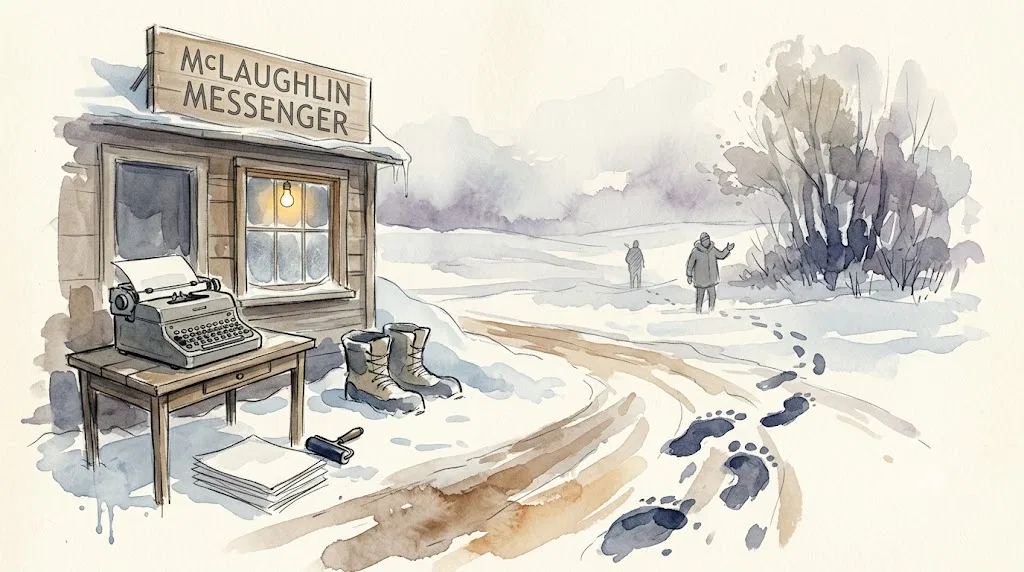
The flap belonged to the South Dakota side of the Standing Rock country. The Bureau of Indian Affairs describes the Standing Rock Sioux Indian Reservation as straddling North and South Dakota and encompassing all of Corson County, with additional parcels in South Dakota; the Standing Rock Sioux Tribe itself describes the reservation as 2.3 million acres of prairie plains, rolling hills and buttes along the Missouri River.[Indian Affairs]bia.govIndian Affairs Standing Rock Agency | Indian AffairsIndian Affairs Standing Rock Agency | Indian Affairs That setting matters because the 1977 story was not a deep-forest Pacific Northwest tale transplanted unchanged. It was a plains-and-river-bottom story, clustered around Little Eagle, McLaughlin, the Grand River area, cattle country, yards, roads and small communities where a rumour could move quickly.
The most useful contemporary snapshot is a 30 September 1977 Associated Press item, preserved in the Oregon Daily Emerald, under the headline “Bigfoot ‘sitings’ spur search in South Dakota”. It reported that residents of north-central South Dakota were searching for a creature resembling Bigfoot after numerous sightings in the Little Eagle and McLaughlin areas. The most recent sighting, according to the article, had occurred near Little Eagle when people drove into a yard and saw the figure in their headlights near penned pigs and chickens.[oregonnews.uoregon.edu]oregonnews.uoregon.eduseq 21seq 21
That article also gives the basic physical template that would stick to the McLaughlin story: tracks said to be 16 to 18 inches long and eight inches wide, with a six-to-eight-foot stride, and a creature described as seven to eight feet tall, very hairy, long-armed and offensive-smelling. Art Eifenbraun of the McLaughlin Messenger told the AP that most of the half-dozen reported sightings had occurred at night.[oregonnews.uoregon.edu]oregonnews.uoregon.eduseq 21seq 21
The Little Eagle Trading Post became part of the story because its owner, Gary Alexander, was quoted as one of the local men who had searched on horseback. He said tracks had been found five and a half miles east of Little Eagle in a remote place, with no human footprints around. In the best-known detail from the flap, he compared one print with the mark made by a man in a size 13 boot who weighed about 240 pounds: the man “hardly made an imprint”, while the alleged creature’s tracks were said to sink about two and a half inches deep.[oregonnews.uoregon.edu]oregonnews.uoregon.eduseq 21seq 21
The same AP report is useful because it also shows restraint amid the excitement. A Corson County sheriff’s office spokesman said the office was not making an official investigation, even though reports had come in about the creature being seen killing cattle and roaming near Little Eagle. Eifenbraun also knocked down a rumour that a man had suffered a heart attack after being surprised by the animal, and said there was no proof behind stories of animals being found killed.[oregonnews.uoregon.edu]oregonnews.uoregon.eduseq 21seq 21
That mix — frightening claims, dramatic tracks, local searches, and immediate rumour-control — is the real shape of the McLaughlin flap. It was never simply “people saw Bigfoot”. It was a fast-moving community event in which each retelling had to sort possible witness testimony from hearsay.

Why Corson County became the centre of the story
Little Eagle was the emotional centre of the 1977 wave, while McLaughlin became the media handle. That is partly because McLaughlin had the newspaper infrastructure. The South Dakota Department of Tribal Relations lists the Standing Rock Reservation in Corson County and notes McLaughlin-area newspapers as part of the reservation’s media landscape; later accounts repeatedly identify the McLaughlin Messenger as a key local paper in shaping the public story.[sdtribalrelations.sd.gov]sdtribalrelations.sd.govStanding Rock Sioux Tribe.aspxStanding Rock Sioux Tribe | South Dakota Department of Tribal Relations…
The Bigfoot Field Researchers Organization’s Corson County page is not proof of the creature, but it is a useful index of how the flap entered Bigfoot archives. Its media-article list for Corson County includes several contemporary pieces: “Sasquatch Getting Much Publicity” in the McLaughlin Messenger on 6 October 1977, “McLaughlin Monster Apparently in Hiding” in the Sioux Falls Argus-Leader on 16 October 1977, “Monster Publicity Floods Little Eagle” in the Argus-Leader on 17 October 1977, and “Two Bigfoots Sighted Near Little Eagle” in the McLaughlin Messenger on 3 November 1977.[BFRO]bfro.netCorson County, South Dakota – Reports & ArticlesCorson County, South Dakota – Reports & Articles
That article list tells a small chronology. First came sightings and tracks; then publicity about Sasquatch; then the “McLaughlin Monster” label; then a wave of attention so noticeable that the press itself became part of the story. By early November, the reports had multiplied enough for the headline to speak of “two Bigfoots” near Little Eagle.[BFRO]bfro.netCorson County, South Dakota – Reports & ArticlesCorson County, South Dakota – Reports & Articles
Sitting Bull College’s 2019 note on “The Bigfoot Excitement of 1977” treats the episode as especially famous on Standing Rock and says the best-known spate involved 28 sightings, mostly around Little Eagle. It also points to Mark A. Hall’s 1978 article, “Contemporary Stories of Taku He or Bigfoot in South Dakota as Drawn from Newspaper Accounts”, as the most complete recounting available to the library.[sittingbullcollege.wixsite.com]sittingbullcollege.wixsite.comthe bigfoot excitement of 1977the bigfoot excitement of 1977
Cryptozoologist Loren Coleman’s later summary, drawing on Hall and other Bigfoot literature, describes the Little Eagle events as “at least 25” Taku-He sightings over about three months, continuing until 5 December 1977. Coleman’s account should be read as specialist cryptozoology commentary rather than official confirmation, but it preserves names and patterns that match the newspaper-based memory of the flap: reports by local residents, some police officers, cattle-pasture sightings, and repeated attention to Little Eagle.[Cryptomundo]cryptomundo.com» Taku-He and Cows in South Dakota» Taku-He and Cows in South Dakota
How newspapers amplified the story
The McLaughlin flap became famous because it passed through several media layers. Local people told one another. The McLaughlin Messenger wrote about it. The Sioux Falls Argus Leader picked it up. Associated Press copy carried it far enough that an Oregon student newspaper could print a South Dakota Bigfoot item. National magazines such as Time and Newsweek were later said to have covered the Little Eagle flap, according to Coleman’s retrospective summary.[oregonnews.uoregon.edu]oregonnews.uoregon.eduseq 21seq 21
The South Dakota Magazine retrospective is especially revealing about the 1997 revival. It says South Dakota’s most publicised Bigfoot “brouhaha” came in the late 1990s, when Merle Lofgren, editor of the weekly McLaughlin Messenger, wrote about strange reports in Corson County. Lofgren’s column, “From the Top of the Hill”, became a running commentary on how a rural community reacted to a worldwide mystery.[South Dakota Magazine]southdakotamagazine.comSouth Dakota Magazine Keystone's BigfootSouth Dakota Magazine Keystone's Bigfoot
That is a crucial clue to the media frenzy. Lofgren was not just recording sightings as a police blotter might. He was turning the town’s reaction into readable local journalism. The result was a story with two subjects: the alleged creature, and the people responding to the alleged creature.
The Argus Leader response shows how a small-town rumour could become a statewide news event. According to South Dakota Magazine, publisher Larry Fuller chartered a plane in September 1997 and sent a team of photographers and writers, including veteran reporter Tom Hasner, to investigate the McLaughlin-area reports. Fuller reportedly said they were uncertain what was happening, but believed there was enough evidence of a “monster-like creature” to justify further investigation.[South Dakota Magazine]southdakotamagazine.comSouth Dakota Magazine Keystone's BigfootSouth Dakota Magazine Keystone's Bigfoot
Hasner’s reporting repeated the same basic pattern from 1977: most sightings after dark, descriptions of a seven-to-eight-foot hairy figure with long arms and a bad smell, and tracks east of Little Eagle that locals considered too deep and large for ordinary explanation.[South Dakota Magazine]southdakotamagazine.comSouth Dakota Magazine Keystone's BigfootSouth Dakota Magazine Keystone's Bigfoot The 1997 revival therefore did not create a new legend from scratch. It reactivated an older Corson County script: Little Eagle tracks, McLaughlin headlines, community curiosity, and a creature always just out of reach.
What evidence survived the publicity
The McLaughlin flap left behind three main kinds of evidence: testimony, track claims and media records. None proves a hidden giant primate in South Dakota. Together, however, they explain why the case survived as folklore.
The testimony is mostly second-hand through newspapers. The AP account gives named local voices, including Ralph Taken Alive and Gary Alexander, but it still filters the event through reporters and local intermediaries. It records what people said they saw, not what was independently verified.[oregonnews.uoregon.edu]oregonnews.uoregon.eduseq 21seq 21
The track evidence is the most concrete-sounding part of the story, but also the most frustrating. Reported dimensions of 16 to 18 inches long, eight inches wide, and impressions around two and a half inches deep sound dramatic, especially when paired with the size-13-boot comparison. Yet the public record does not provide a chain of custody, expert track analysis, clear photographs, or physical casts available for independent examination.[oregonnews.uoregon.edu]oregonnews.uoregon.eduseq 21seq 21
One odd afterlife of the evidence appears in a 21 December 1977 Department of the Interior and Fish and Wildlife Service news release asking what the government would do if Bigfoot or the Loch Ness Monster were found. The release stated that a Bureau of Indian Affairs policeman had 18-inch plaster-cast footprints of the “McLaughlin monster”, a Bigfoot-type creature he said he had seen the previous month in South Dakota. The same document then quoted Fish and Wildlife Service official Keith Schreiner saying emergency protections could be used if Bigfoot were really found, while adding that he seriously doubted such a creature existed.[North American Wood Ape Conservancy]woodape.orgOpen source on woodape.org.
That federal mention is often overplayed in modern Bigfoot circles. It does not mean the government confirmed Bigfoot. It means the McLaughlin story had become visible enough, by late 1977, to be folded into a semi-playful official discussion about how endangered-species law might handle a legendary animal if one were ever proven real. The same release explicitly said no remains, zoo specimens or museum specimens of such legendary monsters existed, and that many sightings were likely exaggerated, misinterpreted or hoaxed.[North American Wood Ape Conservancy]woodape.orgOpen source on woodape.org.
What probably fuelled the frenzy
The safest explanation is not a single debunking answer. The McLaughlin flap looks like a cluster of ambiguous events amplified by community attention and newspapers. Several forces were probably working at once.
First, night sightings are fragile evidence. Both the 1977 AP report and the 1997 retrospective stress that most sightings happened after dark. Darkness, headlights, distance, fear, livestock noise, dogs, weather and uneven ground can all turn partial impressions into confident memories.[oregonnews.uoregon.edu]oregonnews.uoregon.eduseq 21seq 21
Second, tracks can mislead. Large prints in mud, snow or soft ground can distort, overlap, melt, collapse at the edges, or be enlarged by repeated freezing and thawing. That does not mean every track claim was a hoax. It means tracks without controlled documentation rarely settle a case.
Third, the creature description was already culturally available. By 1977, Bigfoot had become a national media figure associated with the Pacific Northwest: hairy, huge, long-armed, foul-smelling and elusive. The AP article explicitly compared the South Dakota creature to that wider Bigfoot image.[oregonnews.uoregon.edu]oregonnews.uoregon.eduseq 21seq 21 Once a few people in Corson County used that template, later sightings could easily be interpreted through it.
Fourth, the Standing Rock setting added a local layer. Sitting Bull College’s note and Hall-related summaries connect the 1977 wave with “Taku He” or Bigfoot stories in South Dakota.[sittingbullcollege.wixsite.com]sittingbullcollege.wixsite.comthe bigfoot excitement of 1977the bigfoot excitement of 1977 That does not mean every Indigenous tradition should be collapsed into modern Sasquatch lore. It means that when the national Bigfoot story entered Standing Rock country, it encountered existing local language, memory and storytelling patterns rather than an empty stage.
Finally, the press did not merely observe the flap; it helped shape it. A headline such as “Monster Publicity Floods Little Eagle” shows the point at which publicity itself became part of the event.[BFRO]bfro.netCorson County, South Dakota – Reports & ArticlesCorson County, South Dakota – Reports & Articles People were not only asking, “What did someone see?” They were asking, “Why is everyone suddenly coming here to look?”
The changing story around Mc Laughlin Flap
In 1977, the McLaughlin-Little Eagle story was immediate and anxious: sightings, armed or mounted searches, rumours about livestock, and questions about whether anyone might get hurt. The AP story’s reassurance that no one had been harmed, and that some dramatic rumours lacked proof, shows a community trying to manage fear while the story was still unfolding.[oregonnews.uoregon.edu]oregonnews.uoregon.eduseq 21seq 21
By 1997, the story had become partly nostalgic and partly investigative. The same elements were still present — darkness, bad smell, long arms, deep tracks east of Little Eagle — but the coverage had an extra layer of self-awareness. Merle Lofgren’s column and the Argus Leader plane trip turned the flap into a story about journalism, rural humour and the survival of a local mystery.[South Dakota Magazine]southdakotamagazine.comSouth Dakota Magazine Keystone's BigfootSouth Dakota Magazine Keystone's Bigfoot
By the 2000s and 2010s, the episode had become a reference point in Bigfoot catalogues and Standing Rock memory. BFRO preserved a list of media articles. Sitting Bull College identified the 1977 episode as the best-known Bigfoot moment on Standing Rock. Cryptozoology writers folded it into broader “Taku-He” timelines.[bfro.net]bfro.netCorson County, South Dakota – Reports & ArticlesCorson County, South Dakota – Reports & Articles
That evolution is why the McLaughlin flap still matters within South Dakota monster lore. It is not just a claim about a hairy creature. It is a case study in how folklore forms: a few reported encounters, a landscape that gives them a place, local newspapers that give them a voice, outside media that give them scale, and later writers who give them a name.
Why this is South Dakota’s clearest Bigfoot news story
South Dakota has other Bigfoot-style reports, especially in the Black Hills, but the McLaughlin flap stands apart because it became public news in a concentrated time window. It had a cluster of named places, a run of dated newspaper articles, local witnesses, reported tracks, an official-adjacent law-enforcement thread, and later institutional memory through Sitting Bull College and Bigfoot archives.[BFRO]bfro.netCorson County, South Dakota – Reports & ArticlesCorson County, South Dakota – Reports & Articles
It also avoids the neatness of tourist folklore. This was not a roadside statue invented to attract visitors. It began as unsettled local talk in and around Little Eagle and McLaughlin, then became a media object. Later South Dakota Bigfoot tourism, such as Keystone’s Bigfoot celebrations, belongs to a different phase: playful public consumption after the legend has become safe and marketable. South Dakota Magazine’s article uses the McLaughlin case precisely as the earlier, messier precedent for later Bigfoot fun.[South Dakota Magazine]southdakotamagazine.comSouth Dakota Magazine Keystone's BigfootSouth Dakota Magazine Keystone's Bigfoot
The fairest verdict is that the McLaughlin Bigfoot flap is strong folklore and weak zoology. The reports are too fragmentary to establish an unknown animal, and the surviving evidence is mostly mediated through newspapers and later summaries. But as a South Dakota monster story, it is unusually well anchored. It has dates, places, voices, tracks, sceptical corrections, media escalation and a long afterlife. That is why the “McLaughlin Monster” remains one of the state’s most memorable examples of Bigfoot becoming news.
eBay marketplace picks
Marketplace Samples
Live-tested eBay searches with available results related to this page.


Endnotes
1.
Source: oregonnews.uoregon.edu
Title: seq 21
Link:https://oregonnews.uoregon.edu/lccn/2004260239/1977-09-30/ed-1/seq-21.pdf
2.
Source: sittingbullcollege.wixsite.com
Title: the bigfoot excitement of 1977
Link:https://sittingbullcollege.wixsite.com/website/single-post/2019/02/14/the-bigfoot-excitement-of-1977
3.
Source: sdtribalrelations.sd.gov
Title: Standing Rock Sioux Tribe.aspx
Link:https://sdtribalrelations.sd.gov/tribes/Standing-Rock-Sioux-Tribe.aspx
Source snippet
Standing Rock Sioux Tribe | South Dakota Department of Tribal Relations...
4.
Source: bfro.net
Title: Corson County, South Dakota – Reports & Articles
Link:https://www.bfro.net/GDB/show_county_reports.asp?county=Corson&state=sd
5.
Source: cryptomundo.com
Title: » Taku-He and Cows in South Dakota
Link:https://cryptomundo.com/cryptozoo-news/taku-he/
6.
Source: bfro.net
Link:https://www.bfro.net/GDB/newart.asp
7.
Source: newspapers.com
Title: the missoulian little eagle sd sighting
Link:https://www.newspapers.com/article/the-missoulian-little-eagle-sd-sighting/18076071/
8.
Source: newspapers.com
Link:https://www.newspapers.com/newspage/1256745592/
9.
Source: newspapers.com
Title: the missoulian little eagle sd sighting
Link:https://www.newspapers.com/article/the-missoulian-little-eagle-sd-sighting/18076071/?locale=en-GB
10.
Source: cryptomundo.com
Title: l eagle bf
Link:https://cryptomundo.com/cryptozoo-news/l-eagle-bf/
11.
Source: cryptomundo.com
Link:https://www.cryptomundo.com/cryptozoo-news/real-bf-10/
12.
Source: youtube.com
Title: Taku He
Link:https://www.youtube.com/watch?v=2M6NXXFyNYo
Source snippet
Haunted Sica Hollow...
13.
Source: southdakotamagazine.com
Title: South Dakota Magazine Keystone’s Bigfoot
Link:https://southdakotamagazine.com/2020/12/11/keystone-bigfoot-bash/
14.
Source: bia.gov
Title: Indian Affairs Standing Rock Agency | Indian Affairs
Link:https://www.bia.gov/regional-offices/great-plains/north-dakota/standing-rock-agency
15.
Source: woodape.org
Link:https://www.woodape.org/wp-content/uploads/2021/01/Article_US-Dept_of_Interior-Are-we-Ready-for-Bigfoot-or-the-Loch-Ness-Monster.pdf
16.
Source: sittingbull.edu
Link:https://www.sittingbull.edu/about/community/library/standing-rock-history-/
Additional References
17.
Source: digitalhorizonsonline.org
Link:https://digitalhorizonsonline.org/digital/api/collection/ndhorizons/id/1201/download
18.
Source: facebook.com
Link:https://www.facebook.com/UponArriving/posts/driving-through-rhinelander-wisconsin-we-couldnt-help-but-notice-strange-monster/1348467397282442/
19.
Source: littleeaglefriends.com
Link:https://littleeaglefriends.com/
20.
Source: archive.org
Link:https://archive.org/stream/CreepyStories/MysteriousCreatures-AGuideToCryptozoology_djvu.txt
21.
Source: instagram.com
Link:https://www.instagram.com/p/DIRk8-eRqJf/
22.
Source: facebook.com
Link:https://www.facebook.com/groups/TheWritersCoffeehouse/posts/26382710454701794/
23.
Source: facebook.com
Link:https://www.facebook.com/jojo.sayson/photos/jojo-sayson-on-child-mode-posing-by-a-gigantic-chainsaw-sculpture-of-bigfoot-a-f/10161907814747684/
24.
Source: facebook.com
Link:https://www.facebook.com/bigfootcrossroads/posts/little-eagle-bigfoot-invasion/1151158130351318/
25.
Source: mnisose.org
Link:https://mnisose.org/profiles/strock.htm
26.
Source: travelsouthdakota.com
Link:https://www.travelsouthdakota.com/trip-ideas/standing-rock-sioux-tribe
Topic Tree