Within California Cryptids
How Bluff Creek Made Bigfoot Famous
The Bigfoot name took hold in Northern California, where tracks, logging culture and tourism turned a mystery into a regional emblem.
On this page
- The 1958 track reports
- Logging roads and redwood folklore
- Willow Creek tourism and identity
Page outline Jump by section
Introduction
Bluff Creek matters because it is where California’s Bigfoot stopped being a backwoods rumour and became a national creature. The modern name “Bigfoot” took hold in 1958 after road worker Jerry Crew brought a plaster cast of a huge footprint to the Humboldt Times in Eureka, and the story spread from local logging country to newspapers across the United States. Less than a decade later, the nearby Patterson–Gimlin film gave the legend its most famous moving image: a dark, upright figure striding through a creek bed in Northern California. Neither episode proves that an unknown primate lives in the redwoods. Both do show how a specific North Coast landscape — logging roads, deep forest, river corridors, small towns and a strong appetite for mystery — turned Bigfoot into a California identity as much as a creature claim.[uchicago.edu]press.uchicago.eduUniversity of Chicago PressBigfoot: The Life and Times of a Legend by Joshua Blu…In the year after Bigfoot's big debut, Genzoli receiv…
The story is best understood as three things at once: a footprint case, a media event, and a regional emblem. The tracks gave believers something physical to point to; the newspapers gave the creature a name; and Willow Creek, near the Bluff Creek country, kept the legend visible through museums, festivals, roadside sculpture and tourism. The result is “Bigfoot Country”, a North Coast brand built around uncertainty rather than proof.[Visit Redwoods]visitredwoods.comVisit Redwoods China Flat MuseumVisit Redwoods China Flat Museum
How the 1958 track reports gave Bigfoot its name
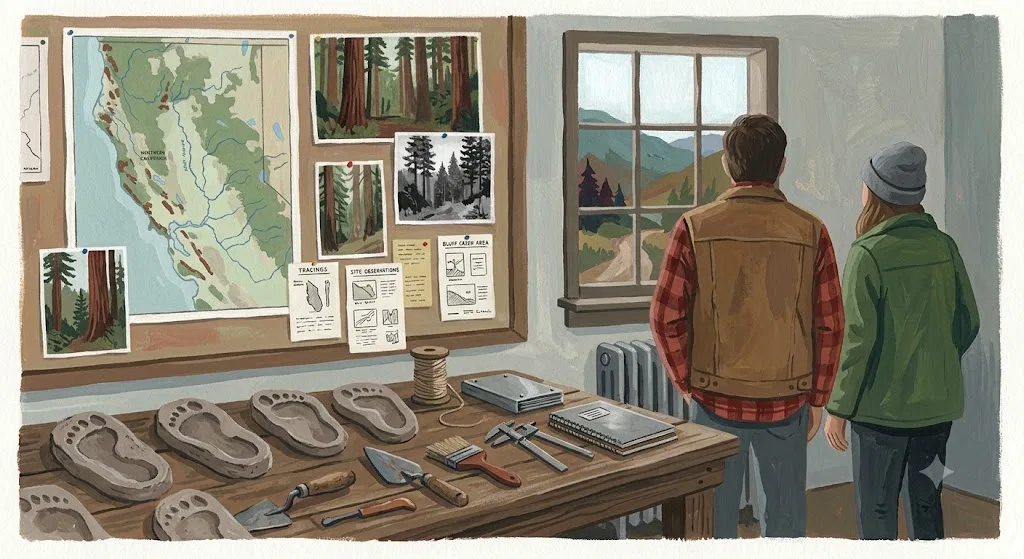
The key episode began in 1958 in the Bluff Creek area of far Northern California, where a road crew was working in forested country associated with the Klamath River drainage and Six Rivers National Forest. Jerry Crew, usually described as a bulldozer or tractor operator, reportedly found large, human-like footprints in mud near the worksite. Accounts commonly describe the casts as about 16 inches long, and Crew’s decision to preserve one in plaster made the story portable: a track in the mud could be dismissed as camp talk, but a cast could be photographed, handled and printed on a newspaper page.[wikipedia.org]WikipediaOpen source on wikipedia.org.
The decisive step was not simply the discovery of tracks. It was Crew taking the cast to the Humboldt Times, where journalist Andrew Genzoli turned a local logging-road puzzle into a public story. The term “Bigfoot” had older uses in other contexts, but the creature-name “Bigfoot” became nationally attached to the Northern California track reports through the 1958 Humboldt coverage and the wire-service attention that followed. Joshua Blu Buhs’s history of the legend notes that, in the year after Bigfoot’s newspaper debut, Genzoli received more than 2,500 letters — a useful measure of how quickly the creature escaped its local setting.[uchicago.edu]press.uchicago.eduUniversity of Chicago PressBigfoot: The Life and Times of a Legend by Joshua Blu…In the year after Bigfoot's big debut, Genzoli receiv…
That helps explain why Bluff Creek is more than just another sighting location. Many places in North America had “wild man”, hairy giant or mountain creature stories before 1958, and the word “Sasquatch” had already circulated from British Columbia traditions and newspaper culture. Bluff Creek’s special role is narrower and sharper: it gave the American public a punchy, physical, newspaper-friendly name linked to giant footprints in California mud. The name made the creature easy to remember, easy to headline and easy to imagine.[Mental Floss]mentalfloss.combigfoot word origin hoaxMental FlossThe Hoax That Led to the Word 'Bigfoot'6 Feb 2024 — Crew's story eventually caught the attention of Humboldt Times columnist…
The early reports also had a workplace quality that shaped the legend. This was not initially framed as a ghost story or a mystical apparition. It came out of road construction, bulldozers, work camps, damaged equipment rumours and men trying to explain strange tracks around a job site. That practical setting gave Bigfoot a different feel from a haunted-house legend. It seemed, at least in presentation, like an animal mystery that had interrupted ordinary labour in the woods.[University of Chicago Press]press.uchicago.eduUniversity of Chicago PressBigfoot: The Life and Times of a Legend by Joshua Blu…In the year after Bigfoot's big debut, Genzoli receiv…

Why Bluff Creek was the right landscape for the legend
Bluff Creek sits in the kind of country that makes a mystery-beast story feel plausible even to people who are not convinced. The U.S. Forest Service describes public access to the lower Bluff Creek area at the confluence with the Klamath River, while related trail listings place the creek within the rugged recreation geography of Six Rivers National Forest. This is river, forest and mountain country: difficult enough to feel remote, but accessible enough for workers, anglers, hunters, campers and later Bigfoot seekers to bring stories back out.[US Forest Service]fs.usda.govOpen source on usda.gov.
The North Coast’s logging-road context mattered. Roads cut into forest do two things for folklore: they open remote places to human observation, and they create muddy, disturbed surfaces where tracks can appear dramatic. A footprint legend needs a surface that can record a print, people who can find it, and enough surrounding wilderness to make the explanation feel uncertain. Bluff Creek supplied all three.[Wikipedia]WikipediaOpen source on wikipedia.org.
The landscape also had a built-in before-and-after drama. The 1964 flood reconfigured Bluff Creek near the Klamath, destroying a bridge and changing the channel; Forest Service history records the flood damage and later bridge work in the area. This matters for the later Patterson–Gimlin story because the famous film’s visual power depends heavily on its setting: an open, altered creek bed, scattered debris, forest edge and a sense of sudden exposure inside otherwise dense country.[NPS History]npshistory.comOpen source on npshistory.com.
For a public reader, this is the central point: Bluff Creek made Bigfoot look ecological rather than abstract. The creature was not merely “somewhere in America”. It was imagined in a specific habitat — wet mud, logging roads, river corridors, Douglas fir and redwood-region tourism, with small towns at the edge of national forest land. The setting did part of the storytelling work before any believer or sceptic made an argument.
The Patterson–Gimlin film made Bluff Creek unforgettable
The 1958 tracks gave Bigfoot its name, but the Patterson–Gimlin film gave it a body. On 20 October 1967, Roger Patterson and Bob Gimlin said they filmed a large, hairy, bipedal figure near Bluff Creek in Northern California. The clip, usually described as roughly a minute long, became the most famous alleged Bigfoot footage in the world and remains the image many people picture when they hear the word.[Wikipedia]WikipediaPatterson–Gimlin filmPatterson–Gimlin film
Its power comes from how simple it is. The figure walks across an open creek bed, turns its head, and disappears into the long argument that has followed ever since. Believers point to the figure’s gait, proportions and apparent muscular movement. Sceptics point to the human film-makers’ prior interest in Bigfoot, the possibility of a costume, the lack of a body or biological specimen, and the fact that the footage emerged from the same broad Bluff Creek tradition already shadowed by hoax claims.[Smithsonian Magazine]smithsonianmag.comIn 1967, Roger Patterson and Bob Gimlin filmed a few seconds of a hairy creature walking on…Read more…
The film also changed the geography of the legend. Bluff Creek was no longer only the place of suspicious tracks. It became a pilgrimage site for people who wanted to stand near the imagined origin of the creature’s most famous appearance. Even when the exact site became difficult to identify because of regrowth and landscape change, the wider Bluff Creek area retained its aura as the place where Bigfoot had supposedly stepped from footprint story into moving image.[Wikipedia]WikipediaPatterson–Gimlin filmPatterson–Gimlin film
That is why the Patterson–Gimlin film should be treated carefully in a California cryptid history. It is not reliable proof of an unknown animal. It is reliable proof of cultural force. A short, disputed film attached to a remote creek in Northern California helped fix Bigfoot’s silhouette in popular culture: broad, dark, upright, long-armed, half-seen and always walking away.
The Wallace hoax problem did not erase the legend
The biggest challenge to the 1958 origin story is the Ray Wallace hoax claim. Wallace, a road contractor connected with the Bluff Creek work, died in 2002; afterwards, members of his family said he had used carved wooden feet to make fake Bigfoot tracks. Reports about the claim described large wooden feet and presented Wallace as a prankster whose track-making helped launch the phenomenon.[Wikipedia]WikipediaRaymond L. WallaceRaymond L. Wallace
For sceptics, this matters enormously. If the famous early tracks were manufactured, then the physical foundation of the Bluff Creek origin story becomes much weaker. The Wallace claims also fit a wider pattern in Bigfoot history: footprints are easy to fake, especially in mud, and a dramatic print can travel further in the media than the circumstances of its making. The Smithsonian’s discussion of Bigfoot belief treats the Wallace connection as one reason to doubt the authenticity of later Bluff Creek-linked evidence, including the Patterson–Gimlin film.[Smithsonian Magazine]smithsonianmag.comIn 1967, Roger Patterson and Bob Gimlin filmed a few seconds of a hairy creature walking on…Read more…
For believers, the Wallace claim does not settle everything. Some argue that not all tracks can be attributed to Wallace, that family testimony after someone’s death is not the same as a demonstrated reconstruction of every print, and that the wider Bigfoot tradition includes many reports beyond Bluff Creek. That defence may keep the legend alive, but it does not restore the 1958 tracks to solid evidence. At minimum, the Wallace material means the Bluff Creek origin has to be read as a contested episode rather than a clean discovery story.[Wikipedia]WikipediaRaymond L. WallaceRaymond L. Wallace
The more interesting cultural point is that the hoax claim did not destroy Bigfoot Country. By the time Wallace’s family went public, Bigfoot had already become a local emblem, a tourism hook, a museum subject, a festival figure and a pop-culture icon. A hoax can undermine evidence, but it does not automatically undo identity. In Willow Creek and the surrounding North Coast imagination, Bigfoot had become a way of describing place.[Cal Alumni Association]alumni.berkeley.edugreetings willow creekgreetings willow creek
Why Willow Creek became the public face of Bigfoot Country
Willow Creek is the town most closely associated with the Bluff Creek legend because it sits close enough to the famous geography to function as its public doorway. Visitor material describes Willow Creek as a gateway to Six Rivers National Forest and highlights the Willow Creek China Flat Museum for its local history and extensive Bigfoot collection. For travellers, that matters: Bluff Creek may be the mythic site, but Willow Creek is where the story gets signs, souvenirs, exhibits and a place to park.[Visit Redwoods]visitredwoods.comOpen source on visitredwoods.com.
The China Flat Museum turns the legend into an archive-like experience. Humboldt tourism pages describe its Bigfoot exhibit as including pictures, newspaper articles, sighting maps and plaster-like footprint casts donated over the years. The museum’s own collection pages similarly foreground the Patterson–Gimlin film exhibit, footprint casts, historical newspaper articles and eyewitness accounts. Again, these displays are not proof of a species. They are evidence of how a community curates a mystery.[Visit Redwoods]visitredwoods.comVisit Redwoods China Flat MuseumVisit Redwoods China Flat Museum
Willow Creek also makes Bigfoot visible outdoors. Local tourism pages mention a 25-foot redwood Bigfoot sculpture, while travel reporting has described the town’s museum, themed businesses and visitor notebooks where people leave messages about belief, scepticism and alleged encounters. That mix is important: the town does not rely only on one claim from 1958 or one film from 1967. It turns the whole atmosphere of Bigfoot seeking into a civic identity.[Visit Redwoods]visitredwoods.comOpen source on visitredwoods.com.
The annual Bigfoot Daze celebration shows how the legend moved from evidence dispute to community ritual. Current event listings describe the festival as a free town celebration with vendors, food, music, contests and family activities. KQED’s earlier coverage likewise framed Bigfoot Days as a continuing Humboldt County celebration drawing visitors decades after the Patterson–Gimlin footage. The creature, whether real, misidentified, invented or performed, has become part of the town calendar.[willowcreekchamber.com]willowcreekchamber.comOpen source on willowcreekchamber.com.
What the North Coast gains from a doubtful monster
Bigfoot gives the North Coast a story that fits its landscape. California’s better-known images often point south or urban: beaches, Hollywood, Silicon Valley, desert highways. Bluff Creek Bigfoot points to another California — wet, forested, rural, working-class, Indigenous-adjacent but largely mediated through settler newspapers and logging culture, and still able to feel remote. That is why the legend has stuck so firmly to Humboldt and the surrounding counties.[SFGATE]sfgate.comOpen source on sfgate.com.
The identity is playful, but not trivial. Berkeley’s California Magazine reported a local view that Bigfoot tourism helps keep the Willow Creek museum and shops alive, with visitors spending money on restaurants, petrol, repairs and festival trips. SFGATE’s 2025 coverage of California’s proposed Bigfoot state-cryptid bill similarly quoted local museum volunteer Eric Nelson seeing official recognition as a tourism opportunity for Willow Creek.[Cal Alumni Association]alumni.berkeley.edugreetings willow creekgreetings willow creek
The proposed California state-cryptid bill shows how far the Bluff Creek identity has travelled. Assembly Bill 666, introduced in 2025, stated the intent to designate Bigfoot as California’s official state cryptid; CalMatters’ bill tracker recorded that wording, and regional coverage tied the proposal especially to the North Coast district including Del Norte, Humboldt, Mendocino, Sonoma and Trinity counties. Even as a light-hearted political gesture, the bill treated Bigfoot as a recognisable California emblem rather than merely a fringe belief.[Digital Democracy | CalMatters]calmatters.digitaldemocracy.orgDigital Democracy | Cal Matters AB 666: State cryptidDigital Democracy | Cal Matters AB 666: State cryptid
That does not mean the state is endorsing Bigfoot as a real animal. It means the legend has become useful shorthand for a particular version of California wilderness. Bigfoot stands for the idea that the redwood and river country still contains secrets, or at least stories good enough to make people stop, look at the trees and wonder what else might be out there.
What the Bluff Creek evidence can and cannot support
The strongest evidence for Bluff Creek’s importance is historical and cultural, not zoological. The 1958 track reports are well established as a media event; the name “Bigfoot” spread from the Humboldt coverage; the Patterson–Gimlin film undeniably exists and was tied to the Bluff Creek area; and Willow Creek has built a durable public identity around those stories. Those are solid claims about folklore, media and regional branding.[uchicago.edu]press.uchicago.eduUniversity of Chicago PressBigfoot: The Life and Times of a Legend by Joshua Blu…In the year after Bigfoot's big debut, Genzoli receiv…
The evidence for an actual unknown large primate is much weaker. Footprints can be hoaxed or misread, film can be staged, eyewitness memory is fallible, and no accepted body, DNA sample, breeding population or clear biological specimen has confirmed Bigfoot as a recognised animal. Sceptical treatments of the subject commonly emphasise hoaxes and misidentifications, while even more sympathetic accounts tend to concede that the Patterson–Gimlin film has never resolved the question either way.[skepticalinquirer.org]skepticalinquirer.orgOpen source on skepticalinquirer.org.
That uncertainty is exactly why Bluff Creek remains compelling. If the story were proven cleanly true, it would move from folklore into zoology. If it were merely forgotten fakery, it would fade into a footnote. Instead, it occupies the unstable middle ground where many cryptid traditions live: a few dramatic artefacts, a beautiful setting, disputed testimony, credible reasons for doubt, and a community that has found meaning in keeping the question open.
How Bluff Creek changed California Bigfoot
Before Bluff Creek, hairy wild-man stories could be local, scattered and hard to separate from older frontier folklore. After Bluff Creek, California Bigfoot had a name, a place, a visual archive and a tourist route. The 1958 casts made the creature seem trackable. The 1967 film made it imaginable. Willow Creek made it visitable. Together, they turned a mystery-beast claim into one of Northern California’s most durable regional identities.[californiasun.co]californiasun.cowhen california introduced bigfoot to the worldwhen california introduced bigfoot to the world
For readers trying to understand California’s cryptid map, Bluff Creek is the hinge. It is not the whole Bigfoot story, and it should not be treated as proof that Bigfoot exists. Its importance is that modern Bigfoot culture learned how to speak there: through footprints, newspaper headlines, logging-road testimony, contested film, roadside attractions and a North Coast community that turned doubt into destination.
Amazon book picks
Further Reading
Books and field guides related to How Bluff Creek Made Bigfoot Famous. Use these as the next step if you want deeper reading beyond the article.
Sasquatch: Legend Meets Science
Examines footprint evidence central to Bluff Creek history.
Where Bigfoot Walks
Captures the landscape that sustains Pacific Northwest and California legends.
eBay marketplace picks
Marketplace Samples
Live-tested eBay searches with available results related to this page.



Endnotes
1.
Source: Wikipedia
Link:https://en.wikipedia.org/wiki/Bigfoot
2.
Source: history.com
Title: bigfoot legend newspaper
Link:https://www.history.com/articles/bigfoot-legend-newspaper
3.
Source: Wikipedia
Title: Patterson–Gimlin film
Link:https://en.wikipedia.org/wiki/Patterson%E2%80%93Gimlin_film
4.
Source: sfgate.com
Title: willow creek norcal town obsessed with bigfoot 18410299
Link:https://www.sfgate.com/travel/article/willow-creek-norcal-town-obsessed-with-bigfoot-18410299.php
5.
Source: Wikipedia
Title: Raymond L. Wallace
Link:https://en.wikipedia.org/wiki/Raymond_L._Wallace
6.
Source: alumni.berkeley.edu
Title: greetings willow creek
Link:https://alumni.berkeley.edu/california-magazine/online/greetings-willow-creek/
7.
Source: sfgate.com
Link:https://www.sfgate.com/northcoast/article/california-takes-steps-toward-officially-20175812.php
8.
Source: kqed.org
Title: small town big legend willow creek celebrates bigfoot
Link:https://www.kqed.org/news/10708114/small-town-big-legend-willow-creek-celebrates-bigfoot
9.
Source: calmatters.digitaldemocracy.org
Title: Digital Democracy | Cal Matters AB 666: State cryptid
Link:https://calmatters.digitaldemocracy.org/bills/ca_202520260ab666
10.
Source: newspapers.com
Title: daily independent journal pic of jerry c
Link:https://www.newspapers.com/article/daily-independent-journal-pic-of-jerry-c/132946143/
11.
Source: humboldt.edu
Link:https://www.humboldt.edu/family/events/bigfoot-daze
12.
Source: digitalcommons.humboldt.edu
Link:https://digitalcommons.humboldt.edu/cgi/viewcontent.cgi?article=1029&context=barnum
13.
Source: Wikipedia
Title: Six Rivers National Forest
Link:https://en.wikipedia.org/wiki/Six_Rivers_National_Forest
14.
Source: people.com
Title: famous 1967 bigfoot film was staged says director of new doc 11926085
Link:https://people.com/famous-1967-bigfoot-film-was-staged-says-director-of-new-doc-11926085
15.
Source: sfgate.com
Title: Bigfoot a fake says family of man who created it 2713046
Link:https://www.sfgate.com/bayarea/article/Bigfoot-a-fake-says-family-of-man-who-created-it-2713046.php
16.
Source: press.uchicago.edu
Link:https://press.uchicago.edu/Misc/Chicago/079790.html
Source snippet
University of Chicago PressBigfoot: The Life and Times of a Legend by Joshua Blu...In the year after Bigfoot's big debut, Genzoli receiv...
17.
Source: mentalfloss.com
Title: bigfoot word origin hoax
Link:https://www.mentalfloss.com/crime/bigfoot-word-origin-hoax
Source snippet
Mental FlossThe Hoax That Led to the Word 'Bigfoot'6 Feb 2024 — Crew's story eventually caught the attention of Humboldt Times columnist...
18.
Source: smithsonianmag.com
Link:https://www.smithsonianmag.com/history/why-so-many-people-still-believe-in-bigfoot-180970045/
Source snippet
In 1967, Roger Patterson and Bob Gimlin filmed a few seconds of a hairy creature walking on...Read more...
19.
Source: visitredwoods.com
Title: Visit Redwoods China Flat Museum
Link:https://www.visitredwoods.com/listing/china-flat-museum-bigfoot/117/
20.
Source: visitredwoods.com
Link:https://www.visitredwoods.com/event/bigfoot-daze-celebration/3689/
21.
Source: visitredwoods.com
Link:https://www.visitredwoods.com/listing/willow-creek/118/
22.
Source: californiasun.co
Title: when california introduced bigfoot to the world
Link:https://www.californiasun.co/when-california-introduced-bigfoot-to-the-world/
23.
Source: fs.usda.gov
Link:https://www.fs.usda.gov/r05/sixrivers/recreation/bluff-creek-river-access
24.
Source: fs.usda.gov
Title: US Forest Service Bluff Creek Trail
Link:https://www.fs.usda.gov/r05/sixrivers/recreation/trails/bluff-creek-trail
25.
Source: npshistory.com
Link:https://npshistory.com/publications/usfs/region/5/six-rivers/history/sec5.htm
26.
Source: visitredwoods.com
Link:https://www.visitredwoods.com/listing/towns-of-humboldt-county/204/
27.
Source: willowcreekchamber.com
Link:https://willowcreekchamber.com/bigfootdaze2026/
28.
Source: skepticalinquirer.org
Link:https://skepticalinquirer.org/2023/12/is-bigfoot-dead/
29.
Source: skepticalinquirer.org
Title: bigfoot collection
Link:https://skepticalinquirer.org/exclusive/bigfoot-collection/
30.
Source: skepticalinquirer.org
Title: documentarys devastating bigfoot debunking
Link:https://skepticalinquirer.org/exclusive/documentarys-devastating-bigfoot-debunking/
31.
Source: fs.usda.gov
Title: bluff creek historical trail
Link:https://www.fs.usda.gov/r05/sixrivers/recreation/trails/bluff-creek-historical-trail
32.
Source: fs.usda.gov
Title: orleans ranger district 0
Link:https://www.fs.usda.gov/r05/sixrivers/recreation/orleans-ranger-district-0
33.
Source: fs.usda.gov
Link:https://www.fs.usda.gov/r05/sixrivers/recreation
34.
Source: visitredwoods.com
Link:https://www.visitredwoods.com/listing/bigfoot-found-in-the-redwoods/146/
35.
Source: visitredwoods.com
Title: bigfoot museum opening day
Link:https://www.visitredwoods.com/event/bigfoot-museum-opening-day/8509/
36.
Source: visitredwoods.com
Link:https://www.visitredwoods.com/event/willow-creek-fathers-day-bbq/8524/
37.
Source: visitredwoods.com
Link:https://www.visitredwoods.com/listing/family-fun-itinerary/73/
38.
Source: visitredwoods.com
Link:https://www.visitredwoods.com/listing/three-day-heritage-tour/61/
39.
Source: facebook.com
Link:https://www.facebook.com/bigfootdazewc/
40.
Source: bfro.net
Title: The Willow Creek
Link:https://www.bfro.net/NEWS/wcmuseum.htm
41.
Source: wildernessportal.com
Title: Six Rivers National Forest
Link:https://www.wildernessportal.com/destinations/six-rivers-national-forest
42.
Source: non-aliencreatures.fandom.com
Link:https://non-aliencreatures.fandom.com/wiki/Bigfoot
43.
Source: humboldthistory.org
Link:https://www.humboldthistory.org/history-nuggets/2021/6/9/bigfoot
Additional References
44.
Source: thetimes.com
Link:https://www.thetimes.com/us/news-today/article/bigfoot-hunters-documentary-hoax-clip-capturing-bigfoot-stzlqhjcn
Source snippet
The Bigfoot community has reacted strongly, with some accusing the filmmakers of misleading the public. Matt Moneymaker, a leading figure...
45.
Source: youtube.com
Title: The Bigfoot Monster Of Willow Creek | Mythology Documentary | Boogeymen | S1 EP6
Link:https://www.youtube.com/watch?v=8RxzK-N6KEI
Source snippet
"OVERNIGHT at Bluff Creek and the Patterson-Gimlin Site | Bigfoot Documentary[https://www.youtube.com/watch?v=Z-24o1nd8Mk..."](https://www.youtube.com/watch?v=Z-24o1nd8Mk...")...
46.
Source: youtube.com
Link:https://www.youtube.com/watch?v=RsU8ul9X2eg
Source snippet
The Bigfoot Monster Of Willow Creek | Mythology Documentary | Boogeymen | S1 EP6...
47.
Source: youtube.com
Link:https://www.youtube.com/watch?v=c4Iio-Z2aS8
Source snippet
Episode 7: Bigfoot: Costume or Creature with special effect expert Bill Munns...
48.
Source: bigfootencounters.com
Link:https://www.bigfootencounters.com/articles/true1959.htm
49.
Source: lostcoastoutpost.com
Link:https://lostcoastoutpost.com/lowdown/events/64th-annual-bigfoot-daze/
50.
Source: reddit.com
Link:https://www.reddit.com/r/Cryptozoology/comments/189ygc9/a_point_i_disagree_with_bigfoot_skeptics_on/
51.
Source: facebook.com
Link:https://www.facebook.com/NorthCoastNewsTV/posts/assembly-bill-666-would-make-bigfoot-the-official-state-cryptid-assembly-member-/1219396103519316/
52.
Source: ebsco.com
Link:https://www.ebsco.com/research-starters/social-sciences-and-humanities/bigfoot-cryptozoology
53.
Source: isu.edu
Link:https://www.isu.edu/media/libraries/rhi/book-reviews/BF-Exposed.pdf
Topic Tree