Within Palmetto Monsters
Why Do People Report Black Panthers?
Black panther stories show how real bears, alligators, escaped pets and brief sightings keep South Carolina's mystery-beast rumours alive.
On this page
- Panther claims in woods, roads and rural edges
- Real animals that can confuse witnesses
- How misidentification becomes folklore
Page outline Jump by section
Introduction
South Carolina’s “black panther” stories usually describe a large, dark, long-tailed cat glimpsed near woods, roads, farms, swamps or trail cameras. The problem is that the animal people imagine — a breeding population of black panthers roaming the state — has not been verified. South Carolina does have real wildlife that can make such reports feel convincing: bobcats, black coyotes, bears, otters, alligators, large dogs, domestic cats seen without scale, and the occasional legal or illegal captive-animal possibility. The result is a classic mystery-beast pattern: repeated sincere sightings, very little hard evidence, and a landscape that helps brief, uncertain animal encounters turn into local folklore. South Carolina Department of Natural Resources biologist Jay Butfiloski summed up the official sceptical view of the state’s black-panther reports as “plenty of sightings, zero proof”.[The State]thestate.comThe State Are there black panthers in South Carolina? What DNR says | The StateThe State Are there black panthers in South Carolina? What DNR says | The State
What are people claiming when they say “black panther”?
In everyday South Carolina talk, “black panther” can mean several different things at once. Some witnesses mean a mountain lion, also called a cougar, puma or panther. Others mean something more exotic: a black leopard or black jaguar. In zoological terms, “black panther” is not a separate species. The phrase is usually used for melanistic, or dark-coloured, leopards and jaguars, not for a confirmed black form of North American cougar. The U.S. Fish and Wildlife Service notes that “panthers” is a loose term rather than a distinct species name, while prohibited big cats under federal law include lions, tigers, leopards, jaguars, cheetahs and cougars.[U.S. Fish and Wildlife Service]fws.govOpen source on fws.gov.
That distinction matters because South Carolina’s historical cougar question is different from its modern black-panther folklore. The eastern cougar was once treated as a subspecies that ranged across eastern North America, but the U.S. Fish and Wildlife Service removed it from the endangered species list in 2018 after concluding that it had likely vanished many decades earlier. The agency also reviewed public reports and found no evidence of an existing eastern cougar population, while allowing that occasional cougars in the East can be Florida panthers, western wanderers, or escaped or released captives.[U.S. Fish and Wildlife Service]fws.govOpen source on fws.gov.
South Carolina panther stories therefore sit in a grey zone between memory and misidentification. The state once belonged to a wider eastern landscape where large cats were part of the natural world. Modern witnesses may also know that Florida panthers still exist farther south. But a living, breeding population of black panthers in South Carolina would leave clearer signs than scattered stories: reliable photographs with scale, DNA, road-killed specimens, tracks examined by specialists, or repeated trail-camera records from the same areas.
Panther claims in woods, roads and rural edges
The strongest pattern in South Carolina is not a single famous panther case, but a repeated setting. Reports tend to come from places where quick sightings are easy and certainty is hard: a dark animal crossing a road at dusk, a shape at the edge of a field, a trail-camera image without a size reference, or a moment in wooded suburbs where pets, deer and wild predators all overlap.
A 2023 report in The State described claims sent to SCDNR from across and around South Carolina, including Marietta, Travelers Rest, Wadmalaw Island, Horry County and a hunt club over the line near Tabor City, North Carolina. Butfiloski said that some supposed South Carolina black-panther images were traced to photographs from a South African wildlife facility and had apparently been reused in local-looking settings. He also said other trail-camera “panthers” he had seen were domestic house cats.[The State]thestate.comThe State Are there black panthers in South Carolina? What DNR says | The StateThe State Are there black panthers in South Carolina? What DNR says | The State
That kind of story spread is important. A panther rumour no longer needs a single newspaper flap or a campfire retelling. It can move through neighbourhood Facebook groups, trail-camera shares, short videos and warning posts about pets. The warning may be sincere, but the image may be detached from its original place, enlarged by forced perspective, or interpreted before anyone checks scale. Once a photo is labelled “panther”, many viewers see the claim before they see the animal.
A 2017 Richland County example shows how this works on a smaller scale. WIS reported that a Hopkins resident had set up a deer camera after her son said he had seen a black panther; the camera then recorded a black animal with cat-like features, prompting concern for neighbours, pets and children. At the time of the report, SCDNR had not yet responded publicly with an identification. The case is useful not because it proves a panther, but because it shows the social chain: family sighting, camera placement, neighbourhood warning, local news interest, and then an open question.[https://www.wistv.com]wistv.comOpen source on wistv.com.
Real animals that can confuse witnesses
South Carolina’s panther folklore survives partly because the state really does have animals large, dark, elusive or unexpected enough to startle people. A sceptical explanation does not require assuming witnesses are lying. It often requires only poor light, a short viewing time and an animal seen without a familiar object beside it.
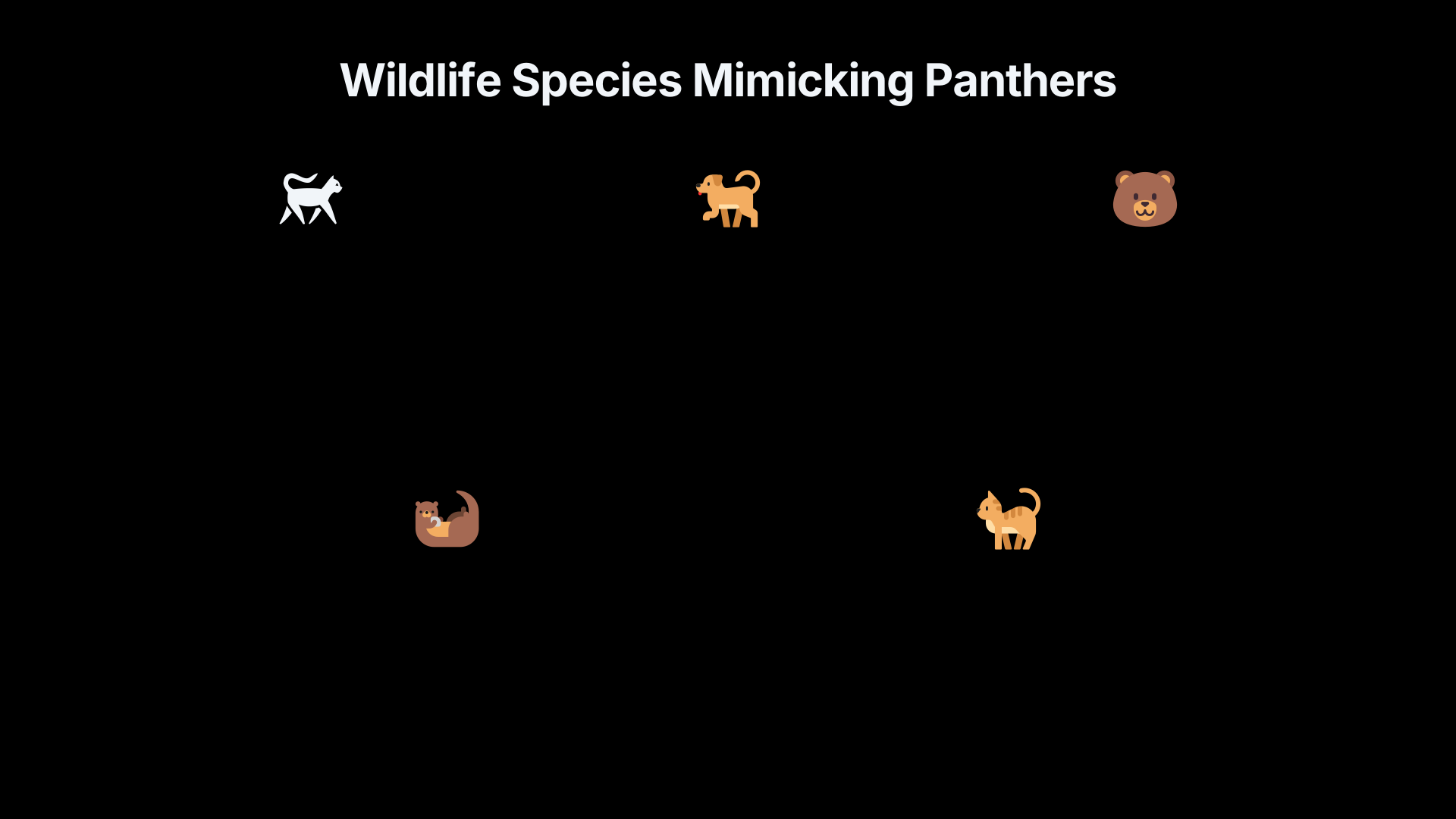
Bobcats are the obvious wild-cat candidate, although they are much smaller than the panther people imagine. SCDNR describes South Carolina bobcats as greyish-brown to reddish-brown, with black spots on the legs and lower sides, longer legs than domestic cats, and a short “bobbed” tail. Southern bobcats stand about 16 to 22 inches at the shoulder and usually weigh 12 to 25 pounds.[SCDNR]dnr.sc.govOpen source on sc.gov. In a clean daylight view, that bobbed tail should separate a bobcat from a cougar-like animal. In a two-second road crossing, in shadow, with brush obscuring the rear end, the difference can blur.
Bobcats also behave in ways that make them feel larger and stranger than their measurements suggest. A 2025 Southeastern Naturalist note documented six observations of bobcats preying on American alligators in coastal South Carolina, including field observations, trail-camera imagery and scat evidence. The scenes included bobcats carrying juvenile alligators at places such as Savannah National Wildlife Refuge, Bear Island Wildlife Management Area and coastal research lands.[media.clemson.edu]media.clemson.edubobcat predation on american alligators in south carolina keating et al 2025bobcat predation on american alligators in south carolina keating et al 2025 That does not make bobcats panthers, but it does remind readers that South Carolina’s real medium-sized predators can do dramatic things.
Coyotes are another strong misidentification candidate because some are dark. SCDNR says coyotes first appeared in South Carolina about 45 years ago, are now found in all 46 counties, and average around 35 pounds, though they can exceed 50 pounds. The agency also notes that coyotes are usually greyish-brown to reddish-tan, but “nearly all black is not uncommon”.[SCDNR]dnr.sc.govOpen source on sc.gov. A black coyote crossing a road low and fast, especially at night, can easily become “big black cat” in memory.
Black bears can complicate the picture, especially in the Upstate and parts of the coastal plain. SCDNR recognises two resident black bear populations in South Carolina: one in the mountains and upper Piedmont and one in the coastal plain. Young male bears disperse in search of new territories and have been sighted in many counties, often only briefly before moving on.[SCDNR]dnr.sc.govOpen source on sc.gov. A small or distant bear is not cat-shaped in a good view, but a dark animal vanishing through brush can leave only size, colour and surprise behind.
Otters, dogs and domestic cats fill in many of the remaining gaps. Butfiloski specifically named dog, cat, bobcat, coyote and otter as possibilities in South Carolina black-panther claims, adding that low light and lack of scale can make judgement difficult.[The State]thestate.comThe State Are there black panthers in South Carolina? What DNR says | The StateThe State Are there black panthers in South Carolina? What DNR says | The State A house cat near a trail camera can look huge if the camera is low and there is no fencepost, tyre, person or known tree diameter for comparison. An otter crossing a wet road may appear long, black and low to the ground. A large black dog seen at speed can become a panther before the witness has time to process the gait.
Why South Carolina makes panther stories feel plausible
The South Carolina setting gives these reports a strong emotional logic. The state has thick pine woods, swamp margins, blackwater rivers, coastal marshes, barrier islands, old rice-field impoundments, deer woods and long rural roads. A reader does not need to believe in mystery cats to understand why a dark animal disappearing into that landscape feels different from the same animal seen in a supermarket car park.
Alligators add to that atmosphere because they make the Lowcountry feel genuinely wild. SCDNR says American alligators use South Carolina’s coastal marshlands extensively, with the ACE Basin among the state’s important nesting areas; the highest alligator populations and nest densities in that area are associated with wetland landscapes shaped by the rice-growing era.[SCDNR]dnr.sc.govOpen source on sc.gov. Alligators are not panthers, of course, but their presence changes how people read the landscape. A state with large reptiles in ditches, bears crossing subdivisions, coyotes in every county and bobcats carrying young alligators already has enough real strangeness for monster stories to feel only one step away.
There is also a cultural inheritance at work. “Panther” has deep roots in southern speech, where it may refer loosely to cougars, mystery cats, frightening screams in the woods or a vanished predator remembered by older generations. That older language can keep moving even after the animal itself has gone. When someone says “panther” in rural South Carolina, they may not be making a careful taxonomic claim. They may be reaching for the nearest local word for “large, dangerous, cat-like thing I did not expect to see”.
Could an escaped big cat explain some reports?
Escaped captive animals are the most reasonable “maybe” in the South Carolina panther debate, but they do not explain the folklore as a whole. The U.S. Fish and Wildlife Service explicitly allows that some eastern cougar reports could involve escaped or released captives, while distinguishing those rare possibilities from evidence for a wild breeding population.[U.S. Fish and Wildlife Service]fws.govOpen source on fws.gov. Neighbouring North Carolina’s wildlife agency makes a similar point: cougar and black-panther reports there are nearly always misidentified domestic or wild animals, though a captive cougar, jaguar or leopard escape is never impossible.[NC Wildlife]ncwildlife.govNC Wildlife Eastern Cougar | NC WildlifeNC Wildlife Eastern Cougar | NC Wildlife
South Carolina law also shows why escaped-exotic rumours are not absurd in principle. State code restricts the import, possession, purchase, breeding and sale of large wild cats, non-native bears and great apes, with exceptions and registration requirements for some possessors. It also requires registered possessors to have contingency plans and to notify animal control and law enforcement if a large wild cat escapes.[scstatehouse.gov]scstatehouse.govCode of LawsCode of Laws Federal law has tightened the picture further: the Big Cat Public Safety Act, enacted in December 2022, restricts private ownership, breeding and commerce involving big cats, with a closed registration window for qualifying pre-Act owners.[U.S. Fish and Wildlife Service]fws.govOpen source on fws.gov.
But an escaped leopard, jaguar or cougar would be an incident, not a hidden population. It should produce a trail of calls, official response, owner records, tracks, carcasses, veterinary paperwork, seizure records or eventually a captured or dead animal. The more reports are spread across many years and counties, the less a single escape explains them. Escapes are useful as a caution against saying “impossible”; they are not strong evidence for South Carolina’s phantom panthers.

How misidentification becomes folklore
A misidentified animal becomes folklore when the story is easier to remember than the correction. The witness sees something briefly. The safest social label is “panther”, because it communicates size, danger and surprise. A neighbour repeats it as a warning. A blurry image appears online. Someone else remembers an older family story from a farm road or hunting lease. Soon the local claim has a past, a pattern and a map.
Several mechanisms push the story along:
- Scale errors: Without a fixed object nearby, a domestic cat, bobcat or coyote can look much larger than it is.
- Low-light colour shifts: Brown, grey and reddish animals can appear black at dawn, dusk or under headlights.
- Memory sharpening: A two-second glimpse may become clearer in the telling, especially if the witness is startled.
- Borrowed images: Real photographs from zoos, sanctuaries or distant places can be reposted as local sightings.
- Local trust: A claim from a hunter, farmer, relative or neighbour may carry more weight than an official denial.
- Wildlife overlap: Real bears, coyotes, bobcats, otters and alligators make the setting feel credible even when the specific panther claim is weak.
This is why official scepticism often fails to kill the legend. A wildlife agency asks for proof; a witness remembers fear, speed and the certainty of the moment. Both are responding to different standards. The witness is answering “what did it feel like I saw?” The biologist is answering “what evidence would establish this animal as present?”
What would count as better evidence?
For a South Carolina black panther claim to move beyond folklore, the evidence would need to be much stronger than a single story or ambiguous trail-camera frame. Useful evidence would include a clear photograph or video with reliable scale, repeated records from the same area, identifiable tracks measured and photographed properly, hair or scat suitable for DNA testing, or a carcass examined by qualified wildlife authorities. The U.S. Fish and Wildlife Service’s eastern cougar review is a useful benchmark: after analysing public reports and consulting researchers and states across the former range, it found no evidence of an eastern cougar population.[U.S. Fish and Wildlife Service]fws.govOpen source on fws.gov.
The absence of proof is especially important because large predators are hard to hide completely in modern landscapes. South Carolina has hunters, road traffic, trail cameras, wildlife officers, social media, farms, suburbs and road-killed animals. A breeding population of large black cats would not need to appear every week, but over years it should leave more than disputed sightings.
That does not make the stories worthless. It changes what they are evidence of. They are weak evidence for unknown big cats, but strong evidence for how South Carolinians experience the edges of their landscape: the dark ditch beyond the headlights, the wooded property line, the trail camera nobody expected to catch anything strange, and the old idea that something larger may still be moving through the pines.
Why the legend persists
South Carolina’s phantom panthers endure because they sit at the meeting point of real wildlife, local memory and uncertain perception. The state has enough bears, bobcats, coyotes, alligators and wetland mystery to make a strange sighting feel plausible. It also has a historical reason for the word “panther” to remain emotionally available, even after the eastern cougar was declared extinct as a recognised subspecies.
The fairest reading is not “everyone is making it up” and not “black panthers are proven”. It is that South Carolina’s panther reports are mostly misidentified wildlife, misread images, recycled rumours and occasional unresolved encounters. A few may involve escaped captive animals or unusually deceptive views of ordinary species. None yet establishes a hidden population of black big cats.
That unresolved middle ground is exactly why the legend works. The panther is not South Carolina’s headline monster in the way the Lizard Man is, but it may be the state’s most repeatable mystery beast: a shape at the edge of the road, a warning shared between neighbours, and a reminder that even familiar woods can still produce a second of doubt.
eBay marketplace picks
Marketplace Samples
Live-tested eBay searches with available results related to this page.


Endnotes
1.
Source: wistv.com
Link:https://www.wistv.com/story/36554625/video-is-this-a-black-panther-on-the-prowl-in-hopkins/
2.
Source: media.clemson.edu
Title: bobcat predation on american alligators in south carolina keating et al 2025
Link:https://media.clemson.edu/public/sewe/bobcat-predation-on-american-alligators-in-south-carolina-keating-et-al-2025.pdf
3.
Source: scstatehouse.gov
Title: Code of Laws
Link:https://www.scstatehouse.gov/code/t47c002.php
4.
Source: facebook.com
Title: News Now Georgia
Link:https://www.facebook.com/NewsNowGA/posts/-caught-on-camera-in-midway-gafor-years-stories-of-black-panthers-have-been-pass/1508004668004788/
5.
Source: facebook.com
Title: What animal is this, possibly a panther?
Link:https://www.facebook.com/groups/837690421655507/posts/921106243313924/
6.
Source: facebook.com
Title: Are there black panthers in South Carolina? Here’s what
Link:https://www.facebook.com/thestatenews/posts/are-there-black-panthers-in-south-carolina-heres-what-the-department-of-natural-/751673796997741/
7.
Source: facebook.com
Link:https://www.facebook.com/groups/cadescovegreatsmokies/posts/10162066596127334/
8.
Source: facebook.com
Link:https://www.facebook.com/groups/330811033679549/posts/24510781358589179/
9.
Source: facebook.com
Link:https://www.facebook.com/AmericanTattooSociety/posts/a-snarling-black-panther-clawing-through-red-flames-on-the-ditch-chris-tolleson-/1580555394112893/
10.
Source: facebook.com
Link:https://www.facebook.com/groups/southernpanthersightings/posts/1354902995390887/
11.
Source: facebook.com
Link:https://www.facebook.com/groups/38455654062/posts/10164212510964063/
12.
Source: facebook.com
Link:https://www.facebook.com/fitsnews/posts/black-bears-have-been-sighted-in-all-but-1-south-carolina-county/4021895697876193/
13.
Source: facebook.com
Link:https://www.facebook.com/wrdwtv/posts/watch-bear-spotted-in-south-carolina-neighborhood/1143013714539171/
14.
Source: facebook.com
Link:https://www.facebook.com/groups/334387122817058/posts/998768659712231/
15.
Source: facebook.com
Link:https://www.facebook.com/isaac.murdoch.2025/posts/thought-i-seen-a-black-panther-cross-the-road-the-other-day-its-been-seen-around/4498982027056205/
16.
Source: facebook.com
Link:https://www.facebook.com/groups/southernpanthersightings/posts/omg-i-have-been-searching-validation-putnam-co-ga-i-saw-panther-near-lake/1952386098975904/
17.
Source: facebook.com
Link:https://www.facebook.com/DraytonHall/posts/just-like-many-of-us-this-american-alligator-is-enjoying-the-sun-and-warmer-temp/970561182007696/
18.
Source: facebook.com
Link:https://www.facebook.com/groups/southernpanthersightings/posts/1363889097825610/
19.
Source: facebook.com
Link:https://www.facebook.com/groups/2444705539158223/posts/2796635430631897/
20.
Source: facebook.com
Link:https://www.facebook.com/naturerelianceschool/videos/no-you-didnt-see-a-black-panther-in-kentucky-heres-why/1917560602358423/
21.
Source: facebook.com
Link:https://www.facebook.com/61564347541208/posts/trail-cam-captures-panther-hunting-a-kitten-second-camera-reveals-the-truthlocal/122175646310478251/
22.
Source: facebook.com
Link:https://www.facebook.com/groups/saludanc/posts/2585075111833403/
23.
Source: facebook.com
Link:https://www.facebook.com/WYFF4/videos/you-can-hear-a-neighbor-scream-and-warn-others-of-the-bear-in-this-greenville-co/1674255913789022/
24.
Source: facebook.com
Link:https://www.facebook.com/mark.j.brisson/videos/black-panther-spotted-in-north-carolina-over-development-is-forcing-these-once-r/986297917014864/
25.
Source: wildlife.org
Title: bringing bobcats back from the brink
Link:https://wildlife.org/bringing-bobcats-back-from-the-brink/
26.
Source: thestate.com
Title: The State Are there black panthers in South Carolina? What DNR says | The State
Link:https://www.thestate.com/news/state/south-carolina/article282106408.html
27.
Source: fws.gov
Link:https://www.fws.gov/what-you-need-know-about-big-cat-public-safety-act
28.
Source: fws.gov
Link:https://www.fws.gov/press-release/2018-01/long-extinct-eastern-cougar-be-removed-endangered-species-list-correcting
29.
Source: dnr.sc.gov
Link:https://www.dnr.sc.gov/wildlife/species/bobcat.html
30.
Source: dnr.sc.gov
Link:https://www.dnr.sc.gov/wildlife/coyote/index.html
31.
Source: dnr.sc.gov
Link:https://dnr.sc.gov/wildlife/species/bear.html
32.
Source: dnr.sc.gov
Link:https://www.dnr.sc.gov/marine/mrri/acechar/speciesgallery/Reptiles/AmericanAlligator/index.html
33.
Source: ncwildlife.gov
Title: NC Wildlife Eastern Cougar | NC Wildlife
Link:https://www.ncwildlife.gov/species/eastern-cougar
34.
Source: dnr.sc.gov
Link:https://www.dnr.sc.gov/
35.
Source: dnr.sc.gov
Link:https://www.dnr.sc.gov/marine/mrri/acechar/speciesgallery/Mammals/Bobcat/index.html
36.
Source: dnr.sc.gov
Link:https://www.dnr.sc.gov/wildlife/publications/nuisance/bobcat.pdf
37.
Source: dnr.sc.gov
Link:https://www.dnr.sc.gov/wildlife/species.html
38.
Source: dnr.sc.gov
Title: Modern day dinosaurs
Link:https://www.dnr.sc.gov/wildlife/alligator/pdf/Modern-day-dinosaurs.pdf
39.
Source: thestate.com
Link:https://www.thestate.com/news/state/south-carolina/article315292753.html
40.
Source: thestate.com
Link:https://www.thestate.com/news/local/article314307718.html
41.
Source: Wikipedia
Title: Black panther
Link:https://en.wikipedia.org/wiki/Black_panther
42.
Source: Wikipedia
Title: Eastern cougar
Link:https://en.wikipedia.org/wiki/Eastern_cougar
43.
Source: ecos.fws.gov
Link:https://ecos.fws.gov/ecp/species/A046
44.
Source: ncwildlife.gov
Link:https://www.ncwildlife.gov/media/1977/download?attachment=
45.
Source: ncwildlife.gov
Link:https://www.ncwildlife.gov/media/1428/download?attachment=
46.
Source: srelherp.uga.edu
Link:https://srelherp.uga.edu/alligators/
47.
Source: fitsnews.com
Title: scdnr warns south carolinians about emerging black bears
Link:https://www.fitsnews.com/2026/05/08/scdnr-warns-south-carolinians-about-emerging-black-bears/
48.
Source: edisto.org
Link:https://edisto.org/bobcat/
Additional References
49.
Source: kiawahisland.gov
Link:https://www.kiawahisland.gov/wildlife/wildlife/mammals/bobcats/index.php
50.
Source: youtube.com
Title: VERIFY: Is there a black panther in Laurens County?
Link:https://www.youtube.com/watch?v=pVGdgr8wrs0
Source snippet
South Carolina woman says video captures mountain lion in Upstate...
51.
Source: reddit.com
Link:https://www.reddit.com/r/southcarolina/comments/1egwn8e/are_there_mountain_lions_in_upstate_sc/
52.
Source: portroyalsoundfoundation.org
Link:https://portroyalsoundfoundation.org/field-guide-post/bobcat/
53.
Source: wltx.com
Link:https://www.wltx.com/video/news/fact-or-fiction-panthers-in-south-carolina/101-2343284
54.
Source: aol.com
Link:https://www.aol.com/seen-black-panther-sc-outside-110000717.html
55.
Source: reddit.com
Link:https://www.reddit.com/r/whatisthisanimal/comments/1bqcqod/is_this_what_i_think_it_is_upstate_south_carolina/
56.
Source: instagram.com
Link:https://www.instagram.com/reel/DWOor6Hh2ev/
57.
Source: instagram.com
Link:https://www.instagram.com/p/C8IlbpTxS3x/?hl=en
58.
Source: reddit.com
Link:https://www.reddit.com/r/AskSouthCarolina/comments/1rbww4f/mountain_lions_in_sc/
Topic Tree