Within Oregon Monsters
Why Oregon Built a Trap for Bigfoot
The Bigfoot Trap shows how a failed monster hunt became a hiking landmark, tourist draw and symbol of playful Oregon belief.
On this page
- Perry Lovell's tracks and the 1974 trap
- Six years of bait, bears and no Sasquatch
- How the trap became a forest landmark
Page outline Jump by section
Introduction
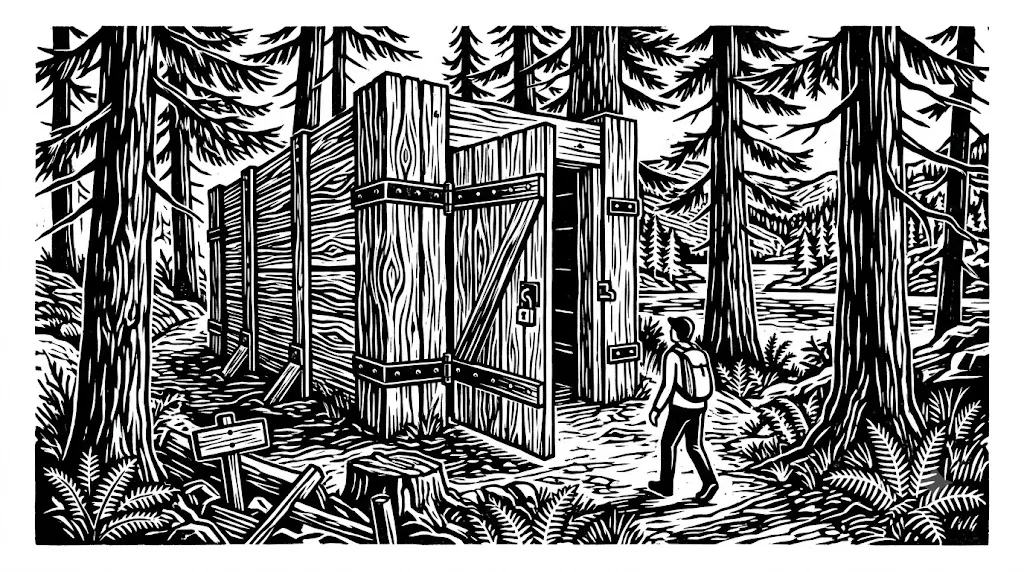
Oregon’s Bigfoot Trap is not evidence that Sasquatch exists. It is something stranger and more revealing: a real wooden trap, built in 1974 in southern Oregon, that turned a monster hunt into a hiking landmark. It stands near Applegate Lake on the Collings Mountain Trail in the Rogue River-Siskiyou National Forest, where the U.S. Forest Service now presents it as “the only bigfoot trap in the world” and a quirky stop among forest views, mining remains and local legend.[US Forest Service]fs.usda.govOpen source on usda.gov.
The story began with a miner, Perry Lovell, who reportedly found huge human-like tracks near the Applegate River. The North American Wildlife Research Team built the trap to catch whatever had made them. For six years, they baited it with carcasses. They caught bears, not Bigfoot. That failure is exactly why the trap matters as Oregon folklore: it is a physical monument to belief, doubt, outdoor humour and the Pacific Northwest habit of letting strange stories live beside ordinary trail signs.[US Forest Service]fs.usda.govOpen source on usda.gov.
Why a Bigfoot trap made sense in Oregon
Oregon already had the right cultural landscape for a Sasquatch trap before anyone nailed the planks together. Bigfoot, also called Sasquatch, is described in regional tradition as a large, hairy, elusive humanoid said to inhabit forested parts of Oregon and the wider West Coast. The Oregon Encyclopedia places the state’s documented Bigfoot record back to 1904, when settlers in the Sixes River area reported a hairy “wild man”, with later accounts from miners, hunters and woods workers adding to the pattern.[Oregon Encyclopedia]oregonencyclopedia.orgBigfoot (Sasquatch) legend…
By the 1970s, Bigfoot had become more than a campfire tale. It had entered logging culture, local jokes, roadside carvings, monster-hunting groups and newspaper-friendly mystery. The Oregon Encyclopedia notes that Bigfoot stories became part of regional folklore, with sightings, alleged tracks, pranks and serious claims all mixing together in the occupational culture of people who worked in forests. That is the world that produced the trap: not a laboratory, but a wooded frontier of rumour, recreation and do-it-yourself certainty.[Oregon Encyclopedia]oregonencyclopedia.orgBigfoot (Sasquatch) legend…
The timing also matters. In 1958, the name “Bigfoot” entered national popular culture after giant footprints were reported near Bluff Creek in northern California, and the legend grew through media coverage, hoaxes, films and disputed evidence. Smithsonian Magazine notes that the Bluff Creek tracks helped transform older wild-man and Sasquatch traditions into a modern American media phenomenon. Oregon’s trap belongs to that post-1958 boom, when some believers moved from telling stories to building devices.[Smithsonian Magazine]smithsonianmag.comSmithsonian Magazine Why Do So Many People Still Want to Believe in Bigfoot?Smithsonian Magazine Why Do So Many People Still Want to Believe in Bigfoot?

Perry Lovell’s tracks and the 1974 trap
The trap’s origin story centres on Perry Lovell, a miner who lived near the Applegate River. According to the Forest Service’s Collings Mountain Trail page, Lovell reported finding 18-inch, human-like tracks with a six-foot stride in his garden. The North American Wildlife Research Team, a now-defunct group based in Eugene, built the trap in 1974 after that claim.[US Forest Service]fs.usda.govOpen source on usda.gov.
The claim had exactly the kind of detail that makes a Bigfoot story memorable: huge tracks, a long stride, a named local witness and a remote forested setting. None of those details proves that an unknown animal made the prints. They do, however, explain why the story travelled. A vague “something in the woods” report can fade quickly; a miner’s garden tracks with measurements can become a reason to act. In this case, the action was unusually literal: a trap big enough for a monster.[US Forest Service]fs.usda.govOpen source on usda.gov.
The structure itself is part of the legend’s appeal. Atlas Obscura describes it as a 10-by-10-foot wooden square made from thick slabs of wood, bound with metal bands and secured to the ground with a telephone pole. That makes it feel less like a prop than a frontier contraption: simple, heavy, physical and slightly absurd.[Atlas Obscura]atlasobscura.comAtlas Obscura The Bigfoot Trap in JacksonvilleAtlas Obscura The Bigfoot Trap in Jacksonville
Its location adds another layer. The Collings Mountain Trail does not simply lead to a novelty box in the trees. It also passes old mining features, including mine adits, and runs through a landscape tied to nineteenth-century mining history. The Forest Service notes that the Collings Mountain area is named for two brothers who mined there in the 1850s and 1860s. So the Bigfoot Trap sits in a place already shaped by extraction, rumour, rough trails and human attempts to pull secrets out of the hills.[US Forest Service]fs.usda.govOpen source on usda.gov.
Six years of bait, bears and no Sasquatch
The trap’s active career was short and unsuccessful. The Forest Service says it was baited with carcasses for six years and produced “disappointing results”: a couple of bears were caught. Its Jackson Campground page gives the same basic outcome: the organisation operated the trap for six years, but caught only bears.[US Forest Service]fs.usda.govOpen source on usda.gov.
That result is the clearest evidence the trap provides, though not in the way its builders intended. It shows that baited carcasses in Oregon forest country attract known wildlife. Bears are a mundane explanation, but they are also exactly the kind of animal that complicates Bigfoot reports: large, dark, powerful, sometimes upright from a distance, and common enough in forested landscapes to be mistaken under poor viewing conditions. The trap’s catches therefore pull the story back towards ecology rather than cryptozoological proof.[US Forest Service]fs.usda.govOpen source on usda.gov.
There are also embellished versions of the trap story. Atlas Obscura says the trap was usually set off by bears and, in one instance, a confused hunter; other retellings add comic details about angry visitors or odd accidental captures. These details are best treated as folklore colour unless tied to strong primary documentation. They show how the trap’s failure became funnier and more repeatable over time.[Atlas Obscura]atlasobscura.comAtlas Obscura The Bigfoot Trap in JacksonvilleAtlas Obscura The Bigfoot Trap in Jacksonville
In 1980, the hatch was reportedly locked open because the trap had become a safety hazard. That detail matters because it marks the shift from “device meant to catch Bigfoot” to “object meant to be visited by people”. Once a trap cannot trap, it becomes something else: a monument, a joke, a warning, a photo stop and a story you hike towards.[Atlas Obscura]atlasobscura.comAtlas Obscura The Bigfoot Trap in JacksonvilleAtlas Obscura The Bigfoot Trap in Jacksonville

How the trap became a forest landmark
The Bigfoot Trap survives because it changed roles. The Forest Service says the structure was restored in 2006, and its current trail listing presents it as a feature of Collings Mountain Trail alongside views of the Siskiyou Crest and Applegate Lake. Travel Oregon uses similar language, inviting visitors to see “something truly unique” while noting the same origin story, six years of baiting and bear-only results.[US Forest Service]fs.usda.govOpen source on usda.gov.
This is where the phrase “roadside folklore” fits, even though the trap is not simply beside a pavement. Visitors generally reach it by walking from the Hart-tish Park area or nearby trail access. The Forest Service says an abandoned miners’ cabin and the Bigfoot Trap are encountered about 0.75 mile up the trail, while Atlas Obscura’s visitor guidance also places it about three-quarters of a mile in from the Collings Mountain Trail near Hart-Tish Park.[US Forest Service]fs.usda.govOpen source on usda.gov.
That short hike gives the attraction its special texture. It is close enough for casual curiosity, but far enough into the trees to feel like a small expedition. Oregon Wild’s hiking guide describes the route as passing through madrone, chinquapin, Douglas-fir, bigleaf maple and ponderosa pine before a short side trail leads uphill to the “legendary Bigfoot trap”. The folklore is therefore embedded in a real outdoor experience rather than sealed behind a museum case.[Oregon Wild]oregonwild.orgOregon Wild Collings Mountain (Bigfoot TrapOregon Wild Collings Mountain (Bigfoot Trap
The trail also makes the trap feel plausibly placed. The surrounding forest, creek crossings, old mine openings and views towards Applegate Lake do the work that monster stories need: they give the imagination somewhere to roam. Even a sceptical visitor can understand why a person might connect strange tracks, night noises and deep woods into a creature story.[US Forest Service]fs.usda.govOpen source on usda.gov.
What the trap proves, and what it does not
The trap does not prove Bigfoot exists. Oregon’s broader Sasquatch tradition remains a field of reports, folklore, hoaxes, disputed evidence and possible misidentifications rather than confirmed zoology. The Oregon Encyclopedia states that most scientists remain sceptical and explain the phenomenon through mistaken identification of known animals, elaborate hoaxes and planted prints.[Oregon Encyclopedia]oregonencyclopedia.orgBigfoot (Sasquatch) legend…
That scepticism is important, but it does not make the trap meaningless. In folklore terms, the Bigfoot Trap is unusually valuable because it is a built object tied to a specific claim, place and period. Many monster traditions survive as newspaper clippings, witness memories or local jokes. This one survives as timber and metal in the woods. It lets visitors stand inside the afterlife of a belief system and see how seriously some people once took the possibility of catching a Sasquatch.[US Forest Service]fs.usda.govOpen source on usda.gov.
It also shows how Bigfoot culture tolerates contradiction. The same object can be treated as a failed experiment, a tourist attraction, a hiking destination, a joke, a conservation-era curiosity and a piece of Oregon identity. The Forest Service’s own pages are evidence of that dual status: one says the Forest Service “keeps an eye on” the inactive trap but otherwise does not maintain it, while the trail page notes that it was restored in 2006 and promotes it as a unique visitor feature.[US Forest Service]fs.usda.govOpen source on usda.gov.
The safest reading is that the trap is not an official endorsement of Sasquatch. It is a managed or tolerated piece of recreation folklore on public land: interesting enough to preserve, harmless enough to joke about, and famous enough that removing it would erase a distinctive bit of southern Oregon story culture.[US Forest Service]fs.usda.govOpen source on usda.gov.
Why this Oregon oddity still works
The Bigfoot Trap endures because it gives visitors a complete story in one object. There is a reported clue, a group of believers, a practical attempt, a comic failure and a second life as a landmark. That arc is easy to understand and easy to retell, which is why the trap has become one of Oregon’s most memorable cryptid-related places.[US Forest Service]fs.usda.govOpen source on usda.gov.
It also fits Oregon’s larger relationship with Sasquatch. The state has forests deep enough to sustain mystery, outdoor communities willing to swap strange stories, and public-facing tourism that can treat Bigfoot with a wink without draining away all the wonder. Travel Oregon, Oregon Wild, Atlas Obscura and the Forest Service all frame the trap as something to visit rather than something to fear. That framing is central to its survival as roadside folklore.[traveloregon.com]traveloregon.comTravel Oregon Collings Mountain TrailTravel Oregon Collings Mountain Trail
The most honest ending is also the most Oregonian one: the trap caught no Sasquatch, and that is why people still go. A captured monster would have ended the mystery. An empty wooden cage in the forest keeps it going.
Amazon book picks
Further Reading
Books and field guides related to Why Oregon Built a Trap for Bigfoot. Use these as the next step if you want deeper reading beyond the article.
Sasquatch: Legend Meets Science
Focuses on evidence claims, tracks and investigations tied to Sasquatch lore.
Bigfoot
Explains the cultural environment that made projects like the Oregon Bigfoot Trap possible.
Field Guide To Bigfoot, Yeti, & Other Mystery Primates Worldwide
Provides broader Bigfoot context for Oregon's famous trap story.
Where the Footprints End
Explores how Bigfoot stories evolve beyond simple animal-hunt narratives.
eBay marketplace picks
Marketplace Samples
Live-tested eBay searches with available results related to this page.
Endnotes
1.
Source: fs.usda.gov
Link:https://www.fs.usda.gov/r06/rogue-siskiyou/recreation/trails/collings-mountain-trail-943
2.
Source: fs.usda.gov
Link:https://www.fs.usda.gov/r06/rogue-siskiyou/recreation/jackson-campground
3.
Source: oregonencyclopedia.org
Title: Oregon Encyclopedia
Link:https://www.oregonencyclopedia.org/articles/bigfoot_sasquatch_legend/
Source snippet
Bigfoot (Sasquatch) legend...
4.
Source: smithsonianmag.com
Title: Smithsonian Magazine Why Do So Many People Still Want to Believe in Bigfoot?
Link:https://www.smithsonianmag.com/history/why-so-many-people-still-believe-in-bigfoot-180970045/
5.
Source: atlasobscura.com
Title: Atlas Obscura The Bigfoot Trap in Jacksonville
Link:https://www.atlasobscura.com/places/the-bigfoot-trap-jacksonville-oregon
6.
Source: traveloregon.com
Title: Travel Oregon Collings Mountain Trail
Link:https://traveloregon.com/things-to-do/outdoor-recreation/hiking-backpacking/collings-mountain-trail/
7.
Source: oregonwild.org
Title: Oregon Wild Collings Mountain (Bigfoot Trap)
Link:https://oregonwild.org/resource/collings-mountain-bigfoot-trap/
8.
Source: Wikipedia
Title: Bigfoot trap
Link:https://en.wikipedia.org/wiki/Bigfoot_trap
9.
Source: Wikipedia
Link:https://en.wikipedia.org/wiki/Bigfoot
10.
Source: oregonhikers.org
Title: Bigfoot Trap
Link:https://www.oregonhikers.org/field_guide/Bigfoot_Trap
11.
Source: facebook.com
Link:https://www.facebook.com/groups/745858165479981/posts/9491722754226768/
12.
Source: truwe.sohs.org
Link:https://truwe.sohs.org/files/bigfoot.html
13.
Source: oregonwild.org
Link:https://oregonwild.org/resource/sasquatch/
14.
Source: unfamiliar.land
Title: Bigfoot Trap
Link:https://www.unfamiliar.land/bigfoot-trap/
15.
Source: fs.usda.gov
Title: rogue siskiyou
Link:https://www.fs.usda.gov/r06/rogue-siskiyou
16.
Source: usda.gov
Title: loss space threatening north american sasquatch
Link:https://www.usda.gov/about-usda/news/blog/loss-space-threatening-north-american-sasquatch
17.
Source: traveloregon.com
Title: bigfoot hiding oregons forests
Link:https://traveloregon.com/plan-your-trip/guides-tours/tours-guided-trips/bigfoot-hiding-oregons-forests/
18.
Source: southernoregon.org
Link:https://www.southernoregon.org/cities/applegate/outdoor-recreation/trails/collings-mountain-trail/
19.
Source: thatoregonlife.com
Title: bigfoot trap
Link:https://thatoregonlife.com/2018/05/bigfoot-trap/
Additional References
20.
Source: youtube.com
Title: What’s INSIDE Oregon’s Hidden BIGFOOT TRAP?
Link:https://www.youtube.com/watch?v=0bJ_2byMrN4
Source snippet
Historic Bigfoot Trap of Collings Mountain Trail - Sasquatch Country...
21.
Source: youtube.com
Link:https://www.youtube.com/watch?v=0fDr8sXBNgw
Source snippet
Real Life BIGFOOT Trap!! | Applegate Lake, Oregon...
Published: June 2009
22.
Source: dotycoyote.com
Link:https://www.dotycoyote.com/writing/bigfoot.html
23.
Source: reddit.com
Link:https://www.reddit.com/r/Cryptozoology/comments/189ygc9/a_point_i_disagree_with_bigfoot_skeptics_on/
24.
Source: facebook.com
Link:https://www.facebook.com/CBSNewsTexas/posts/also-known-as-bigfoot-sasquatch-is-a-mythical-creature-that-in-folklore-is-said-/1033079938849959/
25.
Source: facebook.com
Link:https://www.facebook.com/VisitGrantsPass/posts/breaking-newsafter-over-50-years-the-collings-mountain-bigfoot-trap-has-finally-/1405999948235600/
26.
Source: instagram.com
Link:https://www.instagram.com/p/DWl3t5GgIyD/
27.
Source: facebook.com
Link:https://www.facebook.com/groups/ForgottenOregon/posts/2665129850421603/
28.
Source: scribd.com
Link:https://www.scribd.com/document/1008407218/Bigfoot-Exposed-An-Anthropologist-Examines-America-s-Enduring-Legend-ISBN-9780759105386-0759105383-All-Sections-Download
29.
Source: facebook.com
Link:https://www.facebook.com/groups/ForgottenOregon/posts/2083910461876881/
Topic Tree