Within Missouri Monsters
Missouri's Forgotten Wild Man Before Bigfoot
The Blue Man shows that Missouri's hairy humanoid lore was already circulating through Ozark stories and newspapers before Bigfoot fame.
On this page
- Spring Creek tales and county clusters
- Newspaper headlines before modern media
- Local pride, pushback and later revivals
Page outline Jump by section
Introduction
The Blue Man of Spring Creek is Missouri’s forgotten wild-man legend: a rough, hairy, man-like figure said to haunt the Ozark hills around Spring Creek, Indian Creek, the North Fork and the Douglas–Howell county border long before “Bigfoot” became the standard American word for such reports. The story matters because it shows that Missouri’s hairy-humanoid lore did not begin with Mo Mo in 1972. By 1915, newspapers were already circulating accounts of an Ozark “wild man” with huge tracks, a club, animal skins, livestock thefts and a den full of bones. Some articles treated the tale as a genuine local mystery; others clearly recognised it as tall-story country humour, regional boosterism or newspaper entertainment. The result is not strong evidence for an unknown animal, but it is excellent evidence for an older Missouri monster tradition: one rooted in creeks, timber country, county pride, oral storytelling and the awkward gap between local folklore and outside sensationalism.[Ozarks Alive]ozarksalive.comOzarks Alive The Blue Man, an Ozarks legend long told – but nearlyOzarks Alive The Blue Man, an Ozarks legend long told – but nearly
What was the Blue Man supposed to be?
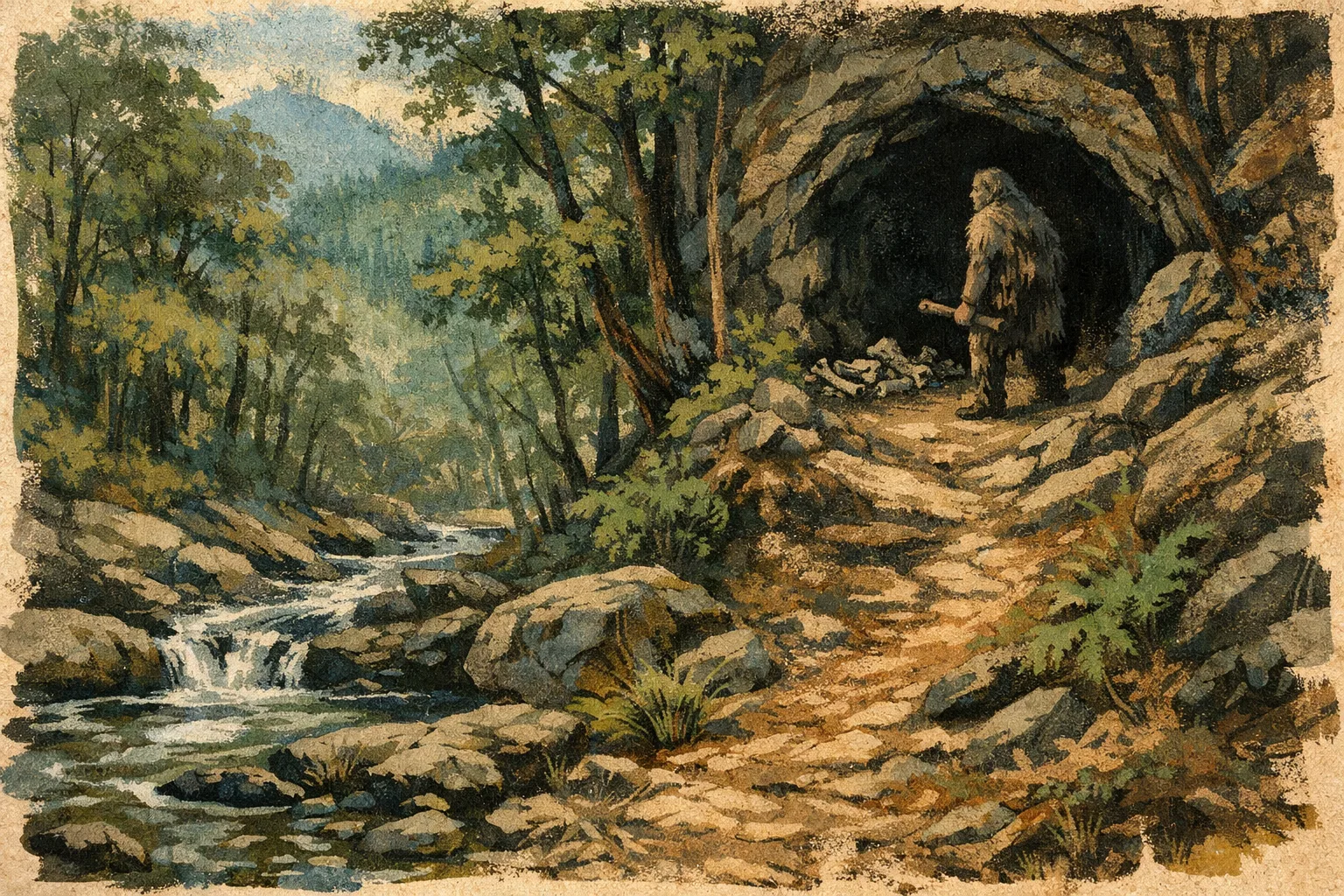
The Blue Man was usually described less like a modern ape-man and more like a feral borderland figure: human-shaped, powerful, elusive, partly clothed, and living beyond ordinary settlement. In the most repeated version, he carried a heavy wooden club, wore animal skins or a breechcloth, left tracks that could be mistaken for a bear’s, and was accused of killing or stealing livestock. Later cryptid summaries often call him Sasquatch-like, but the older newspaper material is more ambiguous. It mixes “wild man”, “man-like animal”, outlaw hermit, ancestral legend and monster tale in a way that feels very different from later Bigfoot reports.[Ozarks Alive]ozarksalive.comOzarks Alive The Blue Man, an Ozarks legend long told – but nearlyOzarks Alive The Blue Man, an Ozarks legend long told – but nearly
The name “Blue Man” was itself unstable. One explanation says he was named after “Blue Sol” Collins, the hunter credited with the first famous sighting. Another says his dark hair or skin had a bluish-black cast. A third version claims he wore skins and feathers stained blue with berries. That uncertainty is important: the legend was not a single fixed eyewitness report, but a story-family that changed depending on who told it, where it was printed, and whether the teller wanted mystery, comedy or local colour.[Ozarks Alive]ozarksalive.comOzarks Alive The Blue Man, an Ozarks legend long told – but nearlyOzarks Alive The Blue Man, an Ozarks legend long told – but nearly
The creature’s “blue” quality also separates him from later Missouri Bigfoot figures. Mo Mo is remembered for stink, shaggy hair and a dramatic 1972 neighbourhood flap. The Blue Man is older and stranger: less a neatly categorised cryptid than a hill-country wild man who sits between folk memory, frontier fear and newspaper yarn.
Spring Creek tales and county clusters
The Blue Man’s strongest geography is not all of Missouri, but a tight Ozark cluster in the south-central part of the state. The most repeated locations are the rough country around Spring Creek, Indian Creek, the Big North Fork and the eastern end of Douglas County, with links into Howell County and occasional references to Ozark County. A 1915 account connected the legend to the divide between North Fork and Spring Creek and to the hills around upper Twin Mountain; later local writing ties the story to Willow Springs, Blue Rock Mountain, Douglas County wood haulers and the county-border world where one community’s local rumour could become another county’s headline.[Ozarks Alive]ozarksalive.comOzarks Alive The Blue Man, an Ozarks legend long told – but nearlyOzarks Alive The Blue Man, an Ozarks legend long told – but nearly
That landscape matters. The Missouri Department of Conservation describes the Ozark highlands of southern Missouri as an eroded upland of limestone, dolomite and chert, cut by deep valleys and marked by karst features such as caves, springs and sinkholes. This is precisely the sort of terrain that makes wild-man stories believable at the level of setting: steep slopes, wooded hollows, creek bottoms, animal tracks in snow, caves, livestock ranges and long distances between neighbours.[Missouri Department of Conservation]mdc.mo.govOpen source on mo.gov.
The classic origin scene is almost cinematic. In the story printed from the 1915 newspaper tradition, Blue Sol Collins follows large, claw-marked tracks after a light snow. He expects a bear-like animal, but instead sees a human-looking figure hurling boulders down a hillside. The detail of the snow is doing useful folklore work: it gives the tale a tracker’s logic, a reason to follow the mystery, and a physical clue that seems more concrete than a vague glimpse in the woods.[Ozarks Alive]ozarksalive.comOzarks Alive The Blue Man, an Ozarks legend long told – but nearlyOzarks Alive The Blue Man, an Ozarks legend long told – but nearly
The livestock element gave the legend practical weight. Reports and retellings accused the Blue Man of taking lambs, hogs or other animals; a supposed 1911 raid on his den allegedly found sheep pelts, hog hides, dog skins, bones, feathers and remains from past feasts. Whether or not such a den existed as described, the motif is revealing. The Blue Man was not only a thing seen in the woods; he was a possible explanation for missing stock, strange tracks, scavenged remains and the unease of living beside rough country.[Ozarks Alive]ozarksalive.comOzarks Alive The Blue Man, an Ozarks legend long told – but nearlyOzarks Alive The Blue Man, an Ozarks legend long told – but nearly

Newspaper headlines before modern Bigfoot
The Blue Man’s best-documented public life came through newspapers, especially in 1915 and again in the mid-1920s. This is the period that makes the legend so valuable for Missouri cryptid history. It predates the famous 1958 northern California “Bigfoot” name explosion and, in Missouri terms, comes decades before Mo Mo. Instead of television crews or internet forums, the transmission system was the small-town press: local editors, reprinted columns, county jokes, sensational headlines and readers who enjoyed a strange tale from the hills.
Several 1915 titles survive in later source lists and local histories, including “Ozark Wild Man Again Reported in His Old Haunts”, “Find a Wild Man in Ozarks”, “The Blue Man of Howell County” and “Famous ‘Blue Man’ of Ozarks Again Harries Country”. These titles show how rapidly the story moved from a local creek-and-county legend into a statewide and even national newspaper curiosity. Howell County News, revisiting the case in 2026, notes that editor-publisher Will Zorn’s 1915 version was picked up by newspapers across Missouri and beyond, and that Zorn became a point of attention among fellow newspapermen that summer.[Howell County News]howellcountynews.comwhen blue man roamed howell countywhen blue man roamed howell county
The 1915 version also tried to give the Blue Man a genealogy. One account, attributed to old-settler lore through Jerry Hilterbrand or Hildebrand, claimed he descended from French traders, a Spanish woman from Florida and Indigenous ancestry. Another origin story, later mentioned in connection with Lost Camp Valley in Howell County, involved a child lost by a family moving towards the gold fields. These ancestry tales should not be treated as reliable history; they are better understood as attempts to pull a frightening wild figure into a frontier romance about lost children, mixed ancestry, old trails and settlement memory.[Howell County News]howellcountynews.comwhen blue man roamed howell countywhen blue man roamed howell county
The key point is that newspapers did not merely preserve the Blue Man legend. They helped shape it. They gave it dates, names, locations, jokes, den raids, ageing hair, county arguments and a public audience. Without those printed versions, the Blue Man might have remained a fading creek-bottom tale. With them, he became one of Missouri’s earliest documented wild-man legends.
Local pride, pushback and the problem of being laughed at
Not everyone welcomed the publicity. One of the most interesting parts of the Blue Man story is the pushback from residents who felt the legend made their region look foolish or dangerous. Ozarks Alive quotes a 1915 Springfield Leader response saying residents of the district objected to the stories because they created the impression that people had to go “armed-to-the-teeth” to protect themselves. That is a familiar pattern in monster folklore: outsiders enjoy the weird tale, while locals may worry it turns their home into a joke.[Ozarks Alive]ozarksalive.comOzarks Alive The Blue Man, an Ozarks legend long told – but nearlyOzarks Alive The Blue Man, an Ozarks legend long told – but nearly
The St. Joseph treatment appears to have leaned comic, turning the Blue Man into a kind of press-meeting entertainment. That reaction matters because it shows the legend operating on two levels at once. Close to Spring Creek, it could be framed as a local mystery or family story. Farther away, it became an Ozark curiosity: colourful, rustic, faintly mocking, and useful for filling newspaper space.[Ozarks Alive]ozarksalive.comOzarks Alive The Blue Man, an Ozarks legend long told – but nearlyOzarks Alive The Blue Man, an Ozarks legend long told – but nearly
This tension also explains why the Blue Man could be both remembered and forgotten. Some residents grew up hearing about him from relatives, while others with deep local roots reportedly knew little or nothing of the tale when asked in the twenty-first century. Ozarks Alive found that even in the region most associated with the legend, memory was patchy: a few people knew the story well, but others were puzzled by it.[Ozarks Alive]ozarksalive.comOzarks Alive The Blue Man, an Ozarks legend long told – but nearlyOzarks Alive The Blue Man, an Ozarks legend long told – but nearly
Ozark storytelling culture gives that patchiness context. Folklorist Vance Randolph, who lived and worked in the Ozarks and collected regional stories, songs and beliefs from the 1920s onward, is a reminder that local oral tradition could be rich, comic, bawdy, exaggerated and family-specific rather than centrally organised. The State Historical Society of Missouri describes Randolph as collecting songs and stories handed down orally in the isolated Ozark region; the Library of Congress finding aid for his collection likewise records his major work on Ozark folksongs, superstitions and folktales.[SHSMO Historic Missourians]historicmissourians.shsmo.orgHistoric Missourians Vance RandolphHistoric Missourians Vance Randolph
In that kind of storytelling world, a wild-man legend did not need to be universally known to be culturally real. It only needed a few families, hunters, editors, children, wood haulers and “kidders” to keep it moving.

What might explain the older wild-man reports?
The most cautious reading is that the Blue Man is a folklore-and-newspaper legend rather than evidence for an undiscovered Missouri primate. The story has too many changing parts: uncertain name origins, doubtful genealogies, comic exaggerations, far-travelling newspaper versions, and claims that become more dramatic as they move away from the creek-country setting. The 1925 revival is especially revealing. According to Ozarks Alive, Ava’s postmaster responded to an outside enquiry with an obviously extravagant version involving blue children, huge cave-dwellers and raw-animal diets; the Nevada paper itself reportedly recognised that outsiders were prone to swallowing the old story whole.[Ozarks Alive]ozarksalive.comOzarks Alive The Blue Man, an Ozarks legend long told – but nearlyOzarks Alive The Blue Man, an Ozarks legend long told – but nearly
That does not mean every sighting detail has to be invented from nothing. Several ordinary ingredients could help generate or sustain wild-man stories in the Ozarks:
Misread animal sign. The original Collins scene begins with tracks that looked somewhat like a bear’s. Missouri has real black bears today, mostly south of Interstate 44, and the species is part of the Ozark wildlife picture even though historical abundance has changed over time. A bear walking, feeding, standing briefly, raiding livestock or leaving large tracks can produce surprisingly human-like impressions in poor conditions.[Missouri Department of Conservation]mdc.mo.govOpen source on mo.gov.
Large predators and livestock anxiety. The Blue Man was blamed for missing or damaged animals. In real rural life, livestock losses can involve dogs, scavengers, bears, coyotes, disease, theft or simple disappearance in rough terrain. Missouri officials make a similar point in another context when discussing mountain-lion reports: many compelling sightings do not produce confirming evidence, and animals such as dogs, bobcats, house cats, coyotes, foxes and deer have been mistaken for something rarer.[Missouri Department of Conservation]mdc.mo.govOpen source on mo.gov.
Hermit and “wild man” folklore. The older Blue Man is closer to the nineteenth-century “wild man” newspaper type than to the later Bigfoot template. He is not simply an ape; he has clothing, ancestry rumours, a den, tools and near-human habits. That makes him easy to read as a story about people living outside society as much as a story about an unknown beast.
Tall-tale escalation. Once a tale enters newspapers, each retelling can sharpen the details. A strange track becomes a huge track; an elusive animal becomes a club-carrying man-beast; a pile of bones becomes a den; a local rumour becomes a county disgrace or a statewide laugh.
The strongest sceptical explanation is therefore not one single animal. It is a mixture: real tracks, real woods, real livestock losses, possible misidentifications, local humour, old-settler legend and newspaper amplification.
How the Blue Man differs from Mo Mo and modern Bigfoot
Modern readers often want to know whether the Blue Man was simply “Missouri Bigfoot before Bigfoot”. The answer is: partly, but not neatly. He belongs to the same broad family of hairy-humanoid stories, yet his details come from an older wild-man tradition. Later Bigfoot stories tend to emphasise an unknown ape-like species, large footprints, wood knocks, howls, forest corridors and eyewitness testimony. The Blue Man’s older versions emphasise a named region, a semi-human figure, animal skins, a club, rumours of ancestry, livestock theft and the possibility of a den.
That difference changes the feel of the legend. Mo Mo became famous through a short, dramatic 1972 flap at Louisiana, Missouri, with children, police attention, media coverage and a memorable monster nickname. The Blue Man was slower and older: a recurring rumour said to stretch from the 1860s through 1915, then revived in newspaper nostalgia and later cryptid television. He is less a single outbreak than a case-family, with each version adding or trimming details.[Ozarks Alive]ozarksalive.comOzarks Alive The Blue Man, an Ozarks legend long told – but nearlyOzarks Alive The Blue Man, an Ozarks legend long told – but nearly
The Blue Man also shows that Missouri’s monster landscape was not merely importing the Pacific Northwest’s Bigfoot mythology. Southern Missouri already had its own rough-country template: the wooded Ozarks, old creeks, caves, spring branches, hunters, tie haulers, livestock and small papers. When Bigfoot culture later became national, the Blue Man could be reinterpreted as a local Sasquatch. But historically, he began as something more regionally specific.
Later revivals and the television afterlife
The Blue Man never became as famous as Mo Mo, but he did not disappear entirely. Local writers, history blogs and cryptid sites have revived the story from old newspaper clippings, often emphasising its value as an early Ozark Sasquatch-like account. Ozarks Alive’s 2017 feature is especially important because it treats the Blue Man as both legend and local memory, quoting historians and residents rather than simply repeating the monster version.[Ozarks Alive]ozarksalive.comOzarks Alive The Blue Man, an Ozarks legend long told – but nearlyOzarks Alive The Blue Man, an Ozarks legend long told – but nearly
Television also gave the legend a second life. In 2015, Animal Planet’s Finding Bigfoot aired “A Squatch in the Ozarks”, an episode built around the idea of the Blue Man as a local Sasquatch. Episode listings describe the team travelling into Ozark hollows to investigate the legendary Blue Man, while a local participant later wrote about helping stage historical re-enactments of the 1865 and 1911 episodes.[imdb.com]imdb.comOpen source on imdb.com.
That revival came with a warning from within the story world itself. Vincent Anderson, an Ozark County researcher and reference librarian who helped connect the show to the legend, told Ozarks Alive that “reality TV is not reality” and said the filmed material and broadcast version differed. He also questioned some of the programme’s modern claims, while allowing that some ordinary people believe they have had disturbing experiences.[Ozarks Alive]ozarksalive.comOzarks Alive The Blue Man, an Ozarks legend long told – but nearlyOzarks Alive The Blue Man, an Ozarks legend long told – but nearly
This is a useful way to understand the Blue Man’s modern afterlife. Television made the legend easier to find, but also pushed it towards the familiar Bigfoot-hunt format. The older tale is stranger and more historically interesting than that format suggests.

Why the Blue Man still matters in Missouri monster lore
The Blue Man’s importance is not that he proves a creature was hiding in Douglas County. It is that he preserves an earlier layer of Missouri’s mystery-beast tradition. Before Mo Mo, before cable cryptid shows, before internet sighting databases, the Ozarks already had a wild-man figure moving through newspaper columns and local talk. He was tied to specific watercourses and counties, not just a vague “deep woods”. He caused local pride and local embarrassment. He could be frightening in one telling, comic in another and nostalgic in a third.
For Missouri cryptid history, the Blue Man is best read as a bridge. On one side are older Ozark tall tales, settler legends, hunting stories and newspaper “wild man” items. On the other side are modern Bigfoot-style claims, television investigations and public-facing cryptid culture. The Blue Man stands between them: not a confirmed animal, not merely a modern invention, and not quite forgotten.
That makes him one of the most valuable minor figures in Missouri’s monster map. He reminds readers that state cryptid lore is not only about the biggest famous case. Sometimes the more revealing legend is the one half-buried in old county papers, still carrying snow tracks, creek names, livestock rumours and the sound of Ozarkers arguing over whether the outside world has mistaken a local joke for a monster.
Amazon book picks
Further Reading
Books and field guides related to Missouri's Forgotten Wild Man Before Bigfoot. Use these as the next step if you want deeper reading beyond the article.
Ozark Magic and Folklore
Directly connects to Ozark storytelling, legends, and folk traditions behind the Blue Man accounts.
Mysterious America
Covers American mystery creatures and regional wild-man traditions that frame the Blue Man story.
Ozark Superstitions
Documents beliefs and traditions from the same cultural landscape as the Blue Man legend.
eBay marketplace picks
Marketplace Samples
Live-tested eBay searches with available results related to this page.



Endnotes
1.
Source: newspapers.com
Link:https://www.newspapers.com/article/12682509/blue-man-in-douglas-county-kaleb-you/
2.
Source: historicmissourians.shsmo.org
Title: Historic Missourians Vance Randolph
Link:https://historicmissourians.shsmo.org/vance-randolph/
3.
Source: imdb.com
Link:https://www.imdb.com/title/tt4836414/
4.
Source: ozarkshistory.blogspot.com
Title: finding bigfoot in ozarks
Link:https://ozarkshistory.blogspot.com/2015/06/finding-bigfoot-in-ozarks.html
5.
Source: ozarkshistory.blogspot.com
Title: Ozark Sasquatch
Link:https://ozarkshistory.blogspot.com/2011/03/ozark-sasquatch.html
6.
Source: ozarkshistory.blogspot.com
Title: Ozark Sasquatch
Link:https://ozarkshistory.blogspot.com/2011/03/ozark-sasquatch-part-2.html
7.
Source: imdb.com
Link:https://www.imdb.com/title/tt4836414/plotsummary/
8.
Source: ozarksalive.com
Title: Ozarks Alive The Blue Man, an Ozarks legend long told – but nearly
Link:https://www.ozarksalive.com/stories/blue-man-ozarks-legend-long-told-nearly-forgotten
9.
Source: howellcountynews.com
Title: when blue man roamed howell county
Link:https://www.howellcountynews.com/history/when-blue-man-roamed-howell-county
10.
Source: mdc.mo.gov
Link:https://mdc.mo.gov/discover-nature/habitats/forests-woodlands
11.
Source: mdc.mo.gov
Link:https://mdc.mo.gov/discover-nature/habitats/caves-karst
12.
Source: mdc.mo.gov
Link:https://mdc.mo.gov/wildlife/report-wildlife-sightings/bear-reports
13.
Source: mdc.mo.gov
Link:https://mdc.mo.gov/wildlife/mdc-management-plans/black-bear-management-missouri
14.
Source: mdc.mo.gov
Link:https://mdc.mo.gov/wildlife/report-wildlife-sightings/mountain-lion-reports
15.
Source: facebook.com
Link:https://www.facebook.com/FOX2Now/posts/the-missouri-department-of-conservation-is-offering-a-rare-glimpse-into-the-wint/1504634314586527/
16.
Source: mdc.mo.gov
Title: douglas branch conservation area
Link:https://mdc.mo.gov/discover-nature/places/douglas-branch-conservation-area
17.
Source: mdc.mo.gov
Title: confirmed mountain lion reports
Link:https://mdc.mo.gov/wildlife/report-wildlife-sightings/mountain-lion-reports/confirmed-mountain-lion-reports
18.
Source: mdc.mo.gov
Title: places go
Link:https://mdc.mo.gov/magazines/conservationist/2012-12/places-go
19.
Source: libraries.uark.edu
Link:https://libraries.uark.edu/specialcollections/research/guides/folklore/randolph.php
20.
Source: ozarksalive.com
Title: eight unique ozarks legends
Link:https://www.ozarksalive.com/stories/eight-unique-ozarks-legends
21.
Source: mijnserie.nl
Link:https://www.mijnserie.nl/finding_bigfoot/afleveringen/seizoen_7/aflevering_5/
22.
Source: openlibrary.org
Title: Vance Randolph
Link:https://openlibrary.org/authors/OL160555A/Vance_Randolph
Additional References
23.
Source: youtube.com
Title: The [Ozark Howler]({{ ‘howler/’ | relative_url }}): A Beast That Shouldn’t Exist
Link:https://www.youtube.com/watch?v=X_p1TLjqvoo
Source snippet
Ozark Monsters and Mysteries - The Foulk Monster, Goatman, and Spook Light Explained...
24.
Source: facebook.com
Link:https://www.facebook.com/AnimalPlanet/posts/kansass-great-plains-have-no-mountains-and-little-in-the-way-of-forests-could-th/704960505011729/
25.
Source: facebook.com
Link:https://www.facebook.com/moconservation/posts/hikers-and-campers-be-bear-aware-bear-sightings-in-missouri-are-becoming-more-co/10159193243197962/
26.
Source: facebook.com
Link:https://www.facebook.com/100069951171618/posts/bigfoot-may-have-been-spotted-at-top-of-the-rock-in-branson-missouri-stunned-tou/1070114638663565/
27.
Source: facebook.com
Link:https://www.facebook.com/KCTV5/posts/a-rare-black-bear-sighting-at-the-lake-of-the-ozarks-has-officials-providing-rem/1426777356161892/
28.
Source: facebook.com
Link:https://www.facebook.com/groups/1565114127094467/posts/2067888473483694/
29.
Source: explorebranson.com
Link:https://www.explorebranson.com/blog-explore/blog/post/campfire-stories-ozark-folklore/
30.
Source: instagram.com
Link:https://www.instagram.com/p/C6CCZSnRuYp/
31.
Source: reddit.com
Link:https://www.reddit.com/r/ozarks/comments/j7linc/famous_blue_man_of_ozarks_again_harries_country/
32.
Source: facebook.com
Link:https://www.facebook.com/moconservation/videos/forests-and-woodlands/1742852789181972/
Topic Tree