Within Wyoming Monsters
Is Smetty Wyoming's Loch Ness Story?
Smetty is Wyoming's main lake-monster legend, built from serpent-like sightings, old local accounts and a deep-water setting.
On this page
- Lake De Smet as a monster setting
- Sea serpent accounts from ranchers and travellers
- Why lake monsters thrive on shadows and wakes
Page outline Jump by section
Introduction
Smetty is Wyoming’s home-grown lake monster: a serpent-like creature said to live in Lake DeSmet, a large reservoir just north of Buffalo in Johnson County. The story matters because it is not simply a modern “Wyoming Nessie” pasted onto a scenic lake. Its strongest version comes through local ranching memories, Edward Gillette’s 1925 memoir of railroad surveying, and older water-spirit and drowning traditions attached to the lake. At the same time, the evidence is thin, mostly second-hand, and shaped by exactly the conditions that make lake monsters thrive: deep water, mist, wind-driven waves, odd wakes, big fish, campfire warnings and a landscape already full of dramatic geology. The most careful reading is that Smetty is a durable local legend, not a confirmed animal — but it is one of Wyoming’s clearest examples of a place-based monster tradition.[visitbuffalowy.com]visitbuffalowy.comVisit Buffalo WYThe Mysteries of Lake De Smet | Visit Buffalo & Kaycee WYVisit Buffalo WYThe Mysteries of Lake De Smet | Visit Buffalo & Kaycee WY
Lake DeSmet as a monster setting
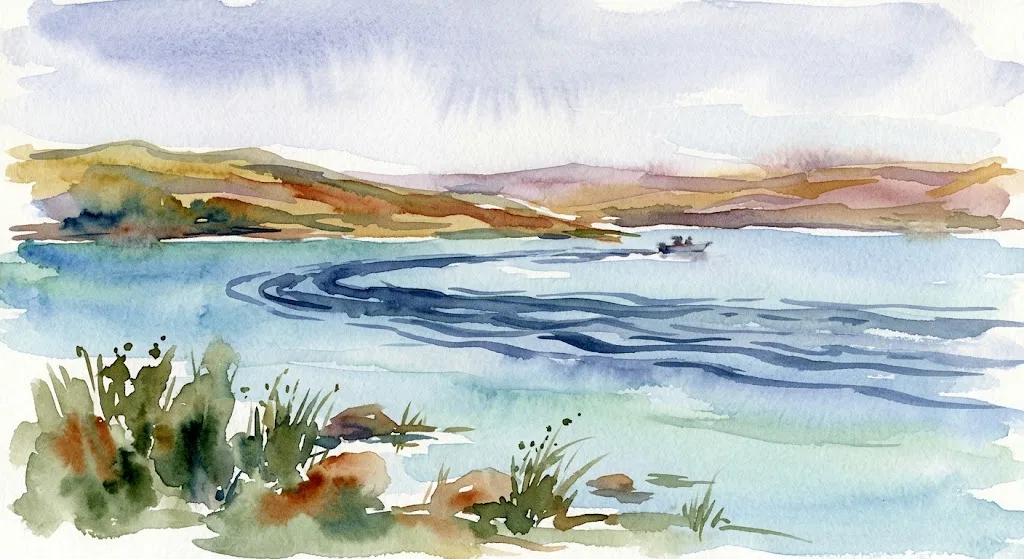
Lake DeSmet has the right stagecraft for a water monster story. It lies in Johnson County, north of Buffalo, close enough to roads and ranches to gather witnesses, but open and moody enough to feel bigger than ordinary recreation. Johnson County’s own Lake DeSmet Operating Department gives the modern reservoir’s maximum depth as 120 feet and its capacity as 234,987 acre-feet; Wyoming Game and Fish material describes the lake as almost 3,600 acres, with trout and walleye among the fish anglers may catch. Those figures do not prove anything monstrous, but they explain why the lake can feel like a credible hiding place in local imagination.[Johnson County Wyoming]johnsoncowy.govOpen source on johnsoncowy.gov.
The lake’s natural history adds another layer. Local tourism accounts describe Lake DeSmet as a basin formed after underground coal deposits burned and the overlying material collapsed; the U.S. Geological Survey has a dedicated 1959 report on the geology and coal resources of the Buffalo-Lake DeSmet area, confirming the region’s serious coal-geology context. That origin story gives the lake a stranger-than-average feel: not just a pretty water body at the foot of the Bighorns, but a place tied to buried fire, red clinker rock and subsidence.[Visit Buffalo WY]visitbuffalowy.comVisit Buffalo WYThe Mysteries of Lake De Smet | Visit Buffalo & Kaycee WYVisit Buffalo WYThe Mysteries of Lake De Smet | Visit Buffalo & Kaycee WY
Older descriptions also made the lake sound less inviting than it looks today. When the Bozeman Trail and the Powder River Expedition passed the area in the 1860s, Lake DeSmet was described as strongly alkaline; a tourism history quotes Captain Henry Palmer saying an egg or potato would not sink in it. The same account says the lake’s salinity later decreased during a wetter period from about 1880 to 1915, before irrigation works changed it further. In folklore terms, that matters: a lake that was once brackish, odd-tasting, dangerous to swimmers, and later altered by dams and diversions is exactly the sort of place where practical warnings can become supernatural stories.[Visit Buffalo WY]visitbuffalowy.comVisit Buffalo WYThe Mysteries of Lake De Smet | Visit Buffalo & Kaycee WYVisit Buffalo WYThe Mysteries of Lake De Smet | Visit Buffalo & Kaycee WY
Smetty also benefits from the lake’s position in Wyoming’s travel history. The Lake DeSmet Segment of the Bozeman Trail lies about a mile west of the water, and travellers in the 1860s mentioned the lake in emigrant diaries, sometimes under variant names such as Smith or Smith’s Lake. This was not an isolated pond known only to one family. It sat beside movement: Indigenous routes, military expeditions, settler travel, ranching, later railway surveying and now boating and fishing. Each era had a chance to add its own explanation for strange water, missing bodies, sudden waves or stories told to keep children away from danger.[Wikipedia]WikipediaLake Desmet Segment, Bozeman TrailLake Desmet Segment, Bozeman Trail

What is Smetty supposed to be?
The core Smetty image is not a furry beast or a ghostly figure onshore. It is usually a water creature: a long, fast, serpent-like or alligator-like animal that breaks the surface, throws up a wake, and vanishes before anyone can get a close look. Modern local media commonly frame it as “Wyoming’s Loch Ness Monster”, but the older descriptions are more varied and less polished than that label suggests.[101.9 KING FM]kingfm.com101.9 KING FMMeet 'Smetty101.9 KING FMMeet 'Smetty
Several recurring features appear across the better-known accounts:
- A long body: witnesses compare it to a telephone pole, a serpent, or a 30-to-40-foot creature.
- Visible movement rather than a clear body: many accounts focus on commotion, waves, speed, or a rising head.
- Uncertain anatomy: descriptions include fins, flappers, a bony ridge, a horse-like mane, alligator traits, or even stranger “flying fish” and gargoyle-like forms.
- A sudden disappearance: the creature is usually glimpsed briefly, then lost in the lake.
That variety is important. In strong zoological evidence, repeated witnesses tend to narrow a description. In folklore, repeated witnesses often expand it. Smetty has not become more precise over time; it has become more flexible. That does not make the story worthless, but it does shift it from “unknown animal file” toward “living local legend with eyewitness-style episodes”.[Wyoming Room]wyomingroom.blogspot.comWyoming Room The Wyoming RoomWyoming Room The Wyoming Room
The 1925 account that anchors the legend
The main reason Smetty has more weight than a casual campfire joke is Edward Gillette. Gillette was not an anonymous storyteller; WyoHistory describes him as a surveyor, Sheridan businessman, water official and later Wyoming state treasurer, and notes that his autobiography was titled Locating the Iron Trail. His career in railroad surveying makes him a significant regional source, even if his lake-monster passage still depends on reported testimony rather than specimen evidence.[WyoHistory]wyohistory.orgWyo History Edward Gillette: Surveyor, Statesman, Entrepreneur | Wyo History.orgWyo History Edward Gillette: Surveyor, Statesman, Entrepreneur | Wyo History.org
According to the Visit Buffalo & Kaycee summary of Gillette’s 1925 book, he surveyed the Lake DeSmet area in 1910 while considering a possible railroad line from Sheridan to Casper. He described the lake as brackish but able to support some aquatic life, and said his own swimming party retreated after seeing ugly fish with large heads, mouths and teeth. That detail is easily overlooked, but it matters: Gillette’s monster discussion begins in a lake he already presented as biologically odd, not in a neutral swimming hole.[Visit Buffalo WY]visitbuffalowy.comVisit Buffalo WYThe Mysteries of Lake De Smet | Visit Buffalo & Kaycee WYVisit Buffalo WYThe Mysteries of Lake De Smet | Visit Buffalo & Kaycee WY
Gillette then repeated older “sea serpent” tales, including a story that a water animal resembling an alligator with longer legs seized a small child from an Indigenous camp. He also speculated about drownings in which bodies were not recovered, noting conventional explanations such as cramps or entanglement in grass before suggesting that the serpent tale might explain them. This is where the account needs careful handling. Gillette was recording and interpreting local lore, not producing forensic evidence. The missing bodies and drowning fears may explain why a monster story stuck, but they cannot confirm that a monster caused the deaths.[Visit Buffalo WY]visitbuffalowy.comVisit Buffalo WYThe Mysteries of Lake De Smet | Visit Buffalo & Kaycee WYVisit Buffalo WYThe Mysteries of Lake De Smet | Visit Buffalo & Kaycee WY
The most famous episode involves the Barkey family. Gillette wrote that a rancher named Barkey, who owned property around the lake, and his wife said they had seen two sea serpents making a great commotion and moving “as fast as a horse could trot”. Mrs Barkey’s comparison — a long telephone pole with lard buckets attached — gave Smetty one of its most memorable images, suggesting a long body with fins or flappers along the sides. A later Sheridan Media article summarising a History After Dark presentation repeats the same Barkey account, showing how that image has remained central to the legend.[Visit Buffalo WY]visitbuffalowy.comVisit Buffalo WYThe Mysteries of Lake De Smet | Visit Buffalo & Kaycee WYVisit Buffalo WYThe Mysteries of Lake De Smet | Visit Buffalo & Kaycee WY
Gillette’s second named witness was Arthur Senff, a rancher living about a mile north of the lake. Gillette said Senff was originally sceptical of the Barkeys’ story, but later saw a serpent raise its head several feet out of the water and rush down the lake, throwing up waves large enough to threaten a small boat. Gillette concluded that he had no reason to doubt the ranchers, though his own interpretation — that the lake might contain specimens of a supposedly extinct water animal — reads today as speculation rather than evidence.[Visit Buffalo WY]visitbuffalowy.comVisit Buffalo WYThe Mysteries of Lake De Smet | Visit Buffalo & Kaycee WYVisit Buffalo WYThe Mysteries of Lake De Smet | Visit Buffalo & Kaycee WY
Ranchers, travellers and the problem of second-hand testimony
Smetty’s best stories come from people who were presented as practical, local and initially sceptical. That is a powerful folklore pattern. A rancher who knows the lake and doubts the tale until he sees something is a more compelling witness than a tourist who wants a thrill. The Barkey and Senff episodes work because they are framed as reluctant testimony from people familiar with the country.[Visit Buffalo WY]visitbuffalowy.comVisit Buffalo WYThe Mysteries of Lake De Smet | Visit Buffalo & Kaycee WYVisit Buffalo WYThe Mysteries of Lake De Smet | Visit Buffalo & Kaycee WY
But the same pattern creates a risk. Most surviving accounts are not direct interviews preserved with dates, weather, distance, light conditions and exact locations. They are retellings: Gillette repeating what ranchers told him, later writers repeating Gillette, local-history blogs summarising library holdings, and modern travel outlets compressing the legend for readers. The Wyoming Room at Sheridan County Fulmer Library is unusually helpful because it openly says hard evidence is scarce, then lists several reported accounts held in books and articles: three ranchers seeing a sea-serpent-like shadow in 1892, Frank Krout seeing something like a wet bay mare in 1924, and Mrs Oliver Townsend recalling a ranch hand’s 30-to-40-foot serpent with a bony ridge near the head.[Wyoming Room]wyomingroom.blogspot.comWyoming Room The Wyoming RoomWyoming Room The Wyoming Room
Those stories broaden Smetty’s claim base, but they also show how unstable the creature’s form is. One account gives a shadow. Another gives a wet horse-like shape. Another gives a brownish-black serpent with its head held high. Later summaries include everything from an alligator-like creature to a giant seahorse or a blob that upsets boats. That is exactly what sceptics would expect if witnesses were interpreting ambiguous water events through an existing monster tradition. It is also exactly what folklore collectors expect when a legend remains active across generations.[Wyoming Room]wyomingroom.blogspot.comWyoming Room The Wyoming RoomWyoming Room The Wyoming Room
The most honest conclusion is that the testimony is culturally strong but evidentially weak. It is strong because it has named places, named families, and a century of repetition in the Sheridan-Buffalo region. It is weak because the surviving record lacks physical remains, clear photographs, biological traces, official investigation, or a stable description. Smetty is therefore best treated as a lake-monster claim with real local roots, not as a demonstrated unknown species.
Indigenous and settler legend around the water
Smetty is often linked with older Indigenous stories, but this is the part that needs the most care. Many modern summaries say Native American lore around Lake DeSmet goes back centuries, and local accounts include stories of water spirits, drownings and fear of the lake. Yet these are usually filtered through later writers, tourism pages or settler-era retellings. They should not be treated as simple, direct transcripts of Indigenous belief.[Cowboy State Daily]cowboystatedaily.comOpen source on cowboystatedaily.com.
One widely repeated Lake DeSmet legend comes from Ella Clark’s 1966 Indian Legends from the Northern Rockies, as summarised by Visit Buffalo & Kaycee. In that story, a Crow warrior named Little Moon goes to meet Star Dust by the lake, sees a misty female vision over the water, and becomes entranced. Star Dust is later found drowned, and Little Moon is chained to a rock and left to die. The haunting sounds at the lake are then explained as Little Moon calling out to the maiden in the mist.[Visit Buffalo WY]visitbuffalowy.comVisit Buffalo WYThe Mysteries of Lake De Smet | Visit Buffalo & Kaycee WYVisit Buffalo WYThe Mysteries of Lake De Smet | Visit Buffalo & Kaycee WY
That tale is not the same as the sea-serpent story, but it deepens the lake’s atmosphere. It frames Lake DeSmet as a place where mist, desire, danger and death meet at the shoreline. Another local-library summary mentions a separate story in which a baby is taken by an unknown beast in the water, and Gillette’s version includes an alligator-like water animal seizing a young child. Whether these are independent traditions, altered retellings, or overlapping settler-era versions is difficult to prove from the accessible record. What is clear is that Smetty lives beside a broader cluster of lake danger stories rather than standing alone.[Wyoming Room]wyomingroom.blogspot.comWyoming Room The Wyoming RoomWyoming Room The Wyoming Room
For a modern public-facing page, the safest wording is not “Indigenous people believed in Smetty” as if that were a single documented doctrine. A better reading is: Lake DeSmet had older water-spirit and drowning lore attached to it, and later Smetty stories borrowed that sense of danger. The monster became one way of giving shape to a lake already remembered as mysterious.
Why shadows and wakes can become monsters
A lake monster does not need a monster-sized animal to begin. It needs a moment when the surface of the water behaves in a way people do not immediately understand. Lake DeSmet supplies several possibilities: wind across a large open surface, sudden waves, boat wakes, floating logs, fish near the surface, ice movement, mirage-like effects, mist, low light and the anxiety that comes with deep cold water.[Johnson County Wyoming]johnsoncowy.govOpen source on johnsoncowy.gov.
The fish explanation is not a throwaway. Lake DeSmet is a serious fishery, and current official and fisheries sources list trout, walleye, yellow perch, rock bass and other species in the reservoir. A fisheries document on Lake DeSmet describes an average depth of 69 feet, a maximum of 120 feet, and a coldwater fishery dominated by rainbow trout, with cutthroat, brown and lake trout, yellow perch, rock bass and walleye also present. None of these is a 40-foot serpent, but large fish rolling, chasing prey or disturbing water can look startling at a distance, especially when the witness sees the wake more clearly than the animal.[Fisheries Administration Section]afsfisheriesadministration.wordpress.comFisheries Administration Section Lake De Smet Water Lease to EnsureFisheries Administration Section Lake De Smet Water Lease to Ensure
The “telephone pole with lard buckets” image is also open to misreading. A partly submerged log, a line of birds, a muskrat or beaver wake, a swimming deer, or several fish breaking the surface could create a segmented impression in poor viewing conditions. The problem is not that any one explanation neatly solves every account. It is that the accounts are usually too imprecise to rule ordinary explanations out. When a story is remembered chiefly through vivid comparison rather than measurable detail, the comparison can become the creature.
Ice stories show the same issue. The Wyoming Room summary mentions a later account of a fishing trip interrupted by something breaking through the ice, with people reportedly finding a long rip in thick ice the next day. That is a dramatic image, but without documentation of temperature changes, pressure cracks, wind stress, water level changes or direct observation, it remains a legend-shaped anecdote rather than a biological clue.[Wyoming Room]wyomingroom.blogspot.comWyoming Room The Wyoming RoomWyoming Room The Wyoming Room
How Smetty changed from warning tale to local mascot
Smetty’s modern life is less about terror and more about local identity. A 2024 Cowboy State Daily column by Tom Lubnau recalls childhood weekends at Seney Point, where his father told stories of Smetty as a big green, smelly sea serpent that rose from the mist and snatched naughty children from shore. Lubnau’s own interpretation is telling: the story may have been a way to keep children away from dark, dangerous waves, or it may simply have been a good monster yarn. Either way, it worked because the lake itself was real and risky.[Cowboy State Daily]cowboystatedaily.comOpen source on cowboystatedaily.com.
That childhood-warning function is common in water folklore. Lakes kill by cold, depth, weeds, cramps, alcohol, boats and weather. A named monster gives parents a memorable shortcut: do not go too close, do not swim alone, do not ignore the water. In that sense, Smetty may be less like a zoological puzzle and more like a safety story with scales.
The legend has also absorbed humour. The Wyoming Room summary describes a 1938 satirical Smetty episode by W.K. “Hi” Cole of the Sheridan Flour Mill, in which a fake monster hunt ended with an exploding carcass and a ridiculous scatter of objects, from horseshoes to an outboard motor. That episode matters because it shows the community was not always treating Smetty with solemn belief. People could enjoy the story, parody it, and still keep it alive.[Wyoming Room]wyomingroom.blogspot.comWyoming Room The Wyoming RoomWyoming Room The Wyoming Room
Modern travel and radio pieces continue the transformation. KING-FM and KGAB have framed Smetty as Wyoming’s Loch Ness-style creature, while Visit Buffalo & Kaycee places the serpent alongside spirits, lake history, fishing and recreation. That is the afterlife of many American lake monsters: what begins as fear, rumour or ambiguous testimony becomes a regional curiosity that gives a place one more story to tell visitors.[kingfm.com]kingfm.com101.9 KING FMMeet 'Smetty101.9 KING FMMeet 'Smetty
Is Smetty Wyoming’s Loch Ness story?
Smetty is Wyoming’s closest fit for a Loch Ness-style lake monster, but the comparison should not be pushed too far. Loch Ness has a vast international media history, famous photographs, organised searches and a global brand. Smetty is smaller, more local and more dependent on ranch testimony, regional memory and tourism retellings. That local scale is part of its charm. It belongs to Lake DeSmet rather than to the whole world.[101.9 KING FM]kingfm.com101.9 KING FMMeet 'Smetty101.9 KING FMMeet 'Smetty
The best argument for taking Smetty seriously as folklore is not that a prehistoric animal is likely to be hiding in the reservoir. It is that the legend has a recognisable documentary spine: Gillette’s 1925 book, named ranch families, local-library accounts, later newspaper humour and present-day community memory. The best argument against taking it as zoology is equally clear: no physical evidence, no consistent anatomy, no verified modern footage, and a lake environment full of ordinary causes for strange sights.[Visit Buffalo WY]visitbuffalowy.comVisit Buffalo WYThe Mysteries of Lake De Smet | Visit Buffalo & Kaycee WYVisit Buffalo WYThe Mysteries of Lake De Smet | Visit Buffalo & Kaycee WY
That leaves Smetty in an interesting middle place. It is not just a disposable internet cryptid, because the story is tied to Wyoming’s ranching, railway and lake history. It is not a confirmed mystery animal either, because the evidence never rises above anecdote. Smetty is best understood as a Wyoming lake legend with a sceptical reading built in: a creature made from wakes, warnings, deep water, old drownings, local humour and a few accounts vivid enough to keep people looking twice at the surface.
Amazon book picks
Further Reading
Books and field guides related to Is Smetty Wyoming's Loch Ness Story?. Use these as the next step if you want deeper reading beyond the article.
The Loch Ness Monster
Provides a useful comparison for understanding claims that Smetty is a Wyoming version of Nessie.
American Monsters
Places Smetty within the wider landscape of American monster stories.
Monsters of the Gévaudan
Shows how local folklore, memory, and rumor can create durable monster traditions.
The Vanishing Hitchhiker
Helps explain how local legends spread and survive across generations.
eBay marketplace picks
Marketplace Samples
Live-tested eBay searches with available results related to this page.
Endnotes
1.
Source: visitbuffalowy.com
Title: Visit Buffalo WYThe Mysteries of Lake De Smet | Visit Buffalo & Kaycee WY
Link:https://visitbuffalowy.com/stories/the-mysteries-of-lake-desmet/
2.
Source: Wikipedia
Title: Lake Desmet Segment, Bozeman Trail
Link:https://en.wikipedia.org/wiki/Lake_Desmet_Segment%2C_Bozeman_Trail
3.
Source: kingfm.com
Title: 101.9 KING FMMeet ‘Smetty’
Link:https://kingfm.com/is-wyomings-lake-de-smet-home-to-the-prehistoric-creature-smetty-video/
4.
Source: wyohistory.org
Title: Wyo History Edward Gillette: Surveyor, Statesman, Entrepreneur | Wyo History.org
Link:https://www.wyohistory.org/encyclopedia/edward-gillette-surveyor-statesman-entrepreneur
5.
Source: kgab.com
Title: is wyomings lake de smet home to the prehistoric creature smetty video
Link:https://kgab.com/is-wyomings-lake-de-smet-home-to-the-prehistoric-creature-smetty-video/
6.
Source: wyohistory.org
Link:https://www.wyohistory.org/encyclopedia/topics/founding-figures-exploration
7.
Source: wyomingroom.blogspot.com
Title: Wyoming Room The Wyoming Room
Link:https://wyomingroom.blogspot.com/2017/09/
8.
Source: cowboystatedaily.com
Link:https://cowboystatedaily.com/2024/10/16/tom-lubnau-sometimes-wyoming-urban-legends-are-true/
9.
Source: johnsoncowy.gov
Link:https://www.johnsoncowy.gov/departments/lake-desmet-operating-department
10.
Source: afsfisheriesadministration.wordpress.com
Title: Fisheries Administration Section Lake De Smet Water Lease to Ensure
Link:https://afsfisheriesadministration.wordpress.com/wp-content/uploads/2016/02/wy-gfc-lake-desmet.pdf
11.
Source: visitbuffalowy.com
Title: haunted places you can actually visit
Link:https://visitbuffalowy.com/stories/haunted-places-you-can-actually-visit/
12.
Source: sheridanmedia.com
Title: lake desmet
Link:https://sheridanmedia.com/todo/193783/lake-desmet/
13.
Source: landingaday.wordpress.com
Title: lake de smet
Link:https://landingaday.wordpress.com/tag/lake-de-smet/
14.
Source: landingaday.wordpress.com
Title: lake de smet wyoming
Link:https://landingaday.wordpress.com/2015/02/09/lake-de-smet-wyoming/
15.
Source: cowboystatedaily.com
Title: wyoming history surveyor misses raise but gillette gains his name
Link:https://cowboystatedaily.com/2025/12/13/wyoming-history-surveyor-misses-raise-but-gillette-gains-his-name/
16.
Source: sweetheartsofthewest.blogspot.com
Title: re run ghosts legends and lore beneath
Link:https://sweetheartsofthewest.blogspot.com/2015/10/re-run-ghosts-legends-and-lore-beneath.html
17.
Source: tripadvisor.com
Title: Lake De Smet
Link:https://www.tripadvisor.com/Attraction_Review-g60430-d4832906-Reviews-Lake_DeSmet-Buffalo_Wyoming.html
18.
Source: sheridanwyoming.com
Title: lake desmet
Link:https://sheridanwyoming.com/2021/06/16/lake-desmet/
Additional References
19.
Source: usgs.gov
Link:https://www.usgs.gov/publications/geologic-history-natural-coal-bed-fires-powder-river-basin-usa
20.
Source: pubs.usgs.gov
Link:https://pubs.usgs.gov/publication/b1078
21.
Source: youtube.com
Title: 12 Haunted Legends Still Reported Across Wyoming
Link:https://www.youtube.com/watch?v=1cEfeT3USnE
Source snippet
Uncovering the Secrets of Loch Ness (Full Episode) | Drain the Oceans...
22.
Source: facebook.com
Link:https://www.facebook.com/groups/434175414555004/posts/1494979288474606/
23.
Source: archive.org
Link:https://archive.org/stream/generalhistorica1974harv/generalhistorica1974harv_djvu.txt
24.
Source: abebooks.com
Link:https://www.abebooks.com/first-edition/GEOLOGY-COAL-RESOURCES-BUFFALO-LAKE-SMET-AREA/13235153648/bd
25.
Source: scispace.com
Link:https://scispace.com/pdf/hydrology-of-area-50-northern-great-plains-and-rocky-4q9lygev91.pdf
26.
Source: facebook.com
Link:https://www.facebook.com/groups/everywherewest/posts/669349523171142/
27.
Source: npshistory.com
Link:https://npshistory.com/publications/wildlife/nbs-rib/94-02.pdf
28.
Source: fortphilkearny.org
Link:https://www.fortphilkearny.org/lake-desmet-history
Topic Tree