Within Wyoming Monsters
Where Do Wyoming Bigfoot Stories Cluster?
Wyoming's Bigfoot reports cluster around forests, mountain roads and park country, but official evidence remains thin.
On this page
- Reported hotspots and recurring landscapes
- Cody to Yellowstone and mountain road accounts
- Bears, distance and sceptical explanations
Page outline Jump by section
Introduction
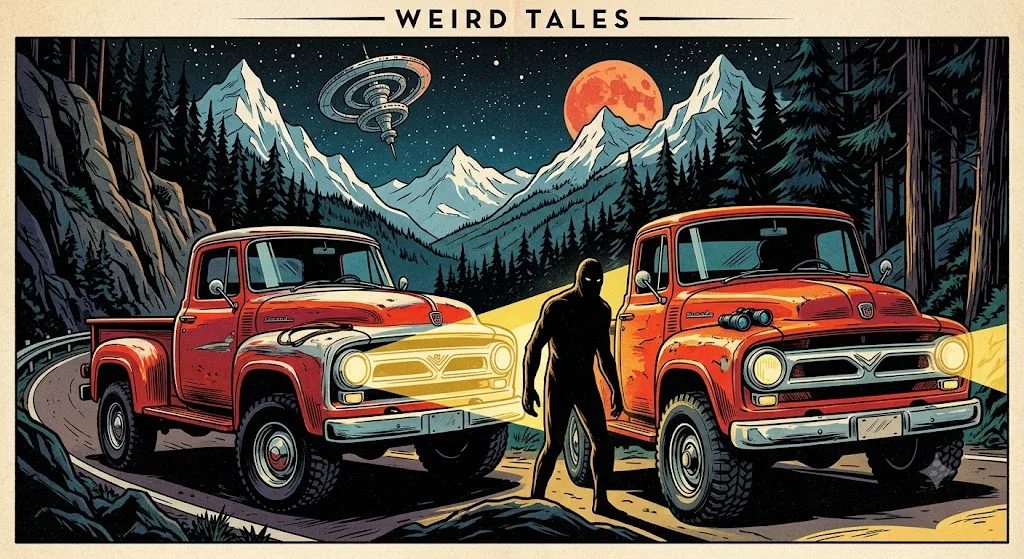
Wyoming’s Bigfoot stories cluster most clearly where the state already feels difficult to read at a glance: the Cody-to-Yellowstone corridor, the timbered slopes around Yellowstone’s East Entrance, and the Wind River country around Fremont and Sublette counties. The creature being claimed is the familiar North American Bigfoot or Sasquatch: a large, upright, hairy figure seen briefly on roadsides, in headlights, on mountain slopes or near camps. What makes the Wyoming version distinctive is not a large body of physical evidence, but a repeated landscape pattern. Reports gather in bear country, dark forest, steep terrain and tourist routes where a glimpse can become a story before anyone has time to check it.
The evidence remains thin. Most accounts are eyewitness reports collected by Bigfoot databases, local media or folklore projects, not verified biological records. Yellowstone itself officially documents grizzlies, black bears, wolves, cougars, wolverines, lynx, bison and many other mammals, but not an unknown primate. That makes Wyoming Bigfoot less a confirmed animal than a useful case study in how wild terrain, credible-seeming witnesses, real wildlife and regional storytelling can combine into a durable modern legend.[National Park Service]nps.govNational Park Service MammalsNational Park ServiceMammals - Yellowstone National Park (U.S. National Park Service)…
Where Wyoming Bigfoot stories cluster
The clearest public cluster is Park County, especially the road country between Cody and Yellowstone National Park. The Bigfoot Field Researchers Organization, a private sightings database rather than an official wildlife authority, lists nine Park County reports, including several near Yellowstone, the East Entrance approach and the Cody road corridor. Its Park County list includes a 1978 road-crossing report by two government geologists, a 1997 motorist report near the East Entrance approach, 2000 reports east of the park, a Mount Washburn family sighting from 2002, and a Yellowstone backcountry ranger account placed in the 1970s–1980s.[BFRO]bfro.netPark County, Wyoming – Reports & ArticlesPark County, Wyoming – Reports & Articles
That concentration has shaped how later local writing frames Wyoming Bigfoot. Cowboy State Daily reported in 2022 that the BFRO database showed Park County as Wyoming’s most frequent county for Bigfoot reports, ahead of Lincoln, Teton, Carbon and Uinta counties. County 10, a Fremont County news site, later emphasised a narrower pattern: half of Wyoming reports in one data view were in the Shoshone National Forest between Cody and Yellowstone. Those numbers should not be treated like wildlife survey data, because they depend on who reports, who records, and how reports are classified. They do, however, show where the legend has accumulated enough repeated claims to become locally recognisable.[Cowboy State Daily]cowboystatedaily.comCowboy State Daily Newly Released Sasquatch Data Shows More WyomingCowboy State Daily Newly Released Sasquatch Data Shows More Wyoming
Wind River Country forms the other important Wyoming strand. Here the emphasis shifts from tourist-road glimpses to mountain and reservation-edge stories: camping encounters, community reports, and the long-running interest of naturalist John Mionczynski, who says he had a frightening 1972 encounter while working in the Wind River Mountains. The BFRO’s statewide Wyoming page lists fewer Fremont and Sublette entries than Park County, but the Wind River stories have had an unusually strong afterlife because they are tied to named local witnesses, oral accounts and rugged backcountry settings.[BFRO]bfro.netstate listing.aspstate listing.asp
The result is a two-part map. Yellowstone-area reports lean towards roads, pull-offs, headlights and slopes seen from a distance. Wind River reports lean towards camps, mountain work, reservation-area memory and backcountry credibility. Both depend on the same basic ingredients: forest cover, large animals, sparse night-time visibility and a landscape already famous for feeling bigger than the person moving through it.
Cody-to-Yellowstone and mountain-road accounts
The Cody-to-Yellowstone road is the strongest recurring setting in Wyoming’s published Bigfoot claims. It offers exactly the conditions that make a roadside monster story plausible to a witness and difficult to verify afterwards: moving vehicles, bends in the road, steep ditches, patchy forest, no easy place to stop, and a constant expectation of seeing wildlife. Travellers in this corridor are already scanning for bighorn sheep, bears, elk and other animals, so an ambiguous upright shape can arrive in the mind as “one more creature” before sceptical checking catches up.
One of the most cited cases is the 1978 BFRO report in which two geologists said they were driving from Cody towards Yellowstone for summer work when their high beams lit up a large, dark, shaggy figure coming out of a ditch roughly 30 minutes east of the East Gate. The report says they estimated it at about 7 to 7.5 feet tall and 600 to 800 pounds, standing upright near a culvert before it crossed their path. The useful detail here is not that the description proves Bigfoot. It is that the account contains many classic roadside-sighting features: late travel, headlights, a brief view, dense forest on both sides, professional witnesses, and no immediate official follow-up because the East Gate was unmanned when they arrived.[BFRO]bfro.netshow report.aspshow report.asp
A 1997 Park County account has a different shape. A motorist leaving Yellowstone from the Cody direction said she saw a tall, hairy, upright figure walking in long strides high on a mountain slope near a patch of snow. Her son reportedly saw it too, but the family could not stop because of fast traffic and road construction. Again, the setting matters as much as the claim: a moving car, a distant slope, a search for ordinary wildlife and no opportunity to examine tracks or scale at the scene.[BFRO]bfro.netReport 903: Sighting by a motorist near the park entrance approach from CodyReport 903: Sighting by a motorist near the park entrance approach from Cody
The BFRO’s own classification system helps explain why these accounts are often repeated in Bigfoot circles. It describes “Class A” reports as clear sightings in which misidentification can supposedly be ruled out with greater confidence, while sound-only or less clear cases fall into lower categories. That terminology can make a report sound more formal than it really is. It is a witness-database rating, not a scientific validation, and it does not replace physical evidence such as a body, verified DNA, unambiguous photographs or independently documented tracks.[BFRO]bfro.netOpen source on bfro.net.
Yellowstone makes the legend feel possible
Yellowstone gives Wyoming Bigfoot stories a powerful stage because it is both heavily visited and genuinely wild. The National Park Service says Yellowstone has 67 mammal species, including grizzly bears, black bears, wolves, cougars, lynx, wolverines, bison, moose, elk and bighorn sheep. A visitor can drive from crowded boardwalks into dark timber and high passes in the same day. That mixture is ideal for legend-making: enough people pass through to generate sightings, but enough wilderness remains to make “something unknown could be out there” feel emotionally plausible.[National Park Service]nps.govNational Park Service MammalsNational Park ServiceMammals - Yellowstone National Park (U.S. National Park Service)…
The park’s bear ecology is especially important. Yellowstone is home to both grizzly and black bears, and the Greater Yellowstone Ecosystem is one of the few areas south of Canada where the two species coexist in substantial numbers. The National Park Service estimated the Greater Yellowstone grizzly population at about 1,030 in 2024, with 150–200 bears having home ranges wholly or partly inside the park. Black bears are also common.[NPS]go.nps.govBear EcologyBear Ecology
This does not mean every Bigfoot report is “just a bear”. Some witnesses insist they saw an upright, long-striding, humanlike figure. But bears create a large amount of visual confusion because their colour varies, they may stand briefly on hind legs, and they are often seen in poor light, at a distance or through trees. The National Park Service specifically warns that colour is not a reliable way to distinguish black bears from grizzlies in Yellowstone, since both species can vary widely in appearance.[NPS]go.nps.govBear EcologyBear Ecology
The park also changes how people remember sightings. A strange glimpse in a supermarket car park might be dismissed in seconds. A strange glimpse after a day of bison, steaming ground, bear warnings and mountain shadows has a different emotional charge. Yellowstone does not need to contain a hidden primate to make a Bigfoot story feel at home there. Its real wildlife already primes visitors to expect the extraordinary.

Wind River Country and the Mionczynski thread
Wind River Country’s Bigfoot tradition is more personal and less road-tourist in flavour. The best-known figure is John Mionczynski, a Wyoming naturalist, field biologist, goat-packing author and wilderness expert who says his interest in Sasquatch began with a 1972 encounter while camping alone in the Wind River Mountains. WyoFile’s profile describes him as convinced he encountered Sasquatch in that episode, while also stressing that he is respected locally for serious natural-history work rather than simply being a paranormal enthusiast.[WyoFile]wyofile.comWyo File John Mionczynski: A biologist revered and ridiculedWyo File John Mionczynski: A biologist revered and ridiculed
High Country News gives the more vivid version of the episode: Mionczynski reportedly awoke to what looked like a large hand pressing on the top of his six-foot tent, first thought it might be a bear, then believed he could distinguish fingers. The account says the tent collapsed and the creature vanished into the woods, after which he kept watch by a fire while something moved around and threw pinecones. This is not hard proof, but it has become one of Wyoming’s most memorable Bigfoot narratives because it joins a named witness, backcountry work and a specific mountain setting.[High Country News]hcn.orgHigh Country News John Mionczynski: naturalist, accordionist, and Bigfoot expertHigh Country News John Mionczynski: naturalist, accordionist, and Bigfoot expert
Mionczynski’s story also shows how Bigfoot belief can sit awkwardly beside conventional wildlife science. WyoFile notes that he had made recognised contributions to understanding Wyoming wilderness, while his Sasquatch interest exposed him to ridicule. High Country News reported that he once took a hair and skin sample to a Wyoming Game and Fish lab, only to be warned by a superior about being publicly associated with Bigfoot. Whether that episode is read as closed-mindedness or appropriate scepticism depends on the reader’s starting point, but it captures the tension at the heart of Wyoming Bigfoot: the witnesses often want to be taken seriously, while the evidence rarely reaches the level that wildlife agencies or biology journals would require.[WyoFile]wyofile.comWyo File John Mionczynski: A biologist revered and ridiculedWyo File John Mionczynski: A biologist revered and ridiculed
There is also a Wind River Reservation strand. The Native Memory Project preserves a Shoshone-centred account noting several reported Sasquatch sightings around the Wind River Reservation in the years around 1970, including Reba Teran’s remembered sighting. Such accounts should be handled carefully. They are not simply “proof claims” in the modern Bigfoot-hunter sense, nor should they be flattened into tourist folklore. They show that the Wind River version of the story overlaps with local memory, Indigenous community testimony and the broader North American pattern of large, humanlike beings being interpreted differently by different communities.[Native Memory Project]nativememoryproject.orgsasquatch shoshone sightingssasquatch shoshone sightings
Bears, distance and sceptical explanations
The strongest sceptical explanation for many Wyoming Bigfoot reports is not a single hoax but a bundle of ordinary factors that become persuasive in combination. Large bears live in the same landscapes where reports cluster. Many sightings happen from cars, at dusk, in headlights or across slopes. Witnesses are often startled and have only seconds to interpret size, posture and movement. Once the “upright hairy figure” category enters the mind, later memory can sharpen the shape.
Scientific work on alleged Bigfoot material has not produced support for an unknown primate. A 2014 Proceedings of the Royal Society B study analysed 30 hair samples attributed to “yeti, bigfoot and other anomalous primates” and found that, apart from two Himalayan samples with affinity to an ancient polar-bear lineage, the samples came from known living mammals. That does not disprove every eyewitness report, but it shows the gap between anecdote and biological confirmation.[PMC]pmc.ncbi.nlm.nih.govOpen source on nih.gov.
A more recent statistical argument points in the same direction. A 2024 Journal of Zoology paper examined whether Sasquatch sightings are associated with black bear populations across the United States and Canada, adjusting for human population and forest area. Its conclusion was not that every report is a bear, but that the sighting pattern is consistent with black bears being an important source of Bigfoot claims. That matters for Wyoming because both Yellowstone and Wind River Country are bear-aware landscapes where people are already trained to watch, worry and tell stories about large animals.[ZSL Publications]zslpublications.onlinelibrary.wiley.comZSL Publications Bigfoot: If it's there, could it be a bear?ZSL Publications Bigfoot: If it's there, could it be a bear?
There are other mundane possibilities too. Bison, moose, elk, people in dark clothing, shadows on snow, tree trunks, road crews, hunters, campers and ordinary bears seen at strange angles can all contribute to the “large dark figure” category. Hoaxes are possible, but they are not required to explain the pattern. In many Wyoming cases, the simplest reading is not that witnesses are lying, but that the environment gives them too little information and too much atmosphere.
What the Wyoming evidence does and does not show
The Wyoming Bigfoot record is strongest as folklore geography and weakest as zoology. It shows that reports repeatedly attach to certain kinds of places: Cody-to-Yellowstone roads, Shoshone National Forest, Yellowstone backcountry, Wind River camps and reservation-edge memory. It shows that witnesses often describe a similar rough figure: tall, dark, hairy, upright, quick, and gone before anyone can inspect the scene. It also shows how local media, private databases, podcasts and travel writing can keep a thin evidence trail alive by retelling the most compelling cases.[BFRO]bfro.netPark County, Wyoming – Reports & ArticlesPark County, Wyoming – Reports & Articles
What it does not show is a confirmed breeding population of unknown apes in Wyoming. That would require evidence very different from the public record currently available: verified remains, repeated DNA results from an unknown primate, clear multi-angle imagery, or tracks documented under controlled conditions by independent specialists. Yellowstone is one of the most studied wildlife landscapes in North America, and its official mammal lists already include rare, elusive animals such as wolverine and lynx. The absence of an unknown primate from that official wildlife picture is not a small detail.[National Park Service]nps.govNational Park Service MammalsNational Park ServiceMammals - Yellowstone National Park (U.S. National Park Service)…
Still, the stories endure because they answer a different question from science. They ask what it feels like to pass through Wyoming’s dark timber and wonder whether the land has more in it than the brochure admits. In that sense, Bigfoot functions differently from Douglas’s jackalope. The jackalope is a known joke that Wyoming happily performs. Bigfoot is a claim people argue about, but in Yellowstone and Wind River Country it survives because the setting itself keeps the argument alive.
Why this legend belongs to Wyoming
Wyoming’s Bigfoot stories are not the state’s most famous monster tradition, but they are among its most landscape-dependent. They do not come from one statue, one hoax mount or one marketable mascot. They come from roads where tourists look for bears, from high slopes where scale is difficult, from Wind River camps where a night sound can feel personal, and from communities where wilderness knowledge carries social weight.
That is why the best way to read these reports is neither blind belief nor flat dismissal. As animal evidence, they remain unproven. As regional folklore, they are revealing. They show how Wyoming’s real animals, real remoteness and real human uncertainty can generate a creature story that feels locally grounded even when the biological case is weak. The Wyoming Bigfoot is not a confirmed resident of Yellowstone or Wind River Country; it is a shadow made durable by the places where people keep seeing, hearing and retelling it.
Amazon book picks
Further Reading
Books and field guides related to Where Do Wyoming Bigfoot Stories Cluster?. Use these as the next step if you want deeper reading beyond the article.
Sasquatch: Legend Meets Science
Directly examines Bigfoot reports, evidence claims, and skeptical challenges.
Bigfoot!
Covers the broader North American Bigfoot tradition that includes Wyoming reports.
Abominable Science!
Provides context for evaluating Bigfoot claims and eyewitness reports.
Where Bigfoot Walks
Explores how remote landscapes encourage Bigfoot sightings and stories.
eBay marketplace picks
Marketplace Samples
Live-tested eBay searches with available results related to this page.


Endnotes
1.
Source: nps.gov
Title: National Park Service Mammals
Link:https://www.nps.gov/yell/learn/nature/mammals.htm
Source snippet
National Park ServiceMammals - Yellowstone National Park (U.S. National Park Service)...
2.
Source: go.nps.gov
Title: Bear Ecology
Link:https://go.nps.gov/YELLBear
3.
Source: bfro.net
Title: Park County, Wyoming – Reports & Articles
Link:https://www.bfro.net/GDB/show_county_reports.asp?county=Park&state=WY
4.
Source: county10.com
Title: most of wyomings bigfoot sightings are concentrated in one area
Link:https://county10.com/most-of-wyomings-bigfoot-sightings-are-concentrated-in-one-area/
5.
Source: bfro.net
Title: state listing.asp
Link:https://www.bfro.net/GDB/state_listing.asp?state=wy
6.
Source: wyofile.com
Title: Wyo File John Mionczynski: A biologist revered and ridiculed
Link:https://wyofile.com/john-mionczynski/
7.
Source: bfro.net
Title: show report.asp
Link:https://www.bfro.net/GDB/show_report.asp?id=1241
8.
Source: bfro.net
Title: Report 903: Sighting by a motorist near the park entrance approach from Cody
Link:https://www.bfro.net/GDB/show_report.asp?id=903
9.
Source: bfro.net
Link:https://www.bfro.net/gdb/classify.asp
10.
Source: pmc.ncbi.nlm.nih.gov
Link:https://pmc.ncbi.nlm.nih.gov/articles/PMC4100498/
11.
Source: nps.gov
Link:https://www.nps.gov/yell/planyourvisit/safety.htm
12.
Source: bfro.net
Title: show report.asp
Link:https://www.bfro.net/GDB/show_report.asp?id=2963
13.
Source: bfro.net
Title: show report.asp
Link:https://www.bfro.net/GDB/show_report.asp?id=19472
14.
Source: bfro.net
Title: show report.asp
Link:https://www.bfro.net/gdb/show_report.asp?id=1242
15.
Source: bfro.net
Title: show report.asp
Link:https://www.bfro.net/GDB/show_report.asp?id=1240
16.
Source: bfro.net
Title: show report.asp
Link:https://www.bfro.net/GDB/show_report.asp?id=2216
17.
Source: bfro.net
Title: show report.asp
Link:https://www.bfro.net/gdb/show_report.asp?id=44489
18.
Source: bfro.net
Link:https://www.bfro.net/GDB/show_county_reports.asp
19.
Source: bfro.net
Title: show report.asp
Link:https://www.bfro.net/GDB/show_report.asp?id=23033
20.
Source: yellowstone.org
Title: how to identify grizzly and black bears
Link:https://www.yellowstone.org/how-to-identify-grizzly-and-black-bears/
21.
Source: time.com
Title: bigfoot dna bear animal
Link:https://time.com/2949457/bigfoot-dna-bear-animal/
22.
Source: cowboystatedaily.com
Title: Cowboy State Daily Newly Released Sasquatch Data Shows More Wyoming
Link:https://cowboystatedaily.com/2022/08/23/newly-released-sasquatch-data-shows-more-wyoming-people-are-bigfoot-believers/
23.
Source: hcn.org
Title: High Country News John Mionczynski: naturalist, accordionist, and Bigfoot expert
Link:https://www.hcn.org/issues/44-2/john-mionczynski-naturalist-accordionist-bigfoot-expert/
24.
Source: nativememoryproject.org
Title: sasquatch shoshone sightings
Link:https://nativememoryproject.org/animal/sasquatch-shoshone-sightings/
25.
Source: pubmed.ncbi.nlm.nih.gov
Link:https://pubmed.ncbi.nlm.nih.gov/24990672/
26.
Source: zslpublications.onlinelibrary.wiley.com
Title: ZSL Publications Bigfoot: If it’s there, could it be a bear?
Link:https://zslpublications.onlinelibrary.wiley.com/doi/abs/10.1111/jzo.13148
27.
Source: cowboystatedaily.com
Title: think you saw bigfoot chances are it was only a bear
Link:https://cowboystatedaily.com/2024/04/24/think-you-saw-bigfoot-chances-are-it-was-only-a-bear/
28.
Source: cowboystatedaily.com
Title: man recounts 1972 bigfoot sighting in wyomings wind river mountains
Link:https://cowboystatedaily.com/2022/01/04/man-recounts-1972-bigfoot-sighting-in-wyomings-wind-river-mountains/
29.
Source: plotkml.r-forge.r-project.org
Link:https://plotkml.r-forge.r-project.org/bigfoot.html
30.
Source: zslpublications.onlinelibrary.wiley.com
Link:https://zslpublications.onlinelibrary.wiley.com/doi/10.1111/jzo.13148
Additional References
31.
Source: researchgate.net
Link:https://www.researchgate.net/publication/263711067Molecular_analysis_of%27anomalous_primate%27_hair_samples_A_commentary_on_Sykes_et_al
32.
Source: researchgate.net
Link:https://www.researchgate.net/publication/384016754_Grizzly_bear_and_American_black_bear_interactions_with_people_in_Yellowstone_National_Park
33.
Source: y95country.com
Link:https://y95country.com/are-these-bigfoot-sightings-in-wyoming-fact-or-fiction-3/
34.
Source: windriver.org
Link:https://windriver.org/blog/bear-safety-in-wyomings-wind-river-country/
35.
Source: poi-factory.com
Link:https://www.poi-factory.com/node/26394
36.
Source: facebook.com
Link:https://www.facebook.com/groups/expeditionbigfoot/posts/9521979747891887/
37.
Source: yellowstonesafari.com
Link:https://yellowstonesafari.com/wildlife/black-bear/
38.
Source: facebook.com
Link:https://www.facebook.com/nationalparkcom/posts/-black-bear-vs-grizzly-bear-can-you-spot-the-differencemost-visitors-to-yellowst/122182971674794688/
39.
Source: backcountrychronicles.com
Link:https://www.backcountrychronicles.com/grizzly-bear-distribution/
40.
Source: facebook.com
Link:https://www.facebook.com/groups/1031095493709443/posts/3138340492984922/
Topic Tree