What Counts as a Hawaiian Cryptid?
Hawaii is not a classic Bigfoot-and-lake-monster state.
Page outline Jump by section
Why Hawaii’s monster map looks different
A reader coming from mainland American cryptid lore may expect a list of hairy giants, lake beasts and out-of-place big cats. Hawaii asks for a different lens. Its creature traditions are closely tied to water, landforms, genealogy, fishponds, forested valleys, lava landscapes and family guardianship. Some beings look animal-like; others are ancestors, spirits, shapeshifters or mythic peoples. Treating every one of them as a possible undiscovered animal flattens the stories and misses what makes them Hawaiian.
The islands’ ecology also narrows the field. Hawaii is isolated in the Pacific, and its native land fauna developed very differently from the continental United States. The US Geological Survey identifies the Hawaiian hoary bat as the only native terrestrial mammal in the Hawaiian Islands; the larger land mammals people now encounter, including pigs, cats and mongooses, came through human introduction and have become major ecological forces.[USGS]usgs.govEcology of Hawai'i Volcanoes National Park | U.S. Geological SurveyEcology of Hawai'i Volcanoes National Park | U.S. Geological Survey
That does not make Hawaii “cryptid-free”. It means the state’s best mystery-beast material sits at the border between folklore and place-based memory rather than modern zoological discovery. The most important cases are not “proof files”; they are traditions that explain why a fishpond is sacred, why a pool is dangerous, why a shark may be more than a shark, or why a hidden valley becomes the natural home of a half-seen people.
Menehune: little builders, hidden people or romanticised memory?
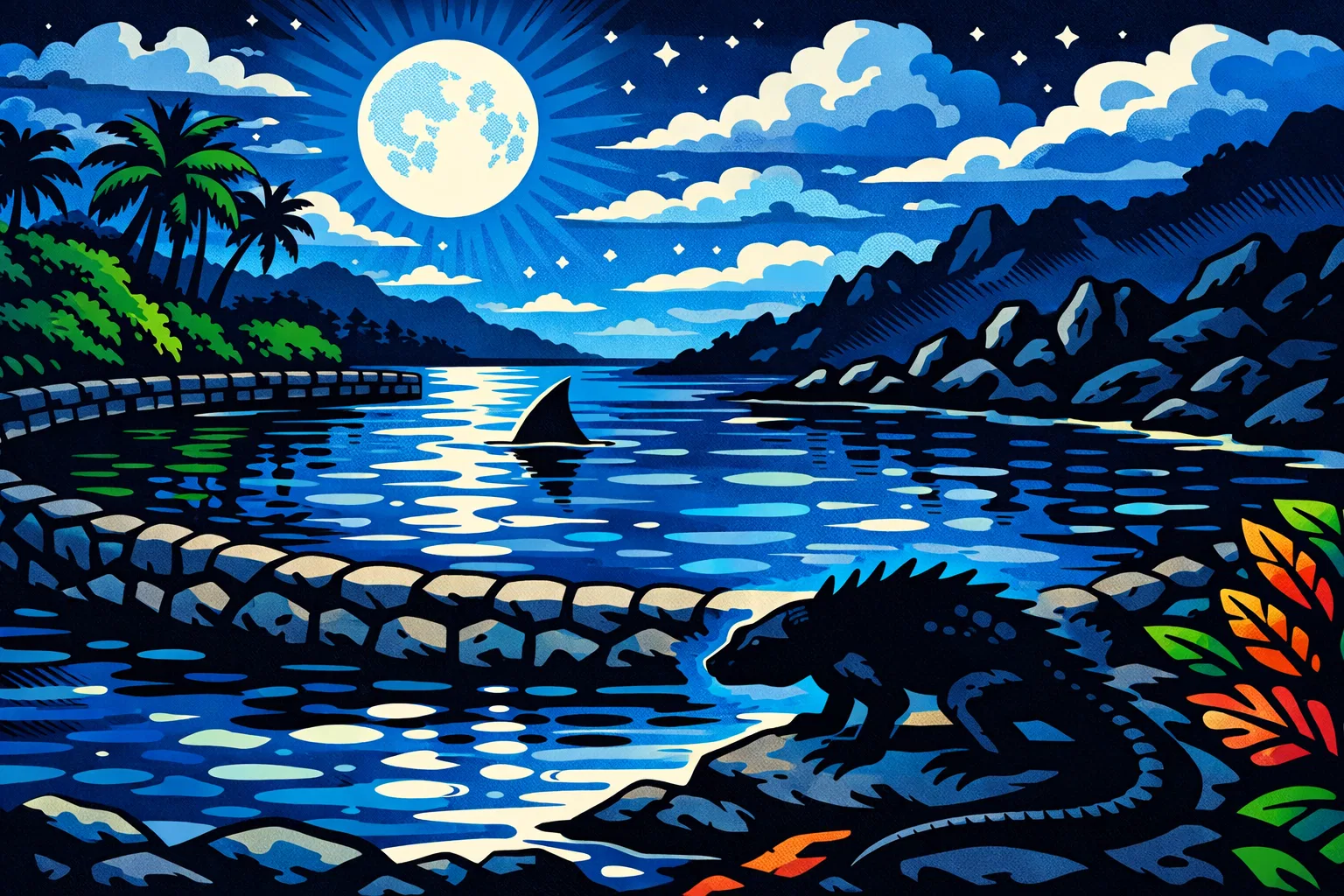
The Menehune are the creature tradition most often pulled into American cryptid lists for Hawaii. They are usually described in popular retellings as small forest-dwelling people who avoid ordinary humans, work at night and possess extraordinary building skill. The most famous places connected with them are on Kauaʻi, especially ʻAlekoko Fishpond near Līhuʻe and Kīkīaola, also known as the Menehune Ditch, near Waimea.
The appeal is obvious: unlike many monster stories, Menehune legends are attached to visible structures. ʻAlekoko Fishpond is promoted by Hawaii’s official tourism site as a legendary ancient Hawaiian fishpond, built nearly 1,000 years ago and listed on the National Register of Historic Places since 1973. The legend says the Menehune built the fishpond in one night by forming a long human chain and passing stones hand to hand. The same source notes a more sceptical linguistic explanation: the word may derive from the Tahitian “manahune”, meaning commoner or someone small in social rank rather than physically tiny.[Go Hawaii]gohawaii.comGo Hawaii Alekoko Menehune Fishpond Kauai | Go HawaiiGo Hawaii Alekoko Menehune Fishpond Kauai | Go Hawaii
Kīkīaola gives the story another physical anchor. Historic Hawaiʻi Foundation describes it as a historic irrigation ditch said to have been built by Menehune, and notes why it stands out: Hawaiians built many stone-lined irrigation channels, but the finely cut basalt blocks lining parts of this ditch are unusual. This is where folklore and archaeology meet most productively. The stones do not prove a hidden race of tiny engineers; they show why later storytellers might preserve awe around a remarkable old work.[historichawaii.org]historichawaii.orgKikiaola (Menehune Ditch) | Historic Hawai‘i FoundationKikiaola (Menehune Ditch) | Historic Hawai‘i Foundation
A strong modern interpretation comes through folklore rather than cryptozoology. Manoa Heritage Center summarises folklorist Catherine Luomala’s view that Menehune may represent commoners whose labour was later glamorised and transformed into stories of magical little builders. It also notes an alternative theory from Te Rangi Hiroa, formerly director of Bishop Museum, that the Menehune reflected an earlier population absorbed or displaced by later arrivals.[Manoa Heritage Center]manoaheritagecenter.orgManoa Heritage Center Menehune • Manoa Heritage CenterManoa Heritage Center Menehune • Manoa Heritage Center
For a cryptid reader, the key distinction is this: Menehune stories are not best read as reports of an unknown primate or miniature human species still hiding in the forest. They are better understood as layered traditions about older peoples, social memory, skilled labour, sacred places and the mystery of ancient engineering.

Moʻo: Hawaii’s water monsters are not just “dragons”
If Hawaii has a creature tradition closest to a monster category, it is the moʻo: lizard, dragon, water spirit, shapeshifter and guardian, depending on the story. Older English-language collections often translated moʻo as “dragons”, but that single word can mislead. In Hawaiian story cycles, moʻo are commonly linked to pools, lakes, springs, fishponds and wetlands. They may appear as reptiles, humans, huge water creatures or beings of double form.
W. D. Westervelt’s early collection, hosted by Sacred Texts, describes moʻo as dragon-like ghost-gods and says the term could refer not only to lizards but also to immense turtles, fish, sharks and other powerful water beings. The same passage stresses their shapeshifting character: they could appear as animals or human beings, and belonged to a wider class of mysterious beings with unusual power.[Internet Sacred Text Archive]sacred-texts.comOpen source on sacred-texts.com.
That makes moʻo very different from a simple “lake monster” claim. A mainland lake monster story often asks whether a large animal is physically present in the water. A moʻo story may ask whether a pool is guarded, whether a family or place has a spiritual relationship with water, or whether a landscape feature preserves the memory of a dangerous being. This does not make the stories less vivid; it makes them less reducible to zoology.
There is also a plausible comparative explanation for the reptilian imagery. Some modern interpreters suggest that moʻo traditions may preserve distant Polynesian memories of large reptiles, such as crocodiles or monitor lizards, encountered elsewhere in the Pacific world. That idea can be useful as a comparison, but it should not be overstated: Hawaii has no hidden crocodile population, and the force of moʻo stories lies in cultural meaning as much as animal resemblance.[Internet Sacred Text Archive]sacred-texts.comOpen source on sacred-texts.com.
Shark guardians, shark-men and the line between animal and ancestor
Sharks are real animals in Hawaiian waters, but Hawaiian shark traditions are not just natural-history notes with a supernatural gloss. They sit in a world where an animal may be a guardian, an ancestor, a warning or a being with agency. The State of Hawaii’s shark information pages include material on Hawaiians’ relationship with sharks and point readers to cultural commentary on ʻaumakua, often translated as family or ancestral guardians.[Hawaii DLNR]dlnr.hawaii.govDLNRHawaiians’ Relationship with Sharks – Hawaiʻi SharksDLNRHawaiians’ Relationship with Sharks – Hawaiʻi Sharks
For cryptid purposes, shark lore matters because it produces some of Hawaii’s most memorable human-animal boundary stories. Tales of shark gods, shark guardians and shark-men do not function like reports of an unknown species. They usually turn on kinship, taboo, protection, punishment or transformation. A shark seen in a particular place might be interpreted through family history or sacred geography rather than as a random predator.
This is one reason Hawaii’s “mystery beasts” can seem slippery to outside readers. A tiger shark is a known animal. A shark ʻaumakua is not a new species. A shark-man story is not a wildlife report. Yet all three may occupy the same imaginative coastline. The same animal can be biological, symbolic and ancestral, depending on the story being told.
The sceptical explanation here is not “people mistook sharks for monsters”. It is more nuanced: real sharks provide a powerful living basis for stories in which animals, ancestors and moral rules overlap. That makes shark traditions central to Hawaii’s creature folklore, but weak evidence for a zoological cryptid.
Dog-men, man-eaters and older scary beings
Hawaii also has darker creature-adjacent traditions that sometimes get overlooked because they do not fit neat American cryptid categories. Martha Beckwith’s classic survey of Hawaiian mythology includes sections on “Mu and Menehune People” and “Runners, Man-Eaters, Dog-Men”, showing that Hawaiian tradition contains more than gentle little builders and beautiful water guardians.[Internet Sacred Text Archive]sacred-texts.comInternet Sacred Text Archive Hawaiian Mythology IndexInternet Sacred Text Archive Hawaiian Mythology Index
Hawaii lacks the ecological background that would make an undiscovered large primate plausible. There is no native ape, bear or large terrestrial mammal lineage on the islands. The only native land mammal is a bat, while modern mammal confusion is more likely to involve introduced animals such as pigs, cats, mongooses, goats, sheep or deer, depending on the island and setting.[USGS]usgs.govEcology of Hawai'i Volcanoes National Park | U.S. Geological SurveyEcology of Hawai'i Volcanoes National Park | U.S. Geological Survey
That does not mean no one in Hawaii has ever told a strange forest story. It means that a Hawaii Bigfoot claim needs unusually strong evidence before it deserves serious biological attention. A fleeting dark shape in vegetation, a night noise in a valley or a tale of small hidden forest people is better explained through folklore, misidentification, darkness, introduced animals or modern media influence than through a breeding population of unknown apes.
The more interesting question is why Bigfoot gets imported at all. The answer is probably cultural gravity. Bigfoot is America’s dominant cryptid template, so local legends are often translated into Bigfoot language for television audiences. In Hawaii, that translation can obscure more than it reveals.
Sea serpents, oarfish and the Pacific imagination
Hawaii’s ocean setting makes sea-monster stories feel plausible, but the evidence again points towards a mixture of real marine life, distance, waves and inherited monster imagery. The Library of Congress notes that historical sea-serpent sightings were shaped by older expectations: people often imagined sea serpents as dangerous reptilian monsters, and each report could influence later witnesses, artists and newspapers.[The Library of Congress]blogs.loc.govThe Library of Congress The Great American Sea Serpent | Folklife TodayThe Library of Congress The Great American Sea Serpent | Folklife Today
The oarfish is the best real-world explanation for many sea-serpent impressions, even if it does not explain every story. NOAA Fisheries describes the giant oarfish as a deep-sea fish that can exceed 20 feet in length, with a long tapering body and a bright dorsal fin running along it. NOAA’s interview explicitly notes that its striking shape has often been linked to sea-serpent ideas.[NOAA Fisheries]fisheries.noaa.govFisheries The Giant Oarfish | NOAA FisheriesFisheries The Giant Oarfish | NOAA Fisheries
For Hawaii, that means sea-serpent stories should be treated as possible encounters with real but rarely seen marine animals, plus the optical problems of ocean observation. A long animal glimpsed at distance may be a line of dolphins, a shark, a ribbon-like deep-sea fish, floating debris, a whale body part, or a sick or dying animal near the surface. The Pacific is genuinely full of large, strange-looking life; that is enough to explain much of the wonder without inventing a surviving prehistoric reptile.
Modern legends, tourism and “cryptidification”
Modern Hawaii monster content often comes through guidebooks, ghost tours, television, podcasts, social media and travel writing. This has two effects. First, it keeps old stories visible. Second, it can turn beings with specific cultural roles into generic monsters for entertainment.
The Menehune are the clearest example. A fishpond legend tied to Kauaʻi history becomes, in some retellings, a race of tiny cryptids. A moʻo tied to water guardianship becomes a “Hawaiian dragon”. Shark ʻaumakua become “shark monsters”. These labels can help outsiders find the stories, but they can also strip out the relationships among land, family, water and responsibility that give the traditions meaning.
Tourism adds another layer because Hawaii’s legendary places are often real destinations. ʻAlekoko Fishpond is a historic site and scenic stop; Kīkīaola is a recognised historic property; fishpond restoration groups continue to care for places that are both ecological and cultural landscapes. When a visitor hears “the Menehune built this in one night”, the best response is not to ask only whether the claim is literally true. It is to ask why the story attached itself to that place, what the structure reveals about Hawaiian engineering, and how folklore preserves admiration for work whose builders are no longer individually remembered.[Go Hawaii]gohawaii.comGo Hawaii Alekoko Menehune Fishpond Kauai | Go HawaiiGo Hawaii Alekoko Menehune Fishpond Kauai | Go Hawaii

Best explanations for Hawaii’s creature claims
Hawaii’s mystery-beast traditions are strongest when read through several explanations at once rather than forced into a single yes-or-no category.
Folklore and sacred geography explain much of the material. Moʻo, shark guardians and Menehune stories are deeply attached to ponds, valleys, springs, coastlines and older works of human construction. Their truth is often cultural and place-based rather than zoological.
Social memory is especially important for the Menehune. The idea that “little people” built old structures may encode memories of commoners, earlier populations, specialised workers or simply awe at old engineering. Manoa Heritage Center’s summary of Luomala’s interpretation is useful here because it treats the legend as a literary and social development, not as a failed animal report.[Manoa Heritage Center]manoaheritagecenter.orgManoa Heritage Center Menehune • Manoa Heritage CenterManoa Heritage Center Menehune • Manoa Heritage Center
Misidentified animals matter in modern sighting-style claims. In forests or near roads, introduced pigs, cats, mongooses and other mammals can generate brief, uncertain encounters. At sea, oarfish, sharks, whales, dolphins, turtles and floating remains can produce monster-like impressions under poor viewing conditions.[USGS]usgs.govEcology of Hawai'i Volcanoes National Park | U.S. Geological SurveyEcology of Hawai'i Volcanoes National Park | U.S. Geological Survey
Media translation explains why Hawaii sometimes appears on national cryptid lists in distorted form. Bigfoot is such a dominant American pattern that local beings can be squeezed into it, even when the original tradition is about little builders, water spirits or ancestral guardians rather than unknown apes.
What a careful Hawaii cryptid page should say
The honest summary is that Hawaii has rich creature folklore but little strong evidence for undiscovered large animals. The most important traditions are not weak versions of mainland cryptids; they are their own local forms of mystery. Menehune stories gather around hidden people, night work and ancient structures. Moʻo stories gather around water, shapeshifting and guardianship. Shark traditions gather around kinship, danger and protection. Sea-serpent impressions fit a broader Pacific pattern in which real marine animals and old monster expectations meet.
The state’s ecology makes some popular claims especially unlikely. A breeding Bigfoot population in Hawaii would require evidence far beyond anecdote, because the islands do not have a native background of large terrestrial mammals. The more persuasive “mysteries” are not hidden apes but the survival of stories around fishponds, valleys, springs and shorelines — stories that keep asking readers to look at the landscape as something inhabited by memory as well as animals.
Amazon book picks
Further Reading
Books and field guides related to What Counts as a Hawaiian Cryptid?. Use these as the next step if you want deeper reading beyond the article.
Native Planters in Old Hawaii: Their Life, Lore, and Environment
Provides context for folklore rooted in landscape and ecology.
eBay marketplace picks
Marketplace Samples
Live-tested eBay searches with available results related to this page.

Endnotes
1.
Source: usgs.gov
Title: Ecology of Hawai’i Volcanoes National Park | U.S. Geological Survey
Link:https://www.usgs.gov/geology-and-ecology-of-national-parks/ecology-hawaii-volcanoes-national-park
2.
Source: historichawaii.org
Title: Kikiaola (Menehune Ditch) | Historic Hawai‘i Foundation
Link:https://historichawaii.org/historic-property-ka/kikiaola-menehune-ditch/
3.
Source: sacred-texts.com
Link:https://sacred-texts.com/pac/hlog/hlog28.htm
4.
Source: dlnr.hawaii.gov
Title: DLNRHawaiians’ Relationship with Sharks – Hawaiʻi Sharks
Link:https://dlnr.hawaii.gov/sharks/hawaiian-mythology/hawaiians-relationship-with-sharks/
5.
Source: sacred-texts.com
Title: Internet Sacred Text Archive Hawaiian Mythology Index
Link:https://sacred-texts.com/pac/hm/index.htm
6.
Source: fisheries.noaa.gov
Title: Fisheries The Giant Oarfish | NOAA Fisheries
Link:https://www.fisheries.noaa.gov/podcast/giant-oarfish
7.
Source: dlnr.hawaii.gov
Title: invasive species profiles
Link:https://dlnr.hawaii.gov/hisc/info/invasive-species-profiles/
8.
Source: dlnr.hawaii.gov
Link:https://dlnr.hawaii.gov/hisc/info/species/
9.
Source: dlnr.hawaii.gov
Title: Huilua Fishpond
Link:https://dlnr.hawaii.gov/dsp/files/2014/09/Huilua_Fishpond.pdf
10.
Source: dlnr.hawaii.gov
Link:https://dlnr.hawaii.gov/occl/files/2017/12/Loko-Ia-KA-18-01-Alekoko.pdf
11.
Source: files.hawaii.gov
Title: 2023 12 08 KA DEA Commercial Boat Facility and Residences at Kikiaola
Link:https://files.hawaii.gov/dbedt/erp/Doc_Library/2023-12-08-KA-DEA-Commercial-Boat-Facility-and-Residences-at-Kikiaola.pdf
12.
Source: usgs.gov
Link:https://www.usgs.gov/pacific-island-ecosystems-research-center/science/invasive-mammals-pacific
13.
Source: usgs.gov
Title: volcano watch small mammal predators invade hawaii
Link:https://www.usgs.gov/news/volcano-watch-small-mammal-predators-invade-hawaii
14.
Source: historichawaii.org
Title: the alakoko pond nawiliwili 2009
Link:https://historichawaii.org/mes/the-alakoko-pond-nawiliwili-2009/
15.
Source: historichawaii.org
Link:https://historichawaii.org/wp-content/uploads/NR_Kauai_Waimea_MenehuneDitch84000270.pdf
16.
Source: sacred-texts.com
Link:https://sacred-texts.com/pac/hloh/hloh27.htm
17.
Source: sacred-texts.com
Link:https://sacred-texts.com/pac/hm/hm25.htm
18.
Source: ia601306.us.archive.org
Link:https://ia601306.us.archive.org/16/items/cu31924029908781/cu31924029908781.pdf
19.
Source: hilo.hawaii.edu
Link:https://hilo.hawaii.edu/maunakea/library/ref/333
20.
Source: conservatory.windward.hawaii.edu
Title: the green lady of wahiawa
Link:https://conservatory.windward.hawaii.edu/the-green-lady-of-wahiawa/
21.
Source: evols.library.manoa.hawaii.edu
Link:https://evols.library.manoa.hawaii.edu/bitstreams/eca5f937-e0ae-4f27-a0ca-3511dc0a8e49/download
22.
Source: library.honolulu.hawaii.edu
Link:https://library.honolulu.hawaii.edu/hawlit
23.
Source: guides.library.kapiolani.hawaii.edu
Link:https://guides.library.kapiolani.hawaii.edu/apdl/oahu/stories/waialua
24.
Source: to-hawaii.com
Link:https://www.to-hawaii.com/mythology/
25.
Source: gohawaii.com
Title: Go Hawaii Alekoko Menehune Fishpond Kauai | Go Hawaii
Link:https://www.gohawaii.com/islands/kauai/regions/lihue/alekoko-fishpond
26.
Source: manoaheritagecenter.org
Title: Manoa Heritage Center Menehune • Manoa Heritage Center
Link:https://www.manoaheritagecenter.org/moolelo/menehune/
27.
Source: blogs.loc.gov
Title: The Library of Congress The Great American Sea Serpent | Folklife Today
Link:https://blogs.loc.gov/folklife/2016/08/great-american-sea-serpent/
28.
Source: Wikipedia
Link:https://en.wikipedia.org/wiki/Hawaii
29.
Source: Wikipedia
Link:https://en.wikipedia.org/wiki/Menehune
30.
Source: Wikipedia
Link:https://en.wikipedia.org/wiki/Mo%CA%BBo
31.
Source: Wikipedia
Link:https://en.wikipedia.org/wiki/K%C4%ABk%C4%ABaola
32.
Source: Wikipedia
Link:https://en.wikipedia.org/wiki/Oarfish
33.
Source: cryptidz.fandom.com
Link:https://cryptidz.fandom.com/wiki/Menehune
34.
Source: religion.fandom.com
Link:https://religion.fandom.com/wiki/Menehune
35.
Source: facebook.com
Link:https://www.facebook.com/groups/1002571683091379/posts/2320951627920038/
36.
Source: facebook.com
Link:https://www.facebook.com/groups/335794762076167/posts/427802292875413/
37.
Source: bol.com
Title: hawaiian mythology
Link:https://www.bol.com/nl/nl/f/hawaiian-mythology/35533792/
38.
Source: books.google.com
Title: Hawaiian Mythology
Link:https://books.google.com/books/about/Hawaiian_Mythology.html?id=BqElGaH4DiIC
39.
Source: onlyinhawaii.org
Title: Menehune Ditch
Link:https://onlyinhawaii.org/menehune-ditch-kauai-hawaii/
40.
Source: worldhistory.org
Link:https://www.worldhistory.org/Menehune/
41.
Source: hawaii-guide.com
Title: Menehune Ditch | Kaua’i Hawai’i
Link:https://www.hawaii-guide.com/kauai/sights/menehune-ditch?srsltid=AfmBOooYrGWrFMFEDnY9MxpcbTEzAajTQ0qakIm59S-GDnrFu7cPtSSa
Additional References
42.
Source: youtube.com
Link:https://www.youtube.com/watch?v=NEiayE02hhA
Source snippet
The Menehune: Did The Tiny Natives Of Ancient Hawaii Actually Exist?...
43.
Source: youtube.com
Title: Mo’o – The Reptilian Guardian of Hawaiian Folklore
Link:https://www.youtube.com/watch?v=0R29rRHyyFQ
Source snippet
The Legend Of Mu: Menehune Origins & The Pleiades (Serge Kahili King's Kahuna Healing Prologue)...
44.
Source: youtube.com
Title: Hawaiian Legend: The Menehune | Finding Bigfoot
Link:https://www.youtube.com/watch?v=rDJeoowtB0c
Source snippet
Green Children of Woolpit, Solway Spaceman, Hawaiian Cryptids | EP.132 | Ninjas Are Butterflies...
45.
Source: youtube.com
Title: The Menehune: Did The Tiny Natives Of Ancient Hawaii Actually Exist?
Link:https://www.youtube.com/watch?v=1DPSjRdBE18
Source snippet
Mo'o – The Reptilian Guardian of Hawaiian Folklore...
46.
Source: hoteles.com
Link:https://www.hoteles.com/go/usa/myths-and-legends-hawaii
47.
Source: facebook.com
Link:https://www.facebook.com/KNWAnews/posts/according-to-the-bigfoot-field-researchers-organization-the-top-state-for-sasqua/579615254208104/
48.
Source: freebookapalooza.blogspot.com
Link:https://freebookapalooza.blogspot.com/2016/07/beckwith-hawaiian-mythology.html
49.
Source: facebook.com
Link:https://www.facebook.com/Extreme/posts/divers-encounter-enormous-oarfish-one-of-the-rarest-fish-/1054940876799461/
50.
Source: facebook.com
Link:https://www.facebook.com/mydesignationofficial/posts/everyday-am-shufflin-ft-ramzan______mhmd-grab-our-original-merchandise-only-from/4516197638415377/
51.
Source: facebook.com
Link:https://www.facebook.com/oneway.atetipah/posts/fresh-too-straight-from-chuuk-afani-kich-ika-kemi-kan-pwan-sani-kei-manun-chuuk-/4947465708810974/
Topic Tree
Follow this branch
Related pages 49
- Rhode Island Monsters
- Illinois Cryptids
- Nebraska Cryptids
- Alabama Cryptids
- Arkansas Monsters
- +44 more in sidebar