Within Montana Monsters
Is Flessie Really Hiding in Flathead Lake?
Flessie turns Montana's largest natural freshwater lake into a classic case of honest witnesses, strange water and cautious scepticism.
On this page
- What witnesses say they saw
- The 1889 steamboat story and later reports
- Fish, waves, logs and other explanations
Page outline Jump by section
Introduction
Flessie, the Flathead Lake Monster, is Montana’s classic lake mystery: a long, dark, serpent-like creature said to move through the cold water of Flathead Lake in the state’s north-west. The legend is not backed by firm biological evidence, but it has lasted because the reports are unusually persistent, often soberly told, and tied to a lake large enough to make strange sightings feel possible. Flathead Lake covers about 191.5 square miles, reaches 370.7 feet deep, and is the largest natural freshwater lake in the western United States by surface area outside Alaska.[FLBS-UMT]flbs.umt.eduFLBS-UMTFlathead Lake Facts | FLBS-UMTFLBS-UMTFlathead Lake Facts | FLBS-UMT
The best reading is curious but cautious. Witnesses have described humps, dark backs, black eyes, eel-like movement, giant fish shapes, and objects that sink or turn against the water. Sceptical explanations include sturgeon, large known fish, swimming animals, floating trees, boat wakes, light, shadows and the sheer difficulty of judging size on a big open lake. None explains every account neatly, but together they show why Flathead Lake became Montana’s most durable water-monster story.[Flathead Lakers]flatheadlakers.orgFlathead Lakers Flathead Lake Monster — Flathead LakersFlathead Lakers Flathead Lake Monster — Flathead Lakers
What witnesses say they saw
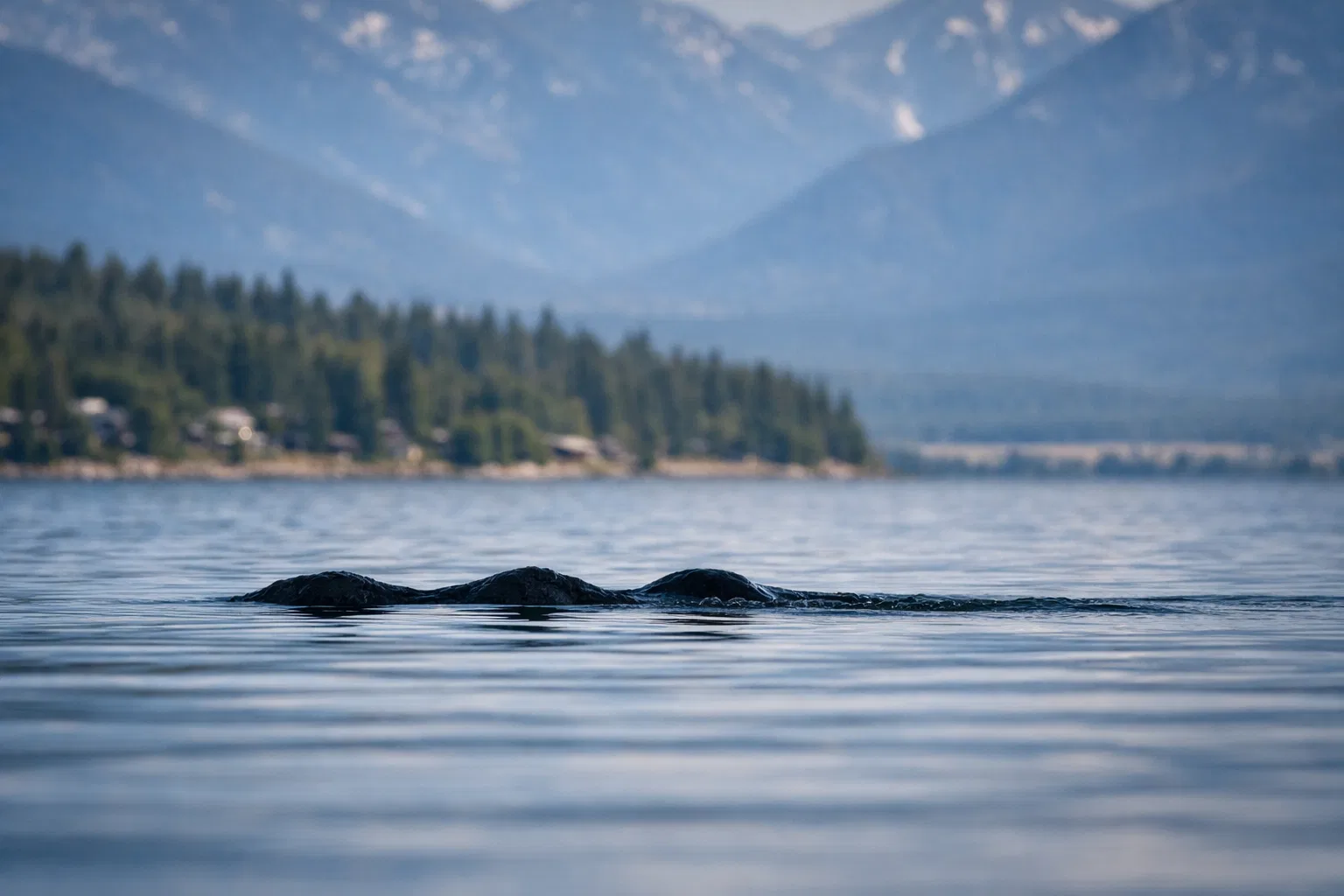
Most Flessie reports do not describe a roaring monster or a dangerous animal. They describe something seen at a distance, usually on the surface: long, dark, rounded, moving oddly, then disappearing. Flathead Lakers, the local lake conservation organisation that keeps a sightings archive, summarises the usual description as a large eel-shaped creature, 20 to 40 feet long, brown to blue-black in colour, with dark eyes and an undulating body. Some reports are less dramatic and identify the object as a massive fish of perhaps 6 to 10 feet, possibly a sturgeon.[Flathead Lakers]flatheadlakers.orgFlathead Lakers Flathead Lake Monster — Flathead LakersFlathead Lakers Flathead Lake Monster — Flathead Lakers
That range matters. A 40-foot serpent and a 7-foot fish are not the same claim. The Flathead tradition is really a bundle of reports: some sound like classic lake-serpent folklore, some sound like giant-fish encounters, and some sound like ambiguous surface phenomena that witnesses interpreted only after the shock of seeing them. The pattern is also geographically local. Flathead Lakers tells watchers to be especially alert around Skidoo Bay, Polson Bay, The Narrows and the west-shore road, suggesting that the legend has developed around named lake corridors rather than a vague “somewhere in Montana” setting.[Flathead Lakers]flatheadlakers.orgFlathead Lakers Flathead Lake Monster — Flathead LakersFlathead Lakers Flathead Lake Monster — Flathead Lakers
The strongest reason the story has endured is not a clear photograph or specimen, but the social profile of the witnesses. Reports have come from residents and visitors, including anglers, engineers, police officers, biologists, doctors and lawyers. That does not prove a hidden animal exists, but it does make the legend harder to dismiss as only drunken fishing talk or tourist invention. Retired Montana Fish, Wildlife and Parks biologist Laney Hanzel, who became an informal historian of the creature reports, told the Daily Inter Lake that many accounts were strikingly consistent even before the monster became a widely publicised local attraction.[dailyinterlake.com]dailyinterlake.comChasing the history of the Flathead Lake Monster | Daily Inter LakeChasing the history of the Flathead Lake Monster | Daily Inter Lake
One unusually useful modern example is the account of Lake County district judge Jim Manley and his wife, who were stranded in their boat near Big Arm Bay after dark when they heard rhythmic splashing about 75 yards away. Manley said they saw a dark object with “two, three, maybe four humps” rising three or four feet above the water, moving slowly and apparently perpendicular to the current. He did not claim proof of a monster; in fact, he said scientists had convinced him that such a creature probably could not be sustained in the lake. What made the account memorable was the gap between scepticism and experience: he still could not find an explanation that matched what he and his wife saw and heard.[dailyinterlake.com]dailyinterlake.comChasing the history of the Flathead Lake Monster | Daily Inter LakeChasing the history of the Flathead Lake Monster | Daily Inter Lake

The 1889 steamboat story and later reports
The modern Flathead Lake Monster story is usually traced to 1889, the same year Montana became a state. The standard version says Captain James C. Kerr was piloting the steamboat U.S. Grant with about 100 passengers when he and those aboard saw a large object in the water. Later retellings describe it as whale-like, eel-like or at first mistaken for a log; one passenger is said to have fired at it before it vanished below the surface.[dailyinterlake.com]dailyinterlake.comChasing the history of the Flathead Lake Monster | Daily Inter LakeChasing the history of the Flathead Lake Monster | Daily Inter Lake
This origin story has exactly the ingredients that make a lake legend travel: a named captain, a public setting, a crowded boat, fear, uncertainty and a creature that disappears before anyone can test the claim. It also comes from the steamboat era, when Flathead Lake was not merely scenery but a working transport route. A mystery seen from a boat full of passengers was much easier to turn into a regional story than a private glimpse from a lonely shore.
The record did not stop with that first famous account. By Hanzel’s count, the creature had been reported 103 times over roughly 125 years by 2015, and 1993 stood out as a record year with 13 separate reports. Hanzel preferred “creature” to “monster”, partly because the accounts are frightening without being violent: no crushed boats, no attacks, no bodies, only people reporting an animal or object they could not identify.[dailyinterlake.com]dailyinterlake.comChasing the history of the Flathead Lake Monster | Daily Inter LakeChasing the history of the Flathead Lake Monster | Daily Inter Lake
Older local accounts added variety to the template. Montana historian Ellen Baumler, writing in a Montana history context, described the 1889 report as a 20-foot object in the steamboat’s path and highlighted a 1985 account by retired Army major George Cote and his son Neal, who said they saw an object in Yellow Bay as long as a telephone pole and twice as wide, with four to six humps showing above the water. Cote later wrote to Fish, Wildlife and Parks about the encounters, placing his account inside the informal documentary trail rather than only fireside retelling.[Ellen Baumler]ellenbaumler.blogspot.comEllen Baumler Montana Moments: Flathead MonsterEllen Baumler Montana Moments: Flathead Monster
There is also an older cultural layer that should be handled carefully. Some modern summaries connect the lake monster to Kootenai stories of a great creature in “Monster Lake”, including a story associated with Sullivan Hill near Elmo. These traditions are not simply cryptid reports in modern costume; they belong to Indigenous storytelling, place memory and relationship with the lake. They help show that Flathead Lake had monster associations before settler newspapers and tourism, but they should not be flattened into “proof” of a zoological creature.[Flathead Lakers]flatheadlakers.orgFlathead Lakers Flathead Lake Monster — Flathead LakersFlathead Lakers Flathead Lake Monster — Flathead Lakers
Why Flathead Lake makes the legend feel plausible
Flathead Lake gives Flessie a believable stage. It is long, broad, deep, cold, clear and busy enough that many people are watching it, but large enough that distance, glare and scale can play tricks. The University of Montana’s Flathead Lake Biological Station lists the lake at 27.3 miles long, 15.5 miles wide, 370.7 feet deep at maximum depth, and nearly 188 miles of total shoreline including islands. Those numbers do not prove a monster, but they do explain why an object on the surface can be hard to judge.[FLBS-UMT]flbs.umt.eduFLBS-UMTFlathead Lake Facts | FLBS-UMTFLBS-UMTFlathead Lake Facts | FLBS-UMT
The lake is also biologically complex. The Biological Station notes that Flathead Lake originally had 11 native fish species, including westslope cutthroat trout and bull trout, but that 19 non-native fishes have been introduced since the late nineteenth century. The modern fish community is now dominated by non-native species including lake trout, lake whitefish and yellow perch. That history matters because “what lives in the lake?” is not a simple question frozen in time. Flathead’s ecology has changed, and real large fish do exist there, even if none is known to match the full monster description.[FLBS-UMT]flbs.umt.eduFLBS-UMTFlathead Lake Facts | FLBS-UMTFLBS-UMTFlathead Lake Facts | FLBS-UMT
The water itself can also mislead. Flathead Lake has a long fetch, meaning wind and wakes can travel far across open water. Its surface can be glassy in one place and broken in another; its clarity can make submerged objects look closer or stranger than they are; and low-angle sunlight can turn ordinary waves into dark moving shapes. These are not excuses to ridicule witnesses. They are exactly the conditions under which honest people can disagree with cameras, maps and biologists.
The result is a legend with two engines. First, there are sincere witnesses who believe they saw a moving creature. Second, there is a lake physically capable of creating false monsters: humps from waves, backs from logs, heads from branches, bodies from swimming animals, and scale errors from distance. Flessie survives in the space between those two facts.
Fish, waves, logs and other explanations
The most famous natural explanation is the white sturgeon. Sturgeon are ancient-looking fish with long bodies, bony plates and a profile that can seem prehistoric to a surprised observer. The theory gained force in 1955 when C. Leslie Griffith caught a 7-foot-6-inch, 181-pound white sturgeon from Flathead Lake during the Big Fish Unlimited contest; the specimen became a local museum object and a central piece of Flessie lore.[leaderadvertiser.com]leaderadvertiser.comSomething fishy | Lake County LeaderSomething fishy | Lake County Leader
But the sturgeon explanation is messier than it first appears. Barry Hansen, fisheries biologist for the Confederated Salish and Kootenai Tribes, told the Lake County Leader that there is no present sturgeon population in Flathead Lake and that the nearest known populations are in the lower Columbia basin and Kootenai River. He also said only a handful of sturgeon had been reported from the lake and that there was strong evidence they had been transported in. The same article reports that a University of Montana biologist examined the 1955 fish’s intestinal contents and found species suggesting another watershed, possibly the lower Columbia or Snake. The investigation was ultimately inconclusive, and Fish and Game officials removed the catch from the record books.[leaderadvertiser.com]leaderadvertiser.comSomething fishy | Lake County LeaderSomething fishy | Lake County Leader
That makes sturgeon a partial explanation rather than a clean answer. A huge sturgeon-like fish could explain some reports of a large, dark, prehistoric-looking animal, especially those closer to the 6-to-10-foot range. It cannot easily explain every long, multi-humped, 20-to-40-foot serpent report, and the uncertain origin of the 1955 fish weakens the idea of a stable hidden sturgeon population in the lake.
Other explanations are more ordinary but often more useful:
- Boat wakes and crossing waves: On a lake more than 27 miles long, wakes can travel, merge and form long moving lines that look like humps or an animal’s back. A distant wake without a visible boat can feel deeply strange.
- Floating logs and trees: A partly submerged tree can rise, sink, rotate and reappear as trapped air, water movement and root weight shift. A 2020 account in Distinctly Montana describes a paddleboarder approaching what he feared might be a swimming animal, only to find an upright Douglas fir repeatedly bobbing out of the water.[distinctlymontana.com]distinctlymontana.comThe Flathead Lake Monster, Still At LargeThe Flathead Lake Monster, Still At Large
- Known large fish: Lake trout and other fish do not match the classic Flessie outline, but a large fish seen briefly, especially at dusk or from a moving boat, can become much stranger in memory.
- Swimming mammals: Deer, elk, bears or dogs in the water can look surprisingly unrecognisable when only the head, back or wake is visible.
- Light and distance: Reflections, shadows, heat shimmer and low sun can make water features look solid, dark and self-propelled.
The best sceptical explanation is therefore not “everyone saw the same thing and it was a log”. It is that Flathead Lake offers many different ways to generate monster-like impressions, and the sightings probably have more than one cause.
Evidence needed to test Flessie
Flessie’s evidence is mostly testimonial. That is not worthless; eyewitness testimony is the raw material of folklore, local history and many genuine wildlife reports. But for an unknown large animal, testimony alone is weak. A breeding population would need food, habitat, space and repeated biological traces. It would also become harder to miss over time as boating, fishing, shoreline development, phone cameras and scientific monitoring increased.
Flathead Lake is not an unstudied wilderness pond. The University of Montana’s Flathead Lake Biological Station has a long research presence on the lake, and the lake’s fish community, water quality and ecology have been extensively monitored. The Biological Station’s factsheet lists known fish species and major ecological changes, including non-native fish introductions and the arrival of Mysis shrimp, but it does not point to an unknown giant animal.[FLBS-UMT]flbs.umt.eduFLBS-UMTFlathead Lake Facts | FLBS-UMTFLBS-UMTFlathead Lake Facts | FLBS-UMT
Stronger evidence would look different from the current record. It would include clear, verifiable video with scale markers; repeated sonar or environmental DNA findings that independent specialists could examine; a carcass, tissue sample or unambiguous photograph; or a pattern of observations that matched a plausible species rather than shifting between serpent, whale, sturgeon, log and humps. Until then, the most honest position is that Flathead Lake has unexplained reports, not a confirmed monster.
That still leaves room for mystery. Some sightings, such as Manley’s rhythmic humps near Big Arm Bay or the Cote account in Yellow Bay, remain interesting because the witnesses were not eager to exaggerate and because the descriptions include specific movement, location and context. The unresolved part of Flessie is not proof of a monster. It is the stubborn fact that some people, including careful observers, have seen things on Flathead Lake that ordinary explanations do not satisfy to them.[dailyinterlake.com]dailyinterlake.comChasing the history of the Flathead Lake Monster | Daily Inter LakeChasing the history of the Flathead Lake Monster | Daily Inter Lake
How Flessie became Montana’s lake monster
Flessie’s staying power comes from a rare blend of ingredients: a dramatic origin story, a giant lake, repeated witness accounts, Indigenous place traditions, a real oversized sturgeon specimen, local newspapers, tourism and a name that playfully echoes Scotland’s Nessie. The Flathead version is not just a borrowed Loch Ness joke, though the nickname encourages that comparison. It belongs specifically to western Montana because the landscape makes it work.
Local culture has also kept the legend alive without needing to settle it. The Daily Inter Lake described the monster as part of Flathead Lake culture, inspiring monster hunts, television documentaries and even huckleberry soda. Flathead Lakers maintains a sighting archive and invites people to report strange things without mockery. The Polson-Flathead Historical Museum’s “big fish” display gives visitors a physical object around which to debate the story.[dailyinterlake.com]dailyinterlake.comChasing the history of the Flathead Lake Monster | Daily Inter LakeChasing the history of the Flathead Lake Monster | Daily Inter Lake
That is why Flessie remains useful as folklore even if no unknown creature is ever found. The story teaches visitors how to look at Flathead Lake: not as a flat blue postcard, but as a deep, cold, changing body of water where scale is deceptive and local memory runs long. It also shows the difference between a hoax-centred legend and an ambiguity-centred one. Flessie is not built mainly on one exposed fake. It is built on repeated uncertainty.
The most satisfying answer is not that Flessie is definitely real or definitely nonsense. It is that Flathead Lake has produced more than a century of sincere, odd and often conflicting reports, while the best explanations remain ordinary but plural: sturgeon rumours, large fish, waves, logs, swimming animals and optical effects. The monster, in other words, may be less a single hidden beast than a name Montana gives to the lake when the water does something people cannot quite explain.
Amazon book picks
Further Reading
Books and field guides related to Is Flessie Really Hiding in Flathead Lake?. Use these as the next step if you want deeper reading beyond the article.
Mysterious America
Places Flessie within the broader American mystery-animal tradition.
Lake Monster Mysteries
Examines lake-monster reports and investigative approaches relevant to Flessie.
Abominable Science!
Explores evidence and misidentification issues relevant to lake-monster reports.
eBay marketplace picks
Marketplace Samples
Live-tested eBay searches with available results related to this page.


Endnotes
1.
Source: flbs.umt.edu
Title: FLBS-UMTFlathead Lake Facts | FLBS-UMT
Link:https://flbs.umt.edu/flathead-lake/flathead-lake-facts/
2.
Source: dailyinterlake.com
Title: Chasing the history of the Flathead Lake Monster | Daily Inter Lake
Link:https://dailyinterlake.com/news/2015/oct/29/chasing-the-history-of-the-flathead-lake-6/
3.
Source: distinctlymontana.com
Title: The Flathead Lake Monster, Still At Large
Link:https://www.distinctlymontana.com/flathead-lake-monster-still-large
4.
Source: leaderadvertiser.com
Title: Something fishy | Lake County Leader
Link:https://leaderadvertiser.com/news/2013/may/03/something-fishy-13/
5.
Source: youtube.com
Title: Flathead Lake Monster | Monsters and Mysteries in America
Link:https://www.youtube.com/watch?v=T_P_ntvGLfk
Source snippet
The Flathead Lake Monster...
6.
Source: youtube.com
Title: The Flathead Lake Monster
Link:https://www.youtube.com/watch?v=DBP98U81G-E
Source snippet
Flathead Lake & Giant Fish [American Terrors]...
7.
Source: youtube.com
Title: Flathead Lake & Giant Fish [American Terrors]
Link:https://www.youtube.com/watch?v=8YuGj-aK5i0
Source snippet
Flathead Lake Monster - Flessie (Ep. 53)...
8.
Source: youtube.com
Title: Flathead Lake Monster
Link:https://www.youtube.com/watch?v=tT1G0hgp2ek
Source snippet
KPAX ARCHIVE: The Monster of Flathead Lake...
9.
Source: flatheadlakers.org
Title: Flathead Lakers Flathead Lake Monster — Flathead Lakers
Link:https://www.flatheadlakers.org/flathead-lake-monster
10.
Source: ellenbaumler.blogspot.com
Title: Ellen Baumler Montana Moments: Flathead Monster
Link:https://ellenbaumler.blogspot.com/2012/10/flathead-monster.html
11.
Source: Wikipedia
Link:https://en.wikipedia.org/wiki/Montana
12.
Source: Wikipedia
Title: Flathead Lake Monster
Link:https://en.wikipedia.org/wiki/Flathead_Lake_Monster
13.
Source: Wikipedia
Title: Flathead Lake
Link:https://en.wikipedia.org/wiki/Flathead_Lake
14.
Source: fwp.mt.gov
Title: flathead lake
Link:https://fwp.mt.gov/stateparks/flathead-lake
15.
Source: polsonflatheadmuseum.org
Title: the flathead lake monster
Link:https://www.polsonflatheadmuseum.org/the-flathead-lake-monster/
16.
Source: bigskytreasure.org
Title: Flathead Lake Monster
Link:https://www.bigskytreasure.org/history/mysteries/flathead-lake-monster
17.
Source: flatheadlakers.org
Link:https://www.flatheadlakers.org/exploring-our-lake-and-watershed
18.
Source: kids.nationalgeographic.com
Link:https://kids.nationalgeographic.com/geography/states/article/montana
19.
Source: itsmth.fandom.com
Title: Flathead Lake Monster
Link:https://itsmth.fandom.com/wiki/Flathead_Lake_Monster
Additional References
20.
Source: nps.gov
Link:https://www.nps.gov/state/mt/index.htm
21.
Source: myfwp.mt.gov
Link:https://myfwp.mt.gov/getRepositoryFile?objectID=39227
22.
Source: facebook.com
Link:https://www.facebook.com/DistinctlyMontana/posts/in-1889-the-year-montana-became-a-state-a-steamship-captain-spotted-something-ma/1306907664809664/
23.
Source: visitmt.com
Link:https://visitmt.com/listing/flathead-lake-11891
24.
Source: flatheadwatershed.org
Link:https://www.flatheadwatershed.org/watershed/flathead_lake.shtml
25.
Source: facebook.com
Link:https://www.facebook.com/100090463034895/posts/flathead-lake-flathead-lake-in-montana-is-the-largest-natural-freshwater-lake-in/1005647709127321/
26.
Source: facebook.com
Link:https://www.facebook.com/mary.kate.teske.2025/videos/montanas-flathead-lake-monster-has-been-spotted-115-times-over-the-years/983120087672805/
27.
Source: flatheadlakefishing.com
Link:https://www.flatheadlakefishing.com/the-fish/
28.
Source: instagram.com
Link:https://www.instagram.com/p/DWhrdzek6iW/
29.
Source: facebook.com
Title: photo postcard sturgeon caught in flathead lake 5 28 1955 weight 181 lb 1 oz 7 1
Link:https://www.facebook.com/100064672122561/posts/photo-postcard-sturgeon-caught-in-flathead-lake-5-28-1955-weight-181-lb-1-oz-7-1/1065647735600954/
Topic Tree