Which Monster Stories From North Dakota Hold Up?
North Dakota’s cryptid tradition is quieter than the monster lore of the Pacific Northwest or the lake-monster tourism of Scotland, but it has a distinctive shape of its own.
Page outline Jump by section
The Missouri River monster that breaks the ice
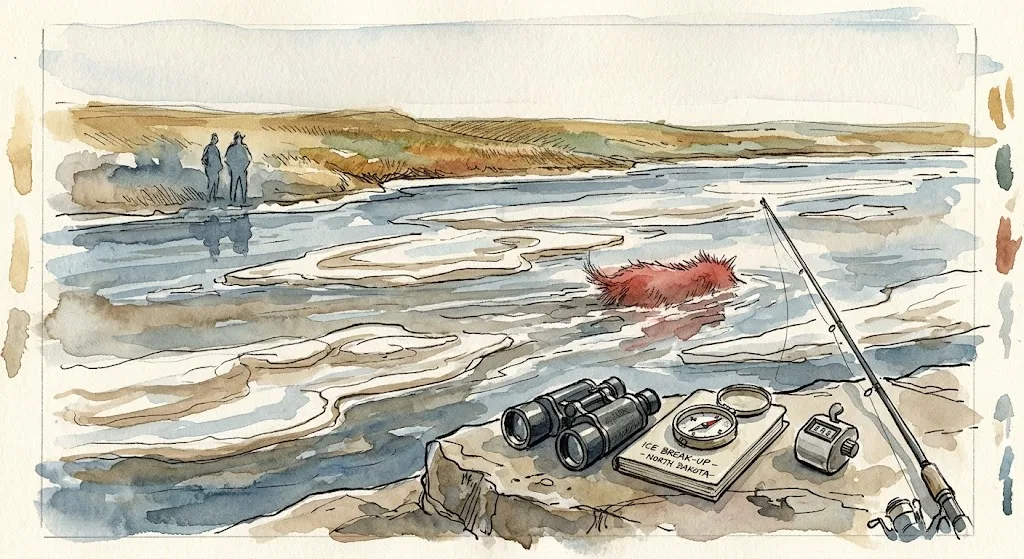
The most memorable North Dakota creature is the Miniwashitu, usually presented today as a Missouri River monster. Its best early printed source is Melvin Randolph Gilmore’s Prairie Smoke, published at Bismarck in the early 1920s, which gives the tale under the heading “Cause of the Breaking Up of the Ice in the Missouri River in Springtime”. Gilmore identifies it as a Dakota myth and describes a being in the Missouri that was rarely seen, terrifying to behold, and associated with red light in the water, roaring, madness, death, and the spring break-up of river ice. In the same account, the creature is red and shaggy like a buffalo, has one central eye, a single horn, and a jagged, saw-like backbone.[Project Gutenberg]gutenberg.orgThe Project Gutenberg eBook of Prairie Smoke, by Melvin Randolph Gilmore…
That is an unusually vivid monster image: part river force, part buffalo, part warning sign. It is not a modern “sighting report” in the Bigfoot sense. It is a traditional explanation for a dangerous seasonal event — the noisy, violent, unpredictable break-up of ice on a large northern river. The monster’s body mirrors the event: a red flash in moving water, a terrible roar, and a back that can smash the frozen surface. Gilmore’s text says the Miniwashitu still lives in the Missouri and breaks up the ice as it moves upstream in spring, but the point is not zoological field identification. It is a mythic way of making a river’s power memorable.[Project Gutenberg]gutenberg.orgThe Project Gutenberg eBook of Prairie Smoke, by Melvin Randolph Gilmore…
The landscape matters. The Missouri River was not just scenery in North Dakota; it was a travel corridor, food source, boundary, village setting, trade route, and danger. Gilmore’s broader introduction to the region places the Mandan along both sides of the Missouri in central North Dakota, with the Hidatsa to the east and the Arikara migrating northward along the river before becoming allied with the Mandan and Hidatsa.[Project Gutenberg]gutenberg.orgThe Project Gutenberg eBook of Prairie Smoke, by Melvin Randolph Gilmore… In that context, a river monster is not a random beast dropped into the map. It belongs to a world where water, ice, villages, animals, and sacred danger were closely connected.
Modern cryptid culture has softened and simplified the Miniwashitu. Atlas Obscura notes that recent popular renderings often make the creature more mascot-like — a strange, almost charming cyclopean river beast — while the older Gilmore account is much darker, including the idea that seeing it in daylight could bring madness and death.[Atlas Obscura]atlasobscura.comAtlas Obscura In North Dakota, the Hideous Miniwashitu Ushers in SpringAtlas Obscura In North Dakota, the Hideous Miniwashitu Ushers in Spring This is a common pattern in American cryptid afterlives: an awe-filled or frightening traditional being becomes a shareable monster profile, then a piece of regional identity.
Devils Lake: serpent story, sacred water, tourist bait, and mirage
Devils Lake has the state’s most classic “lake monster” tradition. The lake is large, shallow, changeable, salty, and historically surrounded by stories. Prairie Public’s Dakota Datebook summarises the legend as a mixture of Indigenous lore, later intertribal battle narratives, late nineteenth-century tourism, and newspaper reports. It notes that the lake’s Indigenous name was rendered as “Minnewaukan”, meaning mysterious or sacred water, and that stories told of a dangerous being or serpent in the lake.[Prairie Public]news.prairiepublic.orgPrairie Public Devils Lake Sea MonsterPrairie Public Devils Lake Sea Monster
The published monster tradition becomes especially visible in the 1890s and early twentieth century. According to the Prairie Public account, the Great Northern Railway connected Devils Lake to the tourist trade in 1883, and local boosters revived old monster legends to attract visitors. In 1894, newspapers reported a frightening amphibious serpent sighted near the lake shore by picnickers from Larimore. In 1908, the Grand Forks Herald revived the creature with a headline about a “Monster Serpent in Devils Lake”, describing a black, horned, twelve-foot creature that rose partly out of the water before disappearing.[Prairie Public]news.prairiepublic.orgPrairie Public Devils Lake Sea MonsterPrairie Public Devils Lake Sea Monster
That makes Devils Lake a good case study in how a cryptid can change jobs over time. In one layer, the lake is sacred or mysterious water. In another, it is a dangerous place with monster warnings. In a later settler layer, it becomes a tourist attraction and newspaper novelty. The same creature can be a warning, a sacred-water story, a commercial hook, and a campfire tale, depending on who is telling it.
There are also plausible visual explanations. The 1938 Federal Writers’ Project guide to North Dakota described Devils Lake as a shrinking inland sea in the early settlement period and discussed the lake’s unusual setting and history.[Project Gutenberg]gutenberg.orgOpen source on gutenberg.org. Prairie Public adds a particularly useful sceptical detail from the Federal Writers’ Guide: under certain atmospheric conditions, vapour over the water could magnify distant birds on the surface, making them look like ships — or, to a primed observer, perhaps lake monsters.[Prairie Public]news.prairiepublic.orgPrairie Public Devils Lake Sea MonsterPrairie Public Devils Lake Sea Monster
The lake’s physical behaviour helps the legend endure. The U.S. Geological Survey describes Devils Lake as a natural closed-basin lake whose levels have fluctuated dramatically since glaciation, sometimes spilling and sometimes drying, with long-term changes driven by precipitation, evaporation, and limited groundwater exchange.[USGS]usgs.govOpen source on usgs.gov. The North Dakota State Water Commission similarly notes that at current water levels the lake has no natural outlet, and that in modern decades its surface area and volume have changed dramatically.[swc.nd.gov]swc.nd.govDevils Lake Fact SheetDevils Lake Fact Sheet A lake that grows, shrinks, floods roads and farms, throws mirages, and carries an old sacred-water name is ideal ground for a serpent story.
Bigfoot reports are sparse, but one cluster stands out
North Dakota is not a major Bigfoot state by report volume. The better-known Bigfoot geography in North America favours the Pacific Northwest, wooded mountain regions, and damp forest corridors; North Dakota’s open agricultural and prairie landscapes do not fit the classic popular image. Still, there are a few reported incidents, mostly preserved by Bigfoot enthusiast sources rather than mainstream scientific or official wildlife records.
The Bigfoot Field Researchers Organization lists only a small set of North Dakota reports, including August 2005 near White Shield in McLean County, February 2004 in McKenzie County involving photographed tracks, and February 2004 in Mountrail County involving a cluster of claimed sightings.[BFRO]bfro.netstate listing.aspstate listing.asp BFRO’s Mountrail County report says the incident occurred near the south-east edge of New Town, where children allegedly saw a large, hairy animal standing on two legs; an adult then reportedly saw it walking away.[BFRO]bfro.netshow report.aspshow report.asp Indianz.com, summarising contemporary coverage, reported in March 2004 that several tribal members on the reservation had described a large human-like creature, with four sightings since 22 February and photographs taken of possible footprints at another location.[indianz.com]indianz.comBig Foot sightings reported on N.D. reservationBig Foot sightings reported on N.D. reservation
These reports are interesting because they form a short-lived local “flap” rather than a single isolated anecdote. They also sit near the Fort Berthold area, where landscape, winter tracking conditions, community rumour, and regional oral traditions can all shape how a strange encounter is interpreted. But they are not proof of an unknown primate. The available material is testimonial, filtered through newspapers and Bigfoot investigators, and lacks the kind of physical evidence — verified DNA, remains, clear repeatable documentation — that would persuade mainstream zoology.
The more cautious reading is that North Dakota’s Bigfoot material is part of a wider North American reporting pattern: brief sightings of large, hairy, upright figures; occasional tracks; community excitement; and later incorporation into cryptid catalogues. It is also worth noting that large animal misidentification is not absurd in North Dakota. The state has real large mammals and predators, including mountain lions, bobcats, coyotes, black bears as occasional wanderers, elk, deer, and bison in managed settings. North Dakota Game and Fish describes mountain lions as long-tailed tan cats and lists bobcat, coyote, badger, fox, muskrat, beaver, mink and other furbearers in the state.[gf.nd.gov]gf.nd.govOpen source on nd.gov. The department has also noted that black bear sightings, especially in the north-eastern and north-central parts of the state, have increased slightly, usually involving young males moving through from neighbouring areas.[gf.nd.gov]gf.nd.govOpen source on nd.gov.
That does not neatly explain every Bigfoot claim, especially those describing an upright hairy figure. It does, however, show why a night-time or winter encounter can become ambiguous quickly: distance, fear, tracks in snow, poor light, local expectations, and partial views can make a known animal feel much stranger than it is.
Thunderbirds belong to living traditions, not just cryptid lists
Thunderbirds are often pulled into cryptid lists as “giant bird” reports, but in North Dakota they should be handled carefully. In many Indigenous traditions, thunderbirds are powerful spiritual beings rather than merely oversized animals. North Dakota Studies’ material on Mandan, Hidatsa and Sahnish culture refers to Hidatsa sacred mythology and notes a story in which High Bird matches the power of enemies with that of the Thunderbird, his supernatural father.[ndstudies.gov]ndstudies.govOpen source on ndstudies.gov. Native Languages of the Americas summarises Dahu, or Tahu, as the Hidatsa Thunderbird, an immense eagle-like being whose wingbeats cause thunder and which is opposed to a water panther.[Native Languages]native-languages.orgOpen source on native-languages.org.
That upper-world-versus-water-being pattern matters for North Dakota monster lore. The Miniwashitu and the Devils Lake serpent are water-linked powers. Thunderbirds belong to the sky and storm. Together, they create a symbolic map of the plains: dangerous waters below, storm powers above, and humans living between them.
There are also physical prompts that can feed giant-bird stories without requiring unknown species. The northern plains have large birds that can startle observers: bald eagles, golden eagles, sandhill cranes, pelicans, herons, and migrating waterfowl. Perspective can exaggerate size, especially against open sky. But a thunderbird tradition should not be reduced to “someone saw a big bird”. In North Dakota’s cultural setting, it carries religious and narrative meaning that is older and deeper than modern cryptozoology.
Phantom cats, bears, and “out-of-place” animals
Some state cryptid pages lean heavily on phantom black panthers or mystery cats. North Dakota has less of a famous named phantom-cat tradition than parts of the South or Appalachia, but the ingredients are present: real mountain lions, occasional debate over range and abundance, bobcats, night sightings, livestock anxiety, and a landscape where a fleeting predator can seem impossible.
The modern wildlife record is important here. North Dakota Game and Fish recognises mountain lions as a present species and regulates hunting. Its hunting information explains that harvest limits are tracked and that seasons close when limits are reached.[gf.nd.gov]gf.nd.govOpen source on nd.gov. The Mountain Lion Foundation, using state management context, describes North Dakota as a recently recolonised mountain lion state and says the state began an experimental hunting season in 2005.[Mountain Lion Foundation]mountainlion.orgOpen source on mountainlion.org. North Dakota Game and Fish’s own 2025 hunting outlook reported recent harvest figures for bobcats, fishers and mountain lions, while noting that mountain lion trends were downward.[gf.nd.gov]gf.nd.govhunting season outlookhunting season outlook
This matters because some “mystery animal” reports age into ordinary wildlife history. A cougar report that sounded bizarre in a period when officials or residents doubted local presence may look less strange once a small breeding or dispersing population is documented. A dark, low, fast animal may be a bobcat, dog, coyote, fisher, or shadow-distorted house cat rather than a black panther. A bear moving through the north-east can become a monster story if seen briefly in a place where the witness did not expect a bear.
The sceptical point is not that witnesses are foolish. It is that North Dakota’s real animal life is dynamic. Species recolonise, disperse, pass through, and surprise people. In a state with long sightlines and sparse settlement, an animal can be both real and unexpected without being an undiscovered cryptid.
Lake Sakakawea and the making of a friendly monster
Not all North Dakota mystery creatures are frightening. Riverdale’s “Misty the Mermaid” shows how local legend, public art, and reservoir history can turn a water story into civic folklore. North Dakota Tourism lists Misty the Mermaid as a family-friendly Riverdale attraction: a metal sculpture by Tom Neary at Central Plaza, with stones from every North Dakota county lining the pathway.[North Dakota Tourism]ndtourism.comOpen source on ndtourism.com. Local newspaper coverage says the statue became part of the town square in 1989 and grew out of local legends.[nordaknorth.com]nordaknorth.commythical creature tradition continuesmythical creature tradition continues
The setting gives the legend extra weight. Lake Sakakawea was created by Garrison Dam on the Missouri River system, and North Dakota Studies notes that the largest lake in the state bears Sakakawea’s name.[ndstudies.gov]ndstudies.govOpen source on ndstudies.gov. Local lore reported by the High Plains Reader presents the mermaid as separated from her lover when the dam created Lake Sakakawea, leaving her to live in the reservoir’s depths.[hpr1.com]hpr1.commonsters on the plainsmonsters on the plains
This is not a cryptid claim in the evidential sense. It is not built around field reports, tracks, or alleged photographs. It is a modern local legend attached to a major engineered landscape. That makes it useful for understanding North Dakota’s monster tradition more broadly: water changes the land, people tell stories about what was lost or hidden beneath it, and a creature becomes a way to give that change a face.
Why North Dakota’s monsters look the way they do
North Dakota’s creature lore is not random. Its strongest patterns follow the state’s geography and history.
Big water produces big beings. The Missouri River, Devils Lake, and Lake Sakakawea dominate the best-known stories. Miniwashitu explains ice break-up; Devils Lake’s serpent belongs to sacred and mysterious water; Misty the Mermaid turns a reservoir into a legend of separation and survival.
Open country changes sightings. In thick forest, a monster can vanish behind trees. On the plains, strangeness often comes from distance, weather, mirage, darkness, or a figure glimpsed too briefly to identify. Devils Lake’s vapour and magnification explanation is especially important because it shows how the environment itself can create monster-like impressions.[Prairie Public]news.prairiepublic.orgPrairie Public Devils Lake Sea MonsterPrairie Public Devils Lake Sea Monster
Indigenous traditions and settler media do different things. Miniwashitu and thunderbird stories belong to Indigenous narrative worlds with their own meanings. Newspaper serpent stories and tourist promotion often repackage those meanings for spectacle. The result can be compelling, but it can also flatten sacred or cautionary material into “weird monster” content.
Modern cryptid culture standardises local stories. Once a creature enters online databases or cryptid catalogues, it is often given a fixed look, habitat, and “profile”. Miniwashitu becomes a red cyclops-buffalo river monster; the Devils Lake serpent becomes North Dakota’s Nessie; Fort Berthold reports become Bigfoot entries. That makes the stories easier to share, but not always truer to their sources.
What evidence exists, and what would count as stronger evidence?
For North Dakota cryptids, the evidence is mostly cultural and testimonial rather than biological. That does not make it worthless. Folklore, newspaper archives, oral accounts, local art, and wildlife records all answer different questions.
For the Miniwashitu, the key evidence is a printed folklore source: Gilmore’s Prairie Smoke. It is valuable because it preserves a striking story and identifies it as Dakota tradition, but it is not a zoological record.[Project Gutenberg]gutenberg.orgThe Project Gutenberg eBook of Prairie Smoke, by Melvin Randolph Gilmore… For Devils Lake, the evidence includes Indigenous place meaning, 1890s and 1908 newspaper-style serpent stories, boosterism, and later sceptical explanation involving atmospheric effects.[Prairie Public]news.prairiepublic.orgPrairie Public Devils Lake Sea MonsterPrairie Public Devils Lake Sea Monster For Bigfoot-like reports, the evidence is chiefly witness testimony and investigator summaries, with the 2004 New Town-area cluster standing out because several people reportedly described related events over a short period.[BFRO]bfro.netshow report.aspshow report.asp
Stronger evidence for an unknown animal would look very different: independently verified biological samples, clear photographs or video with location and chain-of-custody context, repeated observations by trained observers, recoverable remains, or ecological evidence of a breeding population. North Dakota’s known wildlife record already gives plausible explanations for many “mystery beast” categories, especially large cats, passing bears, coyotes, bobcats, and unusual tracks.[gf.nd.gov]gf.nd.govOpen source on nd.gov.
The best conclusion is evidence-aware rather than dismissive. North Dakota has rich monster lore, but not strong proof of undiscovered large animals. Its creature stories are most valuable as regional folklore shaped by rivers, sacred waters, spring ice, railway-era promotion, sudden animal encounters, and the imaginative afterlife of the plains.
North Dakota’s cryptid map in one view
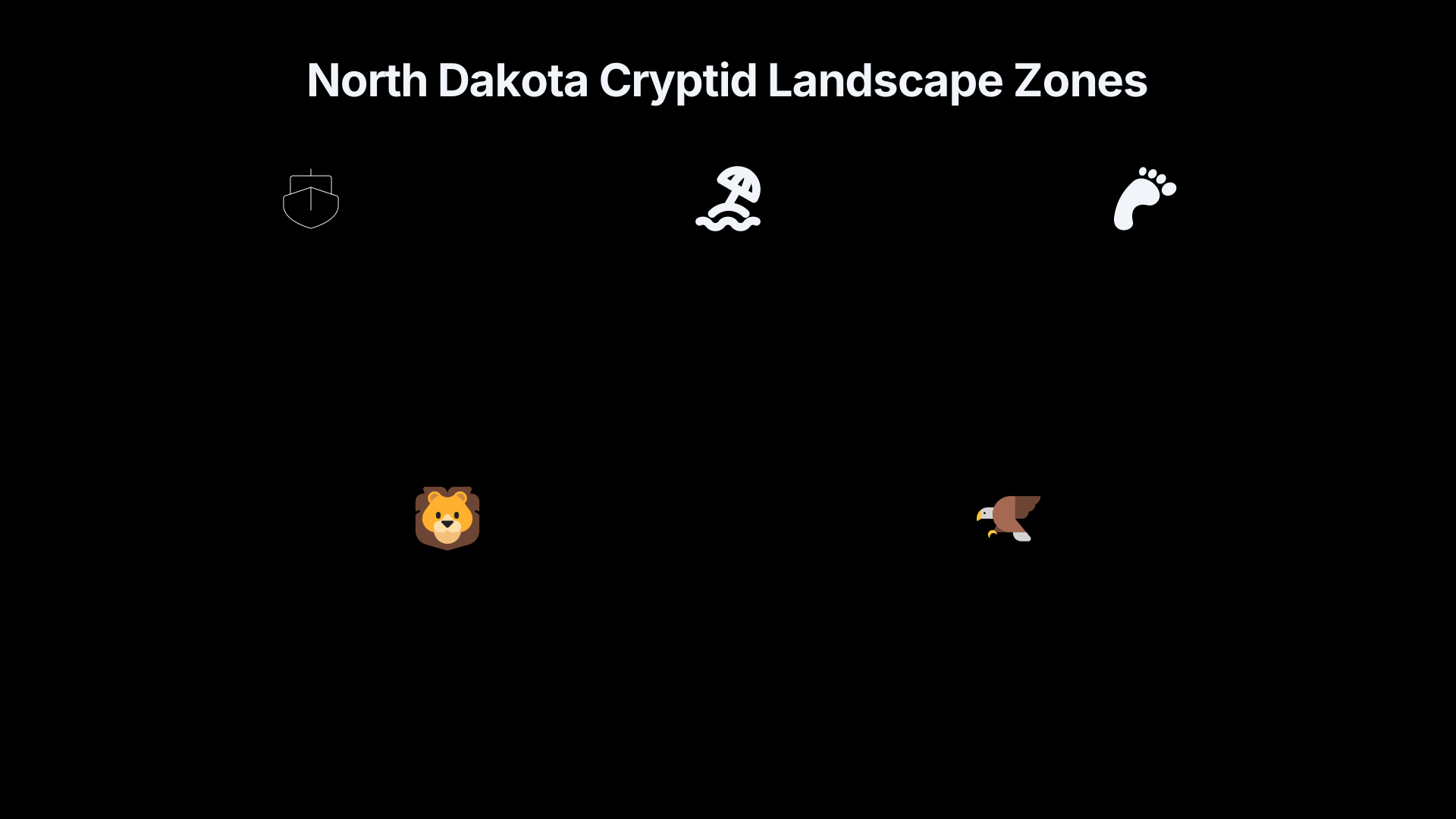
The state’s most useful monster map would not be a scatterplot of every rumour. It would be a set of landscape zones:
- Missouri River corridor: Miniwashitu, spring ice, dangerous currents, river villages, and later Lake Sakakawea mermaid lore.
- Devils Lake basin: sacred or mysterious water, serpent stories, mirages, tourism, newspaper amplification, and real hydrological change.
- Fort Berthold and western counties: the strongest modern Bigfoot-like cluster, especially the 2004 reports around New Town and nearby areas.
- Badlands and western breaks: plausible setting for mountain lion reports, predator misidentification, and large-animal surprise encounters.
- Open prairie and storm country: thunderbird traditions, giant-bird impressions, and the symbolic drama of sky over water.
That pattern gives North Dakota its own monster identity. It is not a state of endless named beasts. It is a state where a few strong stories cling to powerful places — a red river monster under breaking ice, a serpent in a lake of sacred water, a handful of hairy-creature reports on winter roads, and thunder beings moving through the wide northern sky.

Amazon book picks
Further Reading
Books and field guides related to What Haunts North Dakota's Waters and Prairie?. Use these as the next step if you want deeper reading beyond the article.
Cryptozoology A To Z
Provides context for lake monsters, Bigfoot reports and regional creatures.
Weird U.S.
Covers American monster and legend traditions similar to North Dakota cases.
The United States of Cryptids
Connects North Dakota stories to nationwide folklore patterns.
eBay marketplace picks
Marketplace Samples
Live-tested eBay searches with available results related to this page.
Endnotes
1.
Source: gutenberg.org
Title: Project Gutenberg
Link:https://www.gutenberg.org/files/36012/36012-h/36012-h.htm
Source snippet
The Project Gutenberg eBook of Prairie Smoke, by Melvin Randolph Gilmore...
2.
Source: gutenberg.org
Link:https://www.gutenberg.org/files/46661/46661-h/46661-h.htm
3.
Source: usgs.gov
Link:https://www.usgs.gov/centers/dakota-water-science-center/science/devils-lake-basin-overview
4.
Source: eros.usgs.gov
Link:https://eros.usgs.gov/earthshots/devils-lake-north-dakota-usa
5.
Source: swc.nd.gov
Title: Devils Lake Fact Sheet
Link:https://www.swc.nd.gov/pdfs/dl_fact_sheet.pdf
6.
Source: bfro.net
Title: state listing.asp
Link:https://www.bfro.net/GDB/state_listing.asp?state=nd
7.
Source: bfro.net
Title: show report.asp
Link:https://www.bfro.net/GDB/show_report.asp?id=8165
8.
Source: indianz.com
Title: Big Foot sightings reported on N.D. reservation
Link:https://indianz.com/News/2004/000844.asp
9.
Source: gf.nd.gov
Link:https://gf.nd.gov/wildlife/id/carnivores/mountain-lion
10.
Source: gf.nd.gov
Link:https://gf.nd.gov/hunting/furbearers
11.
Source: gf.nd.gov
Link:https://gf.nd.gov/magazine/2025/2025-07/my-2-cents
12.
Source: ndstudies.gov
Link:https://www.ndstudies.gov/curriculum/high-school/mandan-hidatsa-sahnish/culture-mha
13.
Source: native-languages.org
Link:https://www.native-languages.org/morelegends/dahu.htm
14.
Source: gf.nd.gov
Link:https://gf.nd.gov/hunting/mountain-lion
15.
Source: gf.nd.gov
Title: hunting season outlook
Link:https://gf.nd.gov/magazine/2025/aug-sep/hunting-season-outlook
16.
Source: nordaknorth.com
Title: mythical creature tradition continues
Link:https://www.nordaknorth.com/newspapers/mcleancountyindependent/mclean-county-independent-news/mythical-creature-tradition-continues/
17.
Source: ndstudies.gov
Link:https://www.ndstudies.gov/gr4/frontier-era-north-dakota/part-3-lewis-and-clark-expedition/section-7-honoring-sakakawea
18.
Source: hpr1.com
Title: monsters on the plains
Link:https://hpr1.com/index.php/feature/culture/monsters-on-the-plains/
19.
Source: ndstudies.gov
Link:https://www.ndstudies.gov/sites/default/files/PDF/northstar_issue1.pdf
20.
Source: ndstudies.gov
Link:https://www.ndstudies.gov/gr4/further-research
21.
Source: usgs.gov
Title: missouri river basin floods april may 1950 north and south dakota
Link:https://www.usgs.gov/publications/missouri-river-basin-floods-april-may-1950-north-and-south-dakota
Published: may 1950
22.
Source: pubs.usgs.gov
Link:https://pubs.usgs.gov/sir/2010/5225/
23.
Source: usgs.gov
Title: droughts and flooding devils lake basin
Link:https://www.usgs.gov/centers/dakota-water-science-center/science/droughts-and-flooding-devils-lake-basin
24.
Source: pubs.usgs.gov
Title: sir2010 5225
Link:https://pubs.usgs.gov/sir/2010/5225/pdf/sir2010-5225.pdf
25.
Source: pubs.usgs.gov
Link:https://pubs.usgs.gov/publication/sir20235064H/full
26.
Source: usgs.gov
Link:https://www.usgs.gov/centers/dakota-water-science-center/science/hydrology-devils-lake-basin
27.
Source: bfro.net
Link:https://www.bfro.net/gdb/
28.
Source: bfro.net
Title: show report.asp
Link:https://www.bfro.net/GDB/show_report.asp?id=8130
29.
Source: bfro.net
Title: show county reports.asp
Link:https://www.bfro.net/GDB/show_county_reports.asp?county=McLean&state=nd
30.
Source: gf.nd.gov
Title: small game
Link:https://gf.nd.gov/regulations/small-game
31.
Source: gf.nd.gov
Link:https://gf.nd.gov/wildlife/id
32.
Source: gf.nd.gov
Title: fishing guide 2022 2024 1
Link:https://gf.nd.gov/sites/default/files/publications/fishing-guide-2022-2024_1.pdf
33.
Source: swc.nd.gov
Title: ice jams in north dakota
Link:https://www.swc.nd.gov/pdfs/ice_jams_in_north_dakota.pdf
34.
Source: swc.nd.gov
Link:https://www.swc.nd.gov/basins/devils_lake/outlets/
35.
Source: nordaknorth.com
Title: Sakakawea Country 2026 Full PDF web
Link:https://www.nordaknorth.com/image/cache/Sakakawea_Country_2026Full_PDF-_web.pdf
36.
Source: youtube.com
Title: What Lurks Below | The Last Lodge: Underlayers (10)
Link:https://www.youtube.com/watch?v=B8u5rAmnyRA
Source snippet
North Dakota - The Strange World That Doesn't Forgive Mistakes...
37.
Source: youtube.com
Title: North Dakota
Link:https://www.youtube.com/watch?v=rROgPp2C94I
38.
Source: atlasobscura.com
Title: Atlas Obscura In North Dakota, the Hideous Miniwashitu Ushers in Spring
Link:https://www.atlasobscura.com/articles/miniwashitu-missouri-river-north-dakota
39.
Source: news.prairiepublic.org
Title: Prairie Public Devils Lake Sea Monster
Link:https://news.prairiepublic.org/show/dakota-datebook-archive/2022-05-22/devils-lake-sea-monster
40.
Source: mountainlion.org
Link:https://mountainlion.org/us/north-dakota/
41.
Source: ndtourism.com
Link:https://www.ndtourism.com/riverdale/attractions-entertainment/family-fun/misty-mermaid
42.
Source: cryptidz.fandom.com
Title: Devils Lake Serpent
Link:https://cryptidz.fandom.com/wiki/Devils_Lake_Serpent
43.
Source: cryptidz.fandom.com
Link:https://cryptidz.fandom.com/wiki/Miniwashitu
44.
Source: facebook.com
Link:https://www.facebook.com/lewisandclarksfortmandan/photos/a-spooky-tall-tale-the-legend-of-miniwashitustanding-approximately-8-9-feet-tall/4773188926027614/
45.
Source: hauntpedia.com
Title: north dakota
Link:https://hauntpedia.com/haunted-places/state/north-dakota/
46.
Source: archive.org
Link:https://archive.org/download/cu31924079619411/cu31924079619411.pdf
Additional References
47.
Source: ndlegis.gov
Link:https://ndlegis.gov/assembly/62-2011/docs/pdf/wr083011appendixb.pdf
48.
Source: fws.gov
Link:https://www.fws.gov/rivers/rivers/refuge/devils-lake-wetland-management-district/visit-us/activities/hunting
49.
Source: nps.gov
Link:https://www.nps.gov/apis/learn/historyculture/upload/People-and-Places-A-Human-History-of-the-Apostle-Islands-508-_reduced.pdf
50.
Source: indianaffairs.nd.gov
Link:https://www.indianaffairs.nd.gov/sites/www/files/documents/pdfs/History_and_Culture_Mandan_Hidatsa_and_Arikara.pdf
51.
Source: youtube.com
Title: North Dakota is Kinda Haunted | Guide to the Unknown 340
Link:https://www.youtube.com/watch?v=WP98yLdPisM
Source snippet
What Lurks Below | The Last Lodge: Underlayers (10)...
52.
Source: academia.edu
Link:https://www.academia.edu/77811201/The_American_Folklore_Society
53.
Source: researchgate.net
Link:https://www.researchgate.net/publication/332882025_Mountain_Lion_Puma_concolor_Population_Characteristics_in_the_Little_Missouri_Badlands_of_North_Dakota
54.
Source: facebook.com
Link:https://www.facebook.com/groups/709703603504883/posts/1138662647275641/
55.
Source: instagram.com
Link:https://www.instagram.com/reel/DQAp22IjWnV/?hl=en-gb
56.
Source: instagram.com
Link:https://www.instagram.com/reel/DQZwKytEVXh/
Topic Tree
Follow this branch
Related pages 49
- Rhode Island Monsters
- Hawaii Monsters
- Illinois Cryptids
- Nebraska Cryptids
- Alabama Cryptids
- +44 more in sidebar