Within Louisiana Monsters
Was the Honey Island Swamp Monster Ever Evidence?
The Honey Island Swamp Monster turns tracks, witness stories and grainy film into Louisiana's most famous Bigfoot-style case.
On this page
- Ford, Mills and the first famous claims
- Footprints, film and dead animal stories
- Wildlife, hoaxes and sceptical readings
Page outline Jump by section
Introduction
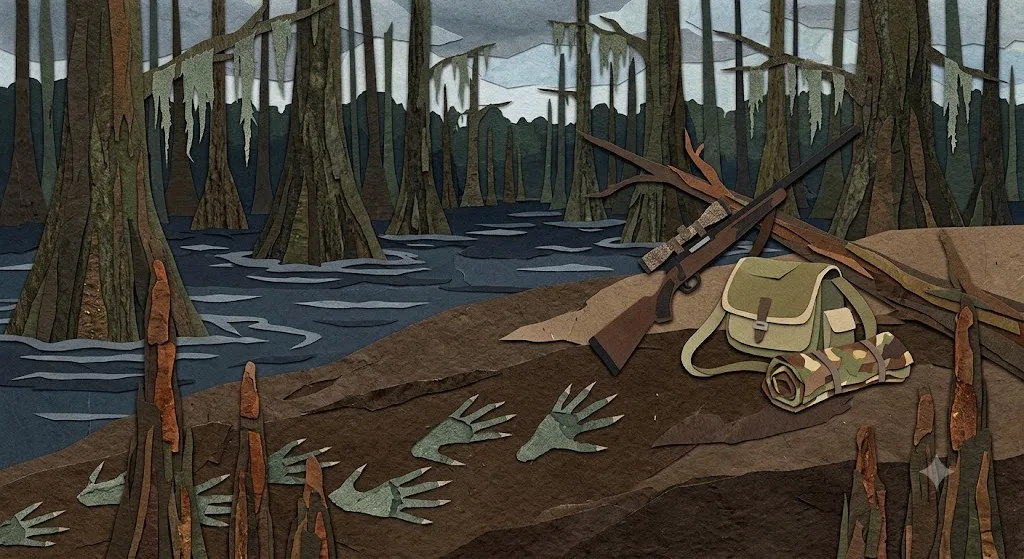
The Honey Island Swamp Monster is Louisiana’s strongest modern Bigfoot-style case, not because it has produced scientific proof, but because it has a unusually tidy evidence trail for a swamp legend: named witnesses, a specific landscape near Slidell, plaster footprint casts, a dead-boar story, and a short, grainy film associated with hunter and wildlife photographer Harlan Ford. The claim is that a large, hairy, upright creature lives in the Honey Island Swamp and Pearl River backwater country; the more cautious reading is that the legend blends eyewitness memory, muddy tracks, real swamp animals, possible hoaxing and local storytelling into one of the state’s most durable mystery-beast traditions.[countryroadsmagazine.com]countryroadsmagazine.comCountry Roads Magazine The Honey Island Swamp MonsterCountry Roads Magazine The Honey Island Swamp Monster
The case matters because it sits exactly where Louisiana monster lore becomes testable. Unlike the Rougarou, which is mostly inherited folklore, the Honey Island Swamp Monster has physical claims people can ask practical questions about. How good were the tracks? What does the film actually show? Could a bear, hog, hunter or prank explain it? The answers do not confirm a hidden animal, but they do show why the story has lasted: Honey Island is remote enough to feel mysterious, busy enough to generate sightings, and culturally rich enough to turn ambiguous evidence into a Louisiana legend.[louisiana.gov]wlf.louisiana.govOpen source on louisiana.gov.
Ford, Mills and the first famous claims
The modern Honey Island Swamp Monster story is usually anchored to Harlan Ford and Billy Mills, two local outdoorsmen associated with a claimed encounter in the Honey Island Swamp. Local tour and folklore accounts describe Ford as a retired air traffic controller and wildlife photographer, while Mills is usually presented as his hunting companion. Their reported sighting is commonly dated to the early 1960s, with later accounts saying they encountered a large creature near a dead boar deep in the swamp.[Pearl River Swamp Tours, New Orleans]pearlriverswamptours.comOpen source on pearlriverswamptours.com.
That origin story already shows why the case is slippery. In some retellings, 1963 is the first sighting; in others, the publicly important moment comes in 1974, when Ford and Mills reportedly found unusual footprints and the carcass of a boar whose throat had been torn or gashed. This difference does not necessarily mean the entire story collapses, but it does mean readers should treat the timeline as a developed folk case rather than a clean incident report. The legend’s public shape was built through retellings, television, family preservation and local tourism, not through a single official wildlife investigation.[wikipedia.org]WikipediaHoney Island Swamp monsterHoney Island Swamp monster
Ford’s role is central because he gave the creature a named witness and a body of alleged evidence. Country Roads Magazine reports that Ford appeared on the 1970s television series In Search Of…, where he described a huge, hairy figure with amber eyes and a human-like face. That national exposure helped move the story beyond campfire talk and into the wider American monster circuit, where it could be compared with Bigfoot, the Fouke Monster of Arkansas and the Florida Skunk Ape.[countryroadsmagazine.com]countryroadsmagazine.comCountry Roads Magazine The Honey Island Swamp MonsterCountry Roads Magazine The Honey Island Swamp Monster
The Honey Island creature, however, was never a neat copy of Bigfoot. The familiar description is Bigfoot-like in posture and hairiness, but the tracks and swamp setting push it into a different category: more amphibious, smellier, more local, and often described as a hybrid-looking thing rather than a plain ape-man. That awkwardness is one reason the legend is interesting. It borrows the credibility language of Bigfoot while keeping the bayou’s taste for creatures that seem half-wildlife, half-warning tale.[Center for Inquiry]centerforinquiry.s3.amazonaws.comOpen source on amazonaws.com.
What the footprints actually add
The footprint casts are the most memorable piece of Honey Island evidence. They are usually described as roughly ten to twelve inches long, with long narrow toes and a fourth toe set back, giving them a strange webbed or almost thumbed appearance. Pearl River Swamp Tours says it displays a cast taken from Ford’s original, and the Abita Mystery House also presents a Honey Island Swamp Monster footprint connected to Ford’s story.[Pearl River Swamp Tours, New Orleans]pearlriverswamptours.comOpen source on pearlriverswamptours.com.
As evidence, the tracks are stronger as folklore objects than as zoological proof. A footprint cast can show that something made a mark, but it cannot by itself show that the mark came from an unknown animal. Without a documented chain of custody, repeated trackways, clear photographs of the tracks in place, stride measurements, soil conditions and independent expert collection, the cast becomes a souvenir of a claim rather than a scientific specimen.
The anatomy also creates problems. Sceptical investigator Joe Nickell examined a plaster copy obtained from Dana Holyfield, Ford’s granddaughter, and argued that the cast did not resemble a standard Bigfoot-style footprint. He described the track as webbed-toed, unusually small for a supposed giant man-beast, and more like the “cross between a primate and a large alligator” description used by believers than a plausible ape or human footprint.[Center for Inquiry]centerforinquiry.s3.amazonaws.comOpen source on amazonaws.com.
That matters because believers often use the tracks to make the case more physical, while sceptics use the same tracks to make the case less biologically coherent. A seven-foot hairy upright animal with webbed, four-toed, smallish feet is not impossible in the loose world of monster lore, but it is difficult to fit into ordinary mammal anatomy. The more unusual the foot becomes, the less it helps the case unless the supporting evidence becomes much stronger.
The footprint evidence also has a hoax problem. Country Roads Magazine records a local counter-claim that someone had a shoe with a monster track attached to the bottom and that Ford or others were accused of using it to make prints. Offscreen’s discussion of the legend notes a “monster shoe” explanation as part of the hoax theory, while also pointing out that such evidence does not automatically prove it was the source of Ford’s original casts. The fair conclusion is not “all tracks were fake”, but “some alleged track evidence around the legend is vulnerable to hoaxing, and the surviving casts are not enough to settle the case”.[Country Roads Magazine]countryroadsmagazine.comCountry Roads Magazine The Honey Island Swamp MonsterCountry Roads Magazine The Honey Island Swamp Monster
The film is famous, but not decisive
The alleged Ford film is the other core exhibit. It is usually described as short, grainy footage of a dark, upright figure moving through dense swamp vegetation. Dana Holyfield’s documentary material presents the film as part of her grandfather’s evidence, and later television programmes have treated it as the case’s visual centrepiece.[honeyislandswampmonster.vhx.tv]honeyislandswampmonster.vhx.tvOpen source on vhx.tv.
The problem is that the film does what most famous cryptid films do: it preserves ambiguity rather than resolving it. A figure glimpsed through trees in poor visual conditions can look uncanny without giving enough detail for identification. In the Honey Island case, the swamp itself helps the mystery. Cypress, water, brush, shadow and camera distance can erase scale, hide gait details and turn an ordinary person in dark clothing into something stranger.
Sceptical readings have been especially hard on the footage. The Center for Inquiry’s “Patterson Knockoff” discussion frames the Honey Island film in relation to the wider Bigfoot-film tradition, where an indistinct upright figure can gain power because viewers already know what kind of monster they are meant to see. The argument is not simply that the footage is fake, but that it is too visually weak to carry the evidential weight placed on it.[centerforinquiry.org]centerforinquiry.orghoney island swamp monster film a patterson knockoffhoney island swamp monster film a patterson knockoff
Television recreation has added another caution. Accounts of the Fact or Faked: Paranormal Files treatment report that investigators could recreate a similar effect with a person wearing a camouflage ghillie suit, suggesting that the film could be a mistaken human figure or staged scene rather than a new animal. A recreation does not prove the original was faked, but it does show that the footage is compatible with a mundane explanation.[Wikipedia]WikipediaHoney Island Swamp monsterHoney Island Swamp monster
That is the key distinction. The film is valuable to the legend because it gives people something to look at, debate and replay. It is weak as proof because it does not clearly show anatomy, facial features, tracks, scale, continuous movement or interaction with known objects. It keeps the monster alive as a question, not as a confirmed creature.
The dead-boar story and the swamp’s real animals
The dead-boar detail is one of the most vivid parts of the Ford and Mills story. In local versions, the men encountered or later connected the creature with a wild boar whose throat had been violently torn. That detail makes the monster feel dangerous and animal-like, not merely ghostly. It also places the story in a real ecological setting where feral hogs are common enough to be part of ordinary swamp experience.[Pearl River Swamp Tours, New Orleans]pearlriverswamptours.comOpen source on pearlriverswamptours.com.
Honey Island and the Pearl River Wildlife Management Area are not empty monster scenery. The Louisiana Department of Wildlife and Fisheries describes Pearl River WMA as flat, poorly drained and flood-prone, with hardwood forest, cypress-tupelo swamp and intermediate marsh. The official WMA page also notes fishing, boating, hunting and primitive camping, which means the area is both wild and regularly entered by people who can see, misread or retell unusual things.[wlf.louisiana.gov]wlf.louisiana.govOpen source on louisiana.gov.
The wildlife list matters because several real animals can produce monster-like ingredients. Regional tour and visitor sources list alligators, wild boar, black bears, nutria, snakes, owls, eagles and other animals as part of the Honey Island environment. Bears can stand briefly on hind legs, hogs can leave torn ground and carcass drama, alligators can damage dead animals, and nocturnal mammals can create eye-shine and movement that become startling when glimpsed in brush.[Cajun Encounters]cajunencounters.comOpen source on cajunencounters.com.
Feral hogs are especially relevant. The Louisiana Department of Wildlife and Fisheries describes them as destructive invasive animals, and the LSU AgCenter estimated in 2022 that feral hogs cause about $91.1 million in annual damage to Louisiana agricultural and timber lands. That does not explain a tall, hairy biped, but it does explain why boar carcasses, churned mud, heavy movement and dramatic animal signs are plausible in this landscape without invoking an unknown predator.[wlf.louisiana.gov]wlf.louisiana.govOpen source on louisiana.gov.
Black bears also belong in any careful reading. The Louisiana black bear was removed from federal threatened status in 2016 after recovery efforts, with the U.S. Fish and Wildlife Service estimating 500 to 750 bears across the bear’s current range at the time. Bear presence does not automatically explain every Honey Island claim, and a bear’s tracks do not match the famous four-toed casts. But a bear seen briefly in swamp cover, especially standing or moving through vegetation, is a plausible source for at least some “large dark animal” impressions.[U.S. Department of the Interior]doi.govOpen source on doi.gov.
Hoax, misidentification or local belief?
The best explanation is probably not one single answer. The Honey Island Swamp Monster looks like a case family: a cluster of related claims, objects, media moments and local stories that have been gathered under one creature name. Some parts may be sincere misidentifications. Some may be embellished memories. Some footprint claims may involve deliberate fakery. Some later sightings may be influenced by the legend rather than independent of it.
The hoax theory has two strong points. First, the tracks are physically odd and easy to fake compared with a body, hair sample or clear close-range video. Second, local counter-stories about a rigged shoe show that at least some people in the area treated the footprint evidence as manufactured or manufacturable. Nickell’s broader conclusion was that the available evidence suggested common hoaxing, especially in the wake of the attention Ford’s claims helped generate.[bigfootencounters.com]bigfootencounters.comOpen source on bigfootencounters.com.
The misidentification theory has a different strength. It does not require every witness to be dishonest. Honey Island is a wet, wooded, visually confusing place with bears, hogs, alligators, hunters, ghillie suits, shadows and animal smells. A person who sees a large shape moving through water at the edge of visibility may report the experience honestly while still being wrong about what they saw.[louisiana.gov]wlf.louisiana.govOpen source on louisiana.gov.
The folklore theory explains why the story persists even when the evidence remains weak. The Louisiana Endowment for the Humanities’ 64 Parishes places the Honey Island Swamp Monster alongside the Rougarou as part of a larger literary and folklore pattern in which swamps become places of hidden danger, supernatural force and elemental mystery. That does not mean Ford’s story was simply copied from older folklore, but it does mean the swamp was already a believable stage for monsters.[64 Parishes]64parishes.orgswamps in literature film and folkloreswamps in literature film and folklore
Local tourism then keeps the case visible. Visit The Northshore presents Honey Island as a roughly 70,000-acre swamp, with more than half preserved within the Pearl River Wildlife Management Area, and local tour companies openly fold the monster into the visitor experience. That turns the creature into more than a disputed animal report. It becomes a mascot of place: a reason to board a boat, listen closely, watch the tree line and imagine what the swamp might be hiding.[Visit The Northshore]visitthenorthshore.comOpen source on visitthenorthshore.com.

Why the evidence still feels stronger than it is
The Honey Island case feels persuasive to many readers because it has several different kinds of evidence pointing in the same direction: witnesses, tracks, a carcass story and film. In ordinary life, that kind of convergence can be powerful. The difficulty is that each item is individually weak when tested.
The tracks are memorable but biologically puzzling and vulnerable to fakery. The film is evocative but too indistinct for identification. The dead-boar story is dramatic but not independently diagnostic. The witness accounts are locally important but shaped by memory, media and the swamp’s strong storytelling culture. Put together, they make a compelling legend. They do not yet make a compelling zoological case.
That distinction is important for a fair reading. “Not proven” does not mean “worthless”. The evidence shows how a Louisiana cryptid case is built: an outdoorsman’s reputation, a remote hunting landscape, physical traces in mud, television exposure, family preservation, local disagreement and tourist afterlife. It is a stronger folklore case than a biology case.
The most useful standard is simple: what would change the assessment? A clear, independently collected biological sample, repeated trackways documented in place by trained observers, high-resolution footage with scale, or verified remains would matter. Another isolated cast, a distant shape in trees or a new anecdote would mostly add to the tradition rather than solve it.
How Honey Island changed in retelling
The Honey Island Swamp Monster began as a hunter’s encounter and became a Louisiana identity story. Ford and Mills gave it names, places and alleged traces. Television gave it a national audience. Later writers, documentary makers, tour guides and roadside attractions gave it staying power. Dana Holyfield’s work has been especially important in preserving and promoting the Ford family version, keeping the film and eyewitness tradition in circulation long after Ford’s death.[DANA HOLYFIELD LOUISIANA AUTHOR]danaholyfield.weebly.comDANA HOLYFIELD LOUISIANA AUTHORDANA HOLYFIELD LOUISIANA AUTHORDANA HOLYFIELD LOUISIANA AUTHORDANA HOLYFIELD LOUISIANA AUTHOR
As the story travelled, it also became easier to connect with other Southern swamp monsters. The comparison with the Fouke Monster is natural: both involve hairy upright creatures, swampy or wooded terrain, 1970s monster-media energy and contested physical traces. But Honey Island’s footprint oddities and Louisiana setting keep it distinct. It is not merely “Bigfoot in a swamp”; it is a bayou case shaped by Pearl River ecology, local hunting culture and Louisiana’s older habit of making waterways feel alive with danger.[Wikipedia]WikipediaFouke MonsterFouke Monster
The legend has also softened in some settings. What began as a frightening creature over a dead boar now often functions as a tour story, museum curiosity, documentary subject and pop-culture creature. That does not erase the fear in the original claims, but it changes how the public meets the monster. Many visitors now encounter it as part of a Louisiana swamp experience: half warning, half wink, and half serious question asked from the safety of a boat.
That is why the Honey Island Swamp Monster remains Louisiana’s most evidence-centred cryptid without being its most proven creature. It has just enough material to invite investigation and just enough uncertainty to resist closure. The swamp supplies real animals, strange sounds, bad visibility and deep cover. The legend supplies the shape people expect to see when something large moves where the water and trees make certainty hard.
Amazon book picks
Further Reading
Books and field guides related to Was the Honey Island Swamp Monster Ever Evidence?. Use these as the next step if you want deeper reading beyond the article.
Sasquatch: Legend Meets Science
Examines evidence claims such as tracks and sightings.
eBay marketplace picks
Marketplace Samples
Live-tested eBay searches with available results related to this page.
Endnotes
1.
Source: wlf.louisiana.gov
Link:https://www.wlf.louisiana.gov/page/pearl-river
2.
Source: 64parishes.org
Title: swamps in literature film and folklore
Link:https://64parishes.org/entry/swamps-in-literature-film-and-folklore
3.
Source: Wikipedia
Title: Honey Island Swamp monster
Link:https://en.wikipedia.org/wiki/Honey_Island_Swamp_monster
4.
Source: honeyislandswampmonster.vhx.tv
Link:https://honeyislandswampmonster.vhx.tv/products/encounters-with-the-honey-island-swamp-monster
5.
Source: Wikipedia
Title: Fouke Monster
Link:https://en.wikipedia.org/wiki/Fouke_Monster
6.
Source: Wikipedia
Title: Skunk ape
Link:https://en.wikipedia.org/wiki/Skunk_ape
7.
Source: offscreen.com
Link:https://offscreen.com/view/homespun_horror
8.
Source: centerforinquiry.org
Title: honey island swamp monster film a patterson knockoff
Link:https://centerforinquiry.org/blog/honey_island_swamp_monster_film_a_patterson_knockoff/
9.
Source: wlf.louisiana.gov
Link:https://www.wlf.louisiana.gov/page/feral-hogs
10.
Source: bigfootencounters.com
Link:https://www.bigfootencounters.com/articles/skeptical2001.htm
11.
Source: wlf.louisiana.gov
Title: black bear
Link:https://www.wlf.louisiana.gov/page/louisiana-black-bear
12.
Source: wlf.louisiana.gov
Title: govlouisiana black bear
Link:https://www.wlf.louisiana.gov/assets/Resources/Publications/Black_Bear/2025-Black-Bear-Monitoring-Report.pdf
13.
Source: 64parishes.org
Link:https://64parishes.org/the-thing-that-ate-abbeville-kind-of
14.
Source: 64parishes.org
Link:https://64parishes.org/category/magazine
15.
Source: Wikipedia
Title: Honey Island Swamp
Link:https://en.wikipedia.org/wiki/Honey_Island_Swamp
16.
Source: centerforinquiry.org
Title: joe nickell the skeptics conscience
Link:https://centerforinquiry.org/blog/joe-nickell-the-skeptics-conscience/
17.
Source: countryroadsmagazine.com
Title: Country Roads Magazine The Honey Island Swamp Monster
Link:https://countryroadsmagazine.com/outdoors/knowing-nature/the-honey-island-swamp-monster/
18.
Source: pearlriverswamptours.com
Link:https://www.pearlriverswamptours.com/legends/
19.
Source: visitthenorthshore.com
Link:https://www.visitthenorthshore.com/honey-island-swamp/
20.
Source: swampmonster.weebly.com
Link:https://swampmonster.weebly.com/
21.
Source: centerforinquiry.s3.amazonaws.com
Link:https://centerforinquiry.s3.amazonaws.com/wp-content/uploads/sites/29/2001/07/22164827/p15.pdf
22.
Source: abitamysteryhouse.com
Title: Honey Island Swamp Monster
Link:https://abitamysteryhouse.com/honeyislandswampmonster.htm
23.
Source: danaholyfield.weebly.com
Title: DANA HOLYFIELD LOUISIANA AUTHORDANA HOLYFIELD LOUISIANA AUTHOR
Link:https://danaholyfield.weebly.com/
24.
Source: pearlriverswamptours.com
Title: wild hogs in louisiana
Link:https://www.pearlriverswamptours.com/blog/swamp-wildlife-lagniappe/wild-hogs-in-louisiana/
25.
Source: cajunencounters.com
Link:https://www.cajunencounters.com/blog/what-to-expect
26.
Source: doi.gov
Link:https://www.doi.gov/pressreleases/teddy-bear-back-us-fish-and-wildlife-service-delists-louisiana-black-bear-due-recovery
27.
Source: science.howstuffworks.com
Title: honey island swamp monster
Link:https://science.howstuffworks.com/science-vs-myth/strange-creatures/honey-island-swamp-monster.htm
28.
Source: cryptidz.fandom.com
Title: Honey Island Swamp Monster
Link:https://cryptidz.fandom.com/wiki/Honey_Island_Swamp_Monster
29.
Source: sons-of-liberty.fandom.com
Title: Honey Island Swamp Monster
Link:https://sons-of-liberty.fandom.com/wiki/Honey_Island_Swamp_Monster
30.
Source: cryptozoologycryptids.fandom.com
Title: Honey Island Swamp Monster
Link:https://cryptozoologycryptids.fandom.com/wiki/Honey_Island_Swamp_Monster
31.
Source: monster.fandom.com
Title: Honey Island Swamp Monster
Link:https://monster.fandom.com/wiki/Honey_Island_Swamp_Monster
32.
Source: non-aliencreatures.fandom.com
Title: Honey Island Swamp Monster
Link:https://non-aliencreatures.fandom.com/wiki/Honey_Island_Swamp_Monster
33.
Source: amazon.com
Title: Honey Island Swamp Monster
Link:https://www.amazon.com/-/es/Honey-Island-Swamp-Monster-Holyfield/dp/B09MJSVNT8?tag=searcht-20
34.
Source: youtube.com
Link:https://www.youtube.com/watch?v=y0NArkJUsQg
35.
Source: cajunencounters.com
Link:https://www.cajunencounters.com/honey-island-swamp
36.
Source: thehorrorcollection.com
Title: honey island swamp monster
Link:https://thehorrorcollection.com/honey-island-swamp-monster/
37.
Source: birdinglouisiana.com
Title: Pearl River Wildlife Management Area
Link:https://www.birdinglouisiana.com/point-of-interest/pearl-river-wildlife-management-area-honey-island-swamp
38.
Source: ecosphere-documents-production-public.s3.amazonaws.com
Link:https://ecosphere-documents-production-public.s3.amazonaws.com/sams/public_docs/petition/20505.pdf
39.
Source: kayakingheaven.com
Title: honey island swamp monster
Link:https://kayakingheaven.com/honey-island-swamp-monster/
40.
Source: bearconservation.org.uk
Title: louisiana black bear
Link:https://www.bearconservation.org.uk/louisiana-black-bear/
Additional References
41.
Source: federalregister.gov
Link:https://www.federalregister.gov/documents/2016/03/11/2016-05206/endangered-and-threatened-wildlife-and-plants-removal-of-the-louisiana-black-bear-from-the-federal
42.
Source: fws.gov
Title: teddy bear back us fish and wildlife service delists louisiana black bear due
Link:https://www.fws.gov/press-release/2016-03/teddy-bear-back-us-fish-and-wildlife-service-delists-louisiana-black-bear-due
43.
Source: researchgate.net
Link:https://www.researchgate.net/publication/281641170_Louisiana_Black_Bear_Management_Plan
44.
Source: skepticalinquirer.org
Link:https://skepticalinquirer.org/2017/09/bigfoot-as-big-myth-seven-phases-of-mythmaking/
45.
Source: amazon.co.uk
Link:https://www.amazon.co.uk/placeholder_title-John-Doe/dp/B0FWYJ1VBR?tag=searcht-20
46.
Source: honeyislandswampkayaktours.com
Link:https://honeyislandswampkayaktours.com/exploring-the-enigmatic-honey-island-swamp-louisianas-pristine-marshland/
47.
Source: connectparanormal.net
Link:https://connectparanormal.net/2026/03/22/facts-about-louisianas-honey-island-monster/
48.
Source: facebook.com
Link:https://www.facebook.com/ldwffb/posts/-%F0%9D%97%A1%F0%9D%97%AE%F0%9D%98%81%F0%9D%97%B6%F0%9D%97%BC%F0%9D%97%BB%F0%9D%97%AE%F0%9D%97%B9-%F0%9D%97%9C%F0%9D%97%BB%F0%9D%98%83%F0%9D%97%AE%F0%9D%98%80%F0%9D%97%B6%F0%9D%98%83%F0%9D%97%B2-%F0%9D%97%A6%F0%9D%97%BD%F0%9D%97%B2%F0%9D%97%B0%F0%9D%97%B6%F0%9D%97%B2%F0%9D%98%80-%F0%9D%97%94%F0%9D%98%84%F0%9D%97%AE%F0%9D%97%BF%F0%9D%97%B2%F0%9D%97%BB%F0%9D%97%B2%F0%9D%98%80%F0%9D%98%80-%F0%9D%97%AA%F0%9D%97%B2%F0%9D%97%B2%F0%9D%97%B8-%F0%9D%97%A6%F0%9D%97%BD%F0%9D%97%BC%F0%9D%98%81%F0%9D%97%B9%F0%9D%97%B6%F0%9D%97%B4%F0%9D%97%B5%F0%9D%98%81-%F0%9D%97%BC%F0%9D%97%BB-%F0%9D%97%99%F0%9D%97%B2%F0%9D%97%BF%F0%9D%97%AE%F0%9D%97%B9-%F0%9D%97%A6%F0%9D%98%84%F0%9D%97%B6%F0%9D%97%BB%F0%9D%97%B2louisiana-is-h/1365373042300499/
49.
Source: audible.com
Link:https://www.audible.com/pd/HONEY-ISLAND-SWAMP-MONSTER-Audiobook/B0FNYXDNJQ?srsltid=AfmBOoof7jdc1Rr4Z8FAgFfindivSMfkK4-iej2JmFqa8jHzWMYkUets
50.
Source: facebook.com
Link:https://www.facebook.com/CajunEncounters/posts/have-you-seen-the-honey-island-swamp-monster-we-want-to-hear-your-storyswampmons/1393095099513032/
Topic Tree